| Author |
Message |
ulf
Profi-Schrauber

Joined: 04/13/2002
Posts: 11058
Karma: +18 / -0 
Location: Saarland
2023 MG ZS
Premium Support
|
 30-08-2012, 9:52 Subject: Air Mass Sensor: TDI vs. 1.8T Comparison Data 30-08-2012, 9:52 Subject: Air Mass Sensor: TDI vs. 1.8T Comparison Data |
Quote |
|
Hello,
When comparing TDI mass airflow logs with randomly captured mass airflow data from gasoline engines, I'm finding some strangely appearing relationships.
For older 1.8T gasoline engines with wide-open throttle (WOT) lambda values significantly below 1, it's reasonable to assume that all the aspirated air is being burned. A user on 9N.info reported maximum logged mass airflow rates in the range of 128-130 g/sec for the unmodified 150 hp engine in the Polo 9N GTI.
In the 150hp TDI engine (ARL), not all of the air is combusted due to the excess of air. Therefore, the amount of air that is actually burned must be calculated based on the injection quantity at the maximum power point (4000 rpm).
54 mg/injection (diesel) * 14.5 = 783 mg/injection (air).
When converted to air mass flow rate (g/sec), this results in:
LuMa current = LuMa/Hub * rpm / 30000 = 104.4 g/sec.
That's only 81% of the 1.8T with the same maximum power!
How does that all fit together?
Is the "air mass combustion-related" Pmax efficiency of the ARL actually about 23% better than that of a 1.8T engine with the same Pmax?
Are the calculations distorted by incorrect or corrupted log data? For example, when looking at the ARL (Average Run Length), the diagnostic values provided by the MSG software for the actual luminescence seem to indicate that approximately 2% are being underreported.
For the 1.8T, I cannot make any statements in this regard due to a lack of insight into the software  . Gruß Ulf
_________
MG4 Electric
Translated on 16-09-2026, 7:55.
|
|
| Back to top |
Profile PM Garage |
 |
dieselschrauber
Administrator

Joined: 04/12/2002
Posts: 18098
Karma: +799 / -0
Location: St.Gallen
2018 Volkswagen T6 
|
| 30-08-2012, 12:10 Subject: Air Mass Sensor: TDI vs. 1.8T Comparison Data |
Quote |
|
Hello Ulf,
The older 1.8T engines have a cylinder head with 5 valves (3 intake, 2 exhaust). It's obvious that this allows for a better airflow compared to the 2 valves found in the 1.9 TDI engine.
In addition, gasoline engines do not require the swirling of the incoming air, as is the case with TDI engines, which also contributes to a higher flow rate.
For the 2.0 16V TDIs with switchable swirl flaps, the comparison might be more favorable.
Best regards, Rainer.
Translated on 16-09-2026, 7:58.
|
|
| Back to top |
Profile PM WWW Garage |
|
dieselmartin
Profi-Schrauber

Joined: 03/13/2003
Posts: 10121
Karma: +29 / -0
Location: in der Werkstatt
2007 Volkswagen Passat
Premium Support
|
| 30-08-2012, 13:47 Subject: Air Mass Sensor: TDI vs. 1.8T Comparison Data |
Quote |
|
Quote: | | For the 2.0 16V TDIs with switchable swirl flaps, the comparison might be better. |
Sure, please provide the text you would like me to translate from German to English. Transparency, Teamwork
... there was another T.
I don't know what the f*ck it was.
Translated on 16-09-2026, 7:58.
|
|
| Back to top |
Profile PM Garage |
|
dieselschrauber
Administrator
Joined: 04/12/2002
Posts: 18098
Karma: +799 / -0
Location: St.Gallen
2018 Volkswagen T6
|
| 30-08-2012, 13:58 Subject: Air Mass Sensor: TDI vs. 1.8T Comparison Data |
Quote |
|
CFFB Engine: 900mg/H air mass at 4000 rpm -> 120g/s with a high air excess. This means that, considering the efficiency, it results in even more power compared to a gasoline engine. The much better diesel efficiency in this operating point is not really surprising, since a large portion of the fuel in a gasoline engine is wasted for cooling purposes.
At 4000 rpm, the required fuel injection amount is approximately 47.7 mg/cycle, which is less than with the ARL engine, despite the presence of a particulate filter. The actual power output (rated power for the CFFB: 140 hp) should be quite similar to the ARL, and may even be higher.
47.7 mg/H * 14.5 = 691 mg/H, which is the calculated air mass required for complete combustion (92 g/s). It is even possible to read out the actual values using the lambda value.
The charging pressure required for this is significantly lower than that of an ARL system.
So, if you want to travel quickly but still don't want to waste a lot of fuel, then a diesel engine is the way to go.
For "Schleicher" cars, it doesn't really matter much these days whether you have a TDI or a TSI engine, as the TSIs aren't bad in low-load situations.
Best regards, Rainer.
Translated on 16-09-2026, 8:00.
|
|
| Back to top |
Profile PM WWW Garage |
|
ulf
Profi-Schrauber
Joined: 04/13/2002
Posts: 11058
Karma: +18 / -0
Location: Saarland
2023 MG ZS
Premium Support
|
| 30-08-2012, 14:15 Subject: Air Mass Sensor: TDI vs. 1.8T Comparison Data |
Quote |
|
dieselschrauber wrote: | . . . It is obvious that a higher mass airflow is possible compared to what is achievable with the 2 valves in the 1.9 TDI engine.
In addition, unlike with a TDI engine, there is no need to create swirl in the incoming air for a gasoline engine, which also contributes to better flow. | Hi Rainer,
I think your answer is heading in the direction of air volume, or "how much boost pressure do I need to achieve a mass flow rate of xy?".
That's not what I'm concerned about, because the data on the air mass flow already describes the (achieved) result of your analysis.
Conversely, expressed in relation to the initial post, the 1.8T engine appears to require approximately 23% more air (or oxygen from it) than the ARL engine to produce 150 horsepower of usable power.
It is well known that gasoline engines consume more fuel than TDIs. However, I previously attributed this to their overly rich air-fuel mixtures at wide-open throttle, the lower energy content of gasoline compared to diesel, and the throttle valves that reduce efficiency under partial load.
It's new to me that the 1.8T, despite its high-tech valve design, seems to be a full-load air-sucker (23% higher fuel consumption, if the data is correct) compared to the ARL, even with the same maximum power. Gruß Ulf
_________
MG4 Electric
Translated on 16-09-2026, 8:03.
|
|
| Back to top |
Profile PM Garage |
|
dieselschrauber
Administrator
Joined: 04/12/2002
Posts: 18098
Karma: +799 / -0
Location: St.Gallen
2018 Volkswagen T6
|
|
| Back to top |
Profile PM WWW Garage |
|
ulf
Profi-Schrauber
Joined: 04/13/2002
Posts: 11058
Karma: +18 / -0
Location: Saarland
2023 MG ZS
Premium Support
|
| 31-08-2012, 8:40 Subject: Air Mass Sensor: TDI vs. 1.8T Comparison Data |
Quote |
|
dieselschrauber wrote: | 2 main reasons for reduced efficiency in turbocharged gasoline engines are...
Bitte gib mir den deutschen Text, den du übersetzt haben möchtest.
- Fuel cooling is necessary at high load. | Indeed, unburned fuel reduces the fuel-related efficiency. However, lambda values around 0.9 seem to provide the absolute best power output, as can be seen, for example, in this:
http://www.google.de/imgres?q=wirkungsgrad+Ottomotor+Lambda&hl=de&sa=X&biw=1558&bih=746&tbm=isch&prmd=imvns&tbnid=w9xeCkv2YvS11M:&imgrefurl=http://www.t4-wiki.de/wiki/Lambda-Wert&imgurl=http://www.t4-wiki.de/wiki/images/thumb/Einfluss_von_Lambda.jpg/250px-Einfluss_von_Lambda.jpg&w=250&h=236&ei=Q1hAUOqnBKnS4QTVwYHQAQ&zoom=1&iact=hc&vpx=380&vpy=445&dur=1609&hovh=188&hovw=200&tx=103&ty=118&sig=102985289735157713139&page=1&tbnh=127&tbnw=135&start=0&ndsp=33&ved=1t:429,r:26,s:0,i:154
According to this, in Lambdas, such as the 150HP 1.8T, the air mass supplied to the gasoline engine is utilized almost optimally...
Does the Lambda-Pmax curve for turbo engines generally follow a different pattern? Gruß Ulf
_________
MG4 Electric
Translated on 16-09-2026, 8:07.
|
|
| Back to top |
Profile PM Garage |
|
mullemaus
Guest
Free account, no CAN development support
|
| 31-08-2012, 12:13 Subject: Air Mass Sensor: TDI vs. 1.8T Comparison Data |
Quote |
|
A 1.8T engine doesn't run at a 0.9 lambda ratio. That would be too lean at full throttle. The idle and partial load range is approximately at 1, according to measurements/calculations. At full load, most lambda sensors are deactivated, and the engine runs based on a pre-defined map. (The value displayed in VCDS is not 100% accurate in this case.)
Your link is also useless. These pages contain a lot of nonsense.
The Lambda value of a jump probe is simply a voltage reading that has nothing to do with the actual Lambda value.
In diesel engines, the lambda value is not measured.
With the old T4, that's not the case.  It's difficult to think outside the box, and then it's easy to quickly categorize everyone into the same group.
Translated on 16-09-2026, 8:09.
|
|
| Back to top |
|
|
ulf
Profi-Schrauber
Joined: 04/13/2002
Posts: 11058
Karma: +18 / -0
Location: Saarland
2023 MG ZS
Premium Support
|
| 31-08-2012, 12:31 Subject: Air Mass Sensor: TDI vs. 1.8T Comparison Data |
Quote |
|
mullemaus wrote: | | A 1.8T engine does not run at a 0.9 lambda. That would be too lean at full throttle. The idle and partial load range is approximately at 1, according to measurements/calculations. At full load, most lambda sensors are deactivated, and the engine runs based on a pre-defined map. | Okay, if it goes below approximately 0.9 at wide open throttle (WOT), and if the graph in my link is at least somewhat accurate, then the 1.8T engine probably enriches the fuel mixture at WOT to prevent the hardware from overheating (you have to consider that with today's fuel prices).
This also makes it easier to understand the significantly higher air consumption of the Pmax compared to a powerful TDI engine. Gruß Ulf
_________
MG4 Electric
Translated on 16-09-2026, 8:10.
|
|
| Back to top |
Profile PM Garage |
|
mullemaus
Guest
Free account, no CAN development support
|
| 31-08-2012, 12:50 Subject: Air Mass Sensor: TDI vs. 1.8T Comparison Data |
Quote |
|
'Graphs or VCDS excerpts are meaningless. Lambda values (even those from a wideband sensor after the catalytic converter) are not displayed accurately in VCDS. The displayed value does not correspond to the actual value.'
This is due to factors such as sensor field calculation and sensor aging, etc. In reality, the deviation can quickly reach 0.1 - 0.2. Failure to comply with manufacturer's specifications, such as replacement intervals, also contributes to the problem.
Translated on 16-09-2026, 8:12.
|
|
| Back to top |
|
|
Uli S.
Schrauber

Joined: 07/02/2003
Posts: 338
Karma: +7 / -0
Location: Äußerster Südwesten
Support
|
| 31-08-2012, 13:21 Subject: Air Mass Sensor: TDI vs. 1.8T Comparison Data |
Quote |
|
Hello,
ulf wrote: | OK, if it goes below approximately 0.9 in WOT and at least the graphics in my link are somewhat accurate, then the 1.8T at WOT will probably be flooded with fuel to prevent the hardware from overheating (you have to really think about that with today's fuel prices).
This also makes it easier to understand the significantly higher Pmax air consumption compared to a powerful TDI engine. |
On the contrary. When there's a direct payment, if Lambda decreases, the air mass also decreases (or, actually, it's the other way around).
I can imagine that the reason for the high air mass values in the 1.8T engine is that the engine control unit (ECU) might be receiving a high replacement value under full load, so that it releases the full fuel injection amount (essentially a factory-installed diode trick  ). This was even done back in the days of catalytic converters on naturally aspirated engines, where a full load switch on the throttle body would disable the lambda control, allowing the engine to run very rich.
Best regards, Uli. Golf2 GTD AAZ, LLK, CYP
Bus T3 JX
Passat 32B SB, LLK, Garett T2, 2N
2x Golf2 GTD/SB
alle fahren/fuhren ganzjährig frauentauglich mit 100% Pflanzenöl
97er Golf 3 AFN, 70-100% Pöl
97er Golf 3 Variant AFN
96er Passat 35i AFN
Translated on 16-09-2026, 8:13.
|
|
| Back to top |
Profile PM |
|
mullemaus
Guest
Free account, no CAN development support
|
| 31-08-2012, 13:44 Subject: Air Mass Sensor: TDI vs. 1.8T Comparison Data |
Quote |
|
Hello,
OK, if it goes below approximately 0.9 in WOT and at least the graphics in my link are somewhat accurate, then the 1.8T at WOT will probably be flooded with fuel to prevent the hardware from overheating (you have to really think about that with today's fuel prices).
This also makes it easier to understand the significantly higher Pmax air consumption compared to a powerful TDI engine.
On the contrary. When there's a direct payment, and Lambda decreases, the air mass also decreases (or, actually, it's the other way around).
I can imagine that the reason for the high air mass values in the 1.8T engine is that the engine control unit (ECU) might be receiving a high replacement value under full load, so that it releases the full fuel injection amount (essentially a factory-installed diode trick ). This was even done back in the days of catalytic converters on naturally aspirated engines, where a full load switch on the throttle body would disable the lambda control, allowing the engine to run very rich.
Best regards, Uli
When the lambda value decreases, for example from 1 to 0.88, it doesn't necessarily mean that the power output decreases. In fact, if the ignition timing and boost pressure are correct (as in the case of a 1.8T engine), the power output can actually increase. However, this value is not very informative under load because the engine is always operating within a fixed operating range. The displayed value is only calculated, and the air mass value is determined by more than one factor, including characteristic curves and correction factors, etc.
Translated on 16-09-2026, 8:16.
|
|
| Back to top |
|
|
Uli S.
Schrauber
Joined: 07/02/2003
Posts: 338
Karma: +7 / -0
Location: Äußerster Südwesten
Support
|
| 31-08-2012, 14:05 Subject: Air Mass Sensor: TDI vs. 1.8T Comparison Data |
Quote |
|
Hello,
mullemaus wrote: |
If the Lambda value decreases, for example, from 1 to 0.88, it doesn't necessarily mean that the power output decreases. On the contrary, if the ignition timing and boost pressure are correct (e.g., in a 1.8T engine), the power output can increase. However, the value under load is not necessarily indicative because the engine is usually operated within a fixed MAP (manifold absolute pressure) range. The displayed value is only calculated, and the air mass value is determined by more than one factor. It includes characteristic curves and correction factors, etc. |
The relationship between lambda/performance is clear, and I haven't claimed anything different (see above, throttle valve switch). Almost all gasoline engines used full-load enrichment in the past, not only for internal cooling, but also to achieve the performance figures listed in the catalogs.
"I just disagreed with Ulf, who essentially said: 'The increased air consumption of a higher-powered TDI engine, compared to one with a richer fuel mixture, becomes more understandable with the use of a richer fuel mixture.'"
Given the displayed lambda (air-fuel ratio) value, it would be interesting to see a full-range log across the entire RPM range. If the value remains constant, then I'm correct in my assumption about the replacement value. If it changes, then it is indeed being continuously calculated.
Best regards, Uli (who consistently gets a reading of 1275mg/H on the AFN ). Golf2 GTD AAZ, LLK, CYP
Bus T3 JX
Passat 32B SB, LLK, Garett T2, 2N
2x Golf2 GTD/SB
alle fahren/fuhren ganzjährig frauentauglich mit 100% Pflanzenöl
97er Golf 3 AFN, 70-100% Pöl
97er Golf 3 Variant AFN
96er Passat 35i AFN
Translated on 16-09-2026, 8:19.
|
|
| Back to top |
Profile PM |
|
ulf
Profi-Schrauber
Joined: 04/13/2002
Posts: 11058
Karma: +18 / -0
Location: Saarland
2023 MG ZS
Premium Support
|
| 31-08-2012, 15:01 Subject: Air Mass Sensor: TDI vs. 1.8T Comparison Data |
Quote |
|
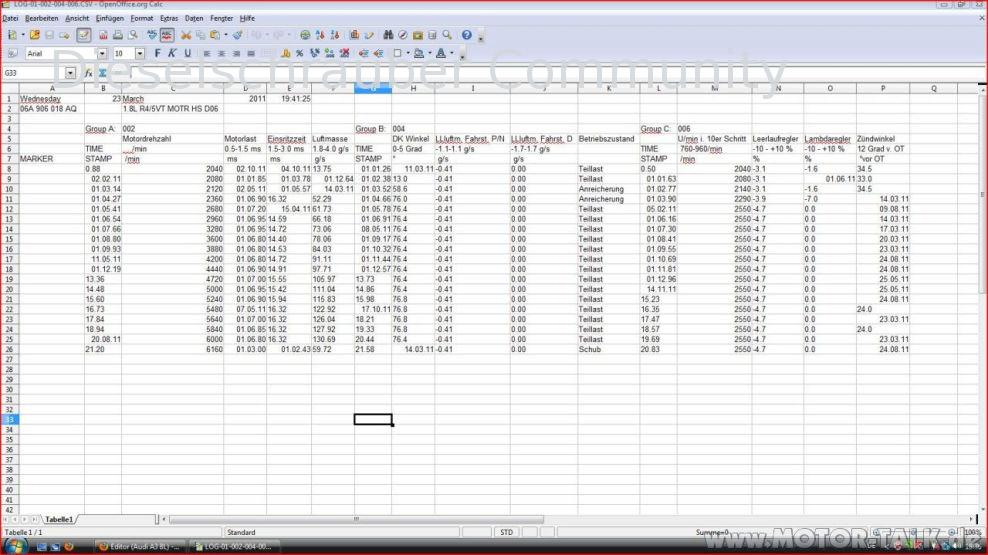
Uli S. wrote: | | Given the displayed LM value, it would be interesting to see a full-throttle log across the entire RPM range. If the value remains constant, then I am correct in my claim about the replacement value. If it changes, then it is actually being continuously calculated. | See the image.
Quote: | | Best regards, Uli (who consistently gets a reading of 1275mg/H on the AFN ). | ... because that's the end of the diagnostic scale. If the boost pressure is normal, you probably have a significant air leak .
| Description: |
| Luftmassenwert 1.8T, 150PS, Spalte F :wink: |
|
| File size: |
109.31 KB |
| Viewed: |
682 times |
|
Gruß Ulf
_________
MG4 Electric
Translated on 16-09-2026, 8:22.
|
|
| Back to top |
Profile PM Garage |
|
mullemaus
Guest
Free account, no CAN development support
|
| 31-08-2012, 15:25 Subject: Air Mass Sensor: TDI vs. 1.8T Comparison Data |
Quote |
|
Given the displayed LM value, it would be interesting to see a full-throttle log across the entire RPM range. If the value remains constant, then I am correct in my claim about the replacement value. If it changes, then it is actually being continuously calculated.
The value continuously increases until the rev limiter. Therefore, the highest value is reached at high engine speed. For a 1.8T engine, the average value is 121g/s at 150 horsepower.
Translated on 16-09-2026, 8:23.
|
|
| Back to top |
|
|
Uli S.
Schrauber
Joined: 07/02/2003
Posts: 338
Karma: +7 / -0
Location: Äußerster Südwesten
Support
|
| 31-08-2012, 17:29 Subject: Air Mass Sensor: TDI vs. 1.8T Comparison Data |
Quote |
|
Hi,
ulf wrote: | | http://www.motor-talk.de/bilder/lmm-logfile-1-8t-150ps-werte-ok-g37236777/a3lmm-i203827354.html -> Column F |
ok, got it.
Quote: | | Best regards, Uli (who consistently gets a reading of 1275mg/H on the AFN ). . . because the diagnostic scale is at its limit. If the boost pressure is normal, you probably have a significant air leak | .
"No, ever since it once went into limp mode on the highway with a 'mass airflow sensor implausible signal' error, I've been using a diode. I prefer to remove unnecessary components that are prone to failure and can cause dangerous situations. The EGR valve is 'broken' anyway, so what's the point of having a mass airflow sensor? As long as you don't use the accelerator pedal digitally at low speeds, it doesn't smoke any more than it did originally."
Mullemaus wrote: | | The value continuously increases until the speed limiter. | Therefore, the highest value is reached at a high speed. }
Okay, so there's no constant replacement value. Then, the indicated value across the entire load curve is consistently much higher than what the actual air demand would correspond to. Is the replacement value perhaps calculated dynamically to the maximum plausible value that corresponds to the respective operating state? I imagine that the programmers prefer a simple approach, essentially erring on the side of caution ("the air mass? Sure, that's plenty"), rather than risking that some plausibility check might cut off the fuel. You say that the mass airflow (MAF) is not measured at full load, but calculated. What reason would there be for this calculation of the MAF if it were completely disregarded?
Best regards, Uli. Golf2 GTD AAZ, LLK, CYP
Bus T3 JX
Passat 32B SB, LLK, Garett T2, 2N
2x Golf2 GTD/SB
alle fahren/fuhren ganzjährig frauentauglich mit 100% Pflanzenöl
97er Golf 3 AFN, 70-100% Pöl
97er Golf 3 Variant AFN
96er Passat 35i AFN
Translated on 16-09-2026, 8:25.
|
|
| Back to top |
Profile PM |
|
|


 Bookmarks
 Links
Links Garage
 FAQ, Legal Notice & Privacy
 RSS Feed
 Register
 Login
Login

