| Author |
Message |
ulf
Profi-Schrauber

Joined: 04/13/2002
Posts: 11058
Karma: +18 / -0 
Location: Saarland
2023 MG ZS
Premium Support
|
 21-05-2015, 9:19 Subject: Sand in Intake: Causes & Solutions 21-05-2015, 9:19 Subject: Sand in Intake: Causes & Solutions |
Quote |
|
Hello,
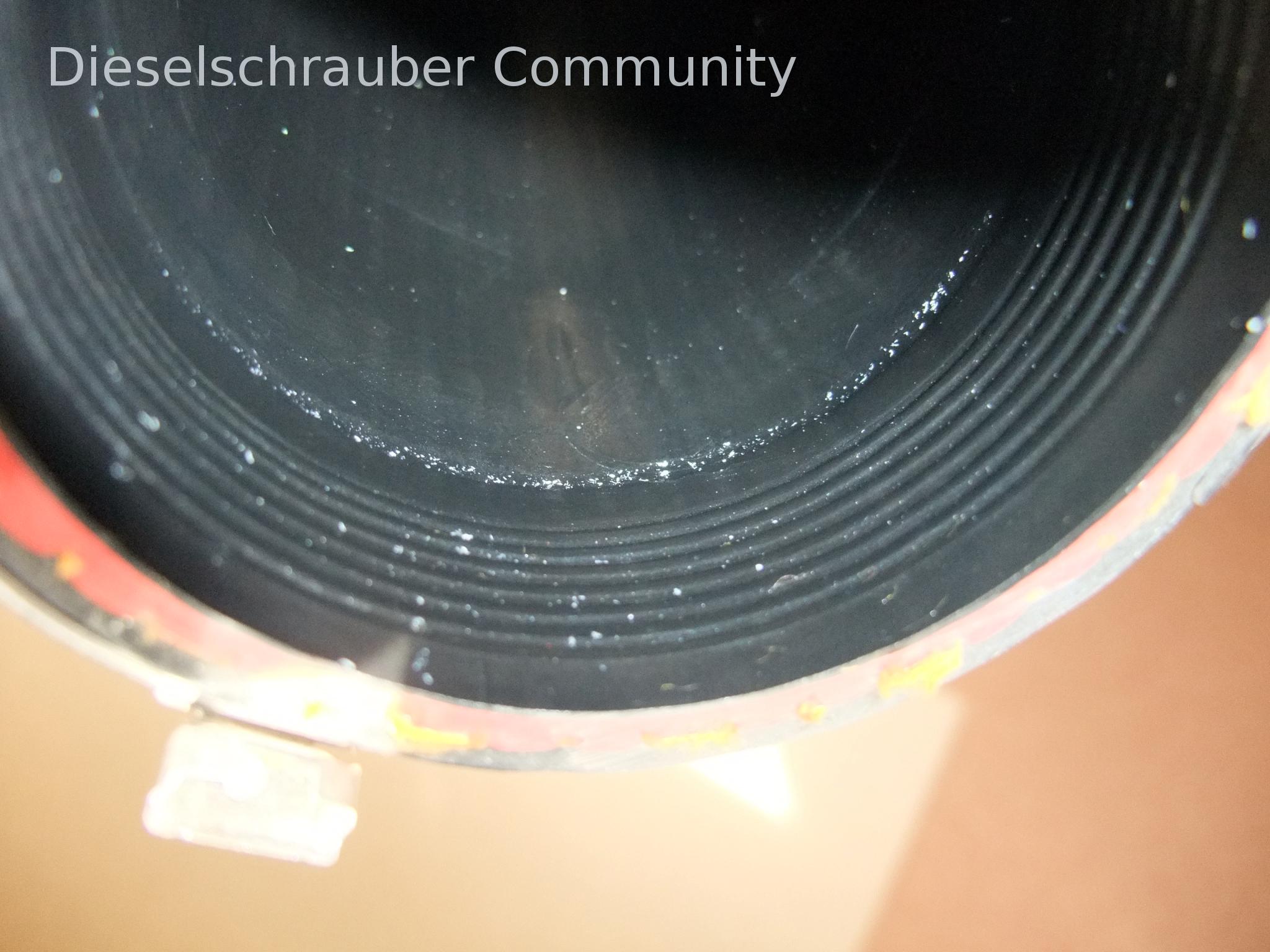
In the Polo WRC, I found a significant amount of small, greenish-gray particles in the pressure hose connecting the turbocharger to the intercooler, at a mileage of 2400 km, as shown in the attached image.
The crumbs don't shine and they don't feel like metal; rather, they feel like some kind of plastic.
The intake manifold from the air filter to the supercharger is clean. The supercharger is running smoothly without any whistling or whining noises, starts boosting around 2000 rpm, and the normal power output is present.
The posts in another forum (which is not publicly accessible) led me to believe that the most likely explanation for the issue is mold release agent used in the manufacturing of the compressor housing.
If that were the case: What does that mean for my engine, which now has almost 300,000 kilometers (or miles)?
Based on my estimate, he has already ingested so much of that substance that the remaining amount distributed in the intake manifold will likely have no further effect on him.
Should I, just to be on the safe side, thoroughly clean the intercooler system, including the front mount intercooler (FMIC), as much as possible (instead of having the work done under warranty, which might not be done very well)?
To what extent could the sand have made him a permanent oil addict? See https://community.dieselschrauber.org/en/viewtopic.php?t=28024.
| Description: |
| Sand in Intake: Causes & Solutions |
|
| File size: |
1.45 MB |
| Viewed: |
1430 times |
|
Gruß Ulf
_________
MG4 Electric
Translated on 24-08-2026, 13:32.
|
|
| Back to top |
Profile PM Garage |
 |
vwSchrauber
Profi-Schrauber
Joined: 09/18/2008
Posts: 1262
Karma: +43 / -0
Support
|
| 22-05-2015, 12:59 Subject: Sand in Intake: Causes & Solutions |
Quote |
|
.
An endoscopy of the cylinder walls can provide clarity. Scratches caused by hard foreign objects are very easily visible during this procedure. selber schrauben - statt Werkstattpfusch
Translated on 24-08-2026, 13:34.
|
|
| Back to top |
Profile PM |
|
ulf
Profi-Schrauber
Joined: 04/13/2002
Posts: 11058
Karma: +18 / -0
Location: Saarland
2023 MG ZS
Premium Support
|
| 22-05-2015, 13:04 Subject: Sand in Intake: Causes & Solutions |
Quote |
|
Ah, thank you.
Do VW workshops typically have the necessary endoscopes as part of their standard equipment? Or, if not, where could I go to obtain one?
Gruß Ulf
_________
MG4 Electric
Translated on 24-08-2026, 13:35.
|
|
| Back to top |
Profile PM Garage |
|
ulf
Profi-Schrauber
Joined: 04/13/2002
Posts: 11058
Karma: +18 / -0
Location: Saarland
2023 MG ZS
Premium Support
|
| 25-05-2015, 17:34 Subject: Sand in Intake: Causes & Solutions |
Quote |
|
Sure, here's the translation:
"One more question:"
Can a liquid cooling system with plastic air ducts be flushed with standard diesel fuel without risking later problems such as chemical damage to the plastic (embrittlement, cracks, etc.)?
Gruß Ulf
_________
MG4 Electric
Translated on 24-08-2026, 13:36.
|
|
| Back to top |
Profile PM Garage |
|
klahaui
Profi-Schrauber

Joined: 08/13/2009
Posts: 1102
Karma: +125 / -0
Location: Vogtland, Land der Berge
2019 Volkswagen Golf
Premium Support
|
| 25-05-2015, 18:58 Subject: Sand in Intake: Causes & Solutions |
Quote |
|
I would say yes, oil can also be used for that purpose, and diesel is not particularly aggressive.
Kaum macht man es richtig, funktioniert es!
Translated on 24-08-2026, 13:36.
|
|
| Back to top |
Profile PM Garage |
|
Bertil
Profi-Schrauber
Joined: 04/15/2002
Posts: 5628
Karma: +108 / -0
Premium Support
|
| 25-05-2015, 19:33 Subject: Sand in Intake: Causes & Solutions |
Quote |
|
Quote: |
Finesand in the intake air path?
|
Definitely not.
The manufacturing process simply doesn't allow for that.
Quote: |
To what extent could the sand have made him a permanent heavy drinker?
|
Once the particle size and hardness are determined, we can say more about it.
Since the particles in the photo appear to be very fine, it's probably not the case. Gruß Bertil
Skoda 5E5 CZDA + Mini R50 W10 + VW ID.3 + Fiat Ducato 250 + 161 DX
*** Technische Anfragen per PN werden von mir nicht beantwortet! ***
Translated on 24-08-2026, 13:37.
|
|
| Back to top |
Profile PM |
|
ulf
Profi-Schrauber
Joined: 04/13/2002
Posts: 11058
Karma: +18 / -0
Location: Saarland
2023 MG ZS
Premium Support
|
| 25-05-2015, 21:00 Subject: Sand in Intake: Causes & Solutions |
Quote |
|
Bertil wrote: | Quote: |
Finesand in the intake air path?
|
Definitely not.
That is not allowed by the manufacturing process. | I would think so too.
But in another forum, the owner of a turbocharger specialist company Quote: | | mentioned that I had actually experienced something similar once with a brand new turbocharger, where there was an inclusion in the compressor housing. The customer then wanted to install the turbocharger, but suddenly sand started pouring out of the compressor housing | .
Another user there: Quote: | | In the past, real molding sand was used, but nowadays there are also plastic granules that fulfill the same purpose. I think it might be something like that. |
"Formed granules seem to me now the most likely explanation for what is actually inside my charge air duct: because of the completely uniform (non-sandy) color of all the particles, without any metallic sheen  ". Gruß Ulf
_________
MG4 Electric
Translated on 24-08-2026, 13:38.
|
|
| Back to top |
Profile PM Garage |
|
Bertil
Profi-Schrauber
Joined: 04/15/2002
Posts: 5628
Karma: +108 / -0
Premium Support
|
| 25-05-2015, 21:53 Subject: Sand in Intake: Causes & Solutions |
Quote |
|
Nonsense!
You seriously believe that the negative form survived multiple washing processes, several machining operations, and further washing processes? It's more likely that there are metal shavings inside.
Okay, so you also have to believe in Santa Claus and the stork that brings children to their parents.
I assume it's dried-out assembly paste. This stuff dries out, turns gray/white, and is completely harmless when it passes through the engine. It's frequently used in factories to make the assembly of rubber and plastic parts "smoother." After all, things need to go quickly... Gruß Bertil
Skoda 5E5 CZDA + Mini R50 W10 + VW ID.3 + Fiat Ducato 250 + 161 DX
*** Technische Anfragen per PN werden von mir nicht beantwortet! ***
Translated on 24-08-2026, 13:40.
|
|
| Back to top |
Profile PM |
|
Herbert
Profi-Schrauber
Joined: 06/22/2005
Posts: 4620
Karma: +1338 / -0
Premium Support
|
| 26-05-2015, 8:54 Subject: Sand in Intake: Causes & Solutions |
Quote |
|
Even though it contradicts all known casting and manufacturing processes, a replacement glow plug that I was installing in my Passat TD came out of the packaging with fine white sand inside (it was a VW part, under warranty, at the workshop). It was immediately returned.
hg
Herbert.
Horch A4 8K CJCD
Golf 7 DDYA
(+ Audi 80 Avant B4 1Z 475Tkm - habe ich vom ersten bis zum letzten Tag gerne gefahren)
(+ Passat Variant 32B CY 400Tkm)
Translated on 24-08-2026, 13:42.
|
|
| Back to top |
Profile PM |
|
Bertil
Profi-Schrauber
Joined: 04/15/2002
Posts: 5628
Karma: +108 / -0
Premium Support
|
| 26-05-2015, 19:45 Subject: Sand in Intake: Causes & Solutions |
Quote |
|
Herbert wrote: | | ... Passat TD ... |
Okay, so from over 20 years ago... Back then, there was also a 1000km oil change service... Why, I wonder? I've seen metal shavings in the oil more than once during those oil changes.
And sand doesn't necessarily have to be molding sand; it could also have gotten in through storage or something similar. Gruß Bertil
Skoda 5E5 CZDA + Mini R50 W10 + VW ID.3 + Fiat Ducato 250 + 161 DX
*** Technische Anfragen per PN werden von mir nicht beantwortet! ***
Translated on 24-08-2026, 13:43.
|
|
| Back to top |
Profile PM |
|
Herbert
Profi-Schrauber
Joined: 06/22/2005
Posts: 4620
Karma: +1338 / -0
Premium Support
|
| 26-05-2015, 21:38 Subject: Sand in Intake: Causes & Solutions |
Quote |
|
Even that's nonsense... 
I am referring to an original ET part that was delivered directly from the factory. The storage conditions at VW were certainly just as impeccable then as they are today, only with fewer "Mänätschers" (likely a colloquial term for something).
By the way, the oil change interval for this model was 7,500 km. 1,000 km was a long time ago, like almost 40 years ago, and some of us were still riding tricycles back then.
Sure, here's the translation:
"Best regards," or "Sincerely," (depending on the context).
Herbert. Horch A4 8K CJCD
Golf 7 DDYA
(+ Audi 80 Avant B4 1Z 475Tkm - habe ich vom ersten bis zum letzten Tag gerne gefahren)
(+ Passat Variant 32B CY 400Tkm)
Translated on 24-08-2026, 13:44.
|
|
| Back to top |
Profile PM |
|
DieselBär30x
Profi-Schrauber

Joined: 01/17/2008
Posts: 3560
Karma: +101 / -0
Location: München & Passau
Premium Support
|
| 27-05-2015, 1:25 Subject: Sand in Intake: Causes & Solutions |
Quote |
|
Hello everyone!
...it's been a crazy long time since the DBär was allowed to pee in the circle, hasn't it? 
Aber es langweilt. Und nicht nur mich... That's why!
@ ulf :
We should go back to basics and start a dedicated topic for hypochondria, separate from the actual discussion about the conflict between expertise and (feigned) menstrual complaints of a MALE individual.
...because having to hear fleas coughing beforehand, at best, through a crystal ball, using all possible force (@TauBär, sorry! ), no longer fits into the general pattern of this technically sound forum for me.
Speaking of the "TauBär" (likely a specific car part or model): Truly, the only effective(!) and productive suggestion: Leave the cover ON! ...What business do you have as a "customer" within the warranty period with any dismantling?! If VW can prove that you were messing around due to an obvious lack of understanding, then that's it with the burden of proof (reversal), and I want to see what legally valuable counter-argument you have!!!
Kurz: Du müßtest Deine Fähigkeiten, Kenntnisse, uva. Aus-/Weiterbildung ÜBER der der Gegenseite VORAB PLAUSIBEL nachweisen können und .. bei DER Denkensart .. JoahPlease provide the text you would like me to translate from German to English. I will then give you only the translation, without any explanations.
@HerBärt:
Thank you again, and once more, for your very insightful contributions!
According to the principle: "Age is not a defense!"... or was it ignorance? *chuckles*
According to the manufacturer's specifications, a 1,000-mile oil change was not always required, but rather tightening the cylinder head screws!!! Of course, back then, VAG employees were much more intelligent and conveyed this information to customers primarily with a sense of responsibility and professionalism, rather than focusing on commercial aspects. ...and before anyone insists on mandatory adjustments (a new word! *g*) or makes it obligatory at all costs: Please consult the maintenance schedule from that time.
But even here, the most important thing is that it is mandatory (regarding point 3), and that's the last word!
The 7:50 PM service was a regular offering on the TD lines back then.
@Berti(l):
Well, I'm not really feeling comfortable approaching you right now.
Back to the topic:
@Ulf
Take photos, conduct laboratory analyses of the foreign objects found in the production line, and write to the corporate headquarters again about this issue. However, be aware that you may be creating more problems for yourself than you intend.
...or annoy them even more by adding 10,000 other hairs to the soup.
Nevertheless, I am certainly not the only one who is very interested in how far the frustration tolerance of such a corporation will extend  .
In this spirit.
Best regards from Munich! 1. S.verlängerung: Audi A4 Avant quattro, 1,9 TDi MKB: AFN, BJ98, Vollausstattung, +VP1L
2. Moped BMW K1200RS, 130 PS, BJ98, Vollausst.
3. T5 1,9 TDI PD (AXC), BJ04 - nur Ärger!
Translated on 24-08-2026, 13:48.
|
|
| Back to top |
Profile PM |
|
matthiasTDI96
Profi-Schrauber
Joined: 02/27/2003
Posts: 5886
Karma: +251 / -0
Premium Support
|
| 27-05-2015, 7:22 Subject: Sand in Intake: Causes & Solutions |
Quote |
|
I still don't fully understand why a new car would be disassembled like that, but it has happened now, and what one thinks about it... well, doesn't really matter (although I also believe that all this tinkering could potentially cause significant problems in the event of an accident).
But:
I have to disagree with Bertil. My employer builds industrial furnaces, which often includes foundries. In recent years, particularly in the automotive industry and especially among German manufacturers, there has largely been a shift towards inorganic binders. This has been accompanied by almost biblical problems during the casting process. Of course, it's nice that the new VW foundry is completely white and no longer the leaky mess it was five years ago, but that's about all the advantages there are (or were). The turbocharger probably won't be coming from Germany either. Regarding the cleaning of products after being removed from the mold, I've seen a lot, so theoretically, it is possible.
Okay, if I were to go back to the main topic and examine the charge air hose, I have a feeling that these "foreign objects" are mainly located in the sealing area, and that's how they got there during the assembly process, where they still are now. That makes sense, because everything else would have been blown out. So, I'm back to Bertil and his assembly aid.
"Foundry sand" is naturally different from "play sand." In fact, it's a very scarce resource (whether you believe it or not). Grain size, surface area, and purity all play a role. I've seen every shade of color imaginable. However, the engine wouldn't care whether it was foundry sand or sand from an improper storage location. The problem is: if it were foundry sand from the repeatedly processed metal part of the turbocharger, it would have long since disappeared and wouldn't be found in the seal...
Translated on 24-08-2026, 13:54.
|
|
| Back to top |
Profile PM |
|
Herbert
Profi-Schrauber
Joined: 06/22/2005
Posts: 4620
Karma: +1338 / -0
Premium Support
|
| 27-05-2015, 8:48 Subject: Sand in Intake: Causes & Solutions |
Quote |
|
Quote: | | ...and before mandatory follow-up actions (a new word! *g*) and also mandatory things that absolutely must happen: Go and look at the maintenance plan from back then... |
Sure, off-topic for forum colleagues who like to make jokes: You only know about maintenance schedules from stories your grandpa used to tell you.
hg
Herbert. Horch A4 8K CJCD
Golf 7 DDYA
(+ Audi 80 Avant B4 1Z 475Tkm - habe ich vom ersten bis zum letzten Tag gerne gefahren)
(+ Passat Variant 32B CY 400Tkm)
Translated on 24-08-2026, 13:56.
|
|
| Back to top |
Profile PM |
|
vwSchrauber
Profi-Schrauber
Joined: 09/18/2008
Posts: 1262
Karma: +43 / -0
Support
|
| 27-05-2015, 9:46 Subject: Sand in Intake: Causes & Solutions |
Quote |
|
Quote: | Do you seriously believe that the negative form survived multiple washing processes, multiple machining operations, and further washing processes? It's more likely that there are metal shavings inside.
|
It's conceivable that this could have happened – perhaps when the negative image wasn't entirely stable, and a few "grains" from a thin aluminum layer were obscuring it, only to flake off later.
Honestly, don't worry about a few crumbs. You should see what the intercooler intakes look like on vehicles that use dry cotton filters (sports air filters). You'll find a kind of "grinding paste" in the quieter areas (hose connections, intercooler, etc.).
These engines, surprisingly, can last well over 100,000 km . selber schrauben - statt Werkstattpfusch
Translated on 24-08-2026, 13:58.
|
|
| Back to top |
Profile PM |
|
ulf
Profi-Schrauber
Joined: 04/13/2002
Posts: 11058
Karma: +18 / -0
Location: Saarland
2023 MG ZS
Premium Support
|
| 27-05-2015, 12:45 Subject: Sand in Intake: Causes & Solutions |
Quote |
|
matthiasTDI96 wrote: | | I still don't fully understand the process of disassembling a new car, but it has now happened, and what one thinks about that...doesn't matter | . I had "only" removed one hose to estimate the amount of oil in the intercooler system - the reason: see my topic on the CDL's oil consumption.
Quote: | | If I were to go back to the topic and examine the charge air hose, I have the impression that these "foreign objects" are mainly located in the sealing area and therefore came there during the assembly process, where they still are now. That makes sense, because the rest would be blown away. So, I'm back to Bertil with his assembly aid. | This explanation seems most plausible to me so far, also because of the significantly different grain sizes, which are typical for other dried-out materials (window sealant, clay, paints, etc.).
Or could residues of foundry sand or plastic granules have a similar particle size distribution?
The many granules on the sealing surface initially suggest the use of a mounting aid. However, unfortunately, I had already wiped the area directly behind the sealing surface with my finger before taking the photo, and I may have spread some of it onto the sealing surface in the process .
(I no longer remember  whether the sealing surface was clean beforehand.)
Quote: | | To be honest: don't worry about a few crumbs. You should see what the intercooler intakes of vehicles running with dry cotton filters (sports air filters) look like. In quieter areas (hose connections, intercooler, etc.), you find a kind of "grinding paste" there. | My worst-case scenario thoughts also go in the direction of clogged crumbs in valve seat seals: If a valve doesn't close properly because of this, apparently exhaust gases can leak past, and it could warp... or am I wrong about that? Gruß Ulf
_________
MG4 Electric
Translated on 24-08-2026, 14:01.
|
|
| Back to top |
Profile PM Garage |
|
|


 Bookmarks
 Links
Links Garage
 FAQ, Legal Notice & Privacy
 RSS Feed
 Register
 Login
Login
