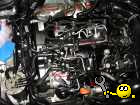
For engine control units (and other control units), there are occasionally software updates that fix errors or issues. As part of the VW emissions scandal, software updates are also intended to ensure compliance with the legal emission standards of the affected engines.
Unfortunately, with new software updates, it's often the case that old bugs are fixed, but sometimes new ones are also introduced. Therefore, it's not necessarily true that a new software version must be overall better than the previous version. Often, it takes several software updates to achieve a satisfactory functional state.
To ensure that you know which versions are involved, it is advisable to perform a scan (VCDS) or read the OBD2 control unit information (KOBD2Check) before and after a software update. This not only contains information about the operating software of the control units, but also any potential errors in the respective error memory.
Example of a Motor Control Unit Software,
Software Name (VAG Part Number, green), Software Version (red):
Quote: |
Address 01: Engine Electronics (CDL) Label file: User\6R0-907-115.lbl
Part Number SW: 6R0 907 115 HW: 6R0 907 115
Part: 2.0l R4/4V TFSI 02 0020
Revision: 5LH02--- Serial Number:
Encoding: 0403000C18070160
Operating Number: WSC 00788 648 00255
VCID: 6FE605087E61F146BE-803A
No error codes found.
Readiness: 0000 0000 |
While the name of the software (VAG part number,
green) usually remains the same, the software version (version number, red) changes with an update.
This information allows, in the event of a failed software update, to restore the previous software (e.g., by a workshop or a chip tuner).
When making changes to the engine control unit (ECU) software, it's also a good idea to perform a before-and-after performance measurement, as different software can also affect the vehicle's performance.
Those who have a suitable stretch of road nearby can use
KPower and VCDS to... KOBD2Check perform a performance measurement (
KPower Bedienungsanleitung = required reading!).
It is important that the two measurements take place under approximately the same environmental conditions (i.e., not once at 38°C in the summer and then at 2°C in the winter, or with headwind/tailwind).
After a software update, the following should be checked:
- Are the known bugs fixed?
- Are there any new bugs?
- Does the car drive the same as before (after changes to the engine control unit), or does it show any abnormalities (driving behavior, performance, fuel consumption)?


 Bookmarks
 Links
Links Garage
 FAQ, Legal Notice & Privacy
 RSS Feed
 Register
 Login
Login