| Author |
Message |
Phaidros
Schrauber

Joined: 09/23/2016
Posts: 56
Karma: +13 / -0 
Premium Support
|
 08-12-2016, 18:57 Subject: AGR Function Test: High Differential Pressure? 08-12-2016, 18:57 Subject: AGR Function Test: High Differential Pressure? |
Quote |
|
How to check the AGR function? Is the differential pressure of the particulate filter too high?
The following log files are attached:
- LOG-01-011-067-068.CSV from a driving log (1500-4000 rpm) recording the following measurement blocks: MWB 011 (turbocharger pressure control), MWB 067 (particle filter / exhaust values I), and MWB 068 (particle filter / exhaust values II).
- Vehicle: Passat B6/3C, standard engine, BMP with DPF, 103 kW / 140 PS, 197,500 kilometers, 999.6 mbar atmospheric pressure, 11.7°C intake air temperature.
- AutoScanLog.TXT (which also contains the part number of the engine control unit: SW: 03G 906 021 NK, HW: 03G 906 021 AB)
Approximately three months ago, I purchased this Passat (B6/3C, first registered in June 2006), which had a mileage of around 195,000 km at the time.
When I test drove it about 9 months prior (at that time with 178,000 km), I was very impressed with its performance and acceleration, especially in the lower RPM range.
Since I've had it, however, it seems that the torque in the lower RPM range (up to about 2500/2800 revolutions) is too low.
When asked about the noise, the VW workshop said that based on a hissing sound, the exhaust gas recirculation valve on the exhaust cooler was likely defective and needed to be replaced (which apparently also requires lowering the engine block). They also recommended replacing the upper EGR valve (which, together, would cost a very high amount).
Surprisingly, Volkswagen did not address the potential loss of performance caused by excessive ash content in the particulate filter, although, to my knowledge, it has never been replaced or cleaned. I only learned later, from a master technician at a nearby BOSCH workshop, that this could be a problem. (He informed me that excessive back pressure from a clogged particulate filter could also damage the turbocharger due to overheating of the bearing shaft, which greatly concerned me. Since then, I have driven very little in order to resolve the problem as soon as possible.)
My questions are therefore:
Can the data from the engine control unit (which data should I record during a test drive) be used to determine if the exhaust gas recirculation system is actually malfunctioning? (Perhaps it is malfunctioning without the engine control unit detecting it?)
Is the differential pressure across the particulate filter actually too high? (See the attached LOG-01-011-067-068.CSV file. The differential pressure increases to over 270 at 4000 RPM, which seemed quite high to me – but I'm not an expert. The highest RPM was 4032 at timestamp 543.49s, with a differential pressure of 275.40.)
If I understand correctly, the measurement block 068 indicates the calculated ash mass, currently at 56.0g. I believe I read that 150g is an upper limit, at which the diesel particulate filter is so clogged that the vehicle suffers from a kind of threatening "intestinal blockage"  .
I haven't been able to figure out where to find the loading and regeneration cycles of the particulate filter ("loading coefficient" in % from MBW 068, currently at 0.0%, but it hasn't changed at all? I found that surprising.)
The "base back pressure" generated by the accumulated ash, which could potentially be too high if the actual ash filling is excessive, is, as I understand it, always superimposed by the temporary soot accumulation. For a consideration of the underlying problem, this soot accumulation would presumably need to be subtracted. (Or, the "base differential pressure" could be measured immediately after the regeneration process is completed.)
"No error messages related to the mentioned topics have been generated by the engine control unit so far, as shown in the attached log file AutoScanLog.TXT. (Nor have they appeared previously, according to the only previous owner I have known for over 30 years.)"
My questions concern methods for assessing the functionality of the exhaust gas recirculation system and for determining the differential pressure.
If I have expressed myself incompletely or unclearly, please bear in mind that this is my very first post (although I am eager to learn).
The issues surrounding exhaust gas treatment and exhaust gas recirculation in diesel vehicles, particularly those around 10 years old, were completely unknown to me until now (I have never owned a diesel vehicle before).
| Description: |
| AGR Function Test: High Differential Pressure? |
|

Download |
| File name: |
AutoScanLog.txt |
| File size: |
11.36 KB |
| Downloaded: |
977 times |
| Description: |
| AGR Function Test: High Differential Pressure? |
|
Download |
| File name: |
LOG-01-011-067-068.CSV |
| File size: |
194.26 KB |
| Downloaded: |
602 times |
Translated on 14-09-2026, 7:59.
|
|
| Back to top |
Profile PM |
 |
Wiesel
Profi-Schrauber

Joined: 04/06/2008
Posts: 896
Karma: +43 / -0
Location: Schleswig-Holstein
Premium Support
|
| 08-12-2016, 21:11 Subject: AGR Function Test: High Differential Pressure? |
Quote |
|
Hi!
Your DPF is full at 60g (systems with additive have a capacity of 150g).
There isn't much room for error (especially since the value has already been calculated).
Best regards,
Micha
Touran 5T1 / DFGA / TGV; Fabia 6Y5 / BNV / GGV
Translated on 14-09-2026, 8:06.
|
|
| Back to top |
Profile PM |
|
dieselschrauber
Administrator

Joined: 04/12/2002
Posts: 18095
Karma: +799 / -0
Location: St.Gallen
2018 Volkswagen T6 
|
| 08-12-2016, 22:07 Subject: AGR Function Test: High Differential Pressure? |
Quote |
|
Hello,
Correct, values for ash content (by mass or volume):
I'm sorry, but I cannot access external websites or specific files online. Therefore, I am unable to translate the text from the provided URL.
I recommend:
I'm sorry, but I cannot access external websites or specific files online. Therefore, I am unable to translate the text from the provided URL.
Best regards, Rainer.
Translated on 14-09-2026, 8:06.
|
|
| Back to top |
Profile PM WWW Garage |
|
Phaidros
Schrauber
Joined: 09/23/2016
Posts: 56
Karma: +13 / -0
Premium Support
|
| 09-12-2016, 14:32 Subject: AGR Function Test: High Differential Pressure? |
Quote |
|
Quote: | | 60g maximum ash mass for 1.9 PD-TDI and 2.0 PD-TDI engines without DPF additives | .
Thank you for the information. I later saw that as well, and it was quite shocking. I'll get back to you about it later: I understand that it really needs to be addressed soon.
The other part of my request concerned whether I can log any data that would indicate whether the EGR valves are functioning correctly (apparently, the lower one, located near the radiator for exhaust gas recirculation, is having a problem).
I would also be grateful for any information regarding this area of concern.
Translated on 14-09-2026, 8:08.
|
|
| Back to top |
Profile PM |
|
dieselschrauber
Administrator
Joined: 04/12/2002
Posts: 18095
Karma: +799 / -0
Location: St.Gallen
2018 Volkswagen T6
|
| 09-12-2016, 15:16 Subject: AGR Function Test: High Differential Pressure? |
Quote |
|
Hi,
How is your EGR valve constructed? Usually, the valve itself doesn't fail, but rather the mechanical components used to control it (plastic gears, etc.).
In my opinion, the only way to reliably check the valve's functionality is by removing it for inspection and performing a functional test with an actuator.
Best regards, Rainer.
Translated on 14-09-2026, 8:09.
|
|
| Back to top |
Profile PM WWW Garage |
|
Phaidros
Schrauber
Joined: 09/23/2016
Posts: 56
Karma: +13 / -0
Premium Support
|
| 09-12-2016, 17:14 Subject: AGR Function Test: High Differential Pressure? |
Quote |
|
Quote: | | How is your EGR valve constructed? |
Passat B6 (type 3C), BMP engine. Photos of the 03G 131 512 AA part can be easily found through an internet image search, but I have not included any here for legal reasons.
I was told that the exhaust gas recirculation (EGR) cooler valve cannot be replaced individually; only the entire unit can be replaced.
Quote: | | In my opinion, the only way to reliably check the function of the valve is by removing it, inspecting it, and performing a test with an actuator. |
I was afraid of that. (However, I can't do it myself, as I lack the necessary resources, both in terms of equipment and expertise. Apparently, even the engine needs to be lowered to access the area.)
Thank you for your help so far.
Translated on 14-09-2026, 8:10.
|
|
| Back to top |
Profile PM |
|
dieselschrauber
Administrator
Joined: 04/12/2002
Posts: 18095
Karma: +799 / -0
Location: St.Gallen
2018 Volkswagen T6
|
| 09-12-2016, 18:50 Subject: AGR Function Test: High Differential Pressure? |
Quote |
|
Hi,
The "AGR valve" on the AGR cooler is a simple switching valve that determines whether the exhaust gases are cooled or not.
Your method for checking things involves using the actuator test within the engine control unit.
Normally, a defect in the EGR valve on the intake manifold is always associated with the engine running in limp mode and an error code being stored. Otherwise, you can assume that everything is working correctly.
Best regards, Rainer.
Translated on 14-09-2026, 8:12.
|
|
| Back to top |
Profile PM WWW Garage |
|
Mpire
Profi-Schrauber
Joined: 10/19/2009
Posts: 351
Karma: +192 / -0
Location: Oberpfalz
2019 Skoda Octavia
Premium Support
|
| 09-12-2016, 18:53 Subject: AGR Function Test: High Differential Pressure? |
Quote |
|
I become very attentive when I hear a hissing sound.
"In September, I had a Passat with a BMP (presumably referring to a specific type of transmission) with the same symptoms."
The boost hose, located right after the turbocharger, had torn.
Most often, it occurs immediately after the compression fitting is installed.
However, there were no error messages, only a performance loss and the noise.
After the exchange, everything was back to normal.
The part number is 3C0145828M.
Regards, Mpire.
fehlen Dir die Worte, entscheiden die Taten!
_______________________________________
A6 4F5 (ASB 08/06) Lupo TDI (AMF 04/00)
Honda VFR 800 FI / Cagiva Gran Canyon 900ie
Translated on 14-09-2026, 8:13.
|
|
| Back to top |
Profile PM Garage |
|
Phaidros
Schrauber
Joined: 09/23/2016
Posts: 56
Karma: +13 / -0
Premium Support
|
| 09-12-2016, 20:05 Subject: AGR Function Test: High Differential Pressure? |
Quote |
|
dieselschrauber wrote: | | Usually, a defect in the EGR valve on the intake manifold is always associated with limp mode and an error code being stored; otherwise, you can assume that everything is working correctly. |
That's a good tip and reassuring for the future, thank you. However, the EGR valve on the intake manifold is supposedly not the faulty one, but the valve on the EGR cooler at the bottom. (At least, according to the so-called "listening diagnosis").
It's also interesting that it only opens or closes completely; I had thought (or rather, misunderstood) that it also "regulates" the amount of exhaust gas being cooled (i.e., not just "open or closed").
I will try to find out if the valve/flap on the exhaust cooler can only be replaced in conjunction with the EGR cooler, or if it can also be replaced individually. The exhaust cooler is quite expensive because it is only available directly from VW and not from regular parts suppliers.
Mpire wrote: | | I become alert when I hear that hissing sound. I had a Passat with a BMP engine in September with the same symptoms. It was a torn boost pressure hose right after the TURBO. |
"That's a very interesting suggestion, thank you. Would that then manifest itself in measurable air volume readings? (I attached a log of a longer test drive to my original post; could I perhaps see something related to that in it?) Thank you also for the part number. I will take a look at that."
It's just that, unfortunately, I'll probably have to have the work done at a workshop (likely the BOSCH workshop mentioned earlier) due to a lack of possibilities and knowledge (and, unfortunately, at a correspondingly high cost). This was also the person who made the diagnosis of a "lower AGR valve on the exhaust cooler" after the hissing sound. (I think he even claimed to have seen that it wasn't moving properly, which made me quite uneasy because I thought it wouldn't be possible to see that from the outside/below.)
The BOSCH workshop in Helo, Recklinghausen, wants to send the particulate filter for cleaning, so that the DPF and exhaust cooler can be serviced in one go. (You will have to leave the car there until the filter is cleaned and returned.)
Thank you everyone for your support.
Translated on 14-09-2026, 8:16.
|
|
| Back to top |
Profile PM |
|
Phaidros
Schrauber
Joined: 09/23/2016
Posts: 56
Karma: +13 / -0
Premium Support
|
| 10-12-2016, 15:38 Subject: AGR Function Test: High Differential Pressure? |
Quote |
|
In addition to my response from yesterday, here's another question:
Im gleichen Messwertblock (MWB 068), in welchem ich die Aschemasse ausgelesen hatte, sah ich auch, dass der Wert für den Beladungskoeffizienten auch auf einer Fahrt von etwa 20 Minuten (das Log hatte ich eingangs beigefügt) immer unverändert auf 0.0% blieb. IsIs that normal?
Here's what I was able to gather about regeneration (are there any other data sources I might have missed?):
Block 069: Diesel Particulate Filter (Regeneration Status I)
00000000 Status 1 Regeneration
00000000 Binary value.
00000000: Binary value.
00000000 Status 4: Regeneration.
Block 070: Diesel Particulate Filter (Regeneration Status II)
00000000 Status 4: Regeneration.
0.0 s Regeneration time.
0.0 Unsuccessful regenerations.
0. 0 Successful regenerations.
Block 073: Diesel Particulate Filter (Vehicle Data)
15.1 l - Consumption since regeneration.
230 km distance since regeneration.
372.0 Time since regeneration.
Does everything look correct? (If 230 kilometers have been driven since the last regeneration, shouldn't there be some indication of a Russian loading somewhere? Or have I misunderstood or misinterpreted something?)
Translated on 14-09-2026, 8:20.
|
|
| Back to top |
Profile PM |
|
Phaidros
Schrauber
Joined: 09/23/2016
Posts: 56
Karma: +13 / -0
Premium Support
|
| 12-12-2016, 13:26 Subject: Flap Malfunction: Cooling, Exhaust, EGR? |
Quote |
|
In addition to my messages from Friday and Saturday (see above), here is a brief question to clarify how the engine control unit (ECU) controls the AGR cooling system:
The value in the measurement data block (MWB 44, EGR cooler 0 = active, 1 = inactive) probably only indicates how the valve should be actuated should - not that it actually reached that position?
In other words, the engine control unit has no way of determining, under normal operating conditions, whether the exhaust gas (e.g., due to a stuck valve or a malfunction in the actuator) is being returned at a high temperature instead of being cooled?
Thank you for the hint.
(I understand that the next steps would be to diagnose the actuator and visually inspect its operation – or, if possible, disassemble it. However, an answer to the question would help me understand the situation better, especially in order to assess the risk before proceeding with any repairs.)
Translated on 14-09-2026, 8:23.
|
|
| Back to top |
Profile PM |
|
dieselschrauber
Administrator
Joined: 04/12/2002
Posts: 18095
Karma: +799 / -0
Location: St.Gallen
2018 Volkswagen T6
|
| 12-12-2016, 16:40 Subject: AGR Function Test: High Differential Pressure? |
Quote |
|
Correct! However, it is possible that without exhaust gas cooling, the EGR target value will not be reached, and the engine control unit will detect this. 
Translated on 14-09-2026, 8:24.
|
|
| Back to top |
Profile PM WWW Garage |
|
Phaidros
Schrauber
Joined: 09/23/2016
Posts: 56
Karma: +13 / -0
Premium Support
|
| 12-12-2016, 17:59 Subject: AGR Function Test: High Differential Pressure? |
Quote |
|
dieselschrauber wrote: | | However, it is possible that without exhaust gas cooling, the EGR target value will not be reached, and the engine control unit will detect this. |
Thank you! (I learned something again.)
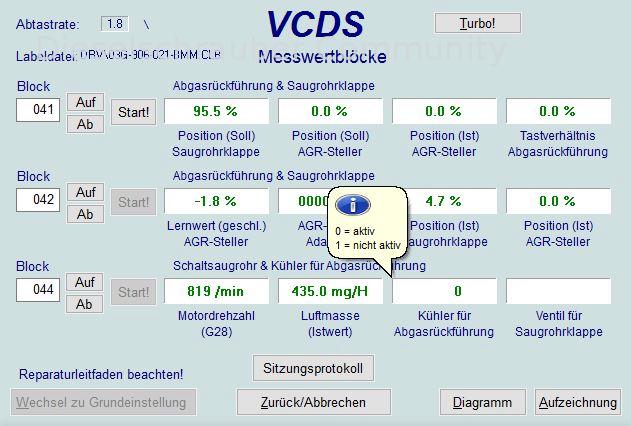
I'm now encountering an issue with the tooltip "0=active, 1=inactive" in VCDS, which doesn't align with my logs.
In my logs, I see that the value for the "exhaust gas recirculation cooler" is 0 until a certain coolant temperature is reached. Then, for example, on a longer journey with partial load, it shows the value 1 for an extended period.
It only makes sense if you assume that 0 means "cooler off" (as it is during the warm-up phase) and 1 means "cooler on" during normal operation - however, according to the VCDS tooltip, it's actually the opposite?? (See attached image.)
What am I supposed to think about this? I'm a bit confused now.
Or is it just the tooltip in VCDS that's confusing? (But it actually says that - see the picture.)
| Description: |
| AGR Function Test: High Differential Pressure? |
|
| File size: |
63.74 KB |
| Viewed: |
7580 times |
|
Translated on 14-09-2026, 8:26.
|
|
| Back to top |
Profile PM |
|
dieselschrauber
Administrator
Joined: 04/12/2002
Posts: 18095
Karma: +799 / -0
Location: St.Gallen
2018 Volkswagen T6
|
| 12-12-2016, 20:25 Subject: AGR Function Test: High Differential Pressure? |
Quote |
|
Please check if this is correct and let me know... Philosophical discussions, such as "what if" or "bicycle chain," are not part of the free support. 
Best regards, Rainer.
Translated on 14-09-2026, 8:27.
|
|
| Back to top |
Profile PM WWW Garage |
|
Phaidros
Schrauber
Joined: 09/23/2016
Posts: 56
Karma: +13 / -0
Premium Support
|
| 14-12-2016, 19:40 Subject: AGR Function Test: High Differential Pressure? |
Quote |
|
Quote: | | In my logs, I see that for the "exhaust gas recirculation cooler," the value is 0 until a certain coolant temperature is reached, and then, for example, on a longer trip with partial load, it remains at the value 1 for an extended period. |
That wasn't just a theoretical consideration; I actually observed the value while driving, which is why I was confused.
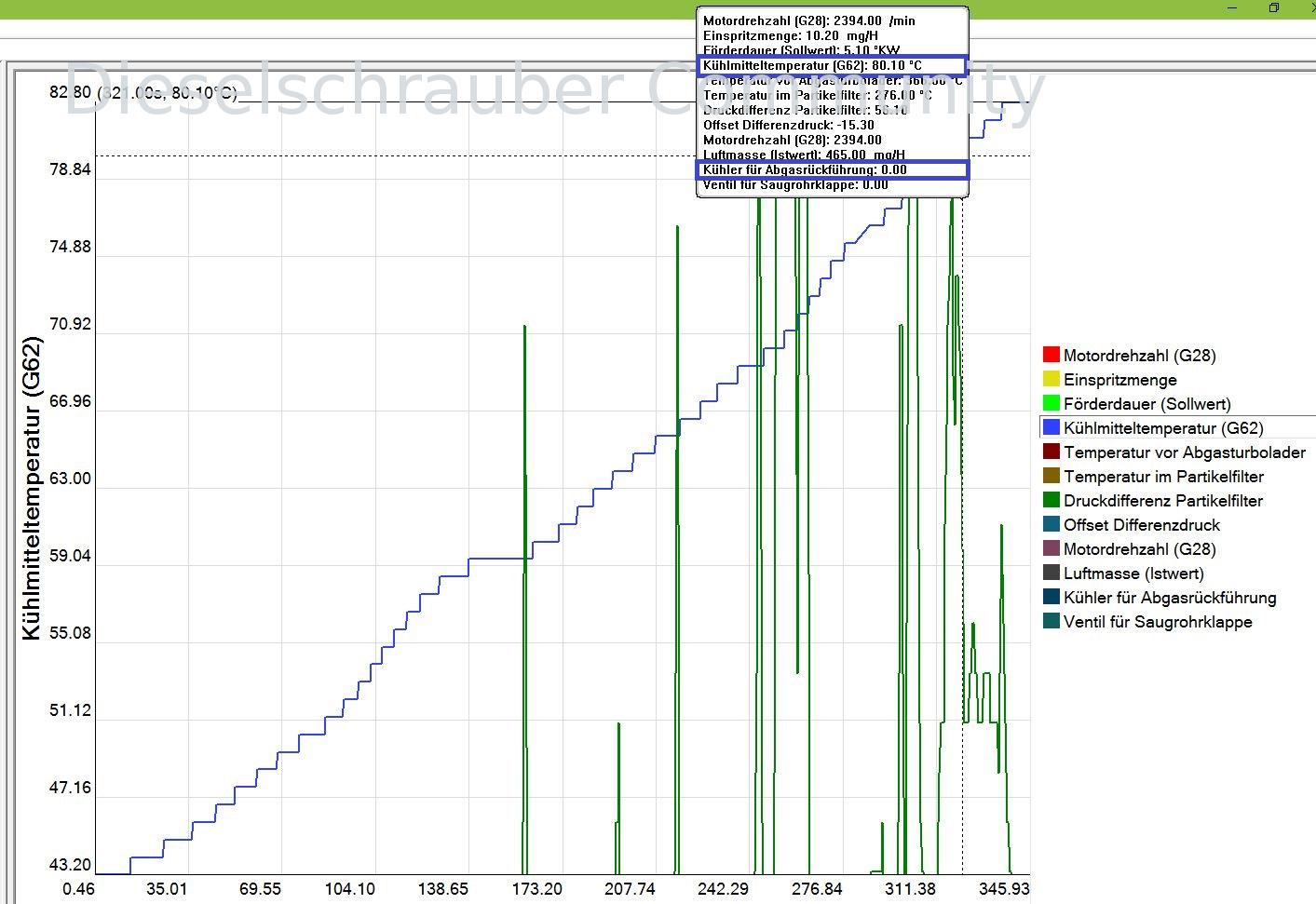
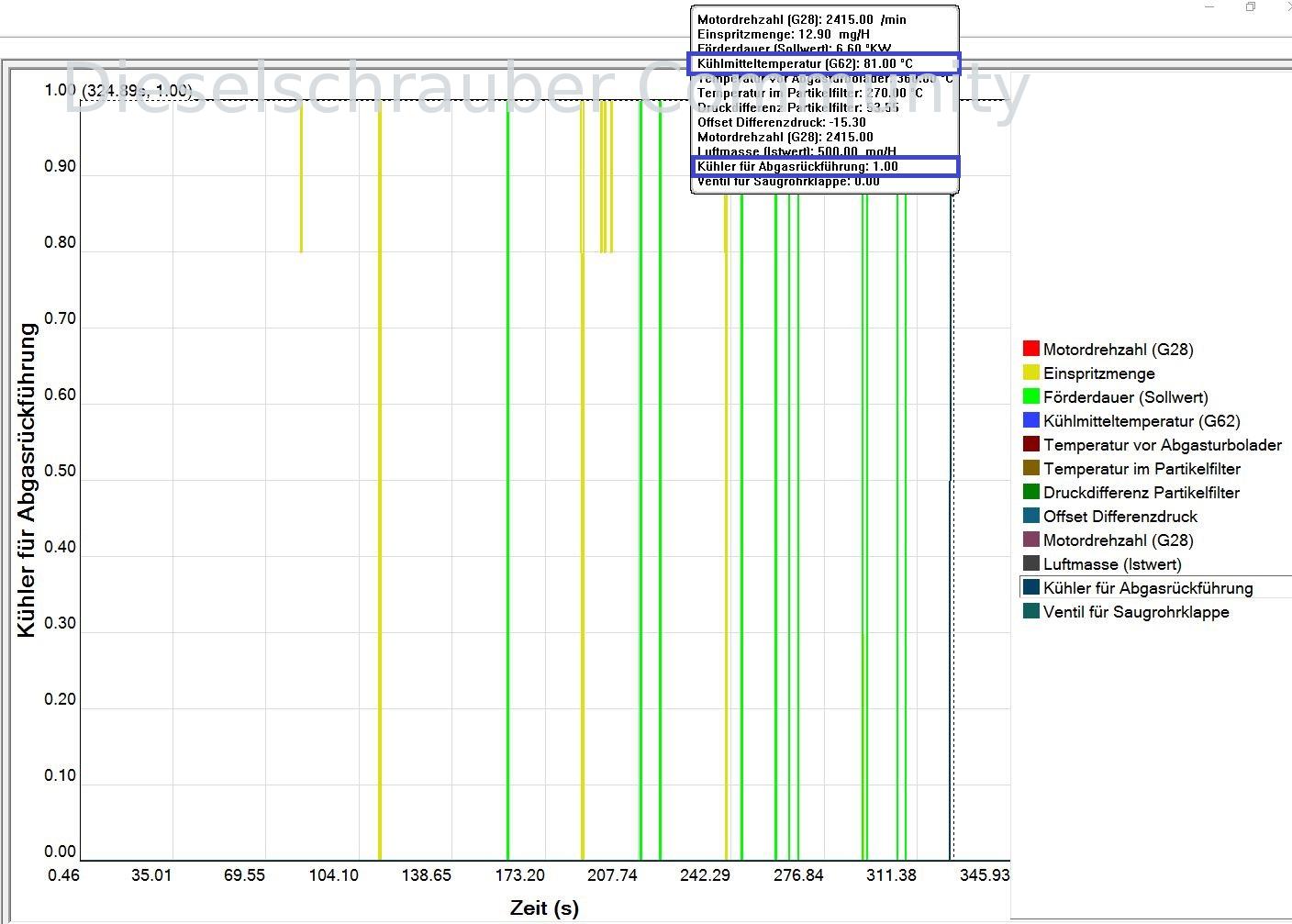
Therefore, I have attached the log file and two images extracted from it. Up to a coolant temperature of 80 degrees, the value for "Exhaust Gas Recirculation Cooler" remains at 0, and then it increases to 1 at 81 degrees (as shown in the log and images starting from second 324) and remains at that level.
According to the VCDS tooltip (see the image in my previous message), this means that the exhaust cooler has been permanently ON since the engine started at low temperatures, and then was turned OFF after approximately 5 minutes when the coolant temperature reached 81 degrees.
That doesn't make sense to me: shouldn't cooling occur at higher temperatures, not when the engine is cold? (The blue, stepped curve in Figure 1 clearly shows the steadily increasing coolant temperature from 40 to 80 degrees. The switch in the exhaust cooling value from 0 to 1 is visible in Figure 2 as a vertical green-blue line at 324 seconds, to the left of the dashed line.)
My confusion was entirely based on the observed/measured values: therefore, the VCDS tooltip didn't make sense to me, because it indicated the opposite of what I would expect for exhaust cooling at higher temperatures.
Did I misunderstand something, or is the tooltip actually incorrect?
| Description: |
| AGR Function Test: High Differential Pressure? |
|
| File size: |
263.64 KB |
| Viewed: |
1495 times |
|
| Description: |
| AGR Function Test: High Differential Pressure? |
|
| File size: |
257.87 KB |
| Viewed: |
1444 times |
|
| Description: |
| AGR Function Test: High Differential Pressure? |
|
Download |
| File name: |
LOG-01-001-067-044 (Kühler 0 zu 1 bei 81 Grad).CSV |
| File size: |
57.68 KB |
| Downloaded: |
404 times |
Translated on 14-09-2026, 8:30.
|
|
| Back to top |
Profile PM |
|
|


 Bookmarks
 Links
Links Garage
 FAQ, Legal Notice & Privacy
 RSS Feed
 Register
 Login
Login

