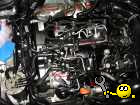
Hallo, mein Problem mit dem 2.0 TDI BRD (170 PS Katastrophenmotor; qualmt und stinkt und ruckelt im Leerlauf) hatte ich vor ein paar Monaten schon mal beschrieben. More details below.
Bisher hatte ich die Einspritzmengenabweichung nur im Meßwertblock angeschaut und daher mal die Düse des verdächtigen Zyl 3 gegen eine gereinigte gebrauchte getauscht. Nachdem das Ergebnis null war, kam ich dann doch mal drauf, eine Aufzeichnung mit graphischer Darstellung zu machen. Anbei zwei Schriebe: a) vom kalten Motor über 2 Minuten mit 2 eingestreuten Gasstößen: läuft recht sauber. Stia) Only mildly pungent (but still unusually strong).
b) 5 minutes later, still cold, the engine had momentarily stalled, direct hit!: severe idling instability, significant white smoke emission, extremely acrid odor.
Ein Grund für diese stark wechselnde Reaktion ist nach wie vor nicht erkennbar. Andere Daten (Ventilstatus, Luftmenge, Lambda, Förderdauer und –beginn, Schaltzeitabweichung) sind dabei stabil und aus meiner Sicht völlig unauffällig. Was aber klar auffällt: die zeitweise stark springenden Einspritzmengenabweichungen beschränken sich nicht nur auf einen Zylinder, sondern sind bunt verteilt. Kann das jemand näher interpretieren? Mir It lacks the necessary experience.
Meine Folgerungen: es kann sich nicht um einen PDE-Defekt handeln, weil alle 4 betroffen sind und die chwankungen immer sporadisch an allen auftreten. Die Ventile scheinen auf irgendeinen anderen Fehler mit einer Korrektur zu reagieren. Und der Qualm muß irgendwas mit dieser Fehlfunktion zu tun haben. Ich war früher schon mal in die Richtung unterwegs, daß dies kein Ventil- sondern ein Ölproblem sein könnte. AHowever, it doesn't noticeably consume oil (estimated at half a liter every 3000-5000 km), and when driving, there's nothing visible coming out the back, not even during acceleration, and certainly not in the headlights of the driver behind, where you would normally see everything clearly.
weitere Checks: PPDs hatte ich alle draußen, Dichtungen gecheckt, teilweise erneuert, Sitze sind neuwertig. Ich kann bestätigen, daß es bei diesen PiezoPDs wohl kein Problem mit Festsitz gibt. Die lassen sich leicht ziehen (obwohl der wohl schon ewig nicht in einer Werkstatt war). Alle 4 waren gleichmäßig verrußt, keins mit extremen Ablagerungen, obwohl natürlich alle verkrustet waren und nun halbwegs gereinigt wurden. Die Einstellschrauben habe ich auch nachgestellt, seitdem zieht er besser, aber das Leerlaufproblem hat sich nicht geändert. I also considered a problem with the valve timing, but the intermittent nature of the issue strongly suggests otherwise.
Hier nochmal eine Problembeschreibung: er läuft eigentlich kalt wie warm recht gut, wenn auch untenrum teilweise irgendwie etwas ruckelig. Leistung ist m.E. voll da. Im Leerlauf läuft er sehr oft recht unrund und dann fängt er teilweise extrem an zu stinken. „Normal“ riecht das Abgas nie! Aus dem Bauch raus würde ich sagen, das „Phänomen“ schwankt zwischen 20 und 100% nach Lust und Laune. Eine Korrelation zu Motor- oder Außentemperatur kann ich nicht erkennen. Es tritt both in short-distance traffic and after a fast drive on the highway, it would immediately drop again.
Spekulationen: Ich habe den Eindruck, daß der Kernmotor völlig i.O. ist, aber an der direkten Peripherie ein Einflußfaktor spinnt. Ein Defekt am AGR würde sich m.E. kaum merklich äußern. Mit einer evtl. nicht ganz öffnenden Drosselklappe wäre der kaum noch fahrbar und rußt immer (hatte ich an meinem Cabrio schon). Kühlwasser ist sauber und verbraucht er nicht. Öl auch nicht wirklich viel. Ein Problem mit der Kopfdichtung schließe ich daher auch fast aus. Außerdem müsste er dann unter Last eher mehr qualmen statt gar nicht. Ähnliches tippe ich für den Lader. Die Schläuche der Ladeluftstrecke habe ich mehrfach ausgewischt, da war immer etwas Öl. Beim lAfter traveling 2000 km, it only used a little bit of fuel.
Das Ruckeln heißt für mich z.B., daß er im Ladetrakt oder in den Brennraum irgendwas bekommt (Diesel oder Öl), was so in der Menge nicht sein soll. Öl in der Abgasseite des Laders würde zwar stinken, aber nicht zum Ruckeln führen. Oder ein zeitweise spinnender Sensor gibt falsche E-Mengen vor. Im Fehlerspeicher steht natürlich nichts! Aber solche Sensordefekte werden nur erkannt, wenn die Werte grob unplausibel sind. SFluctuations within the measurement range were only observed in rare cases, typically when the programmer was particularly skilled.
What other sensors/data should I log in addition to this?
I could technically replace all the pressure differential probes (PDPs) just to be sure, but that would be an expensive undertaking, and for the reasons mentioned above, I'm not convinced it's the solution. Does anyone have any other ideas? Surely someone else has encountered this problem before...
I suspect the unit for the fuel injection quantity deviations of the PD elements is mg/H. If all individual elements fluctuate almost between +2 and -2 mg/H, this does not indicate problems with the PD elements themselves, but rather that something may be loose in the rotating components of the engine, or that the actual fuel injection quantities are fluctuating significantly due to, for example, air (foam) in the fuel.
The latter can be ruled out if the engine reaches its full power output.
Too loose: Definitely check the timing belt, water pump, and all idler pulleys, as well as the ribbed belt and driven components. Don't forget to inspect the dual-mass flywheel.
Thank you for the tips. I also think it's not related to the fuel supply. I haven't looked closely at the mechanical components of the belt drive yet, but I still want to rule out the possibility that something is loose.
- It has now been running for several thousand kilometers without any issues. Any loose parts would likely become progressively worse over time.
- Also, eventually, noticeable noises would start to occur.
- and the phenomenon would always be similar or increasingly worse under comparable operating conditions. But often, it also runs relatively cleanly with not such a bad smell.
And the dual-mass flywheel should gradually deteriorate over time and not simply disappear suddenly. I've also seen this in a friend's TDI; it causes the entire car to shake – and it didn't produce any smoke as a result.
I've thought about it a lot again, and I'm back to where I was months ago (see post 29065): I believe the cause is still oil. However, I can't distinguish between partially burned diesel fuel and engine oil in the exhaust; I lack the reference point for comparison. The "normal" smell of oil fumes (from a gasoline engine) or diesel soot is definitely different.
Here's a theory I've developed:
- Occasionally, a mist of oil appears in the loading area, seemingly from somewhere.
- This burns unevenly as an additional "fuel," causing sporadic and irregular increases in idle speed, which the control system tries to compensate for, thereby generating the strange fluctuations in fuel quantity.
- This only happens when the engine is idling. However, that also means it's only happening at low boost pressure! It's possible that the "leak" stops leaking oil as the boost pressure increases. That would explain why nothing is noticeable while driving and why I'm not noticeably consuming any oil.
- The cause might not be a problem with the charger's bearing (which is what everything else suggests), but rather a malfunctioning oil return system on the shaft.
- The intermittent and sporadic nature of the issue could then be explained by fluctuations in boost pressure and oil pressure, as well as their interaction.
I had already removed and checked the return hose for any obstructions some time ago, because it's apparently a known issue. Are there possibly other bottlenecks at the outlet of the charger or in the channel on the engine block after the flange that could be blocking the return flow?
As I said: so far, it's all just a theory. But it would fit everything together quite well... And I don't have a better idea yet.
I appreciate any suggestions. Are there other measurements that would be useful to log? Any other ideas? Has anyone had specific experience with a blocked oil return line on the turbocharger (which is supposed to happen fairly often)? Have you experienced similar symptoms?
Does anyone have any specific experience with a clogged oil return line on the turbocharger (which is supposed to happen fairly often)?
Replacing the oil return pipe is quicker and cheaper than writing an entire dialogue about it. If you feel better doing it, go ahead, but I doubt that will solve the problem.
What is the mileage of your engine?
According to the odometer, it has 175,000 kilometers on it. Otherwise, there are no noticeable signs of age or wear.
I don't believe the hose itself is the problem. As I mentioned before, I already checked it to make sure it wasn't blocked. However, I'm not yet sure if there might be any other narrow sections either before or after it.
I also don't want to be fixated on the idea that the problem must come from this particular area. However, I haven't had a better idea yet, and I am open to other possibilities as well.
Even if you've already "ruled it out," please read about the dual-mass flywheel in this forum and check it. There might be more play than usual on the drive side.
Hello,
Thank you for your patience. However, unfortunately, the problem still persists.
"@Rainer: Thanks for the tip. Indeed, I'm experiencing symptoms related to the dual-mass flywheel. I wouldn't rule out wear and tear either. However, there must be another primary cause (see below)."
After finally having some time to look into it, I did a few tests. I would be quite certain that the significant fluctuations in fuel injection quantities are caused by "additional fuel" (oil mist). So, I disconnected the turbocharger hose before the throttle body/EGR valve (2.0 TDI BRD 170 hp) while the engine was warm. While it had been smoking noticeably at the traffic light just a few minutes earlier, the exhaust suddenly became almost odorless, and the idle stabilized.To further narrow down the cause of the crankcase ventilation issue, I disconnected the hose from the crankcase ventilation valve and reconnected the larger one. Still good! The membrane in the crankcase ventilation valve does indeed have a hole, but could that really cause so much oil? Also, it's concerning that I had the valve cover from my other TDI (which is running perfectly) on there three months ago, and it still smokes just as much.
So, I tested everything again yesterday under the same conditions, and unfortunately, I seem to have caught a "worst-case" time. Even though both hoses were disconnected, it was still smoking heavily, as you can see in the video.
However, I had forgotten that the EGR valve might be open. Could that much oil possibly pass through it? I need to test it further...
The strong backfire in the intake manifold was not initially noticeable during the first test. Where is this coming from? With a gasoline engine, I would say it's likely due to an overly rich fuel mixture...
And a problem with the hot side of the turbocharger doesn't match the idle fluctuations and backfires. The oil must already be present during combustion.
Then only internal causes remained. I would expect that one cylinder would be noticeably burning differently. But when I had the spark plugs removed 3 months ago, they were all equally dirty. It runs smoothly and cleanly during normal operation. And a problem with the head gasket should become significantly worse over such a long period of time, and also cause more noticeable blow-by during driving.
Does anyone else have any ideas?
Jumping fuel injection deviations: Interpretation? - Audi TDI 2,0 qualmt im Leerlauf; Ursache gesucht.mp4
At the very beginning of the video, you can see smoke coming out right below the intake hose. I mean, you have a serious mechanical problem with the engine. Are the PD elements really sealed and not dripping into the combustion chamber?
I'm just wondering how smoke could possibly come out of there and where it would be coming from.
Take a look at where that's coming from. The EGR pipe goes directly into the intake manifold; is everything sealed properly there?
Please always upload attachments directly to the thread instead of linking them.
Hello Rainer,
Unfortunately, it's not very clear in the video: the smoke is coming out of the intake manifold in bursts! Which shouldn't really happen, or are the valve overlaps that high? That also explains the strange sputtering noises. I put the hose back on while the engine was running, and then everything seems less severe, but it still runs unevenly with the smoke. As mentioned, the "spattering" wasn't noticeable during the first attempt (without smoke), it ran quite smoothly then.
"It definitely didn't come from the EGR valve or the block, etc. I would have noticed that."
Okay... Valve overlap, why don't you check the valve timing mechanism, hydraulic components, and valves if something is being pushed back out of the intake manifold on a diesel engine?
well, because...
- It's only happening intermittently. I'm not sure right now, but as far as I know, the engine doesn't have any variable valve timing mechanisms (like VANOS, etc.) in its valvetrain. Whatever is wrong there is either always wrong, or it's actually correct.
- and because the car otherwise drives normally. Major timing errors would be very noticeable while driving.
- and because the "spitting" only became visible last night.
- and even if the valve timing is incorrect, it unfortunately wouldn't explain why the engine is blowing out oil vapor.
It's certainly something that could be checked, but I wouldn't expect to find a major problem there (especially given the normal driving behavior). Therefore, I'm quite certain that the primary issue lies elsewhere – but where exactly?
and even if the valve timing is incorrect, it unfortunately wouldn't explain why the engine is blowing out oil vapor.
I didn't write anything about valve timing; rather, I listed the parts that I would check if a closed intake valve occasionally allows gases to back up into the intake manifold.
Hello Heating Oil Bomber,
Yes, I think I know more about it now. However, this was the only problem I couldn't completely fix/resolve on one of my cars in a very long time. The effort involved and the range of possibilities were simply too much for me (see below). I ended up selling it years ago as defective – and now, with the same model, I'm experiencing a similar issue, but at a significantly lower level.
Zurück zum Thema, das sicher immer noch viele betrifft: ich gehe davon aus, daß Deiner auch evtl. im Stand an der Ampel qualmt bzw zumindest aus dem Auspuff und auch im Innenraum stinkt? Das ist zumindest bei mir bei beiden so. Ganz sicher bin ich mir mittlerweile, daß dabei verstärkt Öl im Brennraum selbst verbrannt wird (nicht nur im Turbo heiße Seite). Denn immer dann ist auffällig, daß die Drehzahl schwankt. Das Öl bewirkt aus zusätzlicher ungewollter Treibstoff Drehzahlschwankungen. Dies The engine control unit is compensating for something and therefore constantly adjusts the idle injection volume.
Aber wo kommt es zur Leckage? Ich habe damals stundenlang im Internet gesucht und trotz einiger Beiträge von betroffenen keine einzige konkrete Lösung gefunden. Also scheint das Problem recht versteckt zu sein. Weder die angeblichen Probleme mit der Kurbelgehäuseentlüftung noch der Turbolader etc scheinen die Ursache zu sein. Ich kann mir derzeit 3 Ursachen vorstellen: 1. Haarrisse im Kopf zwischen Ölraum und Ansaugkanälen (diese 16V -Köpfe sollen für Risse anfällig sein). Selbst wenn ich den Kopf ausbaue und zerlege würde ich solche Risse nur sehr schwer erkennen können. Da bräuchte man ggfs ein CT, alles sehr aufwändig. Und selbst wenn ich einen Riss fände wäre der je nach Lage evtl nicht für eine Reparaturschweißung erreichbar. 2. Die Koppoetry betweenIn oil pressure drilling and combustion chamber. This might be identifiable after disassembly. Or, 3. the cold side of the turbocharger. This is also unlikely and difficult to detect. Furthermore, according to several reports, replacing the turbocharger has not resolved the problem.
If anyone has now definitively identified this phenomenon, which is likely quite common, please report it.
It should be noted that the amount of oil involved is likely very small. My current vehicle doesn't show any noticeable oil consumption, although it does have a strong odor and hasn't started smoking yet. Even with my previous car, the oil consumption was visible, but not excessive (less than 0.3 liters per 1000 km).
Good luck!


 Bookmarks
 Links
Links Garage
 FAQ, Legal Notice & Privacy
 RSS Feed
 Register
 Login
Login