| Author |
Message |
Jens 16syncro
Joined: 09/16/2002
Posts: 469
Karma: +2 / -3 
Premium Support
|
 22-08-2018, 9:28 Subject: Garrett 2052: Run Turbocharger Without Water Cooling 22-08-2018, 9:28 Subject: Garrett 2052: Run Turbocharger Without Water Cooling |
Quote |
|
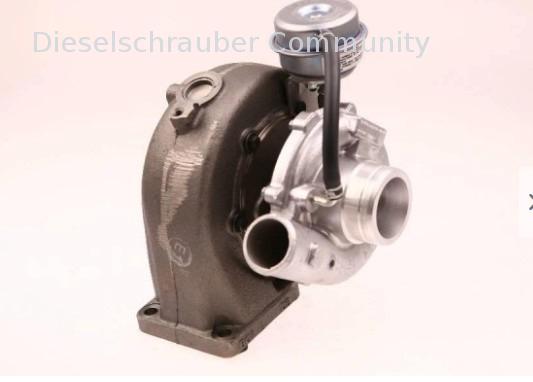
Given a turbocharger manufactured by Garrett, specifically the GT 2052 VW model.
which is equipped with a water-cooled turbine housing.
Specifically, in the designated facility, the turbine casing is flushed with cooling water (see image).
What happens if there is no water cooling connected? Since the turbine housing has a double wall, it acts like thermal insulation. The housing can probably dissipate heat less effectively than with conventional single-walled, uncooled turbochargers.
The housing itself does not have a water jacket, unlike, for example, the water-cooled turbocharger K14 found in the Golf 2 with an SB engine.
Does the turbocharger damage itself through overheating if there is no water cooling system?
Could one simply use air, instead of water, and force it through the housing using an electric fan motor?
Or even simpler:
Replace the turbine housing with one from a similar turbocharger, specifically the GT2052V for LT2 engine code ANJ, Volkswagen part number 074 145 701 D.
Inside the turbine housing are the adjustable guide vanes. However, I would initially assume that they are all the same in GT2052V turbochargers, regardless of the minor differences in housing shape depending on the installation location.
The GT2052V has been and continues to be used in a wide variety of car models from many different manufacturers.
| Description: |
| Garrett 2052: Run Turbocharger Without Water Cooling |
|
| File size: |
24.04 KB |
| Viewed: |
1005 times |
|
Translated on 08-08-2026, 12:38.
|
|
| Back to top |
Profile PM |
 |
dleds
Joined: 04/16/2014
Posts: 40
Karma: +14 / -1
Premium Support
|
| 02-09-2018, 12:17 Subject: Garrett 2052: Run Turbocharger Without Water Cooling |
Quote |
|
Generally, you can determine whether a component is a special marine part, a standard production item, or a modified version by looking at the part number/parts list of the hull assembly. This also clarifies whether the exhaust housing is replaceable.
"Air cooling is theoretically possible, but the same amount of heat needs to be dissipated, which would require approximately 1000 times the volume... The casting material used for the housing will likely be different because a certain level of corrosion resistance is needed (whether it's cooled with seawater or coolant makes a difference), while the temperature resistance can be lower."
Like all VW marine parts, this charger will be very expensive. It would be more economical to simply find a suitable air-cooled one instead.
Translated on 08-08-2026, 12:41.
|
|
| Back to top |
Profile PM |
|
matthiasTDI96
Profi-Schrauber

Joined: 02/27/2003
Posts: 5886
Karma: +251 / -0
Premium Support
dieselschrauber likes this. |
| 03-09-2018, 9:04 Subject: Garrett 2052: Run Turbocharger Without Water Cooling |
Quote |
|
What's the downside of using a turbocharger (complete unit) directly without water cooling?
Operating a water-cooled housing without any water would be completely pointless. The coolant rarely exceeds 90°C. Just consider what happens due to thermal expansion at that higher temperature. Also, the material (regardless of the type) will inevitably be thinner. Sometimes, engineers actually think things through, even if that's often questioned in this context.
Translated on 08-08-2026, 12:42.
|
|
| Back to top |
Profile PM |
|
Jens 16syncro
Joined: 09/16/2002
Posts: 469
Karma: +2 / -3
Premium Support
|
| 04-09-2018, 12:03 Subject: Garrett 2052: Run Turbocharger Without Water Cooling |
Quote |
|
So, I managed to get a used GT2052V turbocharger for the LT2 engine with code ANJ, VW part number 074 145 701 D, for just €110.
Allegedly, the vehicle has only 30,000 km on the odometer, but such claims should always be taken with a grain of salt. However, the turbocharger housing is completely free of rust, meaning it's still in its original cast color. This suggests that the turbocharger hasn't seen much use.
I will then convert it to a pressure can control system  .
Let's see how well I can do this.
The original turbocharger cartridge from the VW Marine Turbo is something Garrett won't release, so there's no way to obtain it through normal replacement parts channels.
"Someone would have to get that directly from the factory."
Translated on 08-08-2026, 12:44.
|
|
| Back to top |
Profile PM |
|
Jens 16syncro
Joined: 09/16/2002
Posts: 469
Karma: +2 / -3
Premium Support
|
| 11-09-2018, 9:15 Subject: Garrett 2052: Run Turbocharger Without Water Cooling |
Quote |
|
I actually managed to "free" a dusty (but unused!) GT 2052 VW from a turbocharger dealer's shelf for a very small price  .
Soon I will have both turbos in the basement.
As soon as I have the GT 2052 VW, I want to characterize the pressure sensor, i.e., record its relevant performance curve.
What's the best way to do this? Do you miss the pressure vessel when it's removed? Actually, yes, right?
I would like to record a series of measurements showing the relationship between input pressure and the extension distance of the piston rod (measured without any counterforce applied to the piston rod).
I need to figure out how to safely generate pressure in increments of 0.1 bar.
Perhaps it would also be useful to determine the opposing force in addition to the travel distance (which would exist without any opposing force).
That is, I would measure the counter-force on the pressure rod (in Newtons) and correlate it to the applied pressure on the membrane sensor.
Does anyone have any other suggestions regarding measurement methods and practical implementation?
Translated on 08-08-2026, 12:47.
|
|
| Back to top |
Profile PM |
|
dleds
Joined: 04/16/2014
Posts: 40
Karma: +14 / -1
Premium Support
|
| 27-09-2018, 17:37 Subject: Garrett 2052: Run Turbocharger Without Water Cooling |
Quote |
|
Hi there,
What benefit would a characteristic curve bring you? A bar graph showing distance versus time will be of little use to you, just as a bar graph showing force versus time will be.
The timing of when the wastegate opens depends on factors such as the diameter of the wastegate valve (which determines the resulting force of the exhaust gases), the lever arm, the current spring preload (as the component heats up and ages), the pressure acting on the diaphragm, and mechanical losses. Additionally, there may be pressure losses from the pressure source, but this is likely not relevant here since the pressure is being taken directly from the turbocharger and not, for example, from the intake manifold.
It gets even more complicated... A water-cooled system like this also has a water-cooled exhaust manifold, which results in lower exhaust gas temperatures. These lower exhaust gas temperatures lead to different back pressures (due to the smaller volume). This results in higher power output at the same boost pressure, but also poorer throttle response.
"...but those are all theoretical approaches; what exactly do you want, or where is the problem specifically?"
Translated on 08-08-2026, 12:49.
|
|
| Back to top |
Profile PM |
|
|


 Bookmarks
 Links
Links Garage
 FAQ, Legal Notice & Privacy
 RSS Feed
 Register
 Login
Login
