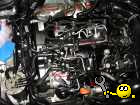
I'm having a problem with my Golf 4 ARL: after 30,000 km, the new camshaft is showing significant signs of wear.
However, these appear to be low on oil. I then started the engine without the valve cover and observed that the camshaft for the direct injection system was very well lubricated, but the camshaft lobes for the valve actuation remained practically dry.
Subsequently, I measured the oil pressure, which was 4.5 bar at the oil filter housing and 3.5 bar at the cylinder head when the engine was cold and idling.
Then, I quickly removed the camshaft so I could take a closer look at everything. In the process, I noticed that the copper-colored layer was already visible on all of the lower bearing shells. Furthermore, the first hydro stage is much easier and more compressible than the others, which may explain the ticking sound that it had started making sporadically a few hundred kilometers before it broke down.
I only saw the oil pressure fittings on the lower bearing supports, those that connect to the rocker arms and the hydraulic system. When I turn the engine over with the camshaft removed using the starter, you can see the oil flowing to the fourth cylinder. The cylinder begins to move and gradually progresses towards the first cylinder, exiting through all the bores in the process.
Now, my question is, how exactly are the running surfaces of the pistons and the camshaft supposed to be lubricated? That's how a warranty claim for a new camshaft currently looks.
My idea is that the oil from the bearing journals of the camshaft should flow out to the left and right, and then onto the hydraulic lifters to lubricate the contact surface. Alternatively, it can drain through the valve cover, but this would be a very small amount.
However, the question is why no oil is reaching the engine if there's supposedly enough oil pressure and all the channels are clear. As far as I know, I haven't experienced any oil dilution. I had an oil analysis done about 20,000 km ago. The proportion of diesel was very small.
"Back then, I replaced the wave ring, the hydraulic components, and the bearing shells. As far as I can tell, I installed everything correctly. All the parts were from INA." It's actually a pretty good manufacturer.
I would be grateful for any help, as I don't quite understand it.
Hi,
The lubrication of the main bearing journals is achieved through the holes in the bearing housings. The excess oil then flows into the space between the cylinder head and the valve cover, where it lubricates the camshaft and the contact surfaces of the hydraulic lifters. The water is pumped in through boreholes drilled in the sidewall.
Are the NW bearings possibly too tight?
Are the oil drilling operations in the ZK area continuous? Ideally, during start-up attempts, the oil should be immediately forced out of the bearing housings, or even spurt out.
hg
Herbert.
Horch A4 8K CJCD
Golf 7 DDYA
(+ Audi 80 Avant B4 1Z 475Tkm - habe ich vom ersten bis zum letzten Tag gerne gefahren)
(+ Passat Variant 32B CY 400Tkm)
Okay, that's good to know. So my assumption was correct. Now the question is why nothing comes out when I try to use the side [feature/port/etc.]. The bearing shells are already quite tightly fitted in the bearing bracket.
Here's a video in the attachment showing the engine running without the camshaft. You can see where the oil is coming from. It's also clear that the camshaft bearings are the last to receive oil. On the other hand, everything is open, which is why it's difficult to build up any real pressure there. You can also see the worn bearing shells (which have 30,000 km on them).
I will reassemble everything again tomorrow. This time, I will install new bearing shells and an old hydro (from the original camshaft) because one of them seems to be faulty. And then we'll see how things look after the party.
How is the camshaft lubricated in a 1.9 TDI pump-injector engine? - Öldruck-Nockenwelle-TDI-Aufbau.mp4
Description:
How is the camshaft lubricated in a 1.9 TDI pump-injector engine?
The slow bubbling suggests a significant blockage, leaks elsewhere where a lot of lubricant is being lost, or insufficient pressure buildup in the pump.
Was the oil pressure already measured at the oil pressure switch during startup?
Does the oil pump have a drive shaft that is too short, connected via a hexagonal shaft to the balancer shaft (causing it to rotate freely at some point)?
Please provide the text you would like me to translate from German to English. I will only provide the translation, without any explanations.
Okay, I'm ready. Please provide the German text you want me to translate.
Oil pressure at startup (with PDE disconnected) is 1.9 bar with a cold engine. So, the measurement was taken only on the oil filter housing using the starter.
Cold reading at the oil filter housing: 4.5 bar.
Cylinder head temperature: 3.5 bar.
I don't have any visible oil leaks, at least not on the outside.
I am aware of the oil pump issue you described, but is it installed in the same way in my (1.9 TDI ARL) engine? Do the 1.9 engines have an oil pump module with that rounded hexagonal shape?
Yes, the oil is coming from the screw holes in the camshaft bearing caps. However, I believe it's correct because the screws are connected to the oil channel. When the screws are tightened, the holes are sealed. And the oil won't come out anymore.
Oil pressure at startup (PDE disconnected) is 1.9 bar with a cold engine. So, the measurement was taken only on the oil filter housing using the starter.
Cold reading at the oil filter housing: 4.5 bar.
Cylinder head temperature: 3.5 bar.
I don't have any visible oil leaks, at least not on the outside.
I am aware of the oil pump issue you described, but is it installed in the same way in my (1.9 TDI ARL) engine? The 1.9 engines don't have an oil pump module with the rounded hexagonal shape, do they?
I would describe the oil pressure as okay, sorry, I had overlooked the ARL. He is definitely not affected by the oil pump drive problem.
Are there any oil leaks elsewhere, or is it just a blockage? Otherwise, isn't the engine supposed to lose oil from somewhere else? What seems a little strange to me is that the oil is coming from the last bearing position, even though the starting process should already be complete. Maybe it's just my impression. But if it were the case that the oil flows back upwards with a delay, it could mean there's air trapped somewhere in the oil system. Perhaps the oil filter cap draws in air when the engine is off, and then the oil filter runs empty?
No matter what, maybe try playing the organ for a longer time. At the very least, after 20 seconds (?), the oil filter should be full, and the oil should be coming out of the top of the valve cover with proper pressure.
I'm going to quickly reattach the shelf supports tomorrow. That will cover up the huge hole where the oil is leaking from. I think the oil is shooting out from there when the larger holes are blocked. Now all the pressure is just gone.
If it works out, I might just quickly reassemble the camshaft without replacing the lifters. If no valve is operated, it works without any problems.
Okay, here's a summary. I'm at a loss now.
Volkswagen Golf 4, 1.9 TDI, ARL engine (150 hp).
Camshaft worn after 30,000 km, lifters severely damaged, and copper visible on the bearing shells. Insufficient lubrication of the camshaft, which actuates the valves, while the engine is running.
All oil passages are clear, and oil is flowing everywhere.
There are plugs inside the pivot lever shaft.
Clean oil filter.
No oil leaks.
No thinning required.
Engine oil pressure at cold idle:
4.5 bar at the oil filter housing.
Cylinder head pressure: 3.5 bar.
Starter motor not engaging, 1.9 bar.
"Of course, I didn't measure the oil pressure before disassembling it. But I don't want to put everything back together with the old bearings. The new ones are arriving on Monday. For now, I'll reassemble the current shaft and hydraulic lifters until the oil problem is resolved." Let's see how long it runs smoothly after that.
Today, I checked out another 1.9 TDI engine, and there's a lot of gunk buildup under the valve cover. It's not that bad for me.
He only has an oil pressure regulating valve in the oil filter housing, and that only limits the maximum oil pressure. I saw a spring at the bottom of the oil pump, so there's also a valve in there. I'm already thinking about installing a new oil pump to try it out. But original VW parts are too expensive for me, and the only reputable aftermarket brand is Vaico. I've had problems with them before.
But there is oil pressure. 3.5 bar at the head should be enough to push the oil out of the camshaft bearings and onto the hydraulic lifters.
What is the probability that something from the Ina set of camshaft bearing shells will not fit properly and be the cause of the problem?
"It's not possible that no oil is coming out, even though there's pressure. When the camshaft is removed, oil comes out of all the oil pressure holes."
I really like the car, especially the engine, but I'm so close to the point where I'm going to lift it up with a forklift and put it in a scrap metal container.
Hi,
"I'm having trouble with your video on my computer; I can only open it sporadically. The oil flow was perfect, like clockwork." Something seems to be wrong with the oil pressure in the cylinder head.
hg
Herbert.
Horch A4 8K CJCD
Golf 7 DDYA
(+ Audi 80 Avant B4 1Z 475Tkm - habe ich vom ersten bis zum letzten Tag gerne gefahren)
(+ Passat Variant 32B CY 400Tkm)
Hi,
"I'm having trouble with your video on my computer; I can only open it sporadically. The oil flow was perfect, like clockwork." Something seems to be wrong with the oil pressure in the cylinder head.
hg
Herbert
Okay, I meant that it's correct because the storage locations are, after all, open. Normally, the camshaft and rocker arm shaft are still mounted there.
The oil pressure here is, of course, only that of the starter motor's speed, not the running engine. The oil pressure, measured at the top of the engine, was 3.5 bar when the engine was cold and idling.
I can also send you the video privately again. Sure, here is the translation of the text from German to English:
"In case of doubt, please provide a Google Drive link."


 Bookmarks
 Links
Links Garage
 FAQ, Legal Notice & Privacy
 RSS Feed
 Register
 Login
Login