| Author |
Message |
Thomas
Profi-Schrauber

Joined: 04/17/2002
Posts: 329
Karma: +2 / -0 
Location: Darmstadt
Support
|
 09-01-2004, 20:24 Subject: Fuel injection pumps and tuning (larger displacement plungers) 09-01-2004, 20:24 Subject: Fuel injection pumps and tuning (larger displacement plungers) |
Quote |
|
Hello,
Lately, I've been reading repeatedly about rebuilt fuel injection pumps.
10mm pistons on 11mm or even 12mm.
In addition, you can now find offers like these on eBay.
But what is the real truth?
With only a few exceptions, so far, only "Boa-Ey" nonsense and outrageous horsepower exaggerations have been seen.  (Just like in the eBay auction).
Here too, there have been occasional writings about it, but it has never really been discussed.
I would really like to know the opinion of the pump experts.
Performance specifications are currently of little importance to me.
I've already inquired with and gathered information from a few people beforehand, but I think it would be great to break down the topic here.
I would really be happy if something came of it. 
Greetings.
Thomas. -----------------------------------------------------
Golf 3 TDI AFN Bj. 1997 -verkauft
Audi S2 ADU Bj. 1993
Polo 86c 2F 1W Bj. 1994 - verkauft
Audi A3 TDI ASZ Bj. 2001
Translated on 03-07-2026, 15:19.
|
|
| Back to top |
Profile PM |
 |
ulf
Profi-Schrauber
Joined: 04/13/2002
Posts: 11058
Karma: +18 / -0
Location: Saarland
2023 MG ZS
Premium Support
|
| 10-01-2004, 12:51 Subject: Re: Fuel injection pumps and tuning (larger displacement plungers) |
Quote |
|
Hi Thomas,
Before anyone else answers, here are my thoughts on the matter:
1. The pump's flow rate is increased by 21% or 44%, respectively (using 11 mm or 12 mm pistons instead of 10 mm).
This also applies to the idle speed, which can again lead to jerky driving.
2. (Edit)
The resulting injection pressure places a higher load on the distributor piston, proportional to the increase in surface area. This means that, with the same injection pressure, the driving forces increase by 21% or 44%, respectively, and all of this is transmitted, among other things, via the timing belt and the camshaft and its associated components.
Not only that: The increased flow rate (volume/time) will create a stronger back pressure effect in front of the unchanged nozzle openings, meaning that the injection pressure will increase and the atomization will be improved.
This also results in a higher load on the entire high-pressure system (pump, injection lines, and injectors), and a "second additional load" on the power transmission path between the crankshaft and the distributor piston, including. Timing belt failure can have serious consequences.
For example, the stresses that are normally only observed at 4000 rpm could potentially occur as early as 2500 rpm (rpm values are arbitrarily chosen).
At first glance, this doesn't seem too bad, because the system is designed to handle the continuous loads at 4000 rpm. But, in my opinion, at the very least, in the early stages of cavitation, a material stress will occur that is definitely unattainable with a standard pump piston.
As a result, a timing belt that may already be damaged could fail more quickly due to a larger pump impeller, with the well-known and expensive consequences for the engine...
To reduce the pressure-related stress, IMO only larger nozzles can help (which again provides additional power, as long as enough air gets into the cylinders) - or a software-based reduction of the boost pressure.
3. With unchanged nozzles, the higher injection pressure will increase the flow losses on the way to the cylinder (-> specialized article on nozzle tuning), so that the cylinders will not receive the full additional amount (which is pumped) that is intended.
Conclusion:
Especially considering the "double load" on the power transmission system between the crankshaft and the distributor piston, including... "To me, a timing belt modification seems like a major tuning adjustment (that actually reduces material stress instead of increasing it!) and is definitely safer than a piston modification. And both are fundamentally illegal (so it doesn't really matter anyway)."
@ Pump experts:
Corrections and additions are, as always, welcome and desired  . Gruß Ulf
_________
MG4 Electric
Translated on 03-07-2026, 15:19.
|
|
| Back to top |
Profile PM Garage |
|
Frank A.
Blaumann

Joined: 02/24/2003
Posts: 66
Karma: +6 / -0
2000 Volkswagen Golf
Free account, no CAN development support
|
| 12-01-2004, 17:21 Subject: Fuel injection pumps and tuning (larger displacement plungers) |
Quote |
|
Hello,
I want to preface this by saying that I don't consider myself a pump expert (which is something I haven't been addressed about in this thread  ).
Regarding the feared and undoubtedly existing increased stress on the pump, injectors, etc., I'm thinking of the ALH engine with an automatic transmission. It has the 11mm pump head and the small injectors (0.158, if I remember correctly). That already represents a significant additional load from the factory, without the need to shorten the maintenance intervals, such as the timing belt interval. Or are there perhaps known instances of frequent failures in the ESP (Electronic Stability Program) or other components when using this combination?
The question is whether the increased workload is really that significant.
Generally, I can imagine that this kind of "pump tuning" could have the effect of...
increased the size of the injectors (delivering more fuel in the same amount of time) even further. The question is, at what point (of extreme) performance gain does it really become necessary, and when can it be done without it?
The corresponding software (see "stuttering tendency") probably won't work either.
But I've also thought about it before... 
Best regards, Frank. '00 G4 ALH 170tkm , 11mm Pumpe, GGU-Getriebe
Translated on 03-07-2026, 15:19.
|
|
| Back to top |
Profile PM Garage |
|
Arne
Guest
Free account, no CAN development support
|
| 12-01-2004, 17:42 Subject: Fuel injection pumps and tuning (larger displacement plungers) |
Quote |
|
My friend has two cars that are running on a 12mm piston.
I don't have much to say about them, except that they also had the 216 injectors installed.
and a T19 turbocharger, plus a custom chip. One car is an A4, and the other one is a...
Corrado, if I remember correctly. It turned out that they were actually being tested.
Just over 200 horsepower.
He hasn't mentioned any issues like stuttering or other problems, just that it provides a significant performance boost. And that's true when he says it.
Just wondering if it's really durable...
Regards,
arne
Translated on 03-07-2026, 15:19.
|
|
| Back to top |
|
|
ulf
Profi-Schrauber
Joined: 04/13/2002
Posts: 11058
Karma: +18 / -0
Location: Saarland
2023 MG ZS
Premium Support
|
| 12-01-2004, 19:06 Subject: Fuel injection pumps and tuning (larger displacement plungers) |
Quote |
|
Frank A. wrote: | Regarding the feared and undoubtedly existing increased load on the pump, injectors, etc., I think of the ALH engine with automatic transmission. It has the 11mm pump head and the small injectors (0.158, if I remember correctly). There is already a significant increased load from the factory without the maintenance intervals, such as the timing belt interval, being shortened. Or are there perhaps known instances of frequent failures in the ESP (Electronic Stability Program) or other components when using this combination?
The question is whether the extra workload | really matters that much.
Hi Frank,
Your thoughts are probably correct.
Unfortunately, we lack sufficient knowledge about the design limitations of the power transmission system between the crankshaft and the distributor piston to make reliable quantitative statements.
Regarding the automatic ALH, a comparison of the aforementioned powertrain, including... ZR with the shift-ALH is interesting... Gruß Ulf
_________
MG4 Electric
Translated on 03-07-2026, 15:19.
|
|
| Back to top |
Profile PM Garage |
|
donalexo
Profi-Schrauber
Joined: 01/09/2003
Posts: 695
Karma: +0 / -0
Location: Würzburg
Support
|
| 12-01-2004, 20:58 Subject: Fuel injection pumps and tuning (larger displacement plungers) |
Quote |
|
Hello everyone!
Superficially, tuning the fuel injection pump plunger in conjunction with stock injectors would likely have a similar effect on the fuel injection volume as combining a standard pump plunger with larger injectors.
Regarding the component stress, I still consider the 11mm piston to be non-critical, as it is also standardly used in the ALH automatic transmission (as has already been mentioned).
Gremlin can probably add more details, as he's known to have the ALH automatic transmission with the larger fuel pump.
In such a case, I would make sure that these Z-axis travel intervals are never exceeded, as the Z-axis load would naturally increase. However, it is likely still within the acceptable tolerance range.
When used with larger nozzles, the stress is actually reduced slightly, so it may be possible to talk about near-standard stress levels for the Zylinderruck (ZR) engine. Of course, the engine itself will be subjected to significantly higher stress, as the injection volume increases considerably due to the combination of these two measures. And without increasing the boost pressure, so much diesel simply cannot be burned, which would necessitate more extensive modifications (such as reducing the compression ratio, etc.).
However, to briefly revisit the "simpler" tuning option, which relies on the stock injectors and a larger pump plunger. I can imagine that this combination would work very well (almost as well as larger injectors), with the added benefit of even better fuel atomization. This should further reduce the risk of excessive particle formation compared to using large nozzles.
Regards,
Alex.
AUDI A3 1.9 TDI, EZ 12/96, ursprüglich MKB AGR, umgebaut zum AHF mit GT1749V-Lader, verkauft mit 250tkm
Golf 4 1.9 TDI, EZ 1/98, MKB ALH, jetzt auch mit GT1749V-Lader, verkauft mit 300tkm
Touran 1.9 TDI, EZ 09/2004
Audi A4 Avant 2.0 TDI, EZ 03/2010
Translated on 03-07-2026, 15:19.
|
|
| Back to top |
Profile PM |
|
Thomas
Profi-Schrauber
Joined: 04/17/2002
Posts: 329
Karma: +2 / -0
Location: Darmstadt
Support
|
| 13-01-2004, 1:25 Subject: Fuel injection pumps and tuning (larger displacement plungers) |
Quote |
|
Hello,
First of all, thank you for your opinions.
Quote: | Not only that: Due to the increased flow rate (volume/time), a stronger back pressure effect will develop in front of the unchanged nozzle bores, meaning that the injection pressure increases and the atomization is improved.
|
That was my main thought when writing this story. The pressure for better atomization can probably never be high enough. Since we are clearly reducing the pressure with these large nozzles, that would likely be a way to compensate for the pressure loss.
At least, that's the idea.
@arne
Quote: | My friend has 2 cars running with a 12mm piston.
I don't have much to say about it, except that they also installed the 216 injectors.
and a T19 turbocharger, plus a custom chip. One car is a Volkswagen Golf (A4) and the other one is a...
Corrado, if I remember correctly. It turned out that they were actually being tested.
Just over 200 horsepower.
He hasn't mentioned any issues like stuttering or other problems, just that it provides a significant performance boost. And that's true when he says it.
Just wondering if it's really durable...
|
If you're referring to Stefan from Digital-Racing.de, I've tried to talk to him about it. Unfortunately, I cannot consider him a reliable source of information, as other interests appear to be taking precedence.
Quote: | To briefly discuss the "simple" tuning stage again, which relies on standard injectors and a larger pump plunger. I can imagine that this combination works very well (almost as well as larger injectors), with the added benefit of even better fuel atomization. This should further reduce the risk of excessive particle formation compared to using large nozzles.
|
I once chatted with a Bosch employee who mentioned that the conversion itself shouldn't be a problem. However, it is supposedly prone to idling problems and excessive black smoke.
I wonder how he came up with that? Unfortunately, he hasn't replied to my email.
Furthermore, the alignment is likely also a problem. When you loosen the pump head and move it, you should mark the original position as described in the technical article. But how do you do that if there's no marking present?
Greetings.
Thomas. -----------------------------------------------------
Golf 3 TDI AFN Bj. 1997 -verkauft
Audi S2 ADU Bj. 1993
Polo 86c 2F 1W Bj. 1994 - verkauft
Audi A3 TDI ASZ Bj. 2001
Translated on 03-07-2026, 15:19.
|
|
| Back to top |
Profile PM |
|
Gremlin
Guest
Free account, no CAN development support
|
| 13-01-2004, 10:43 Subject: Fuel injection pumps and tuning (larger displacement plungers) |
Quote |
|
Furthermore, the alignment is likely also a problem. When you loosen and move the pump head, you should mark the original position as described in the technical article. But how do you do that if there's no marking present?
Greetings.
Thomas
You must have a awl or a nail, right?
@donalexo
I don't have much to say about that. The automatic ALH also has a timing belt interval of 120,000 km.
The load is certainly much higher than in the standard 66kW version, but by how much?
Perhaps the specialists in specific parts could compare the ZR models with each other. Unfortunately, I don't have any PD engines listed.
CU Gremlin.
Translated on 03-07-2026, 15:19.
|
|
| Back to top |
|
|
Thomas
Profi-Schrauber
Joined: 04/17/2002
Posts: 329
Karma: +2 / -0
Location: Darmstadt
Support
|
| 13-01-2004, 11:03 Subject: Fuel injection pumps and tuning (larger displacement plungers) |
Quote |
|
Morning!
Oh no! I don't know how I'm supposed to do this without a marking, because I can't make any markings on a new upper pump part. That's what was meant.
"If you remove the upper pump housing, you can mark it beforehand and largely reattach it in its original position."
But if you have a new part, that won't work, so how am I supposed to do it then?
But why is the load higher? Simply put, if I install larger nozzles, the load decreases. If I increase the size of the pump piston, the load increases again... although the exact intensity is uncertain. Does the load then exceed the standard level significantly, or is the load reduced only slightly by using larger nozzles?
Greetings.
Thomas. -----------------------------------------------------
Golf 3 TDI AFN Bj. 1997 -verkauft
Audi S2 ADU Bj. 1993
Polo 86c 2F 1W Bj. 1994 - verkauft
Audi A3 TDI ASZ Bj. 2001
Translated on 03-07-2026, 15:19.
|
|
| Back to top |
Profile PM |
|
Frank A.
Blaumann
Joined: 02/24/2003
Posts: 66
Karma: +6 / -0
2000 Volkswagen Golf
Free account, no CAN development support
|
| 13-01-2004, 11:13 Subject: Fuel injection pumps and tuning (larger displacement plungers) |
Quote |
|
Hi,
You might be talking about two different things. When the discussion in this forum was about markings, it mentioned the pump cover and its exact position.
The pump head (or high-pressure part) is not adjustable in its position, at least in my opinion, and I don't think a marking is necessary there.
Best regards, Frank.
P.S. Please don't throw stones at me if I'm wrong...
'00 G4 ALH 170tkm , 11mm Pumpe, GGU-Getriebe
Translated on 03-07-2026, 15:19.
|
|
| Back to top |
Profile PM Garage |
|
Thomas
Profi-Schrauber
Joined: 04/17/2002
Posts: 329
Karma: +2 / -0
Location: Darmstadt
Support
|
| 13-01-2004, 11:39 Subject: Fuel injection pumps and tuning (larger displacement plungers) |
Quote |
|
Hi,
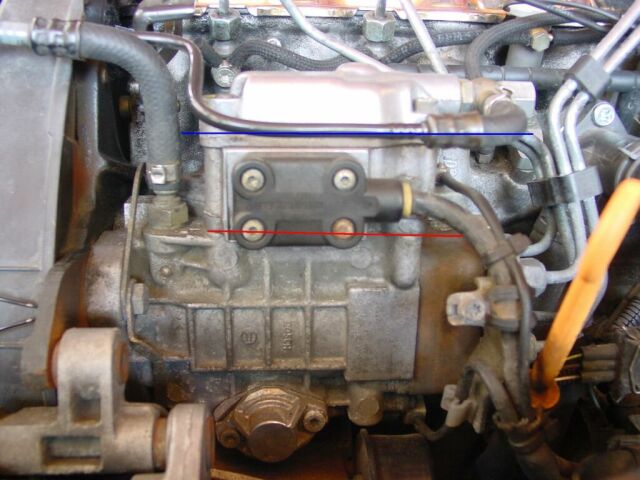
I mean the part above the red line. Do you mean the lid above the Blue one?
Greetings.
Thomas.
| Description: |
| Fuel injection pumps and tuning (larger displacement plungers) |
|
| File size: |
54.64 KB |
| Viewed: |
34316 times |
|
-----------------------------------------------------
Golf 3 TDI AFN Bj. 1997 -verkauft
Audi S2 ADU Bj. 1993
Polo 86c 2F 1W Bj. 1994 - verkauft
Audi A3 TDI ASZ Bj. 2001
Translated on 03-07-2026, 15:19.
|
|
| Back to top |
Profile PM |
|
Frank A.
Blaumann
Joined: 02/24/2003
Posts: 66
Karma: +6 / -0
2000 Volkswagen Golf
Free account, no CAN development support
|
| 13-01-2004, 11:54 Subject: Fuel injection pumps and tuning (larger displacement plungers) |
Quote |
|
hi,
"So, the pump head, where the plunger runs, is that rusty part on the right side of your picture, where the fuel injection lines come out."
Can someone confirm this?
Frank.
'00 G4 ALH 170tkm , 11mm Pumpe, GGU-Getriebe
Translated on 03-07-2026, 15:19.
|
|
| Back to top |
Profile PM Garage |
|
dieselschrauber
Administrator

Joined: 04/12/2002
Posts: 18096
Karma: +799 / -0
Location: St.Gallen
2018 Volkswagen T6 
|
| 13-01-2004, 12:17 Subject: Fuel injection pumps and tuning (larger displacement plungers) |
Quote |
|
Yes, the rusty part on the right is the pump head.
Between the lines, there are track switches and speed control devices.
Best regards, Rainer.
Translated on 03-07-2026, 15:19.
|
|
| Back to top |
Profile PM WWW Garage |
|
donalexo
Profi-Schrauber
Joined: 01/09/2003
Posts: 695
Karma: +0 / -0
Location: Würzburg
Support
|
| 13-01-2004, 13:22 Subject: Fuel injection pumps and tuning (larger displacement plungers) |
Quote |
|
Hello Thomas!
Quote: | | I once exchanged a few bars with a Bosch employee who mentioned that the conversion itself shouldn't be a problem. However, it is supposedly prone to idle problems and excessive black smoke. |
I can imagine the issue with the idling problems, because the idle speed control will now have a much harder time precisely metering this small amount of fuel injection. Due to the increased surface area of the pump piston, even the slightest adjustment to the flow control mechanism has a proportionally greater effect on the flow rate.
I'm not sure how delicately the suspension system operates in the area around the zero-travel point. If it tends to deviate from the zero position, it can cause significant problems with the idle speed control.
Black smoke should not occur when making moderate modifications, such as changing from a 10cc to an 11cc piston. However, when upgrading to a 12cc piston, the excess air or oxygen will almost certainly no longer be sufficient to completely burn the increased amount of fuel. Then the boost pressure needs to be increased.
Regards,
Alex. AUDI A3 1.9 TDI, EZ 12/96, ursprüglich MKB AGR, umgebaut zum AHF mit GT1749V-Lader, verkauft mit 250tkm
Golf 4 1.9 TDI, EZ 1/98, MKB ALH, jetzt auch mit GT1749V-Lader, verkauft mit 300tkm
Touran 1.9 TDI, EZ 09/2004
Audi A4 Avant 2.0 TDI, EZ 03/2010
Translated on 03-07-2026, 15:19.
|
|
| Back to top |
Profile PM |
|
Arne
Guest
Free account, no CAN development support
|
| 13-01-2004, 13:31 Subject: Fuel injection pumps and tuning (larger displacement plungers) |
Quote |
|
@Tomas,
Yes, I've read it. I don't personally know Steffan, but I can imagine that he is...
Tuners don't really like to reveal all the details about their work - after all, they probably want to keep some secrets for themselves.
to make money from it - and if you eventually start relying on it for your daily living. Bread is earned (maybe?).
I'm definitely curious to see how long it lasts!
Regards,
arne
Translated on 03-07-2026, 15:19.
|
|
| Back to top |
|
|
Thomas
Profi-Schrauber
Joined: 04/17/2002
Posts: 329
Karma: +2 / -0
Location: Darmstadt
Support
|
| 13-01-2004, 23:43 Subject: Fuel injection pumps and tuning (larger displacement plungers) |
Quote |
|
Hi,
Okay, now I understand a few things. Thank you very much!
I kept thinking that "pump head" referred to the top part above the red line, and I just couldn't imagine how the piston could be replaced there. That makes a lot more sense now.
Quote: | Yes, I've read it. I don't personally know Steffan, but I can imagine that he...
Tuners don't really like to reveal all the details about their work - after all, they probably want to keep some secrets for themselves.
to make money from it - and if you eventually start relying on it for your daily living. Bread is earned (maybe?).
|
That doesn't justify this behavior, and certainly not the fraudulent activities.
There will be Quote: | reasons why he is not writing here. Alright then!
@donalexo
| The increase in area is also more dependent on the quantity.
I'm not sure how delicately the suspension system operates in the area around the zero-travel point. If it tends to deviate from the zero position, it can cause significant problems with the idle speed control.
Black smoke should not occur when making moderate modifications, such as changing from a 10cc to an 11cc piston. However, when upgrading to a 12cc piston, the excess air or oxygen will almost certainly no longer be sufficient to completely burn the increased amount of fuel. Then the boost pressure needs to be increased.
"That makes sense, but if the main issue is related to idling problems, you can't really increase the boost pressure, because there's virtually no pressure being built up or able to be built up at idle."
Do you have to determine experimentally whether the excess air is still sufficient, or how the turbidity increases, or can this be estimated in advance?
It would definitely be really interesting to hear the experiences of someone who has already tried it.
Basically, it can be said that a 11mm piston likely has more advantages than disadvantages, especially when used with larger nozzles, and there are many unknowns regarding the 12mm piston. Basically, a 11mm piston would be sufficient to at least restore the original pressure level.
Greetings.
Thomas. -----------------------------------------------------
Golf 3 TDI AFN Bj. 1997 -verkauft
Audi S2 ADU Bj. 1993
Polo 86c 2F 1W Bj. 1994 - verkauft
Audi A3 TDI ASZ Bj. 2001
Translated on 03-07-2026, 15:19.
|
|
| Back to top |
Profile PM |
|
|


 Bookmarks
 Links
Links Garage
 FAQ, Legal Notice & Privacy
 RSS Feed
 Register
 Login
Login

