| Author |
Message |
ulf
Profi-Schrauber

Joined: 04/13/2002
Posts: 11058
Karma: +18 / -0 
Location: Saarland
2023 MG ZS
Premium Support
|
 14-10-2004, 15:25 Subject: Turbo Failure: Common Causes in Tuned Engines 14-10-2004, 15:25 Subject: Turbo Failure: Common Causes in Tuned Engines |
Quote |
|
Hello,
In TDI engines that have been modified for performance, the turbocharger boost pressure is not increased as long as there is sufficient headroom within the pressure regulation limits.
However, the loaders operating in the maximum power range must ingest hotter exhaust gases than usual.
High exhaust temperatures can, as far as I know, cause the delicate VTG (Variable Turbine Geometry) mechanisms to warp and seize. This clarifies a possible cause of cargo hold failures related to tuning modifications.
Increased boost pressures in the higher engine speed range, resulting from chip tuning (or pressure sensor manipulation), quickly push today's small turbochargers with minimal reserve to their limits, meaning that the air intake velocity into the compressor approaches the speed of sound.
In this area, even significant increases in the pump speed only result in minimal further pressure increases.
"Given that tuners generally try to extract every last bit of power from the turbocharger, I assume that the turbochargers in most chip-tuned TDIs operate at or above their maximum RPM as specified by the manufacturer when running at peak boost pressure, resulting in increased exhaust temperatures."
My question: What types of charger damage typically occur due to over-revving?
Turbines torn apart by centrifugal forces?
Eaten waves?
Or or...?
Gruß Ulf
_________
MG4 Electric
Translated on 27-07-2026, 14:40.
|
|
| Back to top |
Profile PM Garage |
 |
matthiasTDI96
Profi-Schrauber
Joined: 02/27/2003
Posts: 5886
Karma: +251 / -0
Premium Support
|
| 14-10-2004, 18:34 Subject: Turbo Failure: Common Causes in Tuned Engines |
Quote |
|
I can imagine that due to the increased temperature and higher rotational speed, along with the associated greater centrifugal force, the angle of the blades may have slightly shifted towards a longer position. This could cause an unbalanced shaft to exert larger forces on the bearing, which would then expand it, and the subsequent collision between the blade and the loader wall would occur as a result.
My theory.
Translated on 27-07-2026, 14:42.
|
|
| Back to top |
Profile PM |
|
dieselschrauber
Administrator

Joined: 04/12/2002
Posts: 18098
Karma: +799 / -0
Location: St.Gallen
2018 Volkswagen T6 
|
| 14-10-2004, 19:02 Subject: Turbo Failure: Common Causes in Tuned Engines |
Quote |
|
"In the event of overspeeding, the impeller shafts are designed to break."
Translated on 27-07-2026, 14:43.
|
|
| Back to top |
Profile PM WWW Garage |
|
ulf
Profi-Schrauber
Joined: 04/13/2002
Posts: 11058
Karma: +18 / -0
Location: Saarland
2023 MG ZS
Premium Support
|
| 14-10-2004, 19:07 Subject: Turbo Failure: Common Causes in Tuned Engines |
Quote |
|
Rainer K. wrote: | | In case of overspeeding, the impeller shafts are supposed to break... |
Hmm... do you know why?
Shear fractures caused by excessive transmitted torque, or rather, fatigue-bending-overload fractures?
As far as I recall, the inertial forces (and therefore the effects of imbalances) increase proportionally to the square of the rotational speed. Gruß Ulf
_________
MG4 Electric
Translated on 27-07-2026, 14:43.
|
|
| Back to top |
Profile PM Garage |
|
dieselschrauber
Administrator
Joined: 04/12/2002
Posts: 18098
Karma: +799 / -0
Location: St.Gallen
2018 Volkswagen T6
|
| 14-10-2004, 19:13 Subject: Turbo Failure: Common Causes in Tuned Engines |
Quote |
|
ulf wrote: | Rainer K. wrote: | | In case of overspeeding, the impeller shafts are supposed to break... |
Hmm... do you know why?
Shear fractures caused by excessive transmitted torque, or rather, fatigue-bending-overload fractures?
After all, the mass forces (and thus also the effects of imbalances) increase quadratically with the speed, if I recall correctly. |
Because the waves are too thin?  Sorry, I have no idea.
Translated on 27-07-2026, 14:45.
|
|
| Back to top |
Profile PM WWW Garage |
|
Gremlin
Guest
Free account, no CAN development support
|
| 14-10-2004, 19:23 Subject: Turbo Failure: Common Causes in Tuned Engines |
Quote |
|
In case of overspeeding, the impeller shafts are supposed to break...
Hmm... do you know why?
I would say it's likely caused by permanent or vibrational fractures due to excessive mass forces (imbalance).
At least our electric motors tend to fail in the torture chamber when they're over-revved.
There might also be resonance effects if the charger spins significantly faster than it's supposed to.
I could also imagine that the turbine would undergo plastic deformation if it were exposed to temperatures consistently above 100-150 Kelvin. This resulting imbalance would then cause the component to break apart.
CU Gremlin.
Translated on 27-07-2026, 14:46.
|
|
| Back to top |
|
|
chris11
Profi-Schrauber
Joined: 10/02/2002
Posts: 326
Karma: +3 / -1
Location: Münster
Premium Support
|
| 14-10-2004, 19:36 Subject: Turbo Failure: Common Causes in Tuned Engines |
Quote |
|
Hello,
Considering the temperature gradients of the gas turbine in the direction of the shaft at full load, and that these vary depending on the load during cyclic operation, the turbocharger will be different after each run. The lifespan of the turbocharger is inherently limited by its design. If it is subjected to higher loads, its expected lifespan will not necessarily increase. It's rarely just a single weak point; often, there are multiple issues. Addressing these could result in a significantly better product. With a mature technology, one usually encounters several economically driven compromises.
Best regards,
Christian.
Translated on 27-07-2026, 14:48.
|
|
| Back to top |
Profile PM |
|
schnappi
Guest
Free account, no CAN development support
|
| 14-10-2004, 19:54 Subject: Turbo Failure in Tuned Engines: Common Causes |
Quote |
|
Increased boost pressures in the higher engine speed range, resulting from chip tuning (or pressure sensor manipulation), quickly push today's small turbochargers with minimal reserve to their limits, meaning that the air intake velocity into the compressor approaches the speed of sound.
In this area, even significant increases in the pump speed only result in minimal further pressure increases.
Here's the translation:
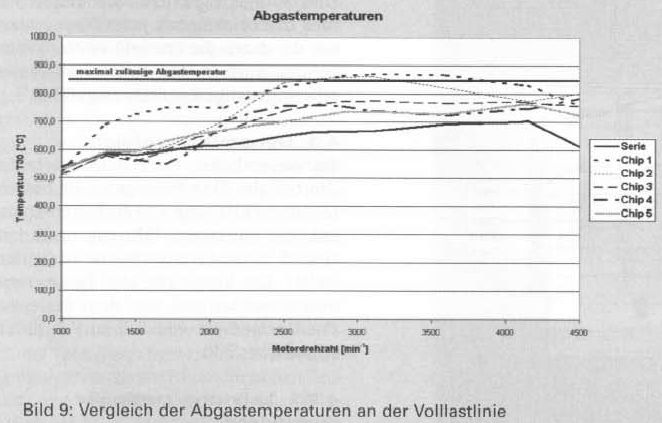
'The fact is that you cannot exceed the speed of sound with gas flows. Increasing the boost pressure, as a result, increases the density of the air. This allows for an increase in mass flow. Therefore, pre-compression of the air (two-stage supercharging) would be necessary. An additional pre-compressor (e.g., a compressor?) would then relieve the turbocharger. The increased exhaust gas temperature, in turn, reduces the density, which significantly increases the speed of the air. Does anyone know what the exhaust gas temperature is with and without a chip? Because for most materials, temperatures in the 450-degree range make a huge difference in fatigue life (according to Wöhler). In this range, even a 10°C increase can be comparable to approximately double the stress!'
Best regards, Olaf.
Translated on 27-07-2026, 14:50.
|
|
| Back to top |
|
|
Gremlin
Guest
Free account, no CAN development support
|
| 14-10-2004, 20:09 Subject: Turbo Failure: Common Causes in Tuned Engines |
Quote |
|
Source: MTZ 11/2002.
| Description: |
| Turbo Failure: Common Causes in Tuned Engines |
|
| File size: |
37.25 KB |
| Viewed: |
4665 times |
|
Translated on 27-07-2026, 14:52.
|
|
| Back to top |
|
|
faz
Blaumann


Joined: 03/12/2004
Posts: 97
Karma: +7 / -0
1994 Audi 80
Premium Support
|
| 14-10-2004, 22:35 Subject: Turbo Failure: Common Causes in Tuned Engines |
Quote |
|
Turbochargers can fail quickly if they are operated below or above the specified fuel pressure limit.
In this process, vibrations occur in the compressor blades, which then lead to their breakage.
In the second scenario, excessively high rotational speed will be the cause of the rapidly increasing unbalanced forces.

Pump cutoff line, engl. surge line.
However, with diesel chip tuning, a lot of adjustments are made to the torque setting, resulting in a significantly increased maximum torque. In this case, the maximum engine speed limit is not exceeded due to the lower airflow through the turbine (which depends on the engine speed). Instead, the pump's limitations become more relevant.
Edit:
I've corrected the errors, thanks Ulf. MfG faz
Audi 80 B4 Avant TDi 10/93
Translated on 27-07-2026, 14:53.
|
|
| Back to top |
Profile PM Garage |
|
donalexo
Profi-Schrauber
Joined: 01/09/2003
Posts: 695
Karma: +0 / -0
Location: Würzburg
Support
|
| 14-10-2004, 23:33 Subject: Turbo Failure: Common Causes in Tuned Engines |
Quote |
|
@schnappi:
Quote: | | The fact is that you cannot exceed the speed of sound with gas flows. |
 You've probably never heard of transonic flows. The critical pressure ratio required for them isn't that large. And with a Laval nozzle, it's very easy to reach supersonic speeds  .
Regards,
Alex. AUDI A3 1.9 TDI, EZ 12/96, ursprüglich MKB AGR, umgebaut zum AHF mit GT1749V-Lader, verkauft mit 250tkm
Golf 4 1.9 TDI, EZ 1/98, MKB ALH, jetzt auch mit GT1749V-Lader, verkauft mit 300tkm
Touran 1.9 TDI, EZ 09/2004
Audi A4 Avant 2.0 TDI, EZ 03/2010
Translated on 27-07-2026, 14:55.
|
|
| Back to top |
Profile PM |
|
schnappi
Guest
Free account, no CAN development support
|
| 15-10-2004, 6:19 Subject: Turbo Failure: Common Causes in Tuned Engines |
Quote |
|
@schnappi:
The fact is that you cannot exceed the speed of sound with gas flows.
You've probably never heard of transonic flows. The critical pressure ratio required for this isn't that large. And with a Laval nozzle, it's very easy to reach supersonic speeds .
Regards,
Alex
'In my fluid dynamics lectures, I was taught that this Laval nozzle is specifically designed to decouple systems by using the speed of sound. Additionally, it was stated that gas flows cannot exceed the speed of sound. If this information is incorrect, please forgive me, and feel free to correct me.'
Translated on 27-07-2026, 14:56.
|
|
| Back to top |
|
|
ulf
Profi-Schrauber
Joined: 04/13/2002
Posts: 11058
Karma: +18 / -0
Location: Saarland
2023 MG ZS
Premium Support
|
| 15-10-2004, 7:44 Subject: Turbo Failure: Common Causes in Tuned Engines |
Quote |
|
Flood level, English: surge line8O
Ähhh Quote: |
Left is the pump curve, also known as the surge line.
The choke line is on the right side and can be identified by the decreasing RPM lines.
"In my opinion, the same information is also available on the BWT website..."
| With diesel chip tuners, a lot is adjusted on the torque screw, meaning a significantly increased maximum torque. And in this case, the limit of maximum RPM is not exceeded due to the lower airflow of the turbine (which depends on the engine speed -> turbine). Here, the "clogging" limit plays a more important role. }
Are you referring to the pump's flow limit here? In other words, a high pressure buildup due to an (too) low mass flow rate?
Gruß Ulf
_________
MG4 Electric
Translated on 27-07-2026, 14:59.
|
|
| Back to top |
Profile PM Garage |
|
faz
Blaumann
Joined: 03/12/2004
Posts: 97
Karma: +7 / -0
1994 Audi 80
Premium Support
|
| 15-10-2004, 14:39 Subject: Turbo Failure: Common Causes in Tuned Engines |
Quote |
|
Yes, of course...
I'm just wondering why I'm not going to bed when I can barely keep my eyes open and am struggling to focus on the monitor.
Surge line, pump curve.
Choke line, blockage limit.
The displacement limit will not play a role in our discussion (unless someone drastically increases the engine displacement ). MfG faz
Audi 80 B4 Avant TDi 10/93
Translated on 27-07-2026, 15:01.
|
|
| Back to top |
Profile PM Garage |
|
ulf
Profi-Schrauber
Joined: 04/13/2002
Posts: 11058
Karma: +18 / -0
Location: Saarland
2023 MG ZS
Premium Support
|
| 15-10-2004, 14:54 Subject: Turbo Failure: Common Causes in Tuned Engines |
Quote |
|
faz wrote: | | The displacement limit will not play a role in our discussion (unless someone drastically increases the engine displacement | ).
I think it can play a role because it limits the mass flow through the compressor.
And that's precisely where the use of a turbocharger increases the mass airflow compared to a naturally aspirated engine -> The higher the boost pressure, the greater the mass airflow, even with the same displacement.
Am I using any technical terms incorrectly now? Gruß Ulf
_________
MG4 Electric
Translated on 27-07-2026, 15:02.
|
|
| Back to top |
Profile PM Garage |
|
Sepp
Guest
Free account, no CAN development support
|
| 15-10-2004, 16:32 Subject: Turbo Failure: Common Causes in Tuned Engines |
Quote |
|
Hello,
In your discussions, a very important point is still missing. One of the most crucial and sensitive components of the turbocharger is the plain bearing system for the turbine/compressor wheel shaft. The radial bearings, and especially the axial bearings, are subjected to high loads. The compressor pressure ratio (pressure ratio - see further above in the compressor map) causes an axial thrust force on the axial bearing. If you operate with higher boost pressure, the load and wear on the axial bearing also increase. The consequences are that, due to increased clearance, turbine and/or compressor blades may rub against the housing contour, leading to a gradual loss of turbocharger performance, potentially resulting in complete failure. Similar damage can occur with an unstable radial bearing; often, imbalances and resonances above the standard permissible turbocharger speed are the cause. I don't want to go into detail about the function of the plain bearing system, as most people here are technically very knowledgeable. Just a reminder: use high-quality engine oil, and it really pays off to change the oil (always with a filter) more often than not.
Best regards from Sepp.
@Ulf - Technical terms are correct.
Translated on 27-07-2026, 15:04.
|
|
| Back to top |
|
|
|


 Bookmarks
 Links
Links Garage
 FAQ, Legal Notice & Privacy
 RSS Feed
 Register
 Login
Login


