Hello everyone,
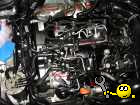
I've now spent about 12 hours troubleshooting an issue on a 2.0 TDI engine with the engine code BKD.
Main problem: Charger pressure - exceeded regulation limit.
The pressure is exceeding 2601 millibars, so it's constantly in emergency mode.
The error only occurs during uphill driving and overtaking maneuvers -> This indicates a high load and a prolonged period of high boost pressure.
AB is rarely/not driven; only country roads are used.
It's a 16V engine without a particulate filter.
Particle accelerator by Garret: 1749VA.
Laufleistung 200tkm. Year of construction: 2005.
Here's the history:
Problem: The turbocharger is making a noticeably loud whistling noise.
Idea: Bearing damage (in the turbocharger), but let's research first. Result -> Replace the EGR pipe.
Work: AGR pipe replaced, part number: 03G 131 521 T.
Result: Pipes unchanged. The old pipe appeared to be slightly leaky, but the subsequent leak test did not confirm this! Apparently still tight after 200,000 km.
Idea: Replace the turbocharger with a used one from another vehicle (1749VA).
Arbeit: Turbo getauscht, Pfeifen weg!

Problem 1: Whistling sound reappears after 2 weeks

.
Problem 2: Again, emergency stop due to overpressure exceeding the sensor range, > 2601 mbar absolute.
Now, the extensive troubleshooting process began, focusing on what was already known.
Vintage, very smooth-running loader. Used, but I cleaned the exhaust side, and it was working perfectly.
The pressure vessel was checked for leaks using a vacuum pump and pressure gauge. The pressure remained constant at -0.7 bar after 30 seconds, indicating the membrane is functioning correctly.
Please refer to the video attached, where I re-checked the functionality today while it was still installed, to be 100% certain!
Idea: The N75 sensor might be failing at this point, considering it has 200,000 km on it.
Work: Replace the old valve block: 6Q0906625 with: 6Q0906625E (see picture!).
Problem 1 & 2: Unchanged, emergency mode due to boost pressure > 2601 mbar absolute
.
Idea: Check the hose from the valve block (6Q0906625) to the air filter, replacing the new one with the old one if necessary, to ensure proper airflow, as this vents the pressure sensor of the turbocharger.
Work: Hose connected to the intake manifold; checked the nozzle for blockage and proper flow.
Result: No abnormalities found; it is clear that the hose is in perfect condition.
Idea: Research suggests that the hoses leading to the pressure chamber may become softer at bends (this is my own HYPOTHESIS!!) and therefore contract, preventing the vacuum inside the pressure chamber from escaping.
Arbeit: Austausch des Schlauches vom Ventilbock zur Druckdose (so ne Scheiße wenn dort niergends Platz ist... (CROSS-ENGINE)
Note: I was too lazy to cut the 2.5-meter (universal) hose, especially since it might not even be defective. If I had cut it, I would have damaged it.
Note: The original (DRECKSSCHLAUCH) has 2 nipples in the middle and actually consists of 3 pieces. The airflow (from my mouth) was also quite bad
there... A quality product, you might say, to put in your G******? No wonder that you read online that the first VNT TDI engines, like the AFN, adjusted their boost pressure peaks faster...
Result: The error remains unchanged for now.
Work 1: Because I was becoming increasingly unsure about the VTG (vibration transmission group) system, in this work process, I created a VTG video to check its functionality while it was installed.
Okay, I'll shorten the hose to the correct length and bring along a T-piece with a pressure gauge. This gauge will also indicate vacuum during the test drives.
Result: No more errors. It now regulates the target pressure and no longer exceeds the absolute pressure of 2601 mbar.
"The hose collapsed due to vacuum pressure at some point, meaning the hose to the vacuum actuator wasn't of particularly high quality. When the N75 valve was opened/is opened at the top, the hose was likely still being pinched by the vacuum reservoir in the pressure sensor, resulting in the turbo being permanently and excessively activated after a full-throttle run. This caused it to generate an abnormally high boost pressure (not measured by the LDA, just based on the data blocks)."Note: I still find it a bit strange that the error persisted even with a very long tube. The tube, which was the same length thanks to the T-piece and LDA (I had used the cut-off piece specifically for the LDA), still had the error, but then (suddenly) the error disappeared.
Appendix:
Video VTG with vacuum hand pump.
Image of a ventilation control block, including the N75 valve, showing both old and new versions.
Log1: I have a log where the turbocharger is charging to 2601 mbar until it enters a failsafe mode, and then there's a second attempt after the engine restarts.
Log2: During the test drive, I had just disconnected the LDA, and it no longer goes into limp mode, and it only exhibits brief overboosts, not prolonged 2601 errors.
I will report on the situation in the coming weeks. Suggestions and further questions are welcome, and I hope that my experiences will help some people with troubleshooting.
The vehicle is not mine, so the flow of information regarding the current situation, whether further issues will arise or not, is a bit slow.
Best regards from Lower Franconia, your apple juice.


 Bookmarks
 Links
Links Garage
 FAQ, Legal Notice & Privacy
 RSS Feed
 Register
 Login
Login