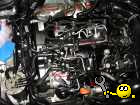
I finished building the car quite some time ago. But I'm only providing feedback now because I've been observing this behavior for about 1000 kilometers.
1.) I cleaned the DPF myself. Before starting the dismantling process, I performed a regeneration cycle to burn off any remaining soot.
"After that, I spoke with a chemist who explained to me what substances accumulate in the solidified ash within the channels. According to him, while baking and treatment with air or dry ice might help, they would never achieve the desired result." The ash would start to glow in the drain, but it wouldn't continue to burn and would continue to clog the drains.
The ingredients of DPF cleaners don't contain anything special; they just have a brand label on the outside so they can sell them at a high price. The ingredients can also be found in inexpensive household products.
3.) The remaining soot dissolves particularly well in a weak alkaline solution. And ash breaks down very well with hydrochloric acid. But be careful - never use it in too high a concentration. It's not necessary at all. And also, don't spend an excessive amount of time dealing with the DPF (flushing and shaking).
4.) First, I rinsed both sides with a simple alkaline solution (from a drain cleaner, heavily diluted). Then, I blew it out with compressed air (not from too close a distance). I repeated that twice.
5.) Afterwards, I rinsed both sides with a highly diluted hydrochloric acid solution (it's important to have pressure during rinsing) and then blew it dry with compressed air, but not from too close a distance. I repeated this process several times. A large amount of red slag came out. Then, I rinsed it thoroughly with lukewarm water for a long time. An immediate difference in permeability was noticeable. I didn't use a pressure washer to avoid potential damage from the water pressure.
Before, it was almost completely impermeable - afterwards, it was absolutely permeable.
Make sure to dry it thoroughly before installation. There should be no moisture left inside. Reinstall everything. The DPF was set to 10g because it's not brand new. I have recalibrated the differential pressure sensor.
Here are the initial observations: The differential pressure at the intake manifold is 3 hPa (previously > 25). Even under full load in the highest gear, the differential pressure does not exceed 150 hPa (previously > 400). The regeneration problem seems to have been resolved. The first regeneration occurred after 600 km, and the regeneration process completed cleanly while driving. The car feels like it's running more smoothly and also seems to have better acceleration.
Here's how I solved the DPF problem. It is not recommended to replicate this.
Thank you for the support in this forum. I decided to do the cleaning myself because I wanted to try it out, and the new DFP (which isn't cheap, Chinese stuff) is already very expensive.
The reason the DPF became clogged so quickly – even though the control unit indicated a loading level of 50% – was likely due to the faulty fuel injectors.
Translated on 05-07-2026, 8:51.
|


 Bookmarks
 Links
Links Garage
 FAQ, Legal Notice & Privacy
 RSS Feed
 Register
 Login
Login