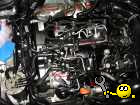
- No vibrations at idle.
- No jerking when starting.
- No knocking sound when the engine is turned off.
-When I accelerate, there's always this jolt, like there's some play in the transmission.
When shifting into the highest gear, which is the 5th gear, there's always a noticeable "clunk" that can be heard inside the car. I don't notice it in the other aisles.
While rotating a wheel on the stage back and forth, I have the impression that it might be producing a similar sound, but not as loud.
I once tried to record a video while driving. You really have to listen carefully!
Transmission damage? Sagging under load - getriebeschlagen.mp4
Description:
Schlagen bei Lastwechsel, Aufnahme während der Fahrt im höchsten Gang
File size:
1.37 MB
Viewed:
3036 times
Caddy 3 mit BLS Motor, 105PS, DPF (0603/AGB)
Renault Laguna 2 mit F9Q Motor, 107PS/120PS (3004/158)
First, I would rule out any play in the engine mounts. I've experienced this issue in several of my own vehicles, such as an Audi A3 8L and my current VW T6.
It's sad to see something like that. I genuinely don't have any feeling in my right foot, and it shouldn't be so difficult to design engine mounts that function properly throughout the vehicle's lifespan.
First, park the car on a level surface, put it in the highest gear, and with the help of an assistant, push it forward/backward (trying to get it rocking).
If the engine starts wobbling or shaking excessively, check the engine mounts. With the A3, I was able to place a piece of rubber tubing in the engine mount to permanently eliminate the excessive play.
If the engine doesn't tilt excessively when being pushed back and forth, the constant velocity joints (CV joints) could also be worn out after a certain mileage. Of course, that will be more expensive.
Regarding the transmission, I would first drain the oil and check for excessive wear or debris.
[...] With the A3, I was able to place a piece of rubber tubing in the engine mount at the time, and permanently eliminate the excessive play. [...]
Similar to my everyday car, a Smart 450, which will be celebrating its 20th birthday in a couple of weeks. As far as I know, the original engine mounts are no longer available, but those ones lasted the longest. The available reproductions, which are based on a very classic rubber-metal bearing design, tend to fail much faster than the validity period of a vehicle inspection sticker.
Ideally, use original, older parts where the rubber has become brittle but hasn't completely torn, as this can make the entire bearing too soft and allow excessive engine movement in the rear engine. If it hits the body, it can also damage wiring harnesses. Also, there isn't necessarily much space for the "exhaust system" near the rear impact protection (under the rear bumper) or the suspension struts. If you install an aftermarket exhaust system, especially one where the casing takes up more space in certain areas than the original part, it will often rattle against something.
The bearings are carefully degreased. Accessible rubber surfaces are roughened with a file or steel brush, and then body adhesive or windshield adhesive is applied to the respective bearing, ensuring it is as relaxed as possible. However, the more you fill the original cavities, the stiffer the bearing becomes. Once you're finished filling, throw dust from the garage floor or talcum powder on it.
On the Smart, it definitely transmitted more idle vibrations to the body, likely adding to the already considerable noise – but it also provided a verschandeln start and crisp gear changes, without the engine having to "struggle" in its mounts each time.
"I've been using it like this for 7 years with the original bearings that were refilled in this way, and it hasn't caused any problems during the technical inspection. However, it now looks bad due to dirt and brake dust." Belt wear very well disguised.
Some of the engine mounts are available at sporty prices (imported from the UK) and are made of PU, but these are even harder. A friend who's good with cars has one, and the engine is quite rigidly mounted in it.
I could only hear the uploaded video through the speaker on the "Schmierfon" device. However, it sounds like some component is tapping against the body or another piece of equipment. Could the tilting moment of the engine/transmission be so large that it potentially causes...? "Can parts of the exhaust system be bent or modified to create a specific noise?"
Automobile Zeitzeugen: |SUZUKI Swift Sport (2008)| |Smart 450 (2002)| |Honda CB 125 F (2018)|
Hmm, could an engine mount from "Meyle" that's only a quarter of a year old already be defective?
Okay, I'll go through the procedure first. But as I said, the noise is only audible in 5th gear. Just a light touch on the gas pedal.
The body adhesive method is a simple way to diagnose the problem! However, the issue is likely to originate first with the lower, circular bearing. Could the other bearings in the transmission and the timing belt exhibit similar symptoms?
Caddy 3 mit BLS Motor, 105PS, DPF (0603/AGB)
Renault Laguna 2 mit F9Q Motor, 107PS/120PS (3004/158)
It's not possible to make a general statement about this. Moreover, even well-made counterfeit parts are often distributed through reputable dealers. What is done exceptionally well often goes unnoticed, even by the trained eye.
One thing that could be tried is to reinforce suspected engine mounts with sturdy straps in a way that prevents them from moving or flexing much (using a process of elimination).
Automobile Zeitzeugen: |SUZUKI Swift Sport (2008)| |Smart 450 (2002)| |Honda CB 125 F (2018)|
I've figured out the following: When I press the clutch pedal down about one-third of the way, the rattling noise occurs in the 5th gear. Walk more confidently.
With the clutch partially engaged, I can then hear a knocking , even in 2nd gear. Gang provokes the engine, because strangely enough, it accelerates more aggressively when you give it gas, and it's not as smooth as when the clutch pedal is fully depressed.
I usually drive very slowly, and mostly it's long-distance driving. "Slowly" means truck speed...
I can start in idle, and I can also climb hills, accelerating slowly or quickly, but it never jerks or stutters. No knocking or engine failure. (I was wondering if the dual-mass flywheel could be tested for defects in this way?)
The drive shafts are not connected to the transmission using a splined connection. These people are playing a game with a tolerance of about 1mm.
Caddy 3 mit BLS Motor, 105PS, DPF (0603/AGB)
Renault Laguna 2 mit F9Q Motor, 107PS/120PS (3004/158)
I was planning to take everything apart next week. Unfortunately, I don't have the time right now. The speakers have only been in the car for about 2 years. But recently, I've also been driving heavier trailers more often...
Since I've only experienced rattling noises or vibrations in the steering wheel under load with my cars due to worn-out components in the past, I've tended to ignore them.
I was at a workshop about it once, and they suspected the transmission because the shafts had no play when you turned them by hand.
I then moved the ridges with pliers and noticed a very small gap, between 0.5 and 1 mm. The waves on another one of my cars are doing the same thing.
...well, if you don't have any idea... or experience.
Caddy 3 mit BLS Motor, 105PS, DPF (0603/AGB)
Renault Laguna 2 mit F9Q Motor, 107PS/120PS (3004/158)


 Bookmarks
 Links
Links Garage
 FAQ, Legal Notice & Privacy
 RSS Feed
 Register
 Login
Login