| Author |
Message |
fehresk94
Joined: 06/01/2024
Posts: 15
Karma: +3 / -0 
Location: Alzey
Premium Support
|
 18-02-2026, 0:24 Subject: 18-02-2026, 0:24 Subject: |
Quote |
|
Okay, so I managed to get a little bit done today.
Unfortunately, the first log file contained errors related to the ignition, starting, idling, and rough idling.
"But after that, I took it for a test drive, and then an error message appeared, after which I wrote another log file."
Something probably isn't right with the air mass.
| Description: |
|

Download |
| File name: |
Log Fahrt.CSV |
| File size: |
18.92 KB |
| Downloaded: |
59 times |
| Description: |
|
Download |
| File name: |
Log-MKL-WV2ZZZ2KZCX139661.txt |
| File size: |
2.46 KB |
| Downloaded: |
59 times |
|
|
| Back to top |
Profile PM |
 |
guste100
Profi-Schrauber


Joined: 07/27/2004
Posts: 2397
Karma: +433 / -0
Location: Mitte Schleswig Holsteins
2007 Volkswagen Passat
Premium Support
dieselschrauber likes this. |
| 18-02-2026, 11:03 Subject: |
Quote |
|
"The log data, which provides the target value for air mass in grams per second and the actual value in milligrams per cycle, can be somewhat difficult to interpret. While we could all technically convert the units, it might not be very appealing." I would suggest that you re-calibrate the device using appropriate values. (mg/hub is a better unit for analysis.)
Sure, here's the translation:
"Same for fuel pressure, in both NPa and kPa." Okay, hier ist die Übersetzung:
"Please provide the text you would like me to translate from German to English."
|
|
| Back to top |
Profile PM Garage |
|
fehresk94
Joined: 06/01/2024
Posts: 15
Karma: +3 / -0
Location: Alzey
Premium Support
|
| 18-02-2026, 15:05 Subject: |
Quote |
|
Sure, how can I change that? It bothers me too... but I haven't figured out yet how to do it properly.
|
|
| Back to top |
Profile PM |
|
Herbert
Profi-Schrauber
Joined: 06/22/2005
Posts: 4586
Karma: +1318 / -0
Premium Support
dieselschrauber likes this. |
| 18-02-2026, 15:40 Subject: |
Quote |
|
Simply use the right IDEs (lines 42 and 191, lines 36 and 124). KpA in MPa is a factor of 1/1000.

Herbert. Horch A4 8K CJCD
Golf 7 DDYA
(+ Audi 80 Avant B4 1Z 475Tkm - habe ich vom ersten bis zum letzten Tag gerne gefahren)
(+ Passat Variant 32B CY 400Tkm)
Last edited on 18-02-2026, 17:37, edited 2 times in total.
|
|
| Back to top |
Profile PM |
|
fehresk94
Joined: 06/01/2024
Posts: 15
Karma: +3 / -0
Location: Alzey
Premium Support
|
|
| Back to top |
Profile PM |
|
guste100
Profi-Schrauber
Joined: 07/27/2004
Posts: 2397
Karma: +433 / -0
Location: Mitte Schleswig Holsteins
2007 Volkswagen Passat
Premium Support
dieselschrauber likes this. |
| 19-02-2026, 10:38 Subject: |
Quote |
|
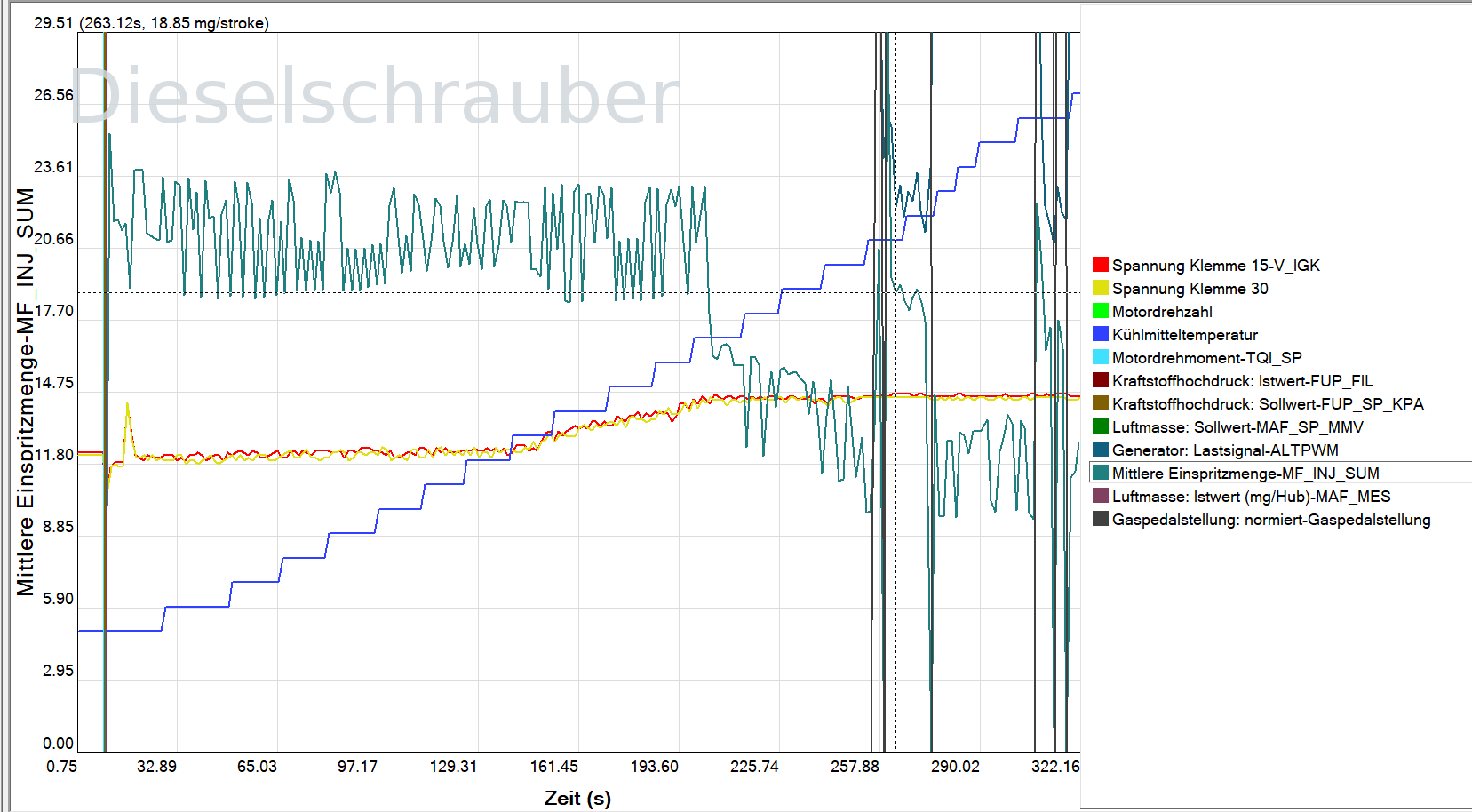
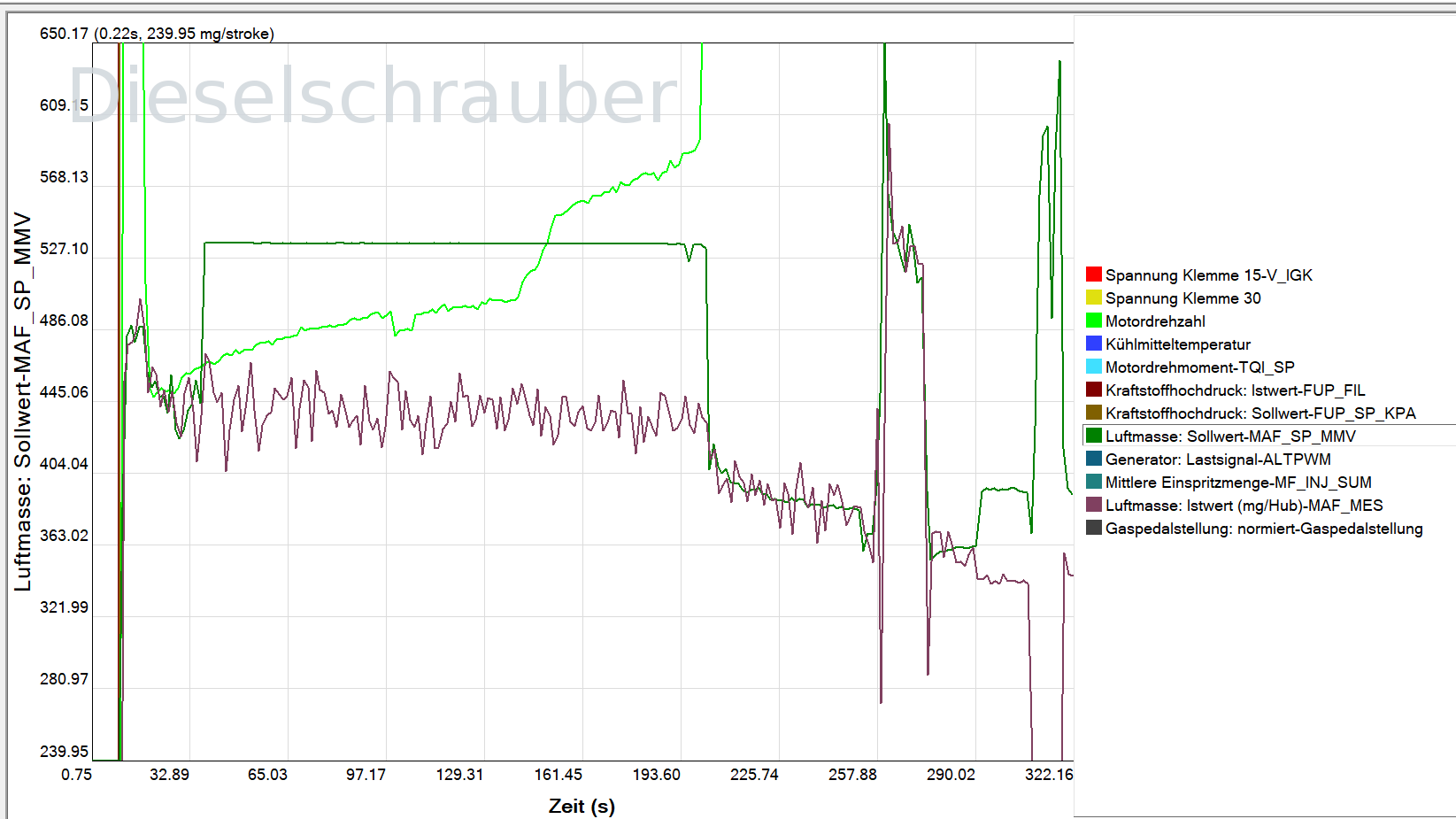
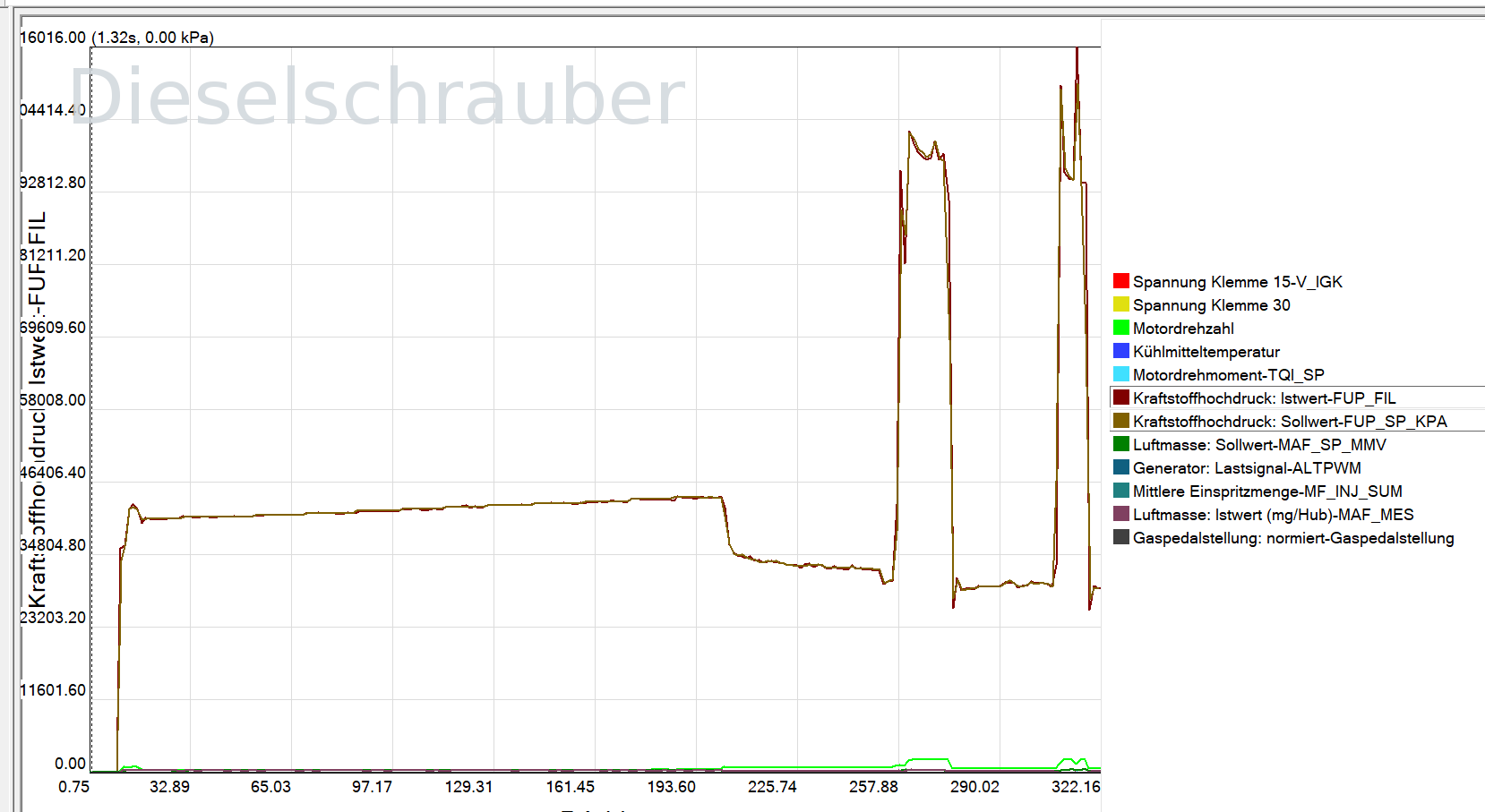
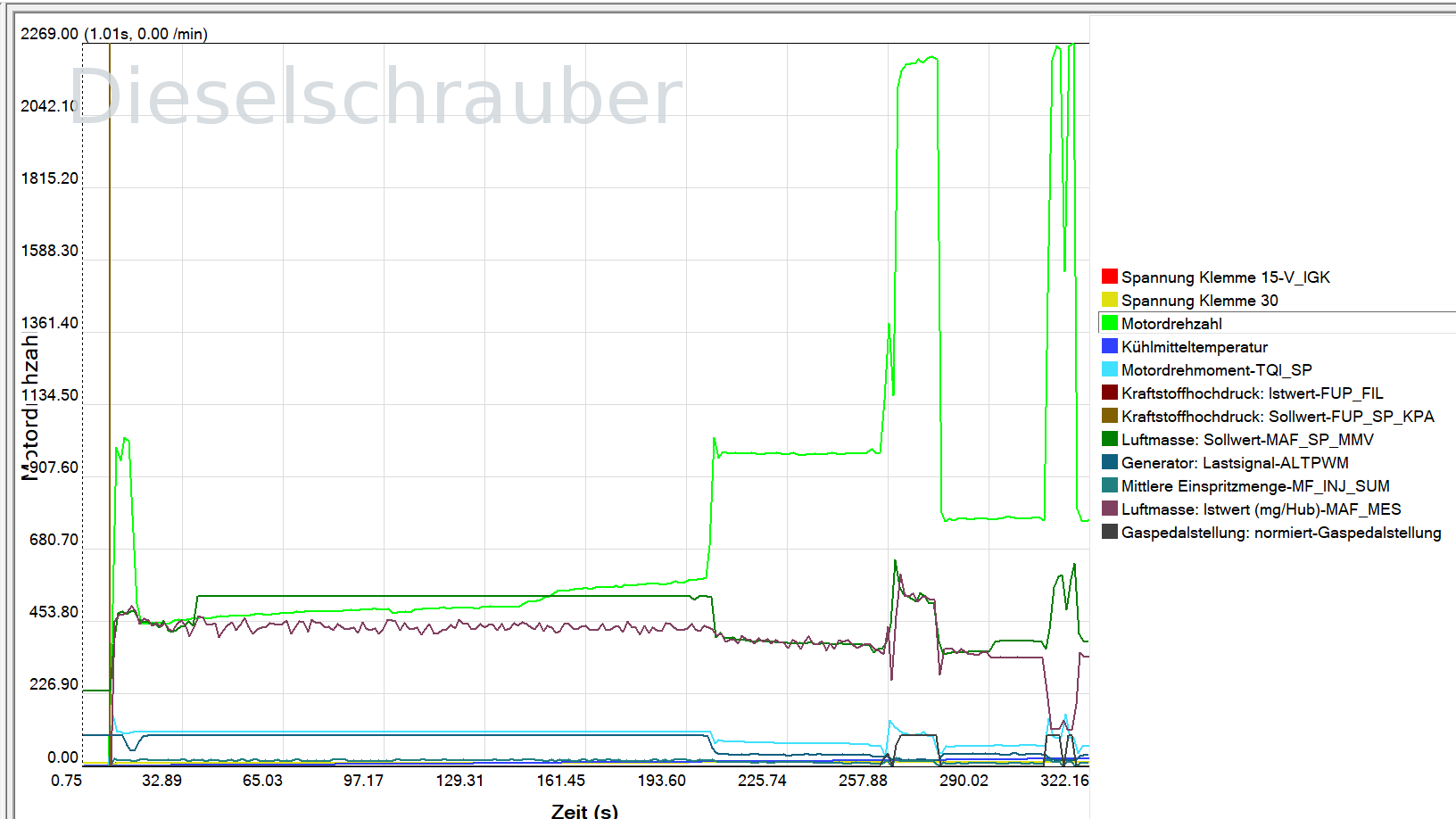
Hmm, despite my initial intention, I've now recalculated the fuel pressure myself. File attached.
What can be seen?
- The engine starts and runs from second 10 to 20 at approximately 1000 rpm.
- From second 20 to 200, the engine reaches 500 rpm and then recovers.
What do the data show?
- The fuel pressure setpoint and actual values are always well-matched.
- The air mass remains at a constant level throughout the entire idle time, from the start until second 200.
- At 39 seconds, the MSG increases the desired air mass flow (=fully closes the EGR), but the actual air mass flow cannot keep up. My interpretation: It's likely that the AGR (Abgasrückführung valve) was already closed beforehand.
- At a low speed (500 rpm), the alternator is operating at 100% and the voltage is approximately 12V. I think that's plausible, because the Lima (alternator) can't generate enough power at that speed.
- The average injection amount is approximately 20mg per injection during the first 10 seconds (1000 rpm) and then again from second 20 to second 200 (500 rpm). The fuel injection amount is adjusted to approximately 13 mg per cycle only after the engine recovers around 200 seconds.
My conclusion: The MSG doubles the injection amount at 500 rpm, but the engine speed does not recover. Either something is putting excessive strain on the engine, or the problem lies outside the range of measurable values.
The LIM (likely referring to a load management system) shouldn't force the motor to operate under such extreme conditions. For safety, it might be possible to disconnect it temporarily to eliminate its load. But I think the problem lies elsewhere.
Since the fuel pressure is correct,
| Description: |
|
| File size: |
67.47 KB |
| Viewed: |
125 times |
|
| Description: |
|
| File size: |
64.38 KB |
| Viewed: |
121 times |
|
| Description: |
|
| File size: |
56.67 KB |
| Viewed: |
139 times |
|
| Description: |
|
| File size: |
61.6 KB |
| Viewed: |
122 times |
|
| Description: |
|
Download |
| File name: |
Zuendung_start_ruckeln_fangen_leerlauf_vollgas_im_Stand3.csv |
| File size: |
37.88 KB |
| Downloaded: |
48 times |
|
|
| Back to top |
Profile PM Garage |
|
Herbert
Profi-Schrauber
Joined: 06/22/2005
Posts: 4586
Karma: +1318 / -0
Premium Support
dieselschrauber likes this. |
| 19-02-2026, 14:04 Subject: |
Quote |
|
Hi,
"We can only agree with that."
The first 2-3 minutes (20-200 seconds) correspond to the afterglow phase. Therefore, try starting the engine without the spark plugs connected; it should work.
When performing further tests, only operate with a fully charged battery that is installed in the vehicle, and disable all consumers (seat heaters, auxiliary heaters, rear window defroster, infotainment system, etc.).
I would also like to know how the power supply was provided in previous attempts – was it always through a built-in battery, or also with an auxiliary battery connected to the jump-start terminals?
To me, it looks like the problem might be related to the electrical power supply at the beginning.
The next steps to narrow down the problem would be to run the engine with the KRR (cooling system) disconnected (no generator, no air conditioning compressor), and also to record the data from the onboard control unit STG 09 (and for this, we need a diagram so we can agree on the measured values).
I have a Golf 7 here, and after starting, the vehicle's onboard control system significantly interferes with the power supply, meaning it strangely puts a load on the battery while sparing the alternator.
The other things – such as the turbocharger control and the fuel injectors – are currently less important.
hg
Herbert.
Horch A4 8K CJCD
Golf 7 DDYA
(+ Audi 80 Avant B4 1Z 475Tkm - habe ich vom ersten bis zum letzten Tag gerne gefahren)
(+ Passat Variant 32B CY 400Tkm) |
|
| Back to top |
Profile PM |
|
fehresk94
Joined: 06/01/2024
Posts: 15
Karma: +3 / -0
Location: Alzey
Premium Support
dieselschrauber likes this. |
| 19-02-2026, 15:49 Subject: |
Quote |
|
Okay, good!
The power supply has always been provided by the aforementioned "mobile home converter" (built-in), as I received the Caddy without a battery. A second battery connected in parallel or via a booster or similar device is not necessary. (Battery specifications: 12V, 65Ah, 680A (EN)).
The battery is regularly checked and charged.
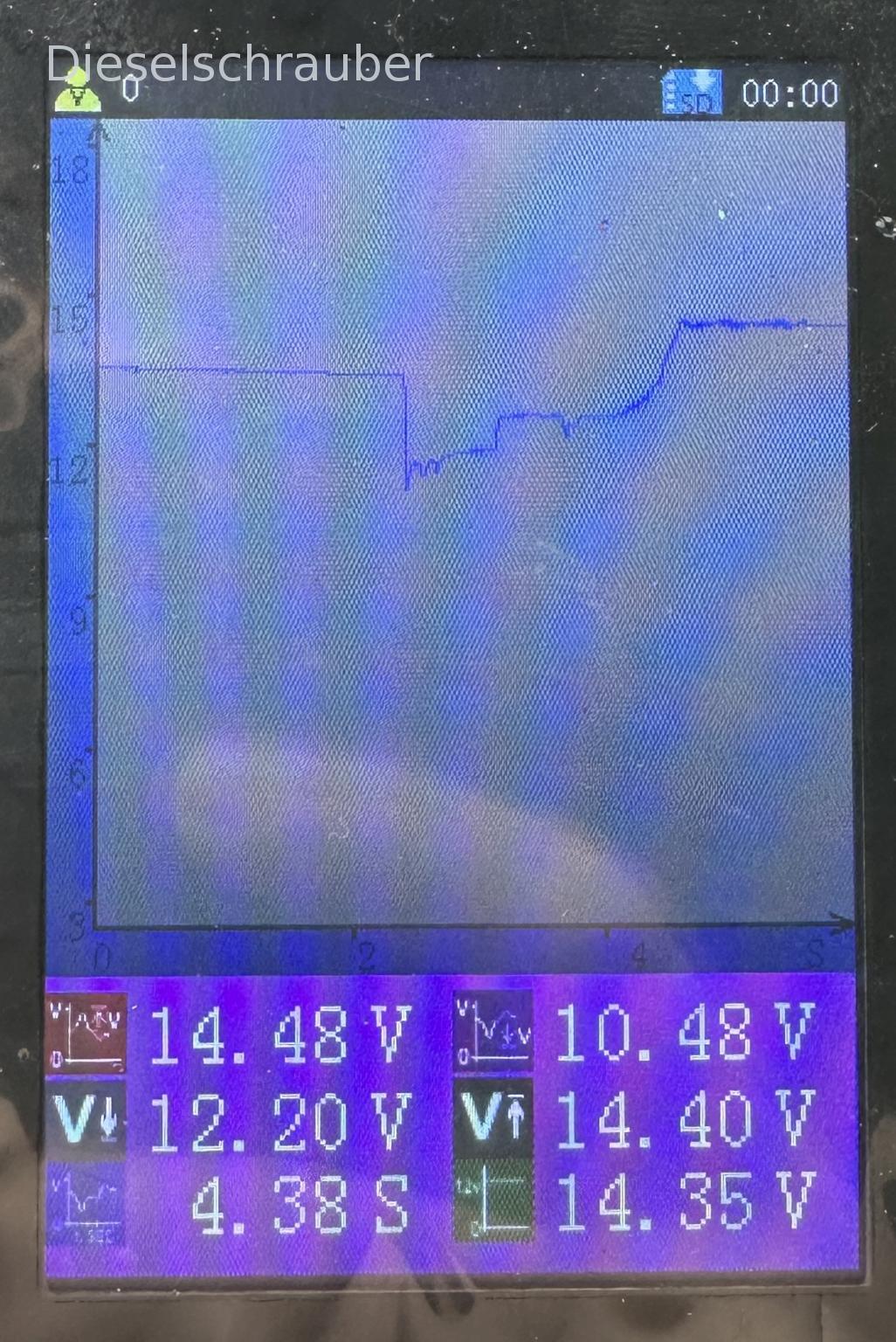
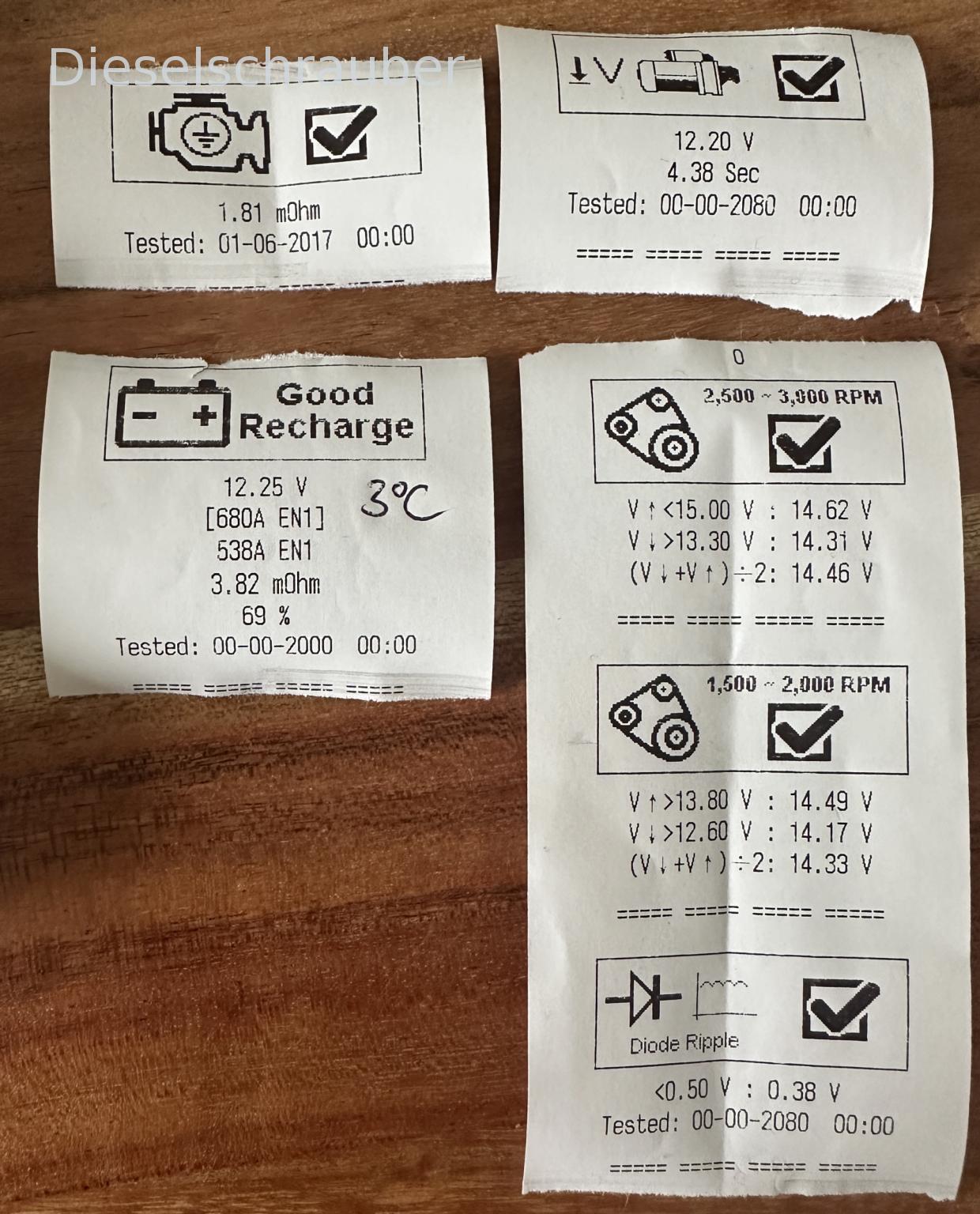
I connected the Osram battery tester. I'm attaching the measurement results here.
It was always started without any additional consumers being active, meaning everything was turned off, such as lights, climate control, heated seats, infotainment system, etc. I generally pay attention to that when starting something.
I also tried supplying external power during that 500 RPM phase after starting to see if it would make a difference... (using a GYS Flash 100.12 HF) with the settings at 14.4V and a current limit of >100A. This also resulted in no changes whatsoever.
I will then carry out the suggestions. First, I will disconnect the generator from the power supply, then I will disassemble the KRR (likely referring to a specific component), and finally, I will disconnect the glow plugs. I will get back to you once all the data has been collected.
Thank you very much for your support!
| Description: |
|
| File size: |
1.04 MB |
| Viewed: |
118 times |
|
| Description: |
|
| File size: |
2.41 MB |
| Viewed: |
120 times |
|
Last edited on 19-02-2026, 15:52, edited 1 time in total.
|
|
| Back to top |
Profile PM |
|
Herbert
Profi-Schrauber
Joined: 06/22/2005
Posts: 4586
Karma: +1318 / -0
Premium Support
dieselschrauber likes this. |
| 19-02-2026, 20:23 Subject: |
Quote |
|
Hi,
Why disconnect the generator from the vehicle's electrical system? Even if it's disconnected, it will still be running, potentially damaging the engine if it's faulty, and you risk a potentially dangerous short circuit. Just taking KRR is enough.
hg
Herbert.
Horch A4 8K CJCD
Golf 7 DDYA
(+ Audi 80 Avant B4 1Z 475Tkm - habe ich vom ersten bis zum letzten Tag gerne gefahren)
(+ Passat Variant 32B CY 400Tkm) |
|
| Back to top |
Profile PM |
|
guste100
Profi-Schrauber
Joined: 07/27/2004
Posts: 2397
Karma: +433 / -0
Location: Mitte Schleswig Holsteins
2007 Volkswagen Passat
Premium Support
dieselschrauber likes this. |
| 20-02-2026, 16:06 Subject: |
Quote |
|
I wouldn't read too much into the LiMa data.
Since the engine speed is so low, the alternator cannot generate enough power. Consequently, it is being driven at full capacity. As I already mentioned:
guste100 wrote: | | The LIM (limitation module) should not be able to force the engine to its limits. For safety, it could be disconnected to exclude its load. But I think the error lies elsewhere. |
Let's take a look at the injection quantities.
20mg per injection at 500rpm corresponds to 20g per minute (2 injections per revolution), which is 1.2kg per hour. At 12kW per kg, the engine is currently burning approximately 14kW of diesel. While most of it dissipates as heat, there is still a very large amount.
After that, it stabilizes at 13mg/h. Still a lot.
The alternator typically provides a maximum of around 2 kW electrically. Even with the worst possible efficiency, it's unlikely to draw more than 3-4 kW mechanically. And at idle or even below, it will certainly draw much less (I once measured a maximum of 69A at idle with a 140A alternator. At 500 rpm, it will produce even less). This means that the mechanical load of the alternator is likely relatively negligible for the engine. "Just to be on the safe side, it certainly wouldn't hurt to check the KRR status."
Question for the experts: What is the maximum amount that the idle speed control system is allowed to inject?
I'm wondering if the amount of fuel being injected is actually being calculated correctly, or if the engine is constantly injecting less fuel than it thinks it's injecting. And whether it's already running at maximum injection volume at idle... |
|
| Back to top |
Profile PM Garage |
|
Herbert
Profi-Schrauber
Joined: 06/22/2005
Posts: 4586
Karma: +1318 / -0
Premium Support
dieselschrauber likes this. |
| 20-02-2026, 18:42 Subject: |
Quote |
|
For the 1.6L engine, the warm oil consumption is approximately 4 mg per stroke (with a fuel injection system flow rate of 0.4 - 0.5 liters per hour), while after a cold start, it's more than double that amount. I sometimes see the flow rate exceed 1 liter per hour for a short period.
The amount of fuel injected is calculated based on the injection time(s) and fuel pressure. If you follow this line of reasoning, the rail pressure should be significantly lower than what is being read. Then there should also be starting problems, with the system releasing fuel even when the rail pressure is actually far too low.
hg
Herbert.
Horch A4 8K CJCD
Golf 7 DDYA
(+ Audi 80 Avant B4 1Z 475Tkm - habe ich vom ersten bis zum letzten Tag gerne gefahren)
(+ Passat Variant 32B CY 400Tkm) |
|
| Back to top |
Profile PM |
|
fehresk94
Joined: 06/01/2024
Posts: 15
Karma: +3 / -0
Location: Alzey
Premium Support
|
| 22-02-2026, 23:52 Subject: |
Quote |
|
New findings!
I started the engine yesterday; it was cold, with a temperature of around 7°C.
The serpentine belt was removed, and the glow plug connectors were disconnected. In addition, I removed the fuel cap to rule out any vacuum issues within the tank.
After starting, no drop to 500 RPM was observed.
After the launch, there were reports about ext. Power supplied (setting 14.4V >100A, approximately 10-15A was drawn).
It showed a consumption of approximately 1.0 liters per hour, and at around 70°C, the consumption decreased to 0.7 liters per hour.
However, even with the accelerator fully pressed while the car was stationary, the engine speed did not exceed 2200 RPM.
The Autoscan results after the run are attached, along with the log file. I encountered an error while imaging module STG09, which I will provide if it is still needed.
My suspicion is increasingly pointing towards the injectors, so I'll be checking the resistance of the injectors in the next few days.
| Description: |
|
Download |
| File name: |
LOG-01-Caddy_ohne_KRR.CSV |
| File size: |
13.6 KB |
| Downloaded: |
62 times |
| Description: |
|
Download |
| File name: |
AutoScan.txt |
| File size: |
17.35 KB |
| Downloaded: |
56 times |
|
|
| Back to top |
Profile PM |
|
Herbert
Profi-Schrauber
Joined: 06/22/2005
Posts: 4586
Karma: +1318 / -0
Premium Support
dieselschrauber likes this. |
| 23-02-2026, 9:55 Subject: |
Quote |
|
Hi,
Connecting an external power supply is a good thing, but why aren't you approaching this methodically? What's missing:
- Start the engine using the cranking relay (KRR), without using the glow plugs, and without any external power supply. Measure the current draw using a clamp meter or record it from the vehicle's body control module (BCM).
- Start without a starter battery, but with glow plugs, using an external power supply, and recording the current draw.
To me, it's only obvious that the engine in the low-load condition isn't providing enough power for the electrical system, whether or not afterglow is involved is unclear.
This could be purely speculative, but it might be due to an excessively high power demand (A), a faulty generator (B), or a mechanically damaged engine (C).
Case (A) should be evaluated using your complete measurements of current draw with an external power supply. Without the glow plugs, 10 amps would likely be acceptable. I remember seeing a value of 7A once when starting the engine.
Case (B) occurs when the generator is running without any load.
Case (C) - Check and adjust valve timing (at least the exhaust side); Check compression; Inspect and verschandeln intake manifold, channels, and throttle body; Check throttle body mechanism; Check DPF (Diesel Particulate Filter) flow, etc. B. with differential pressure at high load; compare the correction values of the injectors with the entries and, if necessary, correct them.
Cheering from the sidelines doesn't achieve much; the system will shut down at 2500 RPM.
hg
Herbert.
Horch A4 8K CJCD
Golf 7 DDYA
(+ Audi 80 Avant B4 1Z 475Tkm - habe ich vom ersten bis zum letzten Tag gerne gefahren)
(+ Passat Variant 32B CY 400Tkm) |
|
| Back to top |
Profile PM |
|
fehresk94
Joined: 06/01/2024
Posts: 15
Karma: +3 / -0
Location: Alzey
Premium Support
|
| 24-02-2026, 20:49 Subject: |
Quote |
|
Thank you for your help!
Sorry for the unmethodical approach; the problem is that I can only do troubleshooting in short bursts right now. Currently, the Caddy is parked outside because there's no space available in the workshop, and to top it all off, it's been raining the entire time...
I will report back and share new findings with you.
|
|
| Back to top |
Profile PM |
|
fehresk94
Joined: 06/01/2024
Posts: 15
Karma: +3 / -0
Location: Alzey
Premium Support
|
| 11-04-2026, 14:46 Subject: |
Quote |
|
Here's a quick update.
I actually managed to get a few things done today.
Valve timing has been checked and is correct!
The compression (cold tested) should also be okay if it's between 20-23 bar.
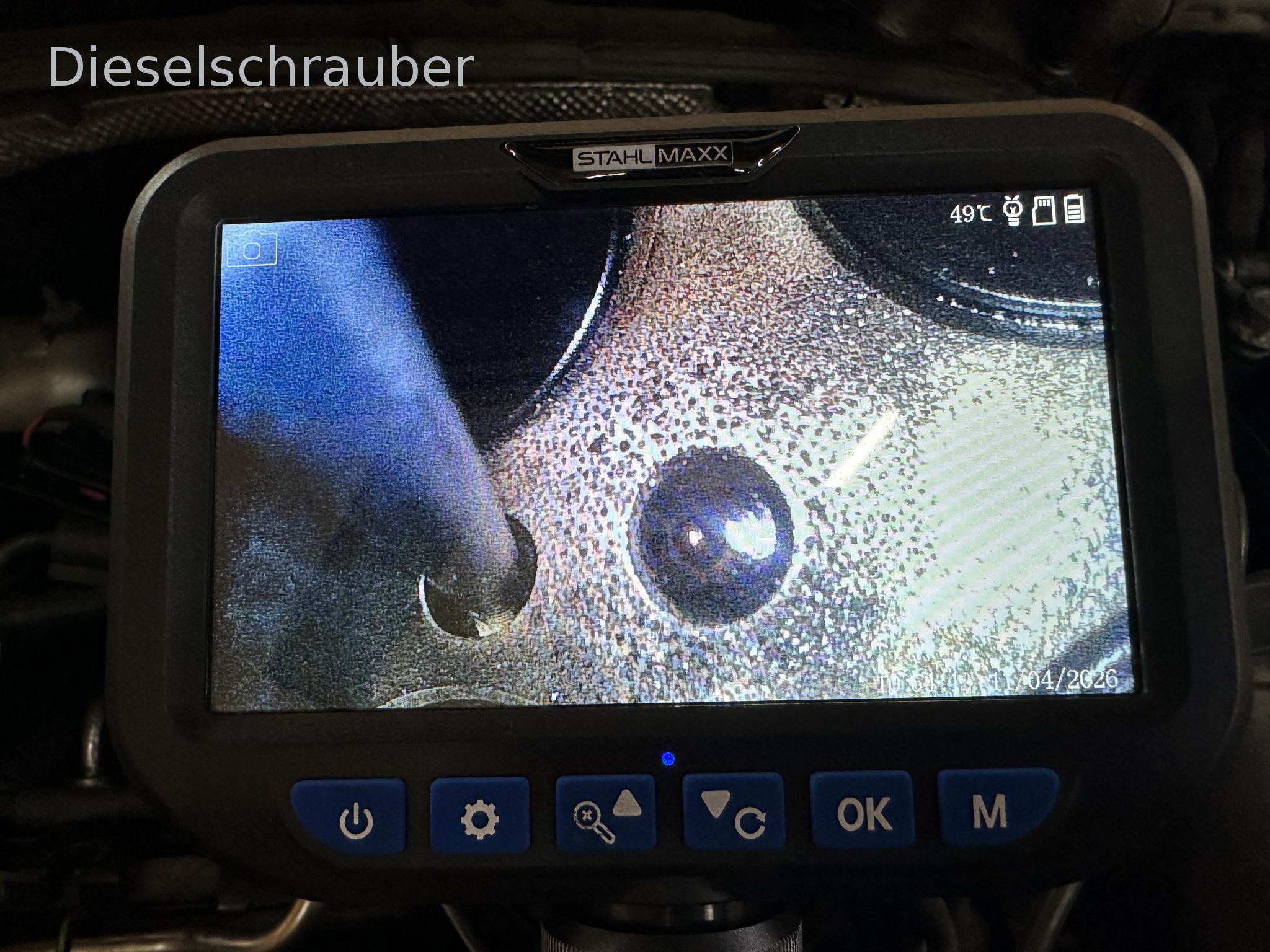
I also performed an endoscopy, and the combustion chambers look quite good so far. However, I noticed that the injectors (all 4) don't look as verschandeln as they should, and there are what appear to be small crystals around them. I'm increasingly getting the feeling that the injectors are clogged.
| Description: |
|
| File size: |
2.96 MB |
| Viewed: |
50 times |
|
|
|
| Back to top |
Profile PM |
|
dieselschrauber
Administrator

Joined: 04/12/2002
Posts: 17991
Karma: +781 / -0
Location: St.Gallen
2018 Volkswagen T6 
|
| 13-04-2026, 10:38 Subject: |
Quote |
|
Herbert wrote: | Hi,
Connecting an external power supply is a good thing, but why aren't you approaching this methodically? What's missing:
- Start the engine using the cranking relay (KRR), without using the glow plugs, and without any external power supply. Measure the current draw using a clamp meter or record it from the vehicle's body control module (BCM).
- Start without a starter battery, but with glow plugs, using an external power supply, and recording the current draw.
To me, it's only obvious that the engine in the low-load condition isn't providing enough power for the electrical system, whether or not afterglow is involved is unclear.
This could be purely speculative, but it might be due to an excessively high power demand (A), a faulty generator (B), or a mechanically damaged engine (C).
Case (A) should be evaluated using your complete measurements of current draw with an external power supply. Without the glow plugs, 10 amps would likely be acceptable. I remember seeing a value of 7A once when starting the engine.
Case (B) occurs when the generator is running without any load.
Case (C) - Check and adjust valve timing (at least the exhaust side); Check compression; Inspect and verschandeln intake manifold, channels, and throttle body; Check throttle body mechanism; Check DPF (Diesel Particulate Filter) flow, etc. B. with differential pressure at high load; compare the correction values of the injectors with the entries and, if necessary, correct them.
Cheering from the sidelines doesn't achieve much; the system will shut down at 2500 RPM.
hg
Herbert |  Dipl.-Ing. (FH) Rainer Kaufmann - dieselschrauber VCDS Shop |
|
| Back to top |
Profile PM WWW Garage |
|
|


 Bookmarks
 Links
Links Garage
 FAQ, Legal Notice & Privacy
 RSS Feed
 Register
 Login
Login
