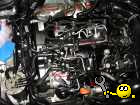
I'm experiencing the following problem with my Seat Leon, 5F, model year 2015, 2.0 TDI, EA288, CUPA 135kW/184PS, with approximately 190,000 km on the odometer.
As is commonly known, the heater core was clogged, and coolant was being forced out of the AGR (Agile Growth Reactor) "pressure relief valve" after DPF (Diesel Particulate Filter) regeneration (this is a known issue and is documented extensively online).
So, I'm going to have a new heat exchanger, terms and conditions, and lid installed.
All the front, air-flow optimized coolers were replaced a year ago. Coolant has been G12evo since then, but the system was not flushed beforehand. The belt-driven water pump is also only about a year old.
During the replacement of the heat exchanger, coolant was drained by disconnecting a hose located behind the right front wheel. Because the flow was slow, compressed air was used to blow through the radiator hoses. "By mechanics, I was just there."
Everything has been refilled, and the venting process has been started.
Right after driving home, the oil temperature was approximately 5-15 degrees (depending on operating conditions/load) higher than normal.
The ventilation routine was run multiple times again via OBD. The heating broke down.
Since then, despite all the subsequent measures taken, the oil temperature has remained consistently 5-10 degrees higher than it was before the heat exchanger was replaced, except when idling. These temperatures refer to moderate driving conditions, as I don't want to push the engine too hard. City driving and up to approximately 100 km/h: +5 degrees Celsius. Cruise control at 120-140 km/h: +7 to

0 degrees Celsius.
The oil temperature is then absolutely 102-115 degrees.
The oil temperature rises very quickly on the highway when accelerating briefly, but so far it hasn't exceeded 120 degrees.
Interestingly, even when the engine is still warm from a previous drive (oil temperature at start > 80 degrees), the temperatures are only completely normal. They only start to exceed the normal values from before the heat exchanger was replaced when there is a slightly higher load, for example, from 2500 RPM. Then, they only drop back down to normal (95-98 degrees) at idle, but immediately rise again to excessively high values under load. You can only gradually return to using normal oil temperatures after a certain period... but then the same problem starts all over again.
I'm completely unsure whether there might be something "stuck" there, or if it's just the higher temperature of the block.
The following actions have now been taken:
- Filled multiple times with vacuum and bled with a tester.
- The check valve was replaced as a precaution while the hose was open for draining during the replacement. Since then, the oil temperature seems to be decreasing again, at least noticeably, when the load is reduced. However, it's still consistently 5-10 degrees too high, and the issue is still reproducible.
- Function of the two electric water pumps tested using a tester. Start it up and it sprays out of the open user agreement.
-Coolant temperature at the sensor in the engine head is normal after driving while the vehicle is stationary.
- The oil analysis showed a slightly increased aluminum level (which is generally high and indicates wear), compared to previous analyses. Otherwise, the analysis showed the same indicators of wear as before (specifically, iron content) and a fuel dilution of 5%, which is consistent with previous analyses. No glycol, water, or similar substances.
- All radiator hoses were checked while the engine was idling, from idle speed up to 2500 RPM, using an infrared thermometer, and all were found to be normally hot/warm.
When cornering or braking, the oil temperature briefly increases very quickly by 3-5 degrees, which, in my opinion, indicates that there is definitely a significant issue.
Hotter oil flows into the oil pan and, due to the more aggressive acceleration, mixes more quickly or reaches the temperature sensor faster.
My assumptions:
The thermostat or the cover of the belt-driven water pump may have been damaged by compressed air during the replacement of the heater core.
But shouldn't that be much more noticeable in the coolant temperature?
Or:
After replacing the heat exchanger, deposits that were located behind it dissolved (because of the now unimpeded flow through the heat exchanger). These deposits are now clogging delicate channels. But where are these channels located? In the oil cooler?
Or:
Some kind of control unit defect caused by tester venting.
My ideas: Flush the entire cooling system with a cleaning solution. However, I haven't been able to find anyone in the Munich area who has the professional equipment to do it. "Doing it by hand is too much of a makeshift solution for me; otherwise, cleaning residue might be left behind."
Does anyone know of a workshop?
Or:
Swapped the thermostat and oil cooler as a precaution.
And:
Check the cover panel of the belt-driven water pump. But how? It can be controlled via OBD, but can you see in the terms and conditions whether that's "enough"?
The workshop and I have no further ideas.


 Bookmarks
 Links
Links Garage
 FAQ, Legal Notice & Privacy
 RSS Feed
 Register
 Login
Login