| Author |
Message |
ulf
Profi-Schrauber

Joined: 04/13/2002
Posts: 11058
Karma: +18 / -0 
Location: Saarland
2023 MG ZS
Premium Support
|
 06-09-2005, 20:47 Subject: 06-09-2005, 20:47 Subject: |
Quote |
|
Zak1976 wrote: | | If we now assume there is a leak in the intake manifold (with a functioning MAF sensor), the MAF sensor would measure an air mass that is too small | , even though there is enough air present. ... Correct up to this point.
Quote: | | This then causes a readjustment that is too slow | ... and now it gets confusing: Which parameter should be adjusted to compensate for being "too slow"? Gruß Ulf
_________
MG4 Electric
Translated on 24-07-2026, 1:50.
|
|
| Back to top |
Profile PM Garage |
 |
Zak1976
Joined: 03/09/2005
Posts: 225
Karma: +0 / -1
Location: Barendorf
Free account, no CAN development support
|
| 06-09-2005, 21:09 Subject: |
Quote |
|
Okay, you're right, my explanation was a bit confusing. What I meant is that the air being drawn in around the mass airflow sensor (MAF) causes fluctuations in the MAF readings. The boost pressure control system then tries to compensate for these fluctuations, but it can't react quickly enough to adjust to the constantly changing MAF values, which results in this wavy (though slight) acceleration pattern. Do you agree with my thought that there might be a leak somewhere in the intake manifold (as a possible cause)?
Fährt mit Golf 3 TDI Umbau (von AFN auf ARL)
Translated on 24-07-2026, 1:51.
|
|
| Back to top |
Profile PM Email |
|
ulf
Profi-Schrauber
Joined: 04/13/2002
Posts: 11058
Karma: +18 / -0
Location: Saarland
2023 MG ZS
Premium Support
|
| 06-09-2005, 21:24 Subject: |
Quote |
|
Zak1976 wrote: | | Yes, you are right, I expressed it a bit confusingly. What I mean is that the air flowing around the mass airflow sensor (MAF) causes fluctuations in the MAF readings, and as a result, the boost pressure control system tries to compensate for this. | The boost pressure control system does not use the MAF reading as its target value; it simply uses the boost pressure itself.
Quote: | | It doesn't adjust quickly enough to the permanently varying LMM values, which is why this wavy (though only slightly) acceleration occurs. | Have you read the technical article that explains wave-like acceleration?
Quote: | | Do you agree with me that there might be a leak in the intake manifold (as a possible cause)? | I already wrote that days ago:
... Suction of "false air" between the mass airflow sensor (MAF) and the compressor... Gruß Ulf
_________
MG4 Electric
Translated on 24-07-2026, 1:52.
|
|
| Back to top |
Profile PM Garage |
|
Zak1976
Joined: 03/09/2005
Posts: 225
Karma: +0 / -1
Location: Barendorf
Free account, no CAN development support
|
| 06-09-2005, 21:52 Subject: |
Quote |
|
Next time, I'll double-check everything more carefully, and I'll thoroughly inspect the intake passages again. Thank you very much for your help and the quick responses.
Fährt mit Golf 3 TDI Umbau (von AFN auf ARL)
Translated on 24-07-2026, 1:54.
|
|
| Back to top |
Profile PM Email |
|
guste100
Profi-Schrauber

Joined: 07/27/2004
Posts: 2403
Karma: +441 / -0
Location: Mitte Schleswig Holsteins
2007 Volkswagen Passat
Premium Support
|
| 07-09-2005, 0:11 Subject: |
Quote |
|
Zak1976 wrote: | | ... but after a certain time, the control unit enters emergency mode with the message "Turbocharger pressure regulation - negative deviation"... |
Just a quick note to the guys who have already experimented with diodes:
Is this error message normal? I would have expected at most one error message, namely "Air mass deviation." But the LD (light intensity) shouldn't actually be affected by the diode, should it?
I might even include a hint about the actual symptom behind the error message. After all, insufficient boost pressure building up too late is nothing more than a "negative boost pressure deviation."
However, it doesn't change anything about the troubleshooting process. I agree with Ulf's assumptions about the cause.
Regards,
Sure.
Here is the translation of the text from German to English:
"Guste" means "gust" in English. It refers to a sudden and strong gust of wind.
Translated on 24-07-2026, 1:55.
|
|
| Back to top |
Profile PM Garage |
|
Devilseye503
Guest
Free account, no CAN development support
|
| 07-10-2005, 19:09 Subject: |
Quote |
|
Hello there,
The error description for my ARL (presumably a piece of equipment or software) is very similar to the one reported by Zak1976.
What was the ultimate error, then?
In my case, both the turbocharger and the intake manifold are sealed properly.
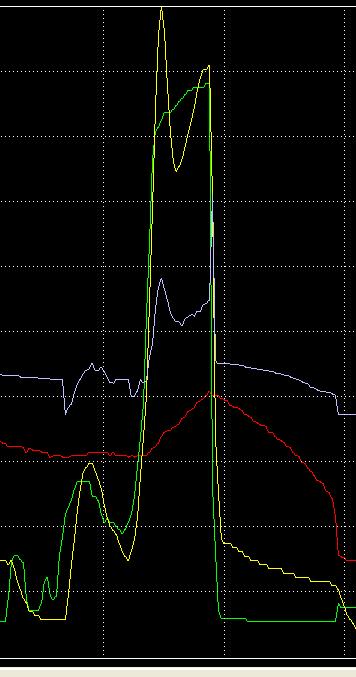
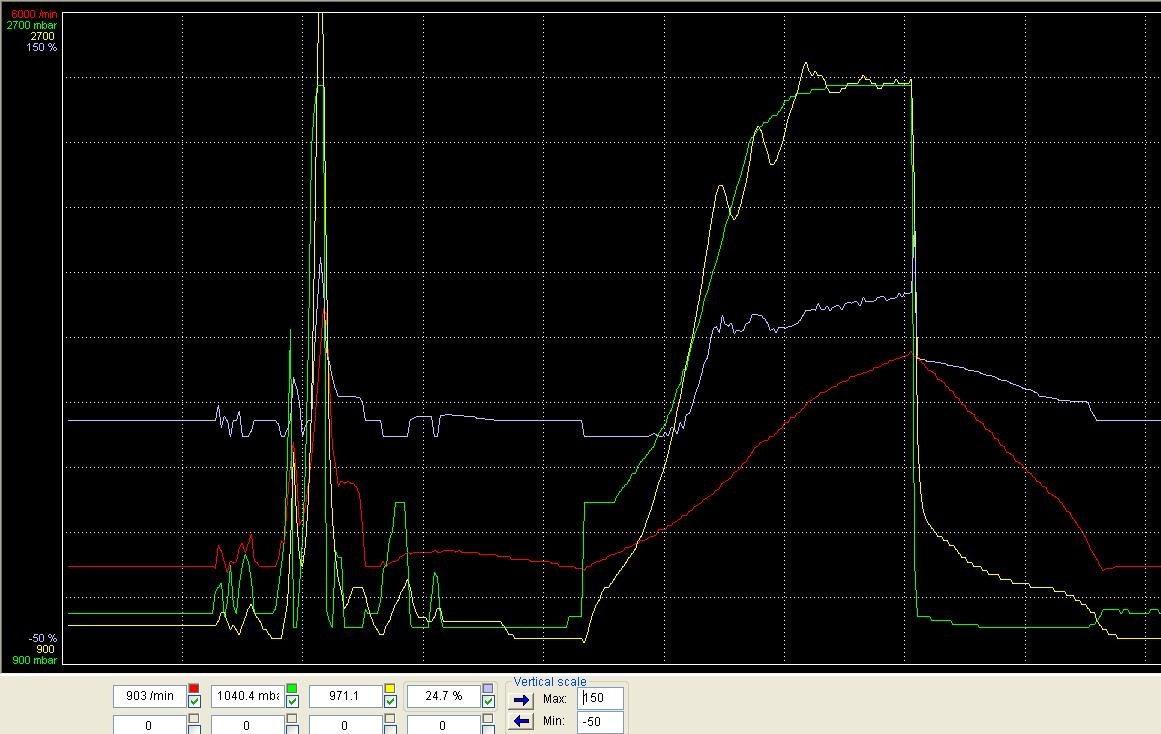
'I also once recorded the MWB11 using a VAG-COM interface (6th gear from idle speed to 100% load - I specifically increased the boost pressure to 2700 in the diagnostic settings because otherwise, the overboost wouldn't be captured).'
Could ULF possibly take a look at this?
'I'm also experiencing extreme pressure spikes, reaching 2700 millibars. In my opinion, the adjustment process is resulting in a very large deviation – when you open the throttle above 1500 RPM, a difference of 500 millibars is not uncommon.'
Who knows the answer? 
| Description: |
| diesmal vollgas ab ca 1850 U/min - gleiche einstellungen wie beim ersten diag |
|
| File size: |
37.15 KB |
| Viewed: |
2730 times |
|
| Description: |
|
| File size: |
119.15 KB |
| Viewed: |
2882 times |
|
Translated on 24-07-2026, 1:57.
|
|
| Back to top |
|
|
Zak1976
Joined: 03/09/2005
Posts: 225
Karma: +0 / -1
Location: Barendorf
Free account, no CAN development support
|
| 07-10-2005, 23:22 Subject: |
Quote |
|
Hello,
I still haven't found the final bug, and I also have little time at the moment, but soon the winter vehicle will be registered again.
Last updated:
Following Ulf's suggestion, I then performed the diode test, which corrected the measurement values and allowed the target values to be reached quickly. From a subjective point of view, nothing seemed to have improved except for two acceleration holes, and as a result, after a short period of full throttle (with the diode), the engine went into limp mode with the error message "Turbocharger control - negative deviation," for some reason. I still feel that it has lost quite a bit of power. Over the past three days, I drove from Hamburg to Bremen and tested how my car performs compared to other diesel vehicles, and it was sad to see that I had significant problems keeping up with the 130 hp Passats. Against the 320s from BMW, I couldn't compete. Either they are all chip-tuned, or something is wrong with my car (which I am convinced of). Things used to be different; even an Audi TDI with 180 hp was inferior back then. For reference, this is a 150 hp ARL engine in a Golf 3 that weighs 1150 kg when fully fueled.
The last approach was to look for a leak between the mass airflow sensor (MAF) and the turbocharger, but I didn't find any. I suspect it's more likely to be:
- Turbo failure or variable geometry turbocharger (VGT) stuck, defective, or misadjusted.
- specifically regarding my conversion: there is a lack of fuel supply, the diesel cooler and pre-feed pump are not installed, and so far, no one has been able or willing to comment on this.
- PD elements worn out (switching times show significant differences per cylinder).
It's strange that the car still consumes very little fuel, around 6 liters per 100 kilometers at highway speeds of about 160 km/h, and it doesn't produce any soot. It feels like driving with the handbrake slightly engaged, and when there's a sudden change in load, it takes about 2 seconds for anything to happen. I'm at a loss, but anyone who has ideas or can offer suggestions will be welcomed.
Fährt mit Golf 3 TDI Umbau (von AFN auf ARL)
Translated on 24-07-2026, 2:01.
|
|
| Back to top |
Profile PM Email |
|
ulf
Profi-Schrauber
Joined: 04/13/2002
Posts: 11058
Karma: +18 / -0
Location: Saarland
2023 MG ZS
Premium Support
|
| 09-10-2005, 19:03 Subject: |
Quote |
|
Devilseye503 wrote: | I also experience extreme pressure spikes of up to 2700 mbar. In my opinion, the adjustment process involves a very large deviation - when you open the throttle above 1500 RPM, a difference of 500 mbar is not uncommon.
Who knows the answer? |
Perhaps an article about common mistakes?
If the valve timing gear is running smoothly, etc.:
Is your loader old and possibly worn out in its linkage mechanism? If there is play between the control lever and the buckets, the over-travel can also become more pronounced over time. Gruß Ulf
_________
MG4 Electric
Translated on 24-07-2026, 2:04.
|
|
| Back to top |
Profile PM Garage |
|
Devilseye503
Guest
Free account, no CAN development support
|
| 10-10-2005, 1:13 Subject: |
Quote |
|
'Are they 70,000 km old? But the problem seems to have been present from the factory.'
I've read the technical articles, and VTG is actually quite easy to operate.
Could this be related to a boost pressure sensor that generally displays a lower pressure than what is actually present? (The atmospheric pressure is 50 mbar higher when the engine is off.) Or, could it be due to the rare phenomenon where, upon starting the engine, the measured boost pressure drops even further? (Meaning, for example, the boost pressure drops below another 20 mbar and goes down to atmospheric pressure) - except when the engine has already been running for a few minutes.
Translated on 24-07-2026, 2:06.
|
|
| Back to top |
|
|
ulf
Profi-Schrauber
Joined: 04/13/2002
Posts: 11058
Karma: +18 / -0
Location: Saarland
2023 MG ZS
Premium Support
|
| 10-10-2005, 9:37 Subject: |
Quote |
|
Devilseye503 wrote: | | are they 70,000 km old? But the problem has been there since it was new | .
As long as it doesn't (significantly) worsen, we can probably rule out any play within the VTG area.
Quote: | | Could this have something to do with a boost pressure sensor that generally displays less pressure than is actually present? (The atmospheric pressure is 50 mbar higher when the engine is off.) |
I don't believe that a measurement error of 50 MB could cause such large overshoots.
It would be a different matter if the measurement error increased with increasing pressure, and for example, at 2.5 bar (absolute), the reading was already off by as much as 125 mbar.
Then a conflict could arise between the duty cycle setting and the measured laser diode (LD) current, which, depending on the control parameters, may potentially cause such oscillations.
Quote: | | or what about the rare phenomenon where, when you start the engine, the measured boost pressure drops even further? (i.e., for example, the boost pressure drops below 20 mbar and goes down to atmospheric pressure) - (unless the engine has already been running for a few minutes) | This is normal: as long as the compressor is stationary (cold oil, etc.), it's an obstruction that slightly reduces the boost pressure.
Once it's running, the LD loss will also decrease or become zero. Gruß Ulf
_________
MG4 Electric
Translated on 24-07-2026, 2:08.
|
|
| Back to top |
Profile PM Garage |
|
ulf
Profi-Schrauber
Joined: 04/13/2002
Posts: 11058
Karma: +18 / -0
Location: Saarland
2023 MG ZS
Premium Support
|
| 10-10-2005, 9:52 Subject: |
Quote |
|
Zak1976 wrote: | | The last approach was to search for a leak between the LMM (lambda measuring module) and the turbocharger, but I didn't find any. |
But with the diode, it runs reasonably well, except for the emergency mode?
Then the error must likely be in the area of the Large Language Model.
Quote: | | - Turbo failure or VGT stuck/defective/misadjusted | .
Just take a look at  .
Quote: | | - specifically regarding my conversion: there's a lack of fuel supply, the diesel cooler and pre-feed pump are not installed, and so far, no one has been able to comment on this | . If it ran better initially without these components, then they shouldn't be the cause - unless high return temperatures over time have deformed some plastic parts that are now hindering the diesel supply (have you ever logged the diesel temperature on a section of highway at maximum power?).
This would also be consistent with the "low pressure" error message on the laser diode, as the laser driver power would be reduced accordingly.
Quote: | | - PD elements worn out (switching times show significant differences per cylinder) | . The tolerance range is +/- 100.
As long as the idle speed is within the acceptable range (+/- 2.7 mg, if I recall correctly), I wouldn't worry too much about the PDE.
Sure, here is the translation of the text from German to English:
"Addendum:"
If the switching times shift significantly and consistently in the same direction relative to the LL (limit value) at higher engine load and speed, it could also be caused by supply problems (incomplete filling of the PDE - pre-injection device).
-> Check the error codes (in the "VAG" subforum): something like "Limit exceeded or not met (?) due to air in the fuel system," or similar. Gruß Ulf
_________
MG4 Electric
Translated on 24-07-2026, 2:12.
|
|
| Back to top |
Profile PM Garage |
|
Zak1976
Joined: 03/09/2005
Posts: 225
Karma: +0 / -1
Location: Barendorf
Free account, no CAN development support
|
| 11-10-2005, 0:10 Subject: |
Quote |
|
Hi Ulf, it's good to hear from you again, so:
Quote: | But with the diode, it runs properly, except for the limp mode?
Then the error can actually only be in the area of the Large Language Model (LLM). |
Okay, with the diode installed, I no longer feel those two acceleration "holes," but it doesn't pull noticeably better. It lacks the usual spontaneity/agility; it feels like driving with the handbrake slightly engaged. However, the measured values with the diode looked as they should. I've now tried a second new MAF sensor and one from a friend, but the behavior doesn't change; it's definitely not the MAF sensor. With the diode installed, it goes into limp mode after a certain amount of time.
The VTG (Variable Turbine Geometry) seems to be working correctly; it can be moved to its maximum position, and it returns quickly and without resistance to the starting position. The locking mechanism of the adjustment screw is still secured with a counter-locking compound and is in its original position. However, there might potentially be an internal defect within the VTG vanes, but this can only be determined through expert knowledge and visual inspection; so, this is more of a guess on my part. I also suspect the turbocharger, as I often work with TDIs (Turbocharged Direct Injection engines), and we've had cases where the engines lost their "smoothness." In those cases, no errors were found in the control system or the turbocharger (according to a "specialized workshop"), but in one case, the turbocharger was replaced under warranty, and after that, it ran like new again. However, my car only has 65,000 km (approximately 40,000 miles) on it and has been properly maintained. Nevertheless, the turbocharger is second on my list of potential issues.
Regarding PDEs.
While the idle speed control and shift times show some deviations, they are within the tolerances you specified. I did experience fluctuations in the idle speed for a while, which were audible and visible on the tachometer (around plus or minus 50-100 RPM), but that hasn't happened for quite some time now (I think it disappeared after my first Mass Air Flow sensor replacement).
Fuel supply / cooling.
"What you're writing is an interesting and logical approach. On my last test drive, there were about 20 liters of fuel in the tank, and the temperature was at least 90°C, and I drove for about half an hour. After a longer highway drive, especially when combined with a low fuel level, it's likely to get even hotter. Something else that comes to mind is that deposits might have formed in the fuel system, possibly near the injectors/PDE, but I think the filter prevents this. The fuel sender unit was broken, so I repaired it using Uhu Endfest 3000 adhesive, but after 3 months, it dissolved (diesel seems quite aggressive). I have a pre-lift pump from a 130hp Passat TDI and a fuel injector assembly from a Polo SDI. Now I just need to figure out how to put them together and then see what happens. Hopefully, the pump from the 130hp TDI is sufficient. I also need to install the diesel cooler; it's lying around here somewhere. In another thread, I read about someone who replaced the camshaft due to a similar problem. Are they really that prone to failure? Could that be a possibility? For him, it improved the driving behavior, but it still didn't seem to be the real issue."
"Bloody awful car, it made everything easier at my derby... (although it's not as fun to drive right now)." Fährt mit Golf 3 TDI Umbau (von AFN auf ARL)
Translated on 24-07-2026, 2:19.
|
|
| Back to top |
Profile PM Email |
|
Devilseye503
Guest
Free account, no CAN development support
|
| 11-10-2005, 0:55 Subject: |
Quote |
|
Quote:
Could this be related to a boost pressure sensor that is generally showing lower pressure than what is actually present? (The atmospheric pressure is 50 mbar higher when the engine is off.)
I don't believe that a measurement error of 50 MB could cause such large overshoots.
It would be a different matter if the measurement error increased with increasing pressure, and for example, at 2.5 bar (absolute), the reading was already off by as much as 125 mbar.
Then, a conflict between the duty cycle control (KF) and the measured LD could occur, which, depending on the regulation parameters, may potentially cause such oscillations.
'It might seem insignificant now, but in the lower RPM range, up to 1300 RPM, this is the difference – it's not reaching the target boost pressure. No matter how well warmed up the turbocharger is beforehand, it just can't do it. I assume the pressure measurement isn't simply shifted downwards, but rather that it's showing a percentage of the actual pressure. This would mean that with an atmospheric pressure of 980 mbar, the intake manifold shows 930 mbar – indicating 95%. At 2500 mbar absolute, this would only translate to 2375 mbar – a difference of 125 mbar. But how can I check that? With boost pressure overshoots regularly exceeding the displayed 2700 mbar... reaching as high as 2840 mbar in reality, this could explain why so many hose clamps on the intake track have simply broken due to overload. Is this just speculation, or is there something to it?'
Translated on 24-07-2026, 2:25.
|
|
| Back to top |
|
|
ulf
Profi-Schrauber
Joined: 04/13/2002
Posts: 11058
Karma: +18 / -0
Location: Saarland
2023 MG ZS
Premium Support
|
| 11-10-2005, 7:34 Subject: |
Quote |
|
Zak1976 wrote: | | The fuel tank fitting was broken, so I used Uhu Endfest 3000 cold weld adhesive to fix it. However, after 3 months, the whole thing dissolved (diesel seems to be quite aggressive). |
And if clumps of owl pellets were sucked in and are still somewhere in the piping system, you would have another supply problem. Gruß Ulf
_________
MG4 Electric
Translated on 24-07-2026, 2:27.
|
|
| Back to top |
Profile PM Garage |
|
ulf
Profi-Schrauber
Joined: 04/13/2002
Posts: 11058
Karma: +18 / -0
Location: Saarland
2023 MG ZS
Premium Support
|
| 11-10-2005, 7:37 Subject: |
Quote |
|
Devilseye503 wrote: | | would already be only 2375 mbar at an absolute pressure of 2500 mbar -> a difference of 125 mbar - but how do I check that? |
Very simple: LDA rules . Gruß Ulf
_________
MG4 Electric
Translated on 24-07-2026, 2:28.
|
|
| Back to top |
Profile PM Garage |
|
|


 Bookmarks
 Links
Links Garage
 FAQ, Legal Notice & Privacy
 RSS Feed
 Register
 Login
Login

