| Author |
Message |
Apfelsaft
Joined: 03/02/2011
Posts: 15
Karma: +3 / -0 
Premium Support
|
 01-10-2013, 22:20 Subject: TSI Engine Problem Solved: 1.4 TSI (103kW) Fix 01-10-2013, 22:20 Subject: TSI Engine Problem Solved: 1.4 TSI (103kW) Fix |
Quote |
|
Good day.
Today I was troubleshooting a Volkswagen Golf V Plus 1.4 TSI with a 103 kW twin-charger engine.
Now I see that this forum has now been expanded with the title "TSI"  , which makes me very happy.
As stated, here are the technical specifications of the child exhibiting problematic behavior:
Volkswagen Golf V Plus, first registration date: 2007.
1.4 TSI with 103 kW / 140 hp as a twin-charger system.
Error: No power output above 3000 RPM.
The engine exhibits a wavy acceleration or stuttering, starting around 1800 RPM, which suggests that the control of the compressor's recirculation valve may be beginning to malfunction.
The wavy acceleration, or even the jerking motion, can sometimes be seen on the tachometer. For example, it occurs at around 100 km/h in 6th gear at approximately 2200 rpm.
(The term "wavy acceleration" is probably poorly phrased, as the jerking occurs more frequently in the partial load range.)
Okay, I've just done a data logging session with VCDS, and it turns out that above approximately 3400 RPM, the target boost pressure is significantly higher than the actual boost pressure.
Sorry, I'm expressing myself incorrectly again; the actual pressure is too high and can no longer maintain the target pressure. The target pressure isn't fluctuating unusually.
The valve control (likely N75?) is usually at 99.6%, which probably indicates full activation.
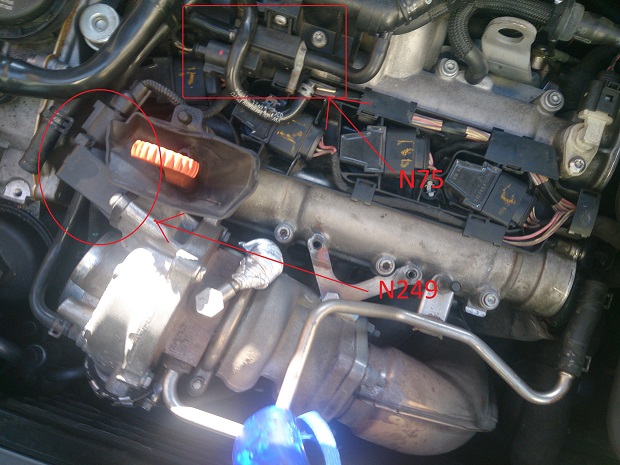
Attached are a diagram of the boost pressure curve and some pictures of the engine.
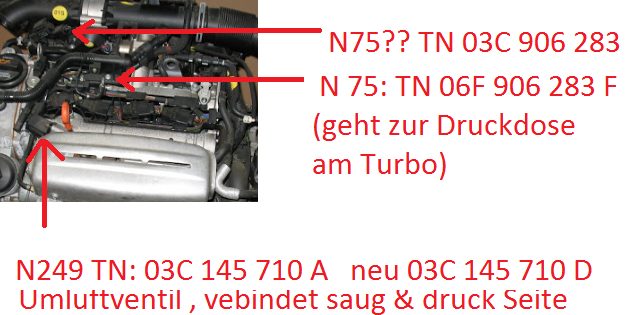
My current problem is that I don't yet understand the valves. It seems there are two N75 valves, but what does the second one control?
A general overview of the TSI technology can be found in Volkswagen's self-study program SSP 359 (simply search for it on Google).
N75 (Turbo pressure sensor) Part number: 06F 906 283 F <- Currently installed.
(supposedly replaced by part number 03C 906 283 A)
N75 ?? TN: 03C 906 283
(wurde getauscht aber was regelt es? Es sitzt eine kleine schwarze Unterdruckdose daran aber wohin führt diese? It is common.
N249 TN: 03C 145 710 A (new version 03C 145 710 D)
(WSL is 03C 145 710. It has been installed, but I have NOT yet verified it. Source regarding new TN http://www.golfv.de/150975-abschaltventil-turbolader-n249-mech-fehler-selbst-getauscht-in-20-minuten.html).
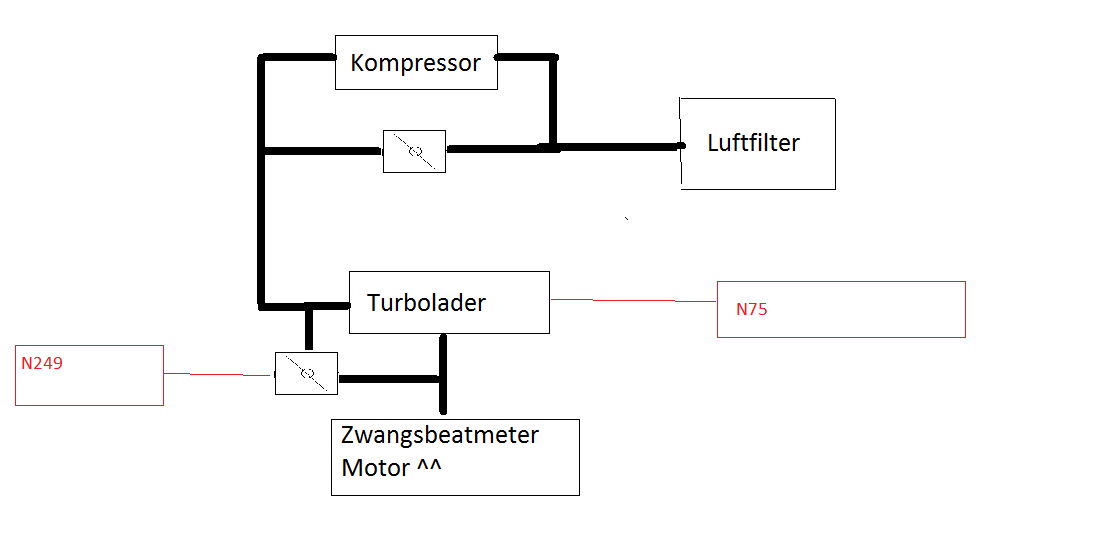
I'm attaching the following images to help you understand the boost pressure curve without a turbocharger (LLK).
As I see it now, both the N75 and N249 sensors could be faulty. It's even possible that the bypass valve on the compressor isn't opening, which would mean the turbocharger isn't getting enough air.
What's the best way to check something without having to order every single little thing?
Best regards, Apple.
| Description: |
| Ladedruck-Strecke ohne Kühler |
|
| File size: |
13.12 KB |
| Viewed: |
90901 times |
|
| Description: |
| TSI Engine Problem Solved: 1.4 TSI (103kW) Fix |
|
| File size: |
127.8 KB |
| Viewed: |
124928 times |
|
| Description: |
| TSI Engine Problem Solved: 1.4 TSI (103kW) Fix |
|
| File size: |
123.42 KB |
| Viewed: |
180354 times |
|
| Description: |
| Log etwas lange aber einmal durchbeschleunigt bis ca 5000.... |
|

Download |
| File name: |
LOG-01-002-115-114_Heri_1.CSV |
| File size: |
45.1 KB |
| Downloaded: |
1794 times |
Translated on 12-08-2026, 17:40.
|
|
| Back to top |
Profile PM |
 |
Herbert
Profi-Schrauber

Joined: 06/22/2005
Posts: 4627
Karma: +1342 / -0
Premium Support
|
| 01-10-2013, 23:24 Subject: TSI Engine Problem Solved: 1.4 TSI (103kW) Fix |
Quote |
|
Hi,
Here are a few initial remarks. There is only one N75 valve, which is used to control the opening of the wastegate on the turbocharger.
edit: The N249 component is used to dampen the boost pressure regulation when the throttle valve is closed (****).
Since the problem occurs even under partial load conditions, I would start by investigating the behavior of the boost pressure of the supercharger (G5839) and the intake manifold pressure (G319). (Please forgive me for referring to the supercharger as a Roots blower  ).
hg
Herbert. Horch A4 8K CJCD
Golf 7 DDYA
(+ Audi 80 Avant B4 1Z 475Tkm - habe ich vom ersten bis zum letzten Tag gerne gefahren)
(+ Passat Variant 32B CY 400Tkm)
Translated on 12-08-2026, 17:45.
|
|
| Back to top |
Profile PM |
|
dieselmartin
Profi-Schrauber
Joined: 03/13/2003
Posts: 10121
Karma: +29 / -0
Location: in der Werkstatt
2007 Volkswagen Passat
Premium Support
|
| 02-10-2013, 8:25 Subject: TSI Engine Problem Solved: 1.4 TSI (103kW) Fix |
Quote |
|
Hi.
Wave acceleration is a hot topic for the 122 hp (turbo only) TSI engine.
There, the wastegate shaft of the Mitsubishi turbo gets stuck, and a Torque Performance Indicator (TPI) is triggered, after which the turbo is partially replaced.
Is your turbo in good working order, meaning is the wastegate definitely not stuck?
Okay, please provide the German text you would like me to translate into English. I will only provide the translation.
Transparency, Teamwork
... there was another T.
I don't know what the f*ck it was.
Translated on 12-08-2026, 17:47.
|
|
| Back to top |
Profile PM Garage |
|
Apfelsaft
Joined: 03/02/2011
Posts: 15
Karma: +3 / -0
Premium Support
|
| 02-10-2013, 9:51 Subject: TSI Engine Problem Solved: 1.4 TSI (103kW) Fix |
Quote |
|
Additional information:
Edit: I'd like to add that the surging/pulsing isn't my main problem, but rather that the turbocharger isn't building any boost pressure. The other issue is likely related to this.
Okay, so the wastegate valve is movable, and the pressure sensor moves approximately 1.5 to maybe 2 centimeters. The sensor is pressurized and then pushes.
As far as I know, the turbocharger is a KKK brand, not a Mitsubishi.
MKB: BMY (according to the vehicle identification number).
Herbert wrote: | There is only one N75 valve, which is used to control the opening of the wastegate on the turbocharger.
edit: The N249 component is used to dampen the boost pressure regulation when the throttle valve is closed (****).
...occurs in the partial load range. Start measuring the blower speed (G5839) and boost pressure (G319).
Sure, here's the translation:
"Best regards," or "Sincerely," (depending on the context).
Herbert | .
What does the second solenoid valve control, specifically the small black pressure sensor located behind the motor?
Dient das N249 nicht auch als Bypass für die Kompressor Luft? Oder läuft die Luft ständig durch den Turbo? Kann ich das N249 nicht einfach Rausbauen, Kunstofftüte darüber stülpen so einbauen und eine (wirklich nur eine!!) Runde drehen ob der Turbo dann Druck macht oberhalb der 3400 umin Marke? So könnte ich das N249 als Übeltäter ausschließen bzw. Entlarven.....
Es gibt laut VW einen Bereich wo Rootgebläse (Kompressor) und Turbo sich überschneiden, daher nehme ich an das der Fehler gar nicht am Rootgebläse zu suchen ist, sondern es auch dort zu einen unerwünschten Regelkreisverhalten aufgrund des fehlenden Turbodruckes kommt. Die von dir genannten Sensoren G5839 und G319 finde ich in den Messwerten? Gibt es online Infos dazu wo diese hardwareseitig Sitzen? Zfor understanding.
dieselmartin wrote: |
Is your turbo in good working order, meaning is the wastegate definitely not stuck?
m; |
Yes, the wastegate valve is movable and has been tested directly on the canister using a hand pump. Also, the turbo shaft is still within acceptable limits regarding play and free movement. The acceleration is weak, but not excessively erratic; the jerking occurs mainly under partial load conditions.
Thank you for the previous answers .
Translated on 12-08-2026, 17:50.
|
|
| Back to top |
Profile PM |
|
Herbert
Profi-Schrauber
Joined: 06/22/2005
Posts: 4627
Karma: +1342 / -0
Premium Support
|
| 02-10-2013, 19:53 Subject: TSI Engine Problem Solved: 1.4 TSI (103kW) Fix |
Quote |
|
Hi,
My recommendation is to consult a repair manual when continuing the troubleshooting process. This makes things easier because individual test steps are described with specified values. This also eliminates questions about parts that you may see on the engine, but which the reader here obviously cannot see. . You can find the repair manual at Erwin.
Regardless, we can first check if the valves, flaps, etc. of the air intake system are mechanically in order. Let's start with the wastegate. As you write, it is not stuck but movable. Is it also held closed in idle by the pressure sensor (which contains a membrane and spring)? You can find information about the function of the wastegate here (should also apply to the TSI wastegate): https://community.dieselschrauber.org/en/viewtopic.php?t=3101
hg
Herbert. Horch A4 8K CJCD
Golf 7 DDYA
(+ Audi 80 Avant B4 1Z 475Tkm - habe ich vom ersten bis zum letzten Tag gerne gefahren)
(+ Passat Variant 32B CY 400Tkm)
Translated on 12-08-2026, 17:53.
|
|
| Back to top |
Profile PM |
|
Autoservice
Profi-Schrauber
Joined: 04/14/2012
Posts: 2130
Karma: +99 / -0
Location: Nähe Düsseldorf
Support
|
| 02-10-2013, 22:43 Subject: TSI Engine Problem Solved: 1.4 TSI (103kW) Fix |
Quote |
|
Quote: | | Regardless, we can first check if the valves, flaps, etc., of the air distribution system are mechanically sound. |
That's where I would start looking. The control valve J808, which regulates the airflow to the compressor/turbo, should be accessible through the measurement data blocks.
It reliably shuts off the compressor from the airflow at 3500 RPM; for further improvements, consider turbocharging.
Then it would be necessary to ensure that the recirculation valve closes properly.
If both are okay, then the only remaining possible cause for the lack of boost pressure is likely the turbocharger, including its wastegate. LG, Onkel BM
*Nichts ist einfacher, als sich schwierig auszudrücken......*
**Technische Fragen bitte ins Forum und nicht in mein Postfach**
Translated on 12-08-2026, 17:55.
|
|
| Back to top |
Profile PM |
|
Apfelsaft
Joined: 03/02/2011
Posts: 15
Karma: +3 / -0
Premium Support
|
| 06-10-2013, 11:02 Subject: TSI Engine Problem Solved: 1.4 TSI (103kW) Fix |
Quote |
|
Autoservice wrote: |
That's where I would start looking. The control valve (J808) that regulates the airflow to the compressor/turbocharger should be accessible through the measurement data blocks.
It reliably shuts off the compressor from the airflow at 3500 RPM; proceed further towards the turbocharger. |
I would like to mechanically test this valve; how is it controlled?
Perhaps the "second N75" is located near the vacuum and pressure sensor (?), where you can see "complete TSI engine" in the upper part of the image?
Autoservice wrote: |
Then, it would be necessary to ensure that the recirculation valve closes securely. |
Please provide the text you would like me to translate from German to English. I need the content of "N249" to complete your request.
Current status:
N75 (turbocharger pressure sensor), part number: 06F 906 283 F - Currently installed.
is now being replaced because it is not working...
only which is the new part number for the improved version?
I have read in various forums that there are now parts with the numbers 03C 906 283 A and B available.
Yesterday I thoroughly tested the N75 valve, and the result was a complete failure. It doesn't do anything at all and isn't even activating! The driver of the Golf is already performing poorly for a 140 hp engine, meaning it's been like that for over 150,000 km...
N75 ?? Part number: 03C 906 283 is new.
I would like to know what this valve with the small plastic vacuum chamber controls? Does anyone have any idea? Could it possibly be the flap J808?
Part number N249 TN: 03C 145 710 A has already been superseded by the new version 03C 145 710 D.
Works perfectly, tested.
Translated on 12-08-2026, 17:59.
|
|
| Back to top |
Profile PM |
|
Herbert
Profi-Schrauber
Joined: 06/22/2005
Posts: 4627
Karma: +1342 / -0
Premium Support
|
| 06-10-2013, 16:46 Subject: TSI Engine Problem Solved: 1.4 TSI (103kW) Fix |
Quote |
|
Hi there.
You're writing above that you're reading the SSP 359, right?
- The control valve J808 is controlled by the MSG (Main System Controller) to regulate the pressure provided by the compressor. Therefore, there is an actuator motor present, but no pneumatic control system.
- There is only one N75 valve, which is used for overboosting the wastegate control. The pressure regulation via the feedback loop consisting of the pressure sensor and the wastegate is overridden by this valve.
hg
Herbert.
Horch A4 8K CJCD
Golf 7 DDYA
(+ Audi 80 Avant B4 1Z 475Tkm - habe ich vom ersten bis zum letzten Tag gerne gefahren)
(+ Passat Variant 32B CY 400Tkm)
Translated on 12-08-2026, 18:02.
|
|
| Back to top |
Profile PM |
|
Apfelsaft
Joined: 03/02/2011
Posts: 15
Karma: +3 / -0
Premium Support
|
| 11-10-2013, 12:16 Subject: TSI Engine Problem Solved: 1.4 TSI (103kW) Fix |
Quote |
|
Herbert wrote: |
You're writing above that you're reading the SSP 359, right?
|
Yes, I also found the J808, but I don't want to create another separate post just for that. It's really annoying that you can only edit a post for 60 minutes!
Herbert wrote: |
- The control valve J808 is controlled by the MSG (Main System Controller) to regulate the pressure provided by the compressor. Therefore, there is an actuator motor present, but no pneumatic control system.
|
And what controls the second solenoid valve, which I'm not allowed to call N75 (even though it essentially functions the same way), because you correct me every time? It controls a plastic pressure sensor using vacuum, and I can't find it in SSP 359.
I've asked this question many times now, but I haven't received an answer yet.
The performance issue has been resolved!
N75 is dead and has been replaced.
Old part number: 06F 906 283 F <- Originally installed.
New part number: 03C 906 283 B
When you call Volkswagen, they will actually try to sell you the old 06F 906 283 F part again! Therefore, it is essential to specify the frame number when searching for the part; otherwise, they will find the new one. This system is really frustrating...
The current price is still only €40.88, but it will probably become more expensive .
The problem with the engine misfire persists, so we are now replacing all the spark plugs and ignition coils (again). We'll see if that makes a difference.
Any other suggestions? VCDS is increasingly documenting misfires, especially on cylinders 1 and 4, sometimes also frequently on cylinder 3, and occasionally fewer on cylinder 2. Is this roughly normal? The test track was only 5 km long.
This time, I'm consistently choosing Beru instead of OEM parts due to negative experiences.
Best regards, Apfel.
Translated on 12-08-2026, 18:06.
|
|
| Back to top |
Profile PM |
|
Autoservice
Profi-Schrauber
Joined: 04/14/2012
Posts: 2130
Karma: +99 / -0
Location: Nähe Düsseldorf
Support
|
| 11-10-2013, 13:41 Subject: TSI Engine Problem Solved: 1.4 TSI (103kW) Fix |
Quote |
|
Quote: | | The problem with the engine misfire persists, so we are now replacing all the ignition coils and spark plugs (again). |
Start with the spark plugs – otherwise, you'll never know if the problem is related to the plugs and/or ignition coils. LG, Onkel BM
*Nichts ist einfacher, als sich schwierig auszudrücken......*
**Technische Fragen bitte ins Forum und nicht in mein Postfach**
Translated on 12-08-2026, 18:09.
|
|
| Back to top |
Profile PM |
|
Herbert
Profi-Schrauber
Joined: 06/22/2005
Posts: 4627
Karma: +1342 / -0
Premium Support
|
| 11-10-2013, 20:37 Subject: TSI Engine Problem Solved: 1.4 TSI (103kW) Fix |
Quote |
|
First of all, it's good that the error is gone.
But to answer your question: Quote: | And what controls the second solenoid valve, which I'm not allowed to call N75 (even though it essentially functions the same way), and you correct me every time? It controls a plastic pressure sensor using vacuum, and I can't find it in SSP 359.
I have asked this question many times now, but I haven't received an answer yet. |
The first image in your initial post has low resolution, so it's difficult to see what you're referring to. However, the upper part is likely either the control module for the mechanical supercharger or the valve for the swirl flap control. The lower part is the boost pressure control valve.
Are the two "valves" actually the same? Where do the connections from the valve in your first picture go?
hg
Herbert. Horch A4 8K CJCD
Golf 7 DDYA
(+ Audi 80 Avant B4 1Z 475Tkm - habe ich vom ersten bis zum letzten Tag gerne gefahren)
(+ Passat Variant 32B CY 400Tkm)
Translated on 12-08-2026, 18:10.
|
|
| Back to top |
Profile PM |
|
Apfelsaft
Joined: 03/02/2011
Posts: 15
Karma: +3 / -0
Premium Support
|
| 24-10-2013, 10:03 Subject: TSI Engine Problem Solved: 1.4 TSI (103kW) Fix |
Quote |
|
Good day.
Okay, so I've already replaced all four spark plugs -> no improvement, the idle is still rough.
Then, spark plugs 1 and 4 were checked ---------> no improvement; the idle is still rough.
Now also spark plugs 2 and 3 have been replaced ----> no improvement. Idle is still rough.
"The car is running like a bag of nuts (i.e., terribly), and the engine is already vibrating quite intensely in its mounts even at idle. The same thing happens under partial load, for example, when driving at 90 km/h."
The shaking/vibration is so intense that the car is now undrivable.
VW bietet 3k für das Fahrzeug... BJ07
I noticed that the jerking disappeared for about 15 seconds when I was clutching and giving it some short bursts of acceleration (up to 1500 rpm). After that, the engine idled normally and remained stable for those 15 seconds until the jerking started again. (When you engage the clutch, the supercharger kicks in and provides forced induction.) There is no jerking at full throttle (but this is subjective).
I also checked all the wiring connections to the ignition coils while the engine was running, trying to rule out any loose connections or intermittent faults.
I have now inquired again about the FSI engine and its problems, and I came across the following: http://www.youtube.com/watch?v=R1T18Zwy7QU
I'm now planning to do it myself...
Do you have any other suggestions, ideas, or recommendations?
Best regards,
Translated on 12-08-2026, 18:14.
|
|
| Back to top |
Profile PM |
|
Herbert
Profi-Schrauber
Joined: 06/22/2005
Posts: 4627
Karma: +1342 / -0
Premium Support
|
| 24-10-2013, 21:19 Subject: TSI Engine Problem Solved: 1.4 TSI (103kW) Fix |
Quote |
|
Hi there,
You're now trying to troubleshoot from the charge air cooler, through the ignition system, to the fuel injectors. I would first focus on the basic things.
- You've taken care of the spark plugs and ignition coils. Did you notice anything unusual about the old spark plugs?
- Is the ignition timing stable?
- are all sensor values plausible, for example, temperature readings. I once had a case with an Audi B3 where a faulty temperature sensor caused the fuel injection to become overly rich.
- Are the fuel pressure and injection volumes correct?
hg
Herbert.
Horch A4 8K CJCD
Golf 7 DDYA
(+ Audi 80 Avant B4 1Z 475Tkm - habe ich vom ersten bis zum letzten Tag gerne gefahren)
(+ Passat Variant 32B CY 400Tkm)
Translated on 12-08-2026, 18:17.
|
|
| Back to top |
Profile PM |
|
Apfelsaft
Joined: 03/02/2011
Posts: 15
Karma: +3 / -0
Premium Support
|
| 06-11-2013, 11:39 Subject: TSI Engine Problem Solved: 1.4 TSI (103kW) Fix |
Quote |
|
Herbert wrote: | - You replaced the spark plugs and ignition coils. Did you notice any abnormalities with the old spark plugs?
- Is the ignition timing stable?
- are all sensor values plausible, for example, temperature readings. I once had a case with an Audi B3 where a faulty temperature sensor caused the fuel injection to become overly rich.
- Are the fuel pressure and injection volumes correct?
|
I've finally found the solution! *happy* And the car isn't shaking anymore either.
First, regarding the questions you asked:
- The spark plugs are very thin all around the electrode (my father initially just said "wow, completely burnt out"... but the new ones look exactly the same). In any case, they were in perfectly fine condition, at least visually.
- How can you check the ignition timing for stability? It's not exactly feasible to attach a speed camera to the signal wires leading to the ignition coil/amplifier, is it?
Did the Golf 3 have a basic setting mode, are you referring to something like that?
- Sensor values are plausible.
- I also logged the high-pressure fuel pressure, and the target and actual values are very well aligned (subjectively; I haven't seen any other comparison values!).
Okay, now let's move on to my solution.
[I only mention this for the sake of completeness, to ensure that potentially implausible sensor readings were not also responsible for the poor engine performance.]
One day, the engine control light suddenly came on. I read the error codes, and the result was "sensor signal implausible" ("air pressure (G71) / (F96) & intake air temperature (G42)"). A look in the engine compartment revealed that a cable had broken. This cable had already been repaired once by the VW workshop, but so poorly that it broke again right behind the repair point. So, I inserted a new pin with the cable and soldered it further back from the break point, then protected it. -> The error was cleared.
I bought this set with a pressure pump and spray nozzle. (see the post above).
Also, also auch dazu: Liqui Moly Valve Cleaner, 150ml per can, available on the Amazon Marketplace for €3.70 per can plus €3.90 shipping... I ordered a few cans right away.
Okay, I've now removed the sensor located at the back of the intake manifold wall. (To access the sensor, I had to remove a small hose first). The sensor was secured with two Torx screws and could be easily detached using standard wrenches.
Now, I have followed the following procedure:
- A nozzle was installed instead of a sensor.
- The sensor tip was soaked in gasoline for cleaning purposes.
- The sensor is dried and connected, but the wiring harness is disconnected.
- Reattach the small hose that was in the way during the sensor removal.
- Started the engine and kept the accelerator pedal pressed down so that the RPMs were above 2000, preferably around 2500 (it's probably better not to have a man in the car because they would intuitively give more gas if the RPMs dropped, which I didn't want!).
- Now inject with the high-pressure pump, wait about 5 seconds, then allow the engine speed to return to normal before proceeding (hence, no one should be holding the accelerator pedal).
- Waited a few seconds based on feel until the speed returned to normal.
- Injected approximately another 5 seconds' worth.
- The total amount is now down to approximately 50-80 ml.
- Now inject continuously until the engine speed drops, then immediately turn off the engine and continue injecting until we reach 0 ml.
- Now let it sit for at least 30 minutes (this allows the mixture to work and loosen the dirt, and also lets the cat cool down again...).
- Start the engine, give it some throttle, and potentially take a short ride (which is somewhat cumbersome due to the pump and cables in the engine compartment).
- Repeat this process several times; I did it a total of 4 times, using approximately 1 liter of gasoline and 200 ml of Liqui Moly - Valve Cleaner.
Mix approximately 250ml of gasoline with 50ml of valve cleaner for each pass!
Okay, the engine has been running smoothly for a week now without any misfires!
The idea behind this cleaning method is that the intake valves in direct injection engines do not experience self-cleaning like they do in port injection systems. Audi (and thus VAG) seems to have learned from this and now builds the 1.8 TFSI in its 3rd generation (from 2010/11) with 8 injectors, using both direct and indirect injection (under the guise of efficiency).
If anyone is interested in borrowing the pressure pump with nozzle that I purchased, please feel free to contact me.
Finally, a moderator could change the title to: "Solved: No power and stuttering / rough engine running, 1.4 TSI (103kW / 140PS)".
Translated on 12-08-2026, 18:24.
|
|
| Back to top |
Profile PM |
|
dieselschrauber
Administrator

Joined: 04/12/2002
Posts: 18113
Karma: +800 / -0
Location: St.Gallen
2018 Volkswagen T6 
|
| 06-11-2013, 11:55 Subject: TSI Engine Problem Solved: 1.4 TSI (103kW) Fix |
Quote |
|
Thank you for the feedback!
Translated on 12-08-2026, 18:31.
|
|
| Back to top |
Profile PM WWW Garage |
|
|


 Bookmarks
 Links
Links Garage
 FAQ, Legal Notice & Privacy
 RSS Feed
 Register
 Login
Login

