| Author |
Message |
super7
Blaumann

Joined: 07/06/2006
Posts: 65
Karma: +2 / -0 
Location: Vorarlberg
Free account, no CAN development support
|
 19-08-2006, 10:54 Subject: 19-08-2006, 10:54 Subject: |
Quote |
|
 ULF Professional Screwdriver VIP and ASZ expert
Yesterday, I quickly did two measurement runs because I didn't have much time.
While not the correct MWB (manufacturer's weight bracket) was used, the MWB10 was included.
The test was performed in the third gear while driving uphill, with approximately 20 seconds of full throttle. The outside temperature was 21 degrees Celsius.
I warmed up the car first to make the effect happen faster.
It started around 60 degrees and reached a maximum of only 95 degrees.
Starting at 80 degrees Celsius, the boost pressure drops to 1650 mbar ("920 mbar atmospheric pressure"). It then reaches a maximum of 95 degrees and stabilizes around 90 degrees with a significantly reduced boost pressure, specifically 1700 mbar.
Printing pressure up to 80°C was between 2250 and 2350 mbar.
The temperature of the intake air increased extremely rapidly, reaching 80 degrees Celsius within 5-6 seconds.
"LMM was also not within the normal range, as it decreased to 730 mg. Is 'vollgas' above 800 mg or what?"
Initially, the dose was 1300mg, but it decreased to the mentioned 730mg.
So, to cut a long story short, I called the mechanic yesterday and told him that the loss of power is related to the high intake air temperature.
He was astonished and wanted to know how I came up with that!
I told him about VAG-COM and that I have the log files if he wants to see them.
He is now making another inquiry to the factory about at what llt (low limit temperature) the engine control unit will reduce ld (load demand). He knows it is 80 degrees . The PDelement and the llt sensor should still be replaced.
I'm curious to see how the workshop will solve the problem, as I'm paying for a 131 hp engine and not getting full power for even 5 seconds. It feels like I'm only getting 70 hp with this SDI engine.
VW Sprinters have nicely sized exhaust pipes that should definitely fit within the bumper cover. Skoda fabia rs 131 pd @170ps motornr.: ASZ
Translated on 04-08-2026, 22:22.
|
|
| Back to top |
Profile PM Email |
 |
dieselschrauber
Administrator

Joined: 04/12/2002
Posts: 18099
Karma: +799 / -0
Location: St.Gallen
2018 Volkswagen T6 
|
| 19-08-2006, 11:03 Subject: |
Quote |
|
Hi,
I'm assuming you've already checked to make sure the ventilation opening for the coolant in the bumper is clear.
"Actually, in my case, someone once installed a version without an opening after an accident repair..."
Best regards, Rainer.
Translated on 04-08-2026, 22:25.
|
|
| Back to top |
Profile PM WWW Garage |
|
super7
Blaumann
Joined: 07/06/2006
Posts: 65
Karma: +2 / -0
Location: Vorarlberg
Free account, no CAN development support
|
| 19-08-2006, 11:12 Subject: |
Quote |
|
The car hasn't been in any accidents before, so I assume that the title is available and clear.
LLK is definitely clean.
Can I also check this without using the staging environment?
Skoda fabia rs 131 pd @170ps motornr.: ASZ
Translated on 04-08-2026, 22:26.
|
|
| Back to top |
Profile PM Email |
|
ulf
Profi-Schrauber

Joined: 04/13/2002
Posts: 11058
Karma: +18 / -0
Location: Saarland
2023 MG ZS
Premium Support
|
| 19-08-2006, 11:37 Subject: |
Quote |
|
super7 wrote: | The test was performed in 3rd gear while going uphill, with approximately 20 seconds of full throttle. The outside temperature was 21 degrees Celsius.
I warmed up the car first to make the effect happen faster.
It started around 60 degrees and reached a maximum of only 95 degrees.
Starting at 80 degrees Celsius, the boost pressure drops to 1650 mbar ("920 mbar atmospheric pressure"). It then reaches a maximum of 95 degrees Celsius and stabilizes around 90 degrees Celsius with a significantly reduced boost pressure, specifically 1700 mbar.
Printing pressure up to 80°C was between 2250 and 2350 mbar.
The temperature of the intake air increased extremely rapidly, reaching 80 degrees Celsius within 5-6 seconds.
"LMM was also not insignificant, as it decreased to 730 mg. Is 'vollgas' above 800 mg or what?"
at the beginning, a dose of 1300mg, decreasing to the aforementioned 730mg | .
Hi,
I am collecting logs related to performance bottlenecks caused by Large Language Models (LLMs).
If anyone has information about the RPM (revolutions per minute) included in their data, please simply post it to the upload forum.
Otherwise, combinations like 001 - 007 - 011 or 007 - 008 - 011 would be interesting if you have some more time  .
[EDIT]
But LLT = 95°C (with LD reduction!) at AT = 21°C is already very high, meaning LLT exceeds AT by 74K  . That's even significantly worse than my Polo in its standard trim with fog lights, which only reached 66K above AT with minimal LD reduction, but without any loss of power.
Quote: | The car hasn't been in any accidents, so I assume that this (vent opening) is present and unobstructed.
LLK is definitely clean.
Can I also check this without a stage? |
Yes: The grille around the passenger-side fog light must be open to allow cooling air to reach the SMIC (Secondary Air Mass Interface Controller).
Just to be on the safe side, please check if the black plastic air duct tunnel is actually installed between the spoiler grille and the SMIC (super mini intercooler). You can see it from the outside if you look at it at an angle.
If you look "all the way back" through the spoiler opening (you may need to remove the grille from the spoiler, similar to how you would change a fog light bulb) and see something other than just the cooling mesh after about 25 cm, then the air duct tunnel is probably missing. In that case, most of the airflow that passes through the grille will bypass the radiator, rendering it less effective.
increases all the more.
Please provide the German text you would like me to translate into English. I will then give you only the translation, without any explanations.
Quote: | | I'm curious to see how the workshop will solve the problem, as I'm paying for 131 horsepower all month long, and not just for 5 seconds of full throttle with a 70 hp SDI engine. |
I'm curious to see what happens too... my prediction is:
1. No clear information for you; rather, it's just vague talk like "in extreme situations, certain protective functions may be activated in high-performance engines..."
"Continue to monitor the vehicle and contact your workshop again if you encounter any major problems... see above: Since the hottest days of 2006 are likely over, they probably hope that you will have at least about 11 months of trouble-free driving."
If you want to show those Skoda engineers how to finish their homework – "Pimp Your SMIC," see part 2 and the appendix.
Okay, I'm ready. Please provide the German text you want me to translate into English. Just paste it here, and I will give you the translation. Gruß Ulf
_________
MG4 Electric
Translated on 04-08-2026, 22:31.
|
|
| Back to top |
Profile PM Garage |
|
super7
Blaumann
Joined: 07/06/2006
Posts: 65
Karma: +2 / -0
Location: Vorarlberg
Free account, no CAN development support
|
| 19-08-2006, 17:27 Subject: |
Quote |
|
I've uploaded my third-gear log file online.
"This car is driving me crazy. It has absolutely no power."
The values are terrible in the standard configuration.
I would really like to take my car to a tuner to get it chipped for the guaranteed 170 horsepower and 400 Nm of torque, and then do another diagnostic log.
No wonder why I use "chip" to trigger the emergency mode. 
I think the LLT is increasing too rapidly, causing the LD to decrease too slowly and therefore occasionally exceeding the limit. On Monday, I will send a mechanic the LOG FILE with a request to fix the problem. 
With a good outside temperature of 20 degrees Celsius, it can handle full throttle for 6 seconds .
 How much resistance in ohms do I need for a -30 degree Celsius low-temperature environment? }
Okay, I'm ready. Please provide the German text you want me to translate into English. Just paste it here, and I will give you the translation. Skoda fabia rs 131 pd @170ps motornr.: ASZ
Translated on 04-08-2026, 22:37.
|
|
| Back to top |
Profile PM Email |
|
ulf
Profi-Schrauber
Joined: 04/13/2002
Posts: 11058
Karma: +18 / -0
Location: Saarland
2023 MG ZS
Premium Support
|
| 19-08-2006, 18:11 Subject: |
Quote |
|
super7 wrote: | I have uploaded my third-gear log file online.
The car is really getting on my nerves. It has zero power | .
Well, your log looks practically identical to the one from your fellow sufferer, Cupra-turbo, in terms of LD and LLT.
I'd really like to see some pictures of the front bumper air intakes on a Fabia, especially the RS version – you rarely see them!
Otherwise, see above -> make the cooling air path to the SMIC clear . Gruß Ulf
_________
MG4 Electric
Translated on 04-08-2026, 22:40.
|
|
| Back to top |
Profile PM Garage |
|
super7
Blaumann
Joined: 07/06/2006
Posts: 65
Karma: +2 / -0
Location: Vorarlberg
Free account, no CAN development support
|
| 19-08-2006, 19:18 Subject: |
Quote |
|
I'll post the pictures tomorrow, okay?
Today, I removed the fog light bezel and visually inspected the air intake "tunnel" to check for any defects or looseness. Everything appears to be in order; it's securely attached to the front bumper without any gaps or issues. It looks and feels fine.
The Skoda workshop has two identical Fabia RS models undergoing repairs. They are both approximately the same age.
"The first car has the problems I mentioned, while the second one runs perfectly with 170 horsepower and 400 Nm of torque, even on hilly roads, without any need for a lowered boost pressure. I went to the same tuner for both cars. I'd like to create a log file for it sometime, but I don't know the other driver."
I'm currently messing around with a series trim and I have a lot of problem and 0 LD.  Skoda fabia rs 131 pd @170ps motornr.: ASZ
Translated on 04-08-2026, 22:42.
|
|
| Back to top |
Profile PM Email |
|
ulf
Profi-Schrauber
Joined: 04/13/2002
Posts: 11058
Karma: +18 / -0
Location: Saarland
2023 MG ZS
Premium Support
|
| 20-08-2006, 11:40 Subject: |
Quote |
|
super7 wrote: | | I manually and visually checked if the intake "air tunnel" is defective or loose, and there's nothing unusual to find. | It sits firmly against the engine block without any gaps or anything else. Quote: | It looks and feels okay.
Strange... could the airflow of the heated air in the Fabia be so ridiculously narrow that it creates a heat buildup?
If you want to investigate the issue further yourself (which is probably your only option, as I don't think Skoda will be of much help), try removing the wheel arch liner.
Jack up the front right side of the car, remove the wheel, loosen all the screws on the fender liner, and pull out the plastic part.
Then take a look at the SMIC from behind to see if it's dirty or oily.
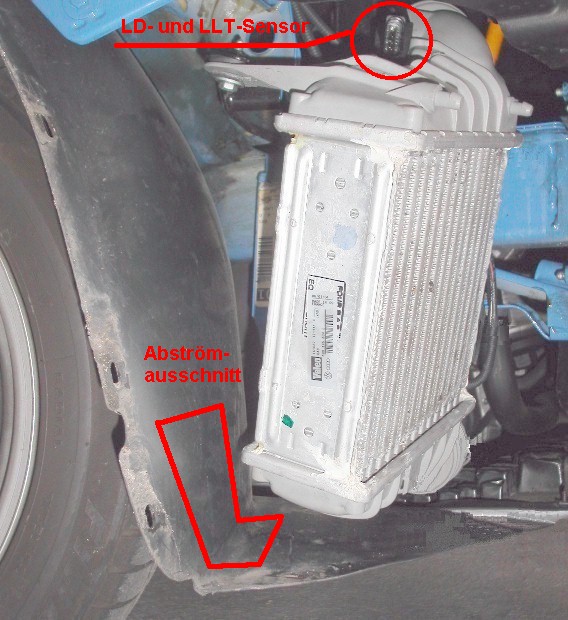
The attachment shows a possible cutout to be made in the Polo's radiator shroud to improve the outflow of warm exhaust air. This modification can reduce the engine temperature by approximately 5K on a Polo. The cutout (approximately 20 cm wide) can be made, for example, with a utility knife. If you heat the plastic thoroughly with a hairdryer or hot air blower, the knife will cut through it easily, like butter.
Round off the corners of the cutout – I've drawn them as squares here for convenience only.
I hope the sensor is located at the top of the SMIC output and not at the bottom of the input, because a wrong SMIC might have been installed.
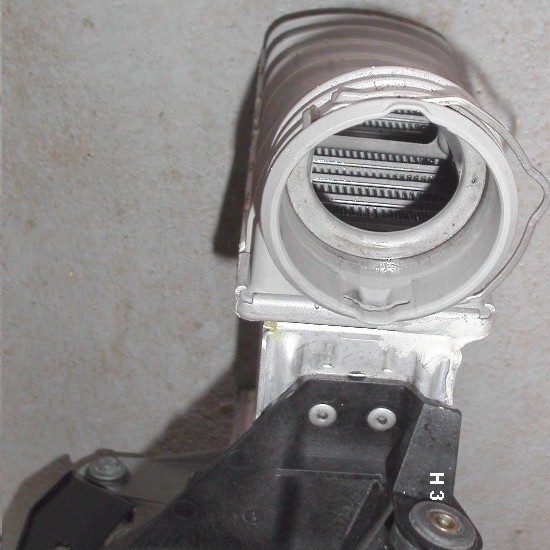
If you can detach the upper hose from the intercooler, try to look inside the cooling fins, possibly using a flashlight and mirror to see around the corner. You should be able to see the internal vanes (see Appendix 2); otherwise, the intercooler is defective and needs to be replaced!
| The Skoda workshop has two Fabia RS models currently in for repairs, and they are both approximately the same age.
"The first one has the aforementioned problems, and the second one runs smoothly with 170 horsepower and 400 Nm of torque without any need for a lower LD (lambda) setting, even on mountain roads, at the same tuning shop where I went." }
Depending on how the tuning was done, this might not mean anything. I have a log from a chipped ASZ Ibiza with LLT (Low Temperature) that goes up to almost 100°C: in that case, the reduction in LD (Lean Definition) compared to the normal target is barely noticeable.
In other words, the chipped Fabia RS might behave just as erratically with its stock software as yours does, see what happened with Cupra-turbo's car...
| Description: |
|
| File size: |
125.44 KB |
| Viewed: |
10298 times |
|
| Description: |
|
| File size: |
92.95 KB |
| Viewed: |
8198 times |
|
Gruß Ulf
_________
MG4 Electric
Translated on 04-08-2026, 22:46.
|
|
| Back to top |
Profile PM Garage |
|
dieselschrauber
Administrator
Joined: 04/12/2002
Posts: 18099
Karma: +799 / -0
Location: St.Gallen
2018 Volkswagen T6
|
| 20-08-2006, 13:06 Subject: |
Quote |
|
Hi,
Quote: | | I have a log from a chipped ASZ Ibiza with LLT up to almost 100°C | .
"Just yesterday, I had a T3 with the recurring problem of excessively high lambda values. Within seconds of full throttle, the lambda value exceeded 100°C (with an ambient air temperature of around 22°C and a boost pressure of approximately 1.2 bar), causing the engine to run completely within the soot management system due to the reduced airflow. This limited the fuel injection amount to just above the standard level."
"Of course, that won't work like that. You need to place a reasonable heat source in a suitable location where it can actually cool things down."
Best regards, Rainer.
Translated on 04-08-2026, 22:50.
|
|
| Back to top |
Profile PM WWW Garage |
|
ulf
Profi-Schrauber
Joined: 04/13/2002
Posts: 11058
Karma: +18 / -0
Location: Saarland
2023 MG ZS
Premium Support
|
| 20-08-2006, 14:07 Subject: |
Quote |
|
Rainer K. wrote: | | Just yesterday, I had a T3 that once again exhibited the problem of excessively high LLT (Low-Temperature Heat). Just a few seconds after full throttle, the LLT rose above 100°C (with an air temperature of approximately 22°C at a boost pressure of about 1.2 bar), and the engine ran completely within the soot reduction mode due to the reduced airflow, which limited the injection amount to just slightly above stock levels. |
Hi Rainer,
The T3 was likely a TDI conversion, or were there already factory-installed TDIs in the T3?
Quote: | | That obviously won't work. -> Place a reasonable heat sink in a suitable location where it can actually cool things down. |
... well, in the Fabia, the hardware including the intercooler is supposedly designed for the 96 kW TDI engine from the factory , and yet the charge air gets too hot -> this represents a different problem for me compared to TDI conversions.
Since the Fabia RS, according to the documentation, has the same engine control unit (ECU) as my Polo, increasing the coolant flow by "drilling" into the cooling system should also allow the intake air temperature (IAT) at the measurement point to be reduced by approximately 50 Kelvin above ambient temperature (AT). This would mean that, with the standard software, it could run at full throttle in summer without any loss of power, and maintain a temperature of around 30°C.Gruß Ulf
_________
MG4 Electric
Translated on 04-08-2026, 22:52.
|
|
| Back to top |
Profile PM Garage |
|
ulf
Profi-Schrauber
Joined: 04/13/2002
Posts: 11058
Karma: +18 / -0
Location: Saarland
2023 MG ZS
Premium Support
|
| 22-08-2006, 9:03 Subject: |
Quote |
|
super7 wrote: | It started at around 60 degrees and reached a maximum of 95 degrees.
Starting at 80 degrees, the boost pressure drops to 1650 mbar "920 mbar atmospheric pressure," then reaches a maximum of 95 degrees and settles around 90 degrees with a significantly reduced boost pressure, meaning 1700 mbar | .
Just something that occurred to me:
Please test the plausibility of the LLT data with a cold engine (standby time at least 6 hours): Turn on the ignition and call up diagnostic parameter group 7 -> Is the LLT value within the range of the other two temperatures (water + diesel)?
It would also be interesting to see a log of the LLT (Low Load Torque) behavior at low engine loads, if you have time: about 5 minutes of cruising on a country road up to approximately 80 km/h in high gears, allowing the car to roll as much as possible, and then, as a final test, full throttle in 3rd gear from approximately 1500 to 4500 rpm.
Based on the data from the liquid cooling system (along with the outside temperature), I hope it will be possible to determine whether your extreme values are more likely due to poor performance of the liquid cooling system or potentially electronic measurement errors.
By the way, I now know that at high load levels (LLT), MSG not only reduces the torque limit (LD), but also performs an additional fuel injection adjustment (of course, downwards): this difference between the lowest limit from map 8 and the value from map 1 will likely become noticeable at LLT = 80°C when running at full throttle.
To track this down, you should try logging values for 001, 007, and 008 while the "LLT emergency brake" is activated.
Unfortunately, as far as I know, there's no way to simultaneously log the LD (likely referring to "load data" or a similar term) along with this process. Gruß Ulf
_________
MG4 Electric
Translated on 04-08-2026, 22:57.
|
|
| Back to top |
Profile PM Garage |
|
dieselschrauber
Administrator
Joined: 04/12/2002
Posts: 18099
Karma: +799 / -0
Location: St.Gallen
2018 Volkswagen T6
|
| 22-08-2006, 10:36 Subject: |
Quote |
|
Hi Ulf,
Observe the air mass at very high Low-Level Temperatures (LLTs). High temperature means large volume and low mass; therefore, the Mass Flow Meter (MFM) will measure a lower value, and the soot reduction system will activate.
Best regards, Rainer.
Translated on 04-08-2026, 23:00.
|
|
| Back to top |
Profile PM WWW Garage |
|
ulf
Profi-Schrauber
Joined: 04/13/2002
Posts: 11058
Karma: +18 / -0
Location: Saarland
2023 MG ZS
Premium Support
|
| 22-08-2006, 10:44 Subject: |
Quote |
|
Rainer K. wrote: | | Observe the air mass at very high LLTs. Hot means large volume, little mass; the LMM measures less; soot reduction becomes active. |
Hi Rainer,
If the active soot reduction system were causing the quantity decrease, then the amount in component group 1 would have to match the amount with the soot reduction system in component group 8.
My test logs clearly show that the amount in container MWB 1 drops below the lower limit of container MWB 8 when the LLT emergency brake is engaged: apparently, this is a form of anti-tuning designed to immediately reduce exhaust gas temperature.
By the way, there's a certain parameter that plausibly explains this behavior – and which, in my opinion, could be adjusted during chip tuning to somewhat mitigate the inevitably higher exhaust temperatures (roughly speaking). Gruß Ulf
_________
MG4 Electric
Translated on 04-08-2026, 23:01.
|
|
| Back to top |
Profile PM Garage |
|
dieselschrauber
Administrator
Joined: 04/12/2002
Posts: 18099
Karma: +799 / -0
Location: St.Gallen
2018 Volkswagen T6
|
| 22-08-2006, 11:22 Subject: |
Quote |
|
Hi Ulf,
Okay, it was an ALH engine control unit. However, I would still find it more sensible to upgrade the cooling system rather than trying to modify the software to make the engine run reasonably well even when hot.
And the physical fact that the air mass (and therefore the possible amount of fuel injection) decreases with increasing engine speed cannot be changed.
Best regards, Rainer.
Translated on 04-08-2026, 23:03.
|
|
| Back to top |
Profile PM WWW Garage |
|
ulf
Profi-Schrauber
Joined: 04/13/2002
Posts: 11058
Karma: +18 / -0
Location: Saarland
2023 MG ZS
Premium Support
|
| 22-08-2006, 11:31 Subject: |
Quote |
|
Rainer K. wrote: | | However, I would still prefer an LLK upgrade rather than modifying the software in a way that allows the engine to run reasonably well even when hot. |
100% ACK - I would never advise users like Cupra_turbo or super7 to eliminate performance drops caused by LLT (Low Temperature) by disabling safety features in the software  .
I meant, for example, a reduction of the LLT (lambda-dependent timing) thresholds for quantity reduction in chip tuning, because the thermal reserves generally become smaller with higher injection quantities - if it becomes really tight, for example, during the hottest summer months, one should, in my opinion, correct the performance back towards the standard settings at an earlier point.
Regarding the LLK (liquid-cooled intake manifold) upgrade: Sometimes, simply clearing the airflow path around the SMIC (short manifold intake chamber) can make a significant difference... For example, on a Polo with an ASZ engine, it can reduce temperatures by approximately 16 Kelvin in the Pmax range. With a hole drilled in the wheel arch liner to allow for direct exhaust of hot air, the reduction can be even greater, closer to 20 Kelvin -> resulting in roughly 6% more airflow at the same load (LD).
For comparison:
Compared to such an optimized mass-produced SMIC, the FMIC of the Ibiza Cupra TDI only provides approximately 20 additional kW of power reduction (in both naturally aspirated measurements and with comparable boost pressure).
EDIT 23.08.
In the case of the parallel failure of the cupra_turbo system, the cause appears to have been a contaminated SMIC (Solid Matrix Interface Controller). See [link/reference].
Okay, I'm ready. Please provide the German text you want me to translate into English.
Because the symptoms are very similar, this suspicion is also likely in this case.
The question then is whether / why the SMIC (Selective Catalytic Reduction) system in the Fabia RS is more prone to clogging than in the Polo or Ibiza  .
P.S.: If the car with the tuning frequently goes into "limp mode" with the error message "boost pressure limit exceeded," it looks like a poorly done tuning job -> Tip for @ super7 : look for something better, e.g., from our host  . Gruß Ulf
_________
MG4 Electric
Translated on 04-08-2026, 23:06.
|
|
| Back to top |
Profile PM Garage |
|
mserge
Schrauber

Joined: 06/20/2005
Posts: 923
Karma: +6 / -0
Location: Luxemburg
Support
|
| 23-08-2006, 16:01 Subject: |
Quote |
|
Rainer K. wrote: | Hi Ulf,
Observe the air mass at very high Low-Level Temperatures (LLTs). High temperature means large volume and low mass; therefore, the Mass Flow Meter (MFM) will measure a lower value, and the soot reduction system will activate.
Greetings, Rainer | .
Hmm, the LMM (likely referring to a Mass Air Flow sensor) measures the air "drawn in" before the intercooler, so it must have a significantly lower temperature than the exhaust gas, right?
The LMM doesn't detect when the LLT increases because this happens "behind" it.
Or am I wrong about that? A4 Avant 2,5 tdi 110kw; AFB; BJ2000
4 neue Nockenwellen bei 135 tkm!!
neuer Turbo bei 200.000km
neue ESP bei 216.000km
verkauft mit 225000tkm
jetzt Renault Espace 2,0 dci 172 Initiale BJ2012
Clio 2 RS 170 PS BJ2003
Translated on 04-08-2026, 23:10.
|
|
| Back to top |
Profile PM |
|
|


 Bookmarks
 Links
Links Garage
 FAQ, Legal Notice & Privacy
 RSS Feed
 Register
 Login
Login

