| Author |
Message |
wbuchi82
Blaumann

Joined: 11/10/2003
Posts: 88
Karma: +9 / -0 
Location: Österreich/Steiermark/Haus
Free account, no CAN development support
|
 21-12-2004, 8:49 Subject: 21-12-2004, 8:49 Subject: |
Quote |
|
Hey guys!
Okay, I need to revisit this topic again because I haven't made any progress with my problem. The buzzing sound and the loud engine are still present, and there doesn't seem to be a solution in sight.
However, I must say that nothing has deteriorated either, and the transmission is still diligently doing its job. In the meantime, I have also exceeded the 170,000 km mark, and it's running perfectly well... except for the annoying humming  .
"@wiarsix or @moby: Has anything changed for you in the meantime? Have you found a solution, or have any damages occurred?"
Sure, here is the translation of the text from German to English:
"MFG" stands for "Mit freundlichen Grüßen," which translates to "Sincerely" or "Best regards" in English. It is a common way to end a formal letter or email. Audi A3 Ambition, Bj.02, ASZ - SoftwareTuning 160PS
Multimedia-CarPC 2,4GHz - 1GB RAM - 300GB HDD - 8" Tochscreen
Translated on 04-08-2026, 14:48.
|
|
| Back to top |
Profile PM Email |
 |
moby
Guest
Free account, no CAN development support
|
| 21-12-2004, 13:49 Subject: |
Quote |
|
Hello, the engine control unit needs to be reflashed. However, the rough running has improved with the new mass airflow sensor! I think it's not as loud at higher RPMs anymore!
I will report back if the buzzing sound changes after the software update.
Sure, here is the translation of the text from German to English:
'CU Thomas' translates to 'See you, Thomas.'
Translated on 04-08-2026, 14:49.
|
|
| Back to top |
|
|
vagtuning
Guest
Free account, no CAN development support
|
| 21-12-2004, 14:14 Subject: |
Quote |
|
Is the ASIC being flashed?
I would be very interested to see the data values *before* and *after* the flashing process!
Translated on 04-08-2026, 14:50.
|
|
| Back to top |
|
|
wiarsix
Guest
Free account, no CAN development support
|
| 23-12-2004, 1:19 Subject: |
Quote |
|
Hello @wbuchi82 & everyone,
neither...nor...everything is the same. I've gotten used to it in the meantime  .
In the spring, if the problem persists and no further damage occurs, I'll have the engine mounts replaced. Thanks for your tips anyway, and please continue to share any updates.
Sure, here is the translation of the text from German to English:
'MFG' stands for 'Mit freundlichen Grüßen,' which translates to 'Sincerely' or 'Best regards' in English. It is a common way to end a formal letter or email.
Translated on 04-08-2026, 14:50.
|
|
| Back to top |
|
|
moby
Guest
Free account, no CAN development support
|
| 06-01-2005, 21:54 Subject: |
Quote |
|
Hello.
I took the time to describe the symptoms as accurately as possible! The periods when the car runs poorly last for approximately 1-3 months, while the periods when it runs well last for about 1-6 weeks. The transition from a 'good' phase to a bad phase occurs with sporadic occurrences of the symptoms. And after about 2 days, the car consistently runs poorly. Conversely, this doesn't happen; it suddenly starts running well again. During the 'bad' phase, the engine noise becomes louder, and the rough running also worsens. I hope that based on this information, you can identify the problem. There are no error codes stored in the diagnostic system. The turbocharger boost control valve and mass airflow sensor have already been replaced.
Note: The humming noise is loudest at exactly 2200 RPM (3rd gear) when the vehicle is decelerated from a higher engine speed.
'Persistent engine anomalies that may be relevant for diagnosis.'
In the first two courses:
1.) A delayed whining sound coming from near the engine when releasing the accelerator pedal.
The howling sound starts with a high pitch and gradually descends to a lower tone before eventually fading away completely.
It occurs approximately 1-3 seconds after the gas is removed.
Duration: approximately 5-8 seconds.
2.) During gas intake, a delayed hissing sound is heard coming from near the engine.
The howling sound starts with a low tone and gradually rises to a high tone, often without disappearing afterwards.
It occurs approximately 1-3 seconds after pressing the accelerator pedal.
No specific duration could be determined, as the sound was likely masked by other noises.
3.) When accelerating strongly in first gear and then shifting to second, it's noticeable that when you immediately floor the accelerator in second gear, the turbo doesn't respond right away, and it feels like you're not getting any power. This wasn't the case directly after replacing the wastegate control valve.
In all aisles:
a) Everything that can be observed during the acceleration process.
aa) Vibrations levels in the range of 1800-2300 RPM occur under partial or full load conditions.
For example, in 6th gear at approximately 120 km/h or when driving uphill.
It feels like the engine is being choked.
The interior paneling on the driver's side is vibrating.
b) Engine stalling during gear changes.
louder and more unrefined engine.
b) Everything detectable upon removal of gas.
The engine starts to rumble 1-3 seconds after releasing the accelerator pedal. The duration of the rumbling varies depending on the gear, lasting approximately 5-10 seconds.
c) All detectable features are present when the gas is admitted (without any acceleration).
The knocking sound inside the car is very noticeable. It's particularly prominent in second gear at 30 km/h (approximately 19 mph). It sounds as if there are missing soundproofing materials in the engine compartment, or that the noise is being transmitted through the ventilation system. This distinct knocking was not present at all when I purchased the vehicle.
II. Non-constant engine anomalies that may be relevant for diagnosis.
In the first hallway:
1. The engine makes a whining noise when accelerating. The sound starts the moment the turbo kicks in and gets louder as the RPM increases.
2. In this case, the engine feels like it's being held back, and it doesn't reach the speed that would be expected when accelerating.
3. Geräusch bleibt auch beim Auskuppeln präsent, und verschwindet erst mit Einlegen des 2. Gattached.
In all aisles.
a) The turbo's response to acceleration is delayed.
b) The turbo's response to acceleration is sometimes absent.
c) The turbo's response to acceleration feels like it's not building up full pressure.
d) The acceleration from the top end feels noticeably restrained.
e) The presence of the passenger is noticeable due to a significantly reduced torque and less responsive acceleration.
f) Acceleration process: With any accelerator pedal position from approximately ¼ throttle onwards, the power/torque is equal (which is bad), especially noticeable in 3rd gear.
g) Pressing the accelerator pedal from 1500 RPM onwards results in absolutely no response from the turbocharger.
h) From approximately 2600 RPM onwards, accelerating hardly produces any additional torque (this is particularly noticeable in the first four gears).
III. Constantly occurring general anomalies that could affect the engine:
1.) The maximum speed on the highway is approximately 200 km/h in one direction.
Direction: At speeds of 215-220 km/h with a ¾ full tank and no passenger.
2.) Fuel consumption is approximately 7-8 liters.
3.) The engine's hum is clearly audible from outside.
IV. Non-constant general anomalies that could affect the engine:
1. Diesel smell inside the car, regardless of the length of the journey. Even while driving.
2.) A noticeable noise, similar to air escaping or something of that nature, was detected near the alternator.
3.) Turning off the automatic climate control immediately after starting the engine in cold conditions causes significant shaking while the car is stationary. It then takes approximately 10-20 seconds for the shaking to begin, and it continues for at least 5 minutes.
4.) ESP-Lampe leuchtet nicht immer auf, trotz deutlich wahrnehmbarem Traktionsproblemen beim Beschleunigen besonders im 1.+ 2. Gang.
'When rolling in second gear WITHOUT pressing the accelerator, the car jerks as if you were briefly accelerating or quickly releasing and then lifting off the clutch pedal. This happens repeatedly within about 2 seconds, maybe 5 times. It causes a significant amount of shaking. It's comparable to the starting problems of driving students who release the clutch too quickly and then immediately press it again.'
Thank you for your help!
moby
Translated on 04-08-2026, 14:59.
|
|
| Back to top |
|
|
moby
Guest
Free account, no CAN development support
|
| 17-01-2005, 18:49 Subject: |
Quote |
|
Hello,
Does anyone know about this problem, or has my detailed post been overlooked???
I put in so much effort  .
Sure, here is the translation of the text from German to English:
'CU Thomas' translates to 'See you, Thomas.'
Translated on 04-08-2026, 15:08.
|
|
| Back to top |
|
|
ulf
Profi-Schrauber

Joined: 04/13/2002
Posts: 11058
Karma: +18 / -0
Location: Saarland
2023 MG ZS
Premium Support
|
| 17-01-2005, 21:35 Subject: |
Quote |
|
moby wrote: | Hello,
Does anyone know about this problem, or has my detailed post been overlooked???
I put in so much effort | .
I read it, but I can't quite make sense of it.
And despite your detailed descriptions, it's difficult for me to exactly imagine what is happening in detail... Gruß Ulf
_________
MG4 Electric
Translated on 04-08-2026, 15:08.
|
|
| Back to top |
Profile PM Garage |
|
moby
Guest
Free account, no CAN development support
|
| 18-01-2005, 1:22 Subject: |
Quote |
|
Hello,
If you, as a professional, can't make sense of this problem, it doesn't surprise me that the workshops and other people in the forum are at a loss.
Let me reiterate: The acceleration is consistently the same with your test (approximately 6.1-6.3 seconds). However, the torque isn't always present. It can change abruptly (and this has only recently started happening). For example, it might pull strongly in 3rd gear, then not at all in 4th, and then work well again in 5th (meaning sometimes it pushes you back into your seat, and other times it doesn't). Also, it feels rough around 2000 RPM.
It's like with the 1.8 turbo engine with 150 horsepower. The speedometer needle goes up quickly, but subjectively, you don't get the feeling that the car is accelerating strongly.
I hope this helps .
Sure, here is the translation of the text from German to English:
'CU Thomas' translates to 'See you, Thomas.'
Translated on 04-08-2026, 15:10.
|
|
| Back to top |
|
|
kini
Blaumann
Joined: 11/09/2003
Posts: 39
Karma: +6 / -0
Premium Support
|
| 18-01-2005, 2:22 Subject: |
Quote |
|
hi
due to the vibrations, do your TDIs already have a two-mass flywheel? I know, for example, that this is something that often breaks on an Opel Omega 3.0 24v and then causes vibrations. Is that maybe what's happening here? I myself drive a simple 1.0 Polo, which doesn't have anything like that. 
Best regards,
Eric
Translated on 04-08-2026, 15:12.
|
|
| Back to top |
Profile PM Email |
|
moby
Guest
Free account, no CAN development support
|
| 20-01-2005, 21:58 Subject: |
Quote |
|
Hello.
I was just reading the boost pressure with the master technician at the Audi workshop. The target value (SOLL) was 2335, while the actual value (IST) peaked at 2515 mbar. He said that the turbine vanes of the VGT are sticking. HOWEVER, according to your list, the acceptable IST value is up to 2600 mbar. So, what's correct? Is it the reading on the diagnostic tool display or the information in the Excel table?
Sure, here is the translation of the text from German to English:
'CU Thomas' translates to 'See you, Thomas.'
Translated on 04-08-2026, 15:13.
|
|
| Back to top |
|
|
Jan6K
Joined: 04/12/2002
Posts: 4741
Karma: +107 / -0
Location: Hagen
Premium Support
|
| 20-01-2005, 22:01 Subject: |
Quote |
|
Hi,
Ueberschwinger von 200 mBar sind absolut normal - ich interpretiere dein "in der Spitze" mal so. Interessant ist der eingeregelte Druck bei 3000 Umdrehungen im 3. Walking pace and full load.
Best regards,
January.
1Z5 CFHF  / AHB H4D 
Translated on 04-08-2026, 15:14.
|
|
| Back to top |
Profile PM |
|
moby
Guest
Free account, no CAN development support
|
| 20-01-2005, 22:18 Subject: |
Quote |
|
Hello, the value was recorded at approximately 2300 RPM.
Why does he then say that the turbo is defective?
Sure, here is the translation of the text from German to English:
'CU Thomas' translates to 'See you, Thomas.'
Translated on 04-08-2026, 15:15.
|
|
| Back to top |
|
|
ulf
Profi-Schrauber
Joined: 04/13/2002
Posts: 11058
Karma: +18 / -0
Location: Saarland
2023 MG ZS
Premium Support
|
| 20-01-2005, 23:24 Subject: |
Quote |
|
moby wrote: | Hello, the value was found to be approximately 2300 RPM.
Why does he then say that the turbo is defective? |
Because he wants to sell you a new one? Gruß Ulf
_________
MG4 Electric
Translated on 04-08-2026, 15:15.
|
|
| Back to top |
Profile PM Garage |
|
Jay_Dee
Guest
Free account, no CAN development support
|
| 21-01-2005, 8:53 Subject: |
Quote |
|
1.) When releasing the accelerator pedal, a delayed whining noise originating from near the engine.
The howling sound starts with a high pitch and gradually descends to a lower tone before fading away completely.
It occurs approximately 1-3 seconds after the gas is removed.
Duration: approximately 5-8 seconds.
2.) Upon starting the engine with gas, a delayed whining noise is heard coming from near the motor.
The howling sound starts with a low tone and gradually rises to a high tone, often without disappearing afterwards.
It occurs approximately 1-3 seconds after pressing the accelerator pedal.
No specific duration could be determined, as the sound was likely masked by other noises.
That's probably your turbocharger.
Stuck VTG?
Given the rattling/rumbling noise, I would suggest, if I were you, that you simply spend around 10 euros and take your car to a local garage with a lift to have it checked out.
Do you also experience these noises when you're stopped at a traffic light with the engine idling?
Mostly in a cold state?
Does the noise disappear immediately when you increase the speed slightly?
I would pay particular attention to the exhaust pipe and the muffler joint between the catalytic converter and the middle section of the exhaust system.
You should remove the undercarriage protection for that.
The best thing to do is get in the car and have someone check the exhaust system.
For example, in my case, all three nuts on the exhaust pipe near the turbo were loose.
Furthermore, the connection joint between the catalytic converter and the middle pipe was causing a nasty squealing noise (similar to the clutch in many Volkswagen Golf II models).
Defective torque arms (transmission supports) can also cause disturbing vibrations.
I've given up searching for the various crackling and buzzing noises in my Volkswagen Golf.
There are simply too many of them.
Lately, there's been a crackling sound in the sky.
Translated on 04-08-2026, 15:18.
|
|
| Back to top |
|
|
moby
Guest
Free account, no CAN development support
|
| 21-01-2005, 14:29 Subject: |
Quote |
|
Hello.
The humming sound is coming from the front right side when you are standing in front of the car, which is the driver's side. There is no humming noticeable on the other side.
Thank you for your advice.
Sure, here is the translation of the text from German to English:
'CU Thomas' translates to 'See you, Thomas.'
Translated on 04-08-2026, 15:22.
|
|
| Back to top |
|
|
moby
Guest
Free account, no CAN development support
|
| 09-07-2005, 22:41 Subject: |
Quote |
|
Hello, after several more visits to the workshop, I wanted to share with you the results of the repairs. The turbocharger and the high-pressure fuel pump (PDE) were replaced.
For a week, I also had a new mass airflow sensor (MAF) installed, which was not a standard replacement part.
The gas response improved starting at 1800 RPM. However, since the change, the engine braking is so extreme that you can feel it in the seatbelts when going downhill at 140 km/h if you completely release the accelerator (6th gear). It loses approximately 20 km/h in about 5 seconds while going downhill! With a 12% incline, the car maintains a speed of around 30 km/h in 2nd gear. The engine revs up excessively; when shifting gears, you can hear the engine continuing to run before slowly reducing the RPM after about 2 seconds. The engine feels very rough and is quite loud. The gas response while idling, with the clutch disengaged, is not as immediate compared to two other A3 models with a 130 HP TDI engine.
Ferner habe ich das Problem, dass mein Wagen für 1-2 Wochen richtig geil läuft, d.h. er hängt am Gas und dann auf einmal läuft er wieder schlecht. Dies tritt meist über Nacht ein. Oder macht sich ein Tag vorher durch sporadische Ausnahmen bzgl. der Gasannahme bemerkbar. Aber auch während dieser guten Phase gibt er mir ab und zu das Gefühl, dass das Drehmoment fehlt. Wenn er schlecht läuft würgt man ihn im kalten Zustand ab. Man muss halb gas geben damit er auch losfährt ohne abgewürgt zu werden. Letzte Woche hatte der Audi so ne Phase als er super lief. Wir waren zu viert im Auto (alles starke Männer *g*) und der Wagen hing richtig am Gas bergauf im 4. Gang bei 70 km/h , besser als im Moment, wenn ich alleine fahre !! Wenn man auf der Landstrasse dahingleiten will im 5. oder 6. Gang, muss man das Gaspedal mehr durchdrücken. Bin in den letzten Tagen gleiche Fahrzeuge gefahren und musste feststellen dass mein Turbo bei ca. 2000 U/min abrupt kommt. Bei den anderen ging es unspektakulär von 1500 U/min -4500 U/min durch. Kein heftiger Einsatz des Turbos. Der LMM wurde gewechselt, da ich dauernd Aussetzer zwischen 2500-3500 U/min besonders im 2. Gang bei stärkerem Beschleunigen hatte. Dies brachte aber keine nennenswerte Besserung. Ein anderes Problem stellt das Rütteln im Stehen dar. Ob im kalten oder warmen Zustand. Der Motor schaukelt sich geradezu hoch. Es fängt langsam an und wird dann innerhalb von 2 minuten immer schlimmer. Wenn es heftig schüttelt dann wirds kurz wieder weniger und dann steigert es sich wieder. D.h. es hat sich nix geändert durch den Tausch der PDE. Der Durchschnittsverbrauch ist schon mehrmals laut FIS kurz (ca. 10-20 sek.) nach dem Starten ohne Gaszugeben von 7.1 auf 7,2 l/100 km angestiegen. Einmal sogar von 7,1 auf 7,3 liter !! Wobei ich ca. 50-100 km gefahren war nach Reset des Durchschnittsverbrauchs. Ist das normal ?? Laut meinen Messungen hatte ich kurz nach den Reparaturen 6.0 sekunden und jetzt 6.2 sekunden (DZR). The strange thing is that the values remain the same, even though you're supposed to...It gives the impression that the torque is varying.
As you can see, there are still some real problems here. My workshop refused to use a comparable vehicle that was parked just 2 kilometers away for logging purposes so they could compare its values with mine. They said it wouldn't be helpful. Instead, someone from the service department should come. Which is something I have already mentioned several times. According to my 'master mechanic,' he's reached the end of his rope.
Two questions that are not related to engine technology:
Why is the WFS suddenly blocked for me? I can't run any diagnostics. I have previous logs that indicated successful WFS diagnosis.
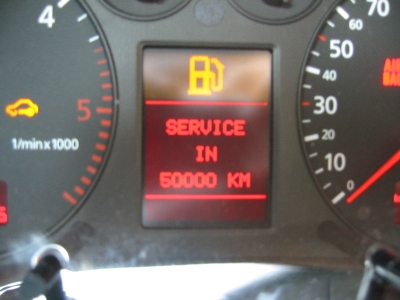
'Why did this message (see attachment) keep appearing on the FIS (driver information system) every time I started the car for a while? The car had just been serviced about a week before. The message appeared for approximately one week. Three Audi master mechanics have never seen this phenomenon before!'
He then read the correct value, which was 37,400 km.
I hope you can help me identify the sources of errors.
Sure, here's the translation:
'Thank you in advance!'
Sure, here is the translation of the text from German to English:
'CU Thomas' translates to 'See you, Thomas.'
| Description: |
|
| File size: |
79.11 KB |
| Viewed: |
2317 times |
|
Translated on 04-08-2026, 15:25.
|
|
| Back to top |
|
|
|


 Bookmarks
 Links
Links Garage
 FAQ, Legal Notice & Privacy
 RSS Feed
 Register
 Login
Login

