| Author |
Message |
Gremlin
Guest
Free account, no CAN development support
|
 02-11-2004, 13:35 Subject: 02-11-2004, 13:35 Subject: |
Quote |
|
One should take the principle of Ernst's 'Fahrschaubild'.
It completely failed for me, at least.
I've entered the values for my old 'alt-opa-kiste' (presumably a specific type of storage box) and also for the Octavia.
Consequently, the Kiste (TM) should have accelerated significantly better.
In practice, the two vehicles are very closely matched. Although the Octavia has 25 horsepower less, it accelerates just as quickly (and only the stopwatch matters, not how it feels). However, the ALH engine produces 210 Nm of torque, compared to 170 Nm for the other engine.
Ultimately, the 'Kiste' (presumably a device or product) didn't offer any performance benefits because it lacked a continuously variable transmission.
The 1.8T engine pulls very smoothly, but it's only superior to the equally powerful TDI if you downshift and rev it out. In a typical acceleration test in 5th gear, even the 1.8T struggles. That's where the TDI's extra +120 Nm of torque really makes a difference.
The religious conflict really hit hard with the field workers here.
Meanwhile, everyone is driving TDIs, and not because of the fuel consumption  .
When it comes to purely driving performance, excluding top speed runs, a 1.8T engine doesn't really stand much of a chance against an ASZ engine.
If you're loading the usual 250 kg of stuff in the back and it's heading to Kassel, then it definitely won't fit .
CU Gremlin.
Translated on 21-07-2026, 3:46.
|
|
| Back to top |
|
 |
ObenbeiMutti
Guest
Free account, no CAN development support
|
| 02-11-2004, 14:37 Subject: |
Quote |
|
Hmm.
Hat man in Relation zur Übersetzung eine größeren Kraftausbeute beim TDI, oder beim Saugbenziner. Will fragen, rechnete man die Fläche auf dem Kraftdiagramm unter der Kurve normiert, in Relation zur Drehzahl aus, würde dann der TDieseli nicht genauso schlecht dastehen, wie der Saugbenz? Bei diversen Neuwagentestberichten sind immer die Benziner mit gleicher Leistung bei selbem Gewicht im Vorrteil. Sowohl Vmax, als auch 0-100. Einzig die Elastizitätsprüfung gewinnt immer, und zwar um Welten der Diesel. Es ist wohl der psychologische Effekt des Dampfhammers bei 2000 der mich von Überlegenheit träumen lässt. Das homogene Benzinerziehen schleicht sich so unbewusst ein, dass man meinte der Wagen liefe im Notprogramm. Aber Zahlen lügen nicht. Auf the racetrack,Even the best TDI wouldn't have been able to compensate if you didn't know the braking points and curves, but its ability to react quickly from low RPMs allows us to excel in everyday driving.
However, it's probably difficult to win against a comparable gasoline engine when accelerating in the last third of the rev range.
my adolescent 'cool kid' diary (doesn't belong here, you don't have to read it, honestly)  .
When I got my GTI TDI (AFN) G3, a latent passion for GTIs (2.0L gasoline, 115 hp) ignited within me, albeit on a very low level, stemming from the experiences of my post-pubescent years.
In the world of :oops:dachshunds, bread ovens, Remusenddoopf (a type of pastry), dog leash belts, and steering wheel covers,} I never felt at home. But, considering the rural population, lowered in perspective and driving around the city, I had a strong need to measure myself }.
The identical G3 model with a 2-liter gasoline engine nominally had 5 horsepower more. Superficially, I had overlooked the gear ratio in my considerations and rested in my thought world on my torque cushion. In first and second gear, it was also a superior experience; even significant driving errors could be easily corrected. In the middle gears (3rd and 4th), the gasoline engine would likely have regained ground, but the slight advantage in vehicle length often left people feeling disillusioned.It wasn't easy. Technically, the gasoline car is faster to reach 100 km/h, but my head start allows me to complete the quarter mile faster. In a straight-up race, it's still behind me, but it has already reached 100 km/h while I'm still at 98.
Fifth gear, highway driving. Both cars accelerate equally through the night until 195 km/h (approximately 121 mph), but at this point, the gasoline engine experiences a drop in power that I can't explain. The diesel engine steadily climbs to 205 km/h (approximately 127 mph) without needing any tailwind or downhill sections.
Minutes later, the gasoline-powered GTI arrives; it must have had a tailwind. It's overtaking us, damn it!
Scenario: Leaving the parking space, third gear, 2000 RPM, and I'm gone! No chance for that gasoline engine.
As far as...
Translated on 21-07-2026, 3:51.
|
|
| Back to top |
|
|
ulf
Profi-Schrauber

Joined: 04/13/2002
Posts: 11058
Karma: +18 / -0 
Location: Saarland
2023 MG ZS
Premium Support
|
| 02-11-2004, 14:44 Subject: |
Quote |
|
Gremlin wrote: | ulf wrote: |
One should take the principle of Ernst's "Fahrschaubild" | .
That completely failed for me, at least. |
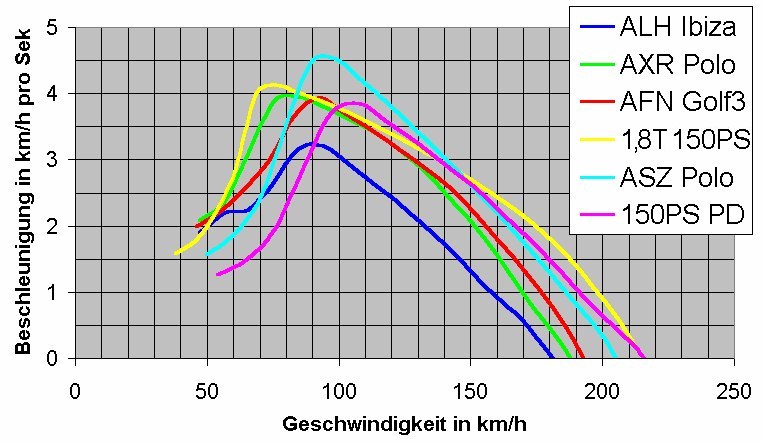
It's funny, it works perfectly fine for me - it's actually simpler than what I wrote above from memory, because the diagram already shows the acceleration relative to the vehicle's speed.
I simply extended the RPM series in the input sheet downwards and expanded the calculation range in the chart.
Assumption: Weight of 1300 kg (1.8 tons) or 1350 kg (TDI). Translation: 216 km/h at 4000 rpm, or 5700 rpm.
Result: Between 100 and 140 km/h, the TDI performs slightly better, while below and above that range, up to 210 km/h, the 1.8T is faster.
Edit:
Attached you will find a few more vehicles that I have previously calculated, all at their maximum speed using maximum power.
| Description: |
|
| File size: |
87.89 KB |
| Viewed: |
10354 times |
|
Gruß Ulf
_________
MG4 Electric
Translated on 21-07-2026, 3:56.
|
|
| Back to top |
Profile PM Garage |
|
ulf
Profi-Schrauber
Joined: 04/13/2002
Posts: 11058
Karma: +18 / -0
Location: Saarland
2023 MG ZS
Premium Support
|
| 03-11-2004, 19:44 Subject: |
Quote |
|
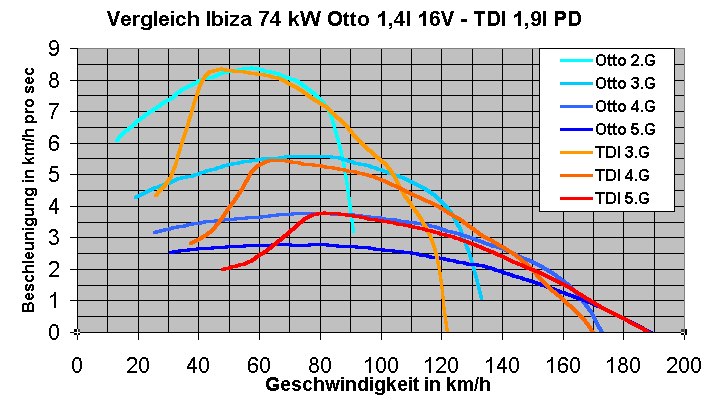
And another diagram (thanks to Ernst S. for creating the driving visualization  ):
Comparison of the 100 hp naturally aspirated gasoline engine and the TDI engine in the Ibiza 6L, specifically focusing on gears 2 through 5 (with the TDI covering gears 3 through 5).
I have the weight figures and translations for the Ibiza, and the torque values are from a 100 hp Polo 9N – assuming that the Ibiza has the same engine.
It's quite clear that the gasoline engine can only keep up with the TDI (once it reaches full boost pressure) in terms of acceleration if it downshifts one gear.
| Description: |
|
| File size: |
90.4 KB |
| Viewed: |
19158 times |
|
Gruß Ulf
_________
MG4 Electric
Translated on 21-07-2026, 3:58.
|
|
| Back to top |
Profile PM Garage |
|
Klausel
Blaumann

Joined: 05/09/2002
Posts: 223
Karma: +4 / -0
Premium Support
|
| 03-11-2004, 23:47 Subject: |
Quote |
|
Hello!
@AboveAllMom, TrashyDiary.
You might be wondering how the AFN in the G3 could achieve such a homogeneous result (tachometer reading of 205).
...while it briefly overtook the 115 horsepower gasoline engine in the last 10 km/h?
It's quite simple; it's due to this lamentable (too short) translation.
The engine reaches almost 4300 rpm (nominal speed 4150) at its maximum velocity. 
Of course, it quickly goes according to the manufacturer's specifications (but with a lot of fanfare).
As you climb a mountain, the performance initially increases.
Sure, here is the translation of the text from German to English:
"OT:" - "Off Topic" or "Out of Topic".
I never understood this nonsense, and I'm just one of many who...
auf der Bahn etwas mehr Länge gegen Durchzug tauschen würden. Vpresumably wanted to.
In 1996, VW set a record for the highest speed in 5th gear (80-100 km/h), which was probably quite impressive at the time.
successful; well-executed; accomplished; thriving.
By the way, some drivers of vehicles with automatic transmissions (AFN) believe that the high displayed RPM is a problem.
that "their" car goes much faster than the factory-stated 193 km/h - amusingly, it's actually capable of that speed.
for this reason, it's almost impossible...
OT End.
Greetings,
Klaus.
Translated on 21-07-2026, 4:01.
|
|
| Back to top |
Profile PM |
|
ObenbeiMutti
Guest
Free account, no CAN development support
|
| 04-11-2004, 12:07 Subject: |
Quote |
|
Hello,
@Clause
'Yes, a longer fifth gear, or even a sixth gear, would be urgently needed, especially considering the frequent use of 10-cent modifications and chip tuning. I read somewhere that constantly high RPMs exponentially increase wear and tear.'
@Ulf
These are great charts  , considering this, the diesel engine always seems to have an advantage (in 5th gear on a Ibiza).
I had never considered that the diesel engine's power delivery is not homogeneous but rather unfolds in a 'bump-like' manner .
But what explains the 0-100 km/h acceleration measurements of comparable diesel and gasoline models reported in automotive magazines, which often make the diesel appear inferior?
(Not that this would be a crucial everyday criterion, but  )
Is it the fact that I'm immediately reaching engine speeds above 3000 rpm after the first gear shift, where the diesel engine's torque curve becomes flatter and the gasoline engine, due to its design, performs best?
And/or the fact that it first needs to build up boost pressure?
Torque and elasticity are undoubtedly areas where diesel engines excel.
Best regards,
Translated on 21-07-2026, 4:05.
|
|
| Back to top |
|
|
ulf
Profi-Schrauber
Joined: 04/13/2002
Posts: 11058
Karma: +18 / -0
Location: Saarland
2023 MG ZS
Premium Support
|
| 04-11-2004, 13:09 Subject: |
Quote |
|
ObenbeiMutti wrote: | | But what explains the 0-100 km/h measurements of comparable diesel/gasoline candidates in automotive magazines, which make the diesel appear worse. |
It's not always the case: For example, in the Polo 9N with 74 kW, the TDI is tested to be 2 seconds faster to reach 100 km/h than the 1.4-liter gasoline engine (12.4 seconds vs. 10.3 seconds), and for the 75 hp version: 13.8 seconds vs. 14.2 seconds for the TDI (AMS 1/2003).
Quote: | | Is it the fact that it immediately moves me into regions above 3000 rpm after the first gear shift, where the diesel's torque curve becomes flatter and the gasoline engine, due to its design, exhibits its strengths? |
Which "strength" exactly are you referring to? 
Gasoline engines often have a weight advantage over diesel engines in the same vehicle.
And the gear ratios in gasoline engines are typically more closely spaced than in diesel engines (see above), which means that after each upshift, you are "relatively closer" to the maximum power point, rather than experiencing a greater drop in engine speed as with a diesel engine.
And ideally, it's best if a gear can reach as close to 100 mph as possible, rather than just being "cut off" like in my Polo.
When accelerating, the 3rd gear doesn't reach its maximum RPM (~4500) until around 125 km/h, but the 2nd gear only goes up to 80 km/h -> this gearing is not ideal for achieving a fast 0-100 km/h time. Gruß Ulf
_________
MG4 Electric
Translated on 21-07-2026, 4:09.
|
|
| Back to top |
Profile PM Garage |
|
ObenbeiMutti
Guest
Free account, no CAN development support
|
| 04-11-2004, 13:32 Subject: |
Quote |
|
Which 'strength' are you referring to exactly?
Well, some four-cylinder gasoline engines don't really start to deliver their power until around 4000 RPM, and then they continue to accelerate all the way up to 6000 RPM. In a sense, a highly tuned, small-displacement gasoline engine holds back its performance until that point, in order to unleash it fully within that range.
The diesel engine behaves very smoothly in this regard. With a powerful surge at 2000 RPM, it delivers a consistent power output all the way up to over 4000 RPM. It distributes its potential across the entire range.
I hadn't considered again that a car whose engine reaches 100 RPM in the second gear is faster to reach 100 than one that needs the third gear.
It makes me happy that the Polo can score points in this ranking  .
For me, my AFN+ with the €0.10 deposit is already the benchmark for price-performance ratio and economy in the G3 series.
Considering that the new boxes are becoming heavier and more expensive .
A new A3 needs at least 140 horsepower to be somewhat up to date .
Translated on 21-07-2026, 4:12.
|
|
| Back to top |
|
|
ulf
Profi-Schrauber
Joined: 04/13/2002
Posts: 11058
Karma: +18 / -0
Location: Saarland
2023 MG ZS
Premium Support
|
| 04-11-2004, 14:50 Subject: |
Quote |
|
ObenbeiMutti wrote: | | I hadn't considered that a car whose engine reaches 100 RPM from the second gear is faster to reach 100 than one that takes three gears to do so. |
It's not that simple after all.
With only one gear shift up to 100, the speed drops further into the lower power range (resulting in poorer acceleration) compared to shifting two times.
However, in reality, with each switching operation, some amount of time is "wasted."
Ideally, a continuously variable transmission (with the efficiency of manual transmissions) would be used, allowing the engine to constantly operate at its maximum power point -> an infinite number of gear changes with zero time loss each time .
Quote: | | I am happy that the Polo can score points in this rating system. |
He's not doing very well right now because his translations are rather unfavorable... Gruß Ulf
_________
MG4 Electric
Translated on 21-07-2026, 4:15.
|
|
| Back to top |
Profile PM Garage |
|
ObenbeiMutti
Guest
Free account, no CAN development support
|
| 04-11-2004, 15:36 Subject: |
Quote |
|
Ideally, a continuously variable transmission (CVT) would be used, offering the efficiency of manual transmissions and allowing the engine to constantly operate at its maximum power point, resulting in an infinite number of gear changes with zero loss of time.
[Spin mode]
You would therefore need to use a conical gear rack instead of individual gears, which would then slide continuously along the drive pinion. The incompatibility of the tooth profiles would only need to be resolved .
[Spin mode/]
The new DSG (dual-clutch transmission) from VAG is heading in the right direction. How much heavier is it compared to a 6-speed manual or automatic transmission?
Could I ask two more questions here?
How much worse is the shift pause for a turbocharged engine compared to a naturally aspirated engine of similar power? (In my AFN, it feels like about 3 out of 10 on a scale of how noticeable it is – could that be accurate?)
'Challenge question. Who can, without using a physics formula collection, explain the difference and relationship between force and power in five concise sentences, in a way that is understandable for my grandmother (and therefore for me ), and derive it? Specifically regarding acceleration and final velocity. Work , distance , time , energy .'
If we've already discussed this, ignore it! Start searching for it immediately.
Translated on 21-07-2026, 4:18.
|
|
| Back to top |
|
|
timo832000
Guest
Free account, no CAN development support
|
| 04-11-2004, 17:04 Subject: |
Quote |
|
Power = Work / Time = Energy / Time = Force * Distance / Time.
Translated on 21-07-2026, 4:20.
|
|
| Back to top |
|
|
chris11
Profi-Schrauber
Joined: 10/02/2002
Posts: 326
Karma: +3 / -1
Location: Münster
Premium Support
|
| 04-11-2004, 17:39 Subject: |
Quote |
|
Quote: | Ideally, a continuously variable transmission (CVT) would be best (with the efficiency of manual transmissions), allowing the engine to constantly operate at its maximum power point -> an infinite number of gear changes, each with zero time loss .
|
Hello,
"It already exists. It's used as a belt drive in almost every motor scooter and is available as a friction-based transmission in Audis. The disadvantage with Audis is that it needs to be replaced every 60,000 km as part of routine maintenance."
Information here http://www.audi.com/de/de/neuwagen/technologie/antrieb_fahrwerk/multitronic/multitronic.jsp
They even do it intentionally and unnecessarily, so that the driver gets a better acoustic sense of the acceleration.
Best regards,
Christian.
Translated on 21-07-2026, 4:21.
|
|
| Back to top |
Profile PM |
|
ulf
Profi-Schrauber
Joined: 04/13/2002
Posts: 11058
Karma: +18 / -0
Location: Saarland
2023 MG ZS
Premium Support
|
| 05-11-2004, 11:50 Subject: |
Quote |
|
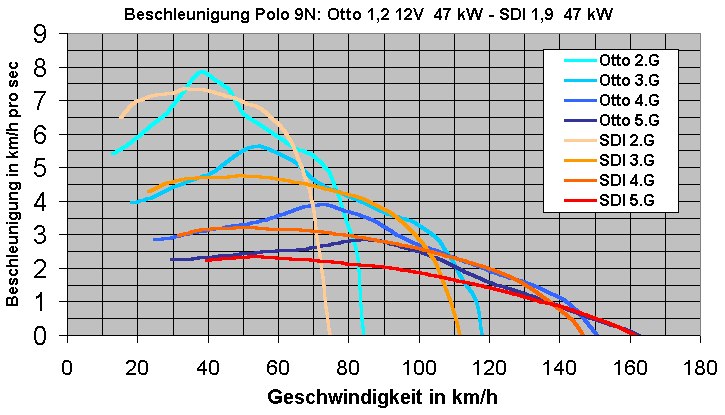
Okay, one last diagram:
Comparison of the Polo 9N with a 47 kW gasoline (petrol) engine - SDI.
It is evident that the diesel engine, without turbocharging, still somewhat lives up to its reputation as a sluggish powerplant (compared to a similarly powerful gasoline engine).
In terms of maximum acceleration, the small gasoline engine, thanks to its torque peak around 3000 rpm in each gear, significantly outperforms the diesel and has a greater range.
Anyone who wants to calculate these comparisons themselves can now download the corresponding Excel file from the "Technical Articles" -> "General" section.
| Description: |
|
| File size: |
90.43 KB |
| Viewed: |
3176 times |
|
Gruß Ulf
_________
MG4 Electric
Translated on 21-07-2026, 4:23.
|
|
| Back to top |
Profile PM Garage |
|
WarLord
Guest
Free account, no CAN development support
|
| 08-11-2004, 22:20 Subject: |
Quote |
|
Regarding the 'rubber band effect' in turbocharged engines: I recently read a report in a magazine about the new A4 with the new 2.0T FSI engine. Apparently, the third gear goes from 25 to 160 km/h. That's what I would really call a significant 'rubber band effect.'
Best regards, WarLord.
Translated on 21-07-2026, 4:24.
|
|
| Back to top |
|
|
ulf
Profi-Schrauber
Joined: 04/13/2002
Posts: 11058
Karma: +18 / -0
Location: Saarland
2023 MG ZS
Premium Support
|
| 09-11-2004, 10:26 Subject: |
Quote |
|
WarLord wrote: | | Regarding the "rubber band effect" in turbocharged engines: I recently read a report in a magazine about the new A4 with the new 2.0T FSI engine. The third gear is supposed to go from 25 km/h to 160 km/h. That's what I would really call a "rubber band" effect. |
This would correspond to a speed range of 6.4.
For example, something like 1000 to 6400 rpm or even 1200 to 7700 rpm – although I don't believe that at 1000 or 1200 rpm there is already a "usable" amount of torque, but rather that these are just arbitrary numbers that were written down. Gruß Ulf
_________
MG4 Electric
Translated on 21-07-2026, 4:25.
|
|
| Back to top |
Profile PM Garage |
|
chris11
Profi-Schrauber
Joined: 10/02/2002
Posts: 326
Karma: +3 / -1
Location: Münster
Premium Support
|
| 09-11-2004, 20:11 Subject: |
Quote |
|
Hello,
"In this case, engine displacement is more helpful. The 25-160 setting works fine for me in third gear, or the 25-200 setting in fourth gear. However, most diesel vehicles are still outperformed, despite their frequent gear changes."
Best regards,
Christian.
Translated on 21-07-2026, 4:26.
|
|
| Back to top |
Profile PM |
|
|


 Bookmarks
 Links
Links Garage
 FAQ, Legal Notice & Privacy
 RSS Feed
 Register
 Login
Login
