| Author |
Message |
Bertil
Profi-Schrauber

Joined: 04/15/2002
Posts: 5628
Karma: +108 / -0 
Premium Support
|
 31-10-2004, 17:35 Subject: Diesel or gasoline... common, outdated slang 31-10-2004, 17:35 Subject: Diesel or gasoline... common, outdated slang |
Quote |
|
Gasoline or diesel? What are the problems?
This article is not intended to spark a discussion about the merits or drawbacks of one type of engine versus another, but rather to explain some commonly held prejudices.
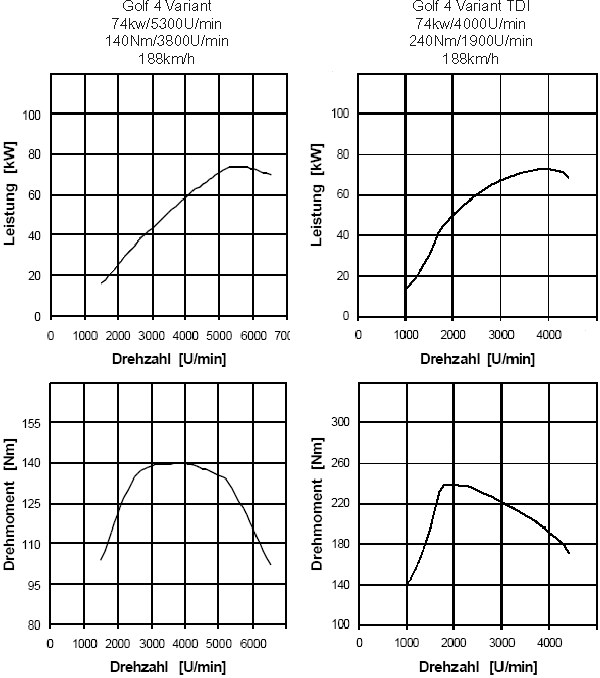
I would like to highlight the most significant differences between two Volkswagen Golf 4 Estate models, both with an engine power of 74 kW.
An den Zahlenwerten ist zu erkennen das beide Fahrzeuge gleich schnell sind. Die Höchstgeschwindigkeit wird im wesentlichen von den Fahrtwiderständen begrenzt. Im Bereich der Höchstgeschwindigkeit halten sich die Motorleistung und die Fahrtwiderstände die Waage. Beim Diesel ist das bereits bei rund 4000U/min der Fall und beim Benziner erst bei rund 5500U/min. Daraus kann man folgern das der Diesel eine rund 30% längere Endübersetzung benötigt. Leider frisst die Getriebeüberstzung somit auch 30% des Drehmomentvorteils auf. Der am Rad ankommende Vorteil ist also im höchsten Gang äusserst gering. ManchSome contemporaries view this as "torque cheating."
But what's so bad about a gearbox?
Every engine needs a transmission to efficiently utilize its power.
Why does the diesel engine still seem to have significantly more power?
Let's take a look at the torque curve on the diagram. As is typical for diesel turbo engines, the torque curve rises very steeply and then flattens out. In gasoline naturally aspirated engines, it also rises quite steeply, but flattens in the middle range before dropping off rapidly. The turbo engine reaches its maximum torque at around 1000 RPM, whereas the naturally aspirated engine requires a good 3000 RPM to achieve the same.
What advantages does an early torque curve offer, even with a longer gear ratio?
Let's consider a speed of 100 km/h. At this speed, the diesel engine is running at 2200 RPM, while the gasoline engine is running at 3200 RPM. As can be seen in the torque diagram, for the gasoline engine, this is below its maximum torque, whereas for the diesel engine, it's above. This clearly shows that a diesel engine is particularly well-suited for transporting heavy loads or towing trailers.When driving both vehicles at 100 km/h uphill, the engine speed will slightly decrease in both. In the gasoline-powered car, the available torque immediately drops significantly, while in the diesel car, it even increases slightly. Downshifting is unavoidable in the gasoline car, but the diesel can continue climbing the hill in the same gear for a bit longer.
This disadvantage of the gasoline engine can only be compensated for by high RPMs. Consequently, fuel consumption increases dramatically.
Diesel engines have terrible acceleration from a standstill!
This blanket statement cannot be left as is.
The correct statement is: Turbomotors have a terrible problem with initial acceleration! This applies to both turbocharged gasoline engines and turbocharged diesel engines.
Since the turbocharger is driven by the exhaust gas flow, it is extremely difficult to generate boost pressure and thus the required power at idle.
The "memory effect" of the turbocharger is clearly visible in the torque curve.
Appropriate design measures can keep this gap relatively small. In diesel engines, this can be achieved, for example, through the use of turbochargers with variable turbine geometry (VTG).
The proper coordination of the components is also very important here. If the transmission is geared too long in first gear, this delay can be quite noticeable. This can be particularly unpleasant when carrying heavy loads or towing a trailer.
Often, the surge in torque after starting is so significant that what feels like a sluggish start is merely a subjective perception. The sudden "jolt" you can experience with a turbocharged engine can be quite unpleasant.
All diesel engines are noisy, rough, and polluting stinkers!
Modern diesel engines have extremely low emissions. The particulate matter emitted by EU4 diesel vehicles is so low that these vehicles actually leave more tire and brake dust than soot. And this can be achieved even without a particulate filter!
Everyone needs to experience for themselves that modern diesel engines haven't been noisy for quite some time. Only the cold start still makes the diesel engine seem old-fashioned.
The heating systems in diesel vehicles are bad!
Modern turbocharged diesel engines have a lower amount of waste heat due to their high efficiency. Therefore, developers must consider strategies early on to quickly bring the engine up to operating temperature. Today's engines often have electric or diesel-powered auxiliary heaters, so they warm up just as quickly as gasoline engines.
How does it compare to a turbocharged gasoline engine?
It's quite simple to explain. Here too, the torque curve rises early and very quickly, then drops off relatively sharply.
To put it plainly: The turbo diesel engine is likely to be significantly inferior to the turbo gasoline engine.
For all engines, it's clear that "you get what you put in!" This means that the more power you demand, the higher the fuel consumption. Diesel engines are somewhat better due to their higher efficiency, but even they start consuming more fuel when you demand full power.
| Description: |
| Diesel or gasoline... common, outdated slang |
|
| File size: |
23.61 KB |
| Viewed: |
13145 times |
|
Gruß Bertil
Skoda 5E5 CZDA + Mini R50 W10 + VW ID.3 + Fiat Ducato 250 + 161 DX
*** Technische Anfragen per PN werden von mir nicht beantwortet! ***
Translated on 21-07-2026, 2:57.
|
|
| Back to top |
Profile PM |
 |
ulf
Profi-Schrauber
Joined: 04/13/2002
Posts: 11058
Karma: +18 / -0
Location: Saarland
2023 MG ZS
Premium Support
|
| 31-10-2004, 18:52 Subject: Diesel or gasoline... common, outdated slang |
Quote |
|
Hi Bertil,
Recently, I presented a comparison between the TDI and the 1.4 gasoline engine in the Polo forum, focusing on their power delivery capabilities – they are practically the same – but using a slightly different calculation method.
http://www.polo9n.com/phpBB2/viewtopic.php?t=6222&postdays=0&postorder=asc&start=10Gruß Ulf
_________
MG4 Electric
Translated on 21-07-2026, 3:04.
|
|
| Back to top |
Profile PM Garage |
|
Bertil
Profi-Schrauber
Joined: 04/15/2002
Posts: 5628
Karma: +108 / -0
Premium Support
|
| 31-10-2004, 19:25 Subject: Diesel or gasoline... common, outdated slang |
Quote |
|
Hi Ulf,
ulf wrote: | | ... however, with a slightly different calculation approach... |
If this article were written for this forum, I would have included the calculation problem (as you did in your article).
I wrote all of this for a forum aimed at amateur campers (sorry, but many of them aren't technically inclined), so I avoided including any complex calculations.
Sure, here's the translation of the text from German to English:
"Just a small addition to the article above:"
All VW TDI engines require a timing belt replacement at 60,000 km.
That's simply incorrect. Only a small series of very early PD TDIs require a timing belt interval of 60,000 km; all others have an interval of 90,000 km. Engines from the MJ 2004 onwards even only need a timing belt replacement at 120,000 km. Gruß Bertil
Skoda 5E5 CZDA + Mini R50 W10 + VW ID.3 + Fiat Ducato 250 + 161 DX
*** Technische Anfragen per PN werden von mir nicht beantwortet! ***
Translated on 21-07-2026, 3:05.
|
|
| Back to top |
Profile PM |
|
mcgregg
Blaumann

Joined: 01/17/2003
Posts: 142
Karma: +7 / -1
Premium Support
|
| 31-10-2004, 21:03 Subject: Diesel or gasoline... common, outdated slang |
Quote |
|
Beim Vergleich Diesel gegen Benziner kommt noch ein weiterer Effekt hinzu. Wenn ich fahre, tendiere ich immer dazu, möglichst früh hochzuschalten, egal ob Diesel oder Benziner. Wenn ich nun bei einem Benziner bei 3000/min in den nächst höhren Gang schalte, bewege ich mich dort eher im unteren Leistungsspektrum. Will ich mehr Leistung, muß ich auch höher drehen. Die dazu gehörende Geräuschkulisse vermittelt einen angestrengten wenig souveränen Eindruck. Weil mich das aber nervt, schalte ich weiterhin spätestens bei 3500/min. Der Motor wirkt entsprechend schlapp. Bewege ich mich beim TDI in diesem Drehzahlbereich, geht es richtig voran. Dadurch stellt sich das Gefühl von souveräner Leistung ein, die der Diesel praktisch aus dem Ärmel schüttelt. Es haligns itselfIn my opinion, it is also related to an acoustic-psychological effect.
Regards,
mcgregg
Skoda Octavia II Combi TDI, 2012, 103kW/140PS MKB CFHC
Translated on 21-07-2026, 3:07.
|
|
| Back to top |
Profile PM |
|
ulf
Profi-Schrauber
Joined: 04/13/2002
Posts: 11058
Karma: +18 / -0
Location: Saarland
2023 MG ZS
Premium Support
|
| 01-11-2004, 1:26 Subject: Diesel or gasoline... common, outdated slang |
Quote |
|
mcgregg wrote: | | When I drive, I always tend to upshift as early as possible, whether it's a diesel or a gasoline engine. | When I operate the TDI in this RPM range, it really picks up speed. This creates a feeling of confident power that the diesel seems to effortlessly produce. In my opinion, it is also an acoustic and psychological effect.}
...which further subjectively enhances the advantages of a diesel engine.
I completely agree!
@ Bertil :
Have you noticed that there are a few Nm and also an estimated amount of power missing from your gasoline engine diagrams compared to the actual figures? Gruß Ulf
_________
MG4 Electric
Translated on 21-07-2026, 3:08.
|
|
| Back to top |
Profile PM Garage |
|
Klausel
Blaumann
Joined: 05/09/2002
Posts: 223
Karma: +4 / -0
Premium Support
|
| 01-11-2004, 2:07 Subject: Diesel or gasoline... common, outdated slang |
Quote |
|
Hello!
The different speed ranges of diesel and gasoline engines allow...
sich ja durch Normierung auf neutrale Prozentzahlen eliminieren. Let's say.
Okay, so a nominal speed corresponds to 100%, and a speed of 0 could be considered as 0%.
but also take into account the idle speed (the latter is probably more sensible).
It is then interesting to examine the performance curves relative to this neutral baseline.
to be placed on top of each other for comparison. Now, let's take the two competing...
Vehicles in the example provided by Bertil, and let's continue to assume that both...
The vehicles are configured such that both can achieve their maximum speed (Vmax) in the highest gear at rated engine speed.
to achieve that, the different acceleration capabilities would need to be considered.
vehicles can reach speeds of, for example, 80 km/h in the highest gear solely due to...
various performances that are achieved at this pace and in this gear.
to be explained.
The varying transit times, ranging from approximately 80 km/h to 120 km/h.
should be determined by calculating the power integrals over this region.
allow to be understood.
The mere visual comparison of the two performance curves from Bertil seems to...
von TDI-Fahrern gepriesenen Vorteil nicht zu erklären. These curves.
(Based on initial observation,) they appear surprisingly close to each other. (@Ulf: see half nominal speed.)
McGregg seems to be right about his opinion regarding a dominant psychological effect.
On the other hand, measurements tell a different story.
Greetings,
Klaus.
-- who is still captivated by his AFN (automatic fuel nozzle) in the Golf 3 and wants to learn more about it.
but can explain Bertil's performance curves less and less.
Translated on 21-07-2026, 3:11.
|
|
| Back to top |
Profile PM |
|
Bertil
Profi-Schrauber
Joined: 04/15/2002
Posts: 5628
Karma: +108 / -0
Premium Support
|
| 01-11-2004, 8:12 Subject: Diesel or gasoline... common, outdated slang |
Quote |
|
ulf wrote: | ....
By the way, have you noticed that in your gasoline engine diagrams, there are a few Nm and also an estimated amount of power missing compared to the numbers? |
... Not only that .... According to the catalog data, the maximum torque for the gasoline engine should occur at 4500 RPM. However, on the diagram, you can already clearly see the beginning of the decreasing curve. Unfortunately, I don't have any other comparable diagrams  .
EDIT:
"I'm sorry, I had put the wrong data into the correct chart. I have corrected it."
74 kW at 5300 RPM.
140 Nm at 3800 RPM. Gruß Bertil
Skoda 5E5 CZDA + Mini R50 W10 + VW ID.3 + Fiat Ducato 250 + 161 DX
*** Technische Anfragen per PN werden von mir nicht beantwortet! ***
Translated on 21-07-2026, 3:15.
|
|
| Back to top |
Profile PM |
|
Bertil
Profi-Schrauber
Joined: 04/15/2002
Posts: 5628
Karma: +108 / -0
Premium Support
|
| 01-11-2004, 9:04 Subject: Diesel or gasoline... common, outdated slang |
Quote |
|
Klausel wrote: |
The different speed ranges of diesel and gasoline engines allow...
sich ja durch Normierung auf neutrale Prozentzahlen eliminieren. Let's say.
Okay, so a nominal speed corresponds to 100%, and a speed of 0 could be considered as 0%.
but also take into account the idle speed (the latter is probably more sensible).
|
Unfortunately, you can't make it that easy for yourself.
If you're making these "comparisons based on standardized values," make sure to use the complete and accurate overall translation for both transmissions. You'll quickly realize that the diesel engine still has a (smaller) torque advantage at the wheel.
Therefore, as I mentioned above, "what's so bad about a gearbox anyway?"
In the standardization comparisons I have encountered so far, it is always assumed that the "bad" diesel engine has a (loss-inducing) transmission... while the gasoline engine doesn't need one  .
Quote: | The mere appearance of the two performance curves from Bertil seems to...
von TDI-Fahrern gepriesenen Vorteil nicht zu erklären. These curves.
(Based on initial observation,) they appear surprisingly close to each other (@Ulf: see half nominal speed). |
"Now, if I overlay the torque curves, I unfortunately can't determine that. At half of the rated speed, the diesel engine has just exceeded its peak torque, while the gasoline engine hasn't reached it yet."
The very fact that we are comparing a turbocharged engine with a naturally aspirated one introduces significant distortions.
Generally, engine manufacturers claim that an engine operates within its ideal range between the point of maximum torque and the point of maximum power. This translates to approximately 2000-4000 RPM for a diesel engine and 3800-5300 RPM for a gasoline engine.
I wonder which gasoline car driver would spend a significant amount of time at this (rather noisy) engine speed range (even at 100 km/h, the RPM is below these values). In contrast, with a diesel engine, we are almost constantly in this range (100 km/h = 2200 RPM). Gruß Bertil
Skoda 5E5 CZDA + Mini R50 W10 + VW ID.3 + Fiat Ducato 250 + 161 DX
*** Technische Anfragen per PN werden von mir nicht beantwortet! ***
Translated on 21-07-2026, 3:19.
|
|
| Back to top |
Profile PM |
|
ulf
Profi-Schrauber
Joined: 04/13/2002
Posts: 11058
Karma: +18 / -0
Location: Saarland
2023 MG ZS
Premium Support
|
| 01-11-2004, 11:40 Subject: Diesel or gasoline... common, outdated slang |
Quote |
|
Bertil wrote: | Klausel wrote: |
The different speed ranges of diesel and gasoline engines can be eliminated by normalizing them to neutral percentages.
So, let's say that the rated speed corresponds to 100%, and a speed of 0 could be represented as 0%.
but also take into account the idle speed (the latter is probably more sensible). |
Unfortunately, you can't make it that easy for yourself.
If you undertake such "normalization comparisons," then only do so with the correct overall translation of both transmissions. |
I would rather side with Klaus' approach, especially since I used the same methodology in the Polo forum (link above) when calculating the superiority of the TDI engine.
Regarding the power distribution across the speed range normalized by "peak power," the TDI engine outperforms every naturally aspirated gasoline engine.
At 50% of the rated speed, a gasoline engine delivers approximately half of its maximum power (Pmax), while a TDI engine already produces about two-thirds of its maximum power.
And that applies to every course .
The lower gears in the gasoline version tend to be longer, because the first gear is usually very similarly geared in both versions (around ~8 km/h @ 1000 rpm), and the gasoline engine achieves approximately 50% more speed at its maximum power output compared to a diesel engine.
The upper gears lead to a shifted Vmax-rpm relationship in the highest gear.
-> wider spacing of the channels in the diesel engine.
-> The higher the gear, the more different the transmission ratios become between diesel and gasoline engines.
In the lower gears, the TDI's torque advantage is even more pronounced than in the gasoline engine (resulting in a noticeable surge of power when accelerating hard in second gear), but the gasoline engine can rev its lower gears to higher speeds.
Even at its maximum speed (which in everyday use covers comparable speed ranges, since ~1300 to 4000 rpm for a diesel engine corresponds to ~2000 to 6000 rpm for a gasoline engine), the high Nm peak already provides so much torque at half of the rated RPM = 2/3 of Pmax at half of Vmax (as mentioned above) that a similarly powerful naturally aspirated gasoline engine simply can't compete without downshifting.
While the gasoline engine still revs up relatively quickly in its highest gear, even without downshifting (which some gasoline enthusiasts might mistake for actual acceleration), the increase in speed remains relatively small due to the shorter gearing.
With the diesel engine, the speedometer needle rises faster than one might expect based on the audible sound. Gruß Ulf
_________
MG4 Electric
Translated on 21-07-2026, 3:24.
|
|
| Back to top |
Profile PM Garage |
|
Bertil
Profi-Schrauber
Joined: 04/15/2002
Posts: 5628
Karma: +108 / -0
Premium Support
|
| 01-11-2004, 12:08 Subject: Diesel or gasoline... common, outdated slang |
Quote |
|
ulf wrote: | I would rather side with Klaus' approach, especially since in the Polo forum (link above), I used precisely this/his method when calculating the superiority of the TDI engine.
|
Stop!
I think we're all talking about the same problem.
I had misinterpreted Klausel's comment. Sorry, my mistake. Gruß Bertil
Skoda 5E5 CZDA + Mini R50 W10 + VW ID.3 + Fiat Ducato 250 + 161 DX
*** Technische Anfragen per PN werden von mir nicht beantwortet! ***
Translated on 21-07-2026, 3:29.
|
|
| Back to top |
Profile PM |
|
WarLord
Guest
Free account, no CAN development support
|
| 01-11-2004, 16:37 Subject: Diesel or gasoline... common, outdated slang |
Quote |
|
Based on my experience, a turbocharged diesel engine accelerates relatively quickly to its top speed, whereas a naturally aspirated gasoline engine starts to slow down sooner (uphill, the TDI in the Touran is even at a disadvantage because it has to pull 200 kg more than the Golf). Even when heavily loaded, the TDI has an advantage.
But, as Bertil already mentioned.
I want to try driving a turbocharged gasoline car sometime. It must be really fast and exciting.
Best regards, WarLord.
Translated on 21-07-2026, 3:30.
|
|
| Back to top |
|
|
Jan6K

Joined: 04/12/2002
Posts: 4741
Karma: +107 / -0
Location: Hagen
Premium Support
|
| 01-11-2004, 17:34 Subject: Diesel or gasoline... common, outdated slang |
Quote |
|
Hi,
Quote: |
I want to try driving a turbocharged gasoline car sometime. It must be really fast.
|
"It also does... my parents have a 1.8T engine in their Passat Variant. However, you can immediately see the receipt for that on the MFA (Multi Function Display), which you can easily push into double-digit numbers during fast highway driving."
In terms of power delivery, there isn't much difference. On paper, the torque is slightly lower with the TDI (210 Nm) compared to the ASV (235 Nm), but subjectively, the TDI feels like it pulls better, even though it has a longer gear ratio (approximately 2000 rpm at 100 km/h on the tachometer for the TDI versus 2700 rpm for the 1.8T). However, the comparison is somewhat unfair because a 3BG Variant weighs significantly more than an Ibiza.
I noticed the difference even more clearly with a 600 kg trailer - the TDI pulls uphill in 5th gear, while the 1.8T already needed 4th gear. Well... and the fuel consumption of 7.8 versus something like 11 liters per 100 km also speaks volumes.
Otherwise, the 1.8T is incredibly quiet; you can barely hear it idling, and it only gets loud at high RPMs (already reaching 5000 RPM at 180 mph).
Best regards,
Jan. 1Z5 CFHF  / AHB H4D 
Translated on 21-07-2026, 3:32.
|
|
| Back to top |
Profile PM |
|
Klausel
Blaumann
Joined: 05/09/2002
Posts: 223
Karma: +4 / -0
Premium Support
|
| 02-11-2004, 2:25 Subject: Diesel or gasoline... common, outdated slang |
Quote |
|
Hello!
Ich empfinde die Diskussion bis hierher äußerst interessant. SIt shows that...
some effects related to the perceived superiority by TDI enthusiasts.
play an important role, which is more related to psychology (Ulf and...
mcGregg made important contributions in that area). Representing this is extremely...
Interesting, but of course there's a risk of getting lost in opinionated arguments.
wenn die teilnehmenden Leute nicht souverän genug sind. The discussion is...
In this regard, it has been a pleasure so far.
However, I also find a precise discussion based on the... to be very interesting.
Physics. In my previous post, I just wanted to clarify the following assumption:
Given a specific rotational speed (d), a given gear ratio (ü), and a given weight (g), ...
Given a certain resistance 'w', the instantaneous maximum acceleration of the vehicle is...
depending on the engine's input POWER (and not, for example, its produced torque).
If that's correct, and if we apply similar assumptions to gasoline and diesel engines...
If one were to have them (I am not claiming that one does), one should consider the superiority of...
Diesel engines based on superimposed performance curves (using a normalized scale).
be able to understand and explain the relationship between engine speed (revolutions per minute) and other factors.
Bertil's presented performance curves appear to be, at least superficially...
they are not significantly different from each other.
Greetings,
Klaus.
Translated on 21-07-2026, 3:36.
|
|
| Back to top |
Profile PM |
|
Bertil
Profi-Schrauber
Joined: 04/15/2002
Posts: 5628
Karma: +108 / -0
Premium Support
|
| 02-11-2004, 9:35 Subject: Diesel or gasoline... common, outdated slang |
Quote |
|
Klausel wrote: | | I find the discussion up to this point extremely interesting. |
Me too!
Therefore, we're now getting to the core of the matter!
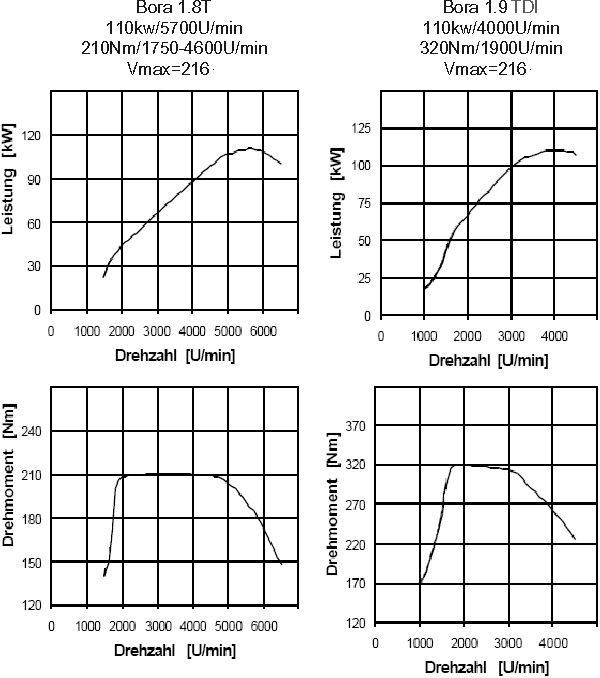
Comparison of turbocharged gasoline engines versus turbocharged diesel engines:
It is clear that the advantage of early torque delivery, which is often associated with diesel engines, is not evident here. The gasoline engine offers a nearly identical torque curve to the diesel engine.
The gasoline engine's torque plateau is even more pronounced and occurs significantly earlier.
Based purely on the data, the gasoline engine should feel like a "rubber band" when driving. It provides strong power from just below 2000 to 6000 RPM. The diesel engine cannot offer such a wide operating range.
If a standardization of data regarding gear ratios were implemented here, it could put diesel engines at a disadvantage.
Does anyone have the relevant data for those four cars readily available?
| Description: |
| Diesel or gasoline... common, outdated slang |
|
| File size: |
24.96 KB |
| Viewed: |
10749 times |
|
Gruß Bertil
Skoda 5E5 CZDA + Mini R50 W10 + VW ID.3 + Fiat Ducato 250 + 161 DX
*** Technische Anfragen per PN werden von mir nicht beantwortet! ***
Translated on 21-07-2026, 3:39.
|
|
| Back to top |
Profile PM |
|
ulf
Profi-Schrauber
Joined: 04/13/2002
Posts: 11058
Karma: +18 / -0
Location: Saarland
2023 MG ZS
Premium Support
|
| 02-11-2004, 11:01 Subject: Diesel or gasoline... common, outdated slang |
Quote |
|
Bertil wrote: | Comparison of turbocharged gasoline engines versus turbocharged diesel engines:
It is clear that the advantage of early torque increase in diesel engines is not confirmed here. . . . If a standardization of data regarding gear ratios were implemented, the diesel engine could fall behind. |
Take the principle of Ernst's power diagram, convert it from RPM to "% of rated speed," and label the x-axis with km/h. In cases where transmission data is unavailable, assume that Vmax (maximum speed) occurs at Pmax (maximum power).
It will probably take me at least a few days to have time for that... but maybe someone else can do it sooner . Gruß Ulf
_________
MG4 Electric
Translated on 21-07-2026, 3:42.
|
|
| Back to top |
Profile PM Garage |
|
herwigw
Guest
Free account, no CAN development support
|
| 02-11-2004, 11:11 Subject: Diesel or gasoline... common, outdated slang |
Quote |
|
To my knowledge, there is a slightly more suitable metric that mechanical engineers often prefer to use in this context instead of torque: the tensile force margin.
I'm not able to provide formulas, but as far as I understand, the argument against using 'torque' as a measure of acceleration perception is that the rotating masses of the motor also have a 'dynamic resistance' to changes in rotational speed. Therefore, a motor with twice the inertia of another will accelerate less well at the same torque.
This would also have an impact because diesel engines require more robust connecting rods, crankshafts, etc., due to the higher combustion pressures, which further complicates comparisons between gasoline and diesel engines.
Best regards,
Herwig.
Translated on 21-07-2026, 3:43.
|
|
| Back to top |
|
|
|


 Bookmarks
 Links
Links Garage
 FAQ, Legal Notice & Privacy
 RSS Feed
 Register
 Login
Login
