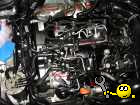
I suspected it.
Nowadays, I occasionally take a slight detour on the highway when driving home, just to generate a little more heat in the engine oil.
I installed a 2-liter catch tank because I only want to empty it once a year. It has a vent pipe for inspection.
I will check it for the first time at the end of May, although I think that the warm temperatures are unlikely to generate much water in the oil.
If the catch tank is working correctly, the compressor side should remain free of oil, and the compressor impeller should be free from carbon deposits.
I will provide an update so that the thread doesn't remain unanswered.
It is pointless and potentially harmful to the inlet valve stems to try to make the compressor side oil-free.
2. The compressor wheel is never covered with oil sludge. Never, ever, and not even if pigs fly to Mars. This is ensured by the 100,000 revolutions per minute that the charger makes and the large amount of cool intake air that flows through the compressor wheel.
To be honest, I don't understand the point of your post.
Well, I don't know what that black stuff on the compressor blades is. All I can think of is a thin layer of soot or carbon buildup. I didn't paint it on.
What exactly don't you understand?
I wonder about that in your case. Because the compressor wheel is usually never hot enough for oil carbon to form in significant amounts. If you're referring to a brown/black film, that's normal and doesn't require any action.
In the picture, you can see an old loader that was often subjected to high thermal loads in the past. Everything is within acceptable limits:
If you are concerned that the charger might overheat (which can indeed cause oil carbon buildup, but specifically at the shaft bearing), monitor the exhaust temperature.
It should be available in the measurement data blocks of the engine control unit (ECU) for the BPW system and should not exceed approximately 840°C at the turbine inlet.