| Author |
Message |
hauminix
Joined: 07/11/2016
Posts: 46
Karma: +7 / -0 
Location: Austria
Premium Support
|
 27-10-2021, 13:47 Subject: 27-10-2021, 13:47 Subject: |
Quote |
|
He gave me 3 refurbished items with test reports. The values of these are good and within the acceptable range, and they include a 2-year warranty. The price is absolutely reasonable when compared to the current market prices for new nozzles.
Translated on 05-07-2026, 8:00.
|
|
| Back to top |
Profile PM |
 |
Herbert
Profi-Schrauber

Joined: 06/22/2005
Posts: 4627
Karma: +1342 / -0
Premium Support
|
| 27-10-2021, 14:58 Subject: |
Quote |
|
Hi,
Regarding the test results, I have my own humble opinion. The abbreviations VM, EL, LL, and VE need to be explained if one wants to understand what was done. But who checked it, with what equipment, and where do the tolerances come from?
- Cylinder 1: Fuel injection quantity (low pressure) is below the minimum tolerance. Fuel injection quantity (high pressure) is below the minimum tolerance at 900 bar. What was the measurement accuracy?
Cylinder 3: The injection quantities for the low-pressure injector (VL), the main injector (EM), and the variable injector (VE) at 900 bar are approximately 10% too low. The question is, what would have been compensated for by the volume matching and switching time correction in this case.
Cylinder 4: Values similar to cylinder 3, too low, but with larger deviations.
All the nozzles appear to be sealing properly at 1600 bar. That's why the question is whether the obvious carbon buildup was actually caused by these injectors. We'll see.
hg
Herbert.
Horch A4 8K CJCD
Golf 7 DDYA
(+ Audi 80 Avant B4 1Z 475Tkm - habe ich vom ersten bis zum letzten Tag gerne gefahren)
(+ Passat Variant 32B CY 400Tkm)
Translated on 05-07-2026, 8:01.
|
|
| Back to top |
Profile PM |
|
hauminix
Joined: 07/11/2016
Posts: 46
Karma: +7 / -0
Location: Austria
Premium Support
|
| 27-10-2021, 15:03 Subject: |
Quote |
|
Hello Herbert,
I will see it soon. Right now, the cleaning of the shafts is scheduled. The test was performed by a certified company that specializes exclusively in fuel injectors and turbochargers.
Translated on 05-07-2026, 8:03.
|
|
| Back to top |
Profile PM |
|
hauminix
Joined: 07/11/2016
Posts: 46
Karma: +7 / -0
Location: Austria
Premium Support
|
|
| Back to top |
Profile PM |
|
Nordhesse_Lukas
Blaumann

Joined: 10/15/2021
Posts: 14
Karma: +10 / -0
2012 Audi A3
Support
|
| 28-10-2021, 8:57 Subject: |
Quote |
|
|
Audi A3 8PA 2.0 TDI quattro BJ 2012 MKB CFFB
Translated on 05-07-2026, 8:03.
|
|
| Back to top |
Profile PM Garage |
|
hauminix
Joined: 07/11/2016
Posts: 46
Karma: +7 / -0
Location: Austria
Premium Support
|
| 28-10-2021, 17:57 Subject: |
Quote |
|
That's exactly what I used  .
The seat is now completely clean. The injectors (rebuilt) have been installed. New codes have been communicated to the control unit.
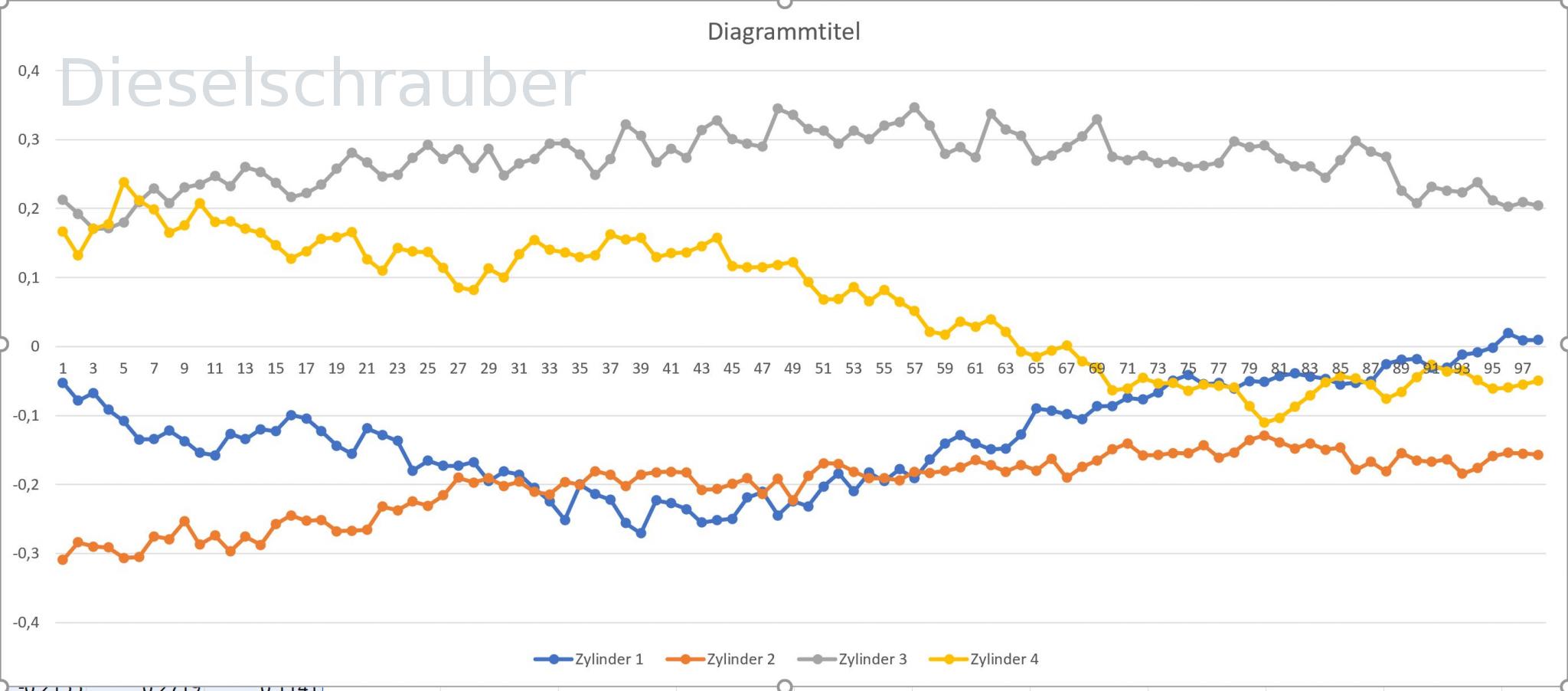
The variations between the individual cylinders already look better. The stuttering is completely gone.
Tomorrow, I'll start by performing the initial calibration for small quantities, and then I'll check the soot values during a test run. In the readiness check, I'm still having a small issue with the lambda sensor heating - it's showing as red (failed).
I would like to know on what basis the "soot value" is determined. What data and sensor technology are used for this?
| Description: |
|
| File size: |
216 KB |
| Viewed: |
450 times |
|
Translated on 05-07-2026, 8:04.
|
|
| Back to top |
Profile PM |
|
hauminix
Joined: 07/11/2016
Posts: 46
Karma: +7 / -0
Location: Austria
Premium Support
|
| 30-10-2021, 12:14 Subject: Took a test drive |
Quote |
|
Let's start with the good things. The car runs very smoothly. The stuttering is gone, and he's also completely calm during recovery.
Unfortunately, the behavior of the soot values has not changed. Could the DPF be causing the problem?
Near the end of the journey, he stopped the regenerative braking process because the fuel level dropped into the reserve.
| Description: |
|

Download |
| File name: |
LOG-01-IDE00021_&11.CSV |
| File size: |
223.97 KB |
| Downloaded: |
253 times |
Translated on 05-07-2026, 8:06.
|
|
| Back to top |
Profile PM |
|
Herbert
Profi-Schrauber
Joined: 06/22/2005
Posts: 4627
Karma: +1342 / -0
Premium Support
|
| 31-10-2021, 8:05 Subject: |
Quote |
|
The air mass, measured in g/s, can be converted to mg/stroke given a specific engine speed. However, converting the raw voltage of the oxygen sensor to a lambda value is not possible without using certain parameters. The lambda value would indicate the amount of excess air present in the exhaust gas.
Ultimately, it boils down to whether the engine is producing excessive soot, the filter is simply clogged, or a sensor on the exhaust side is malfunctioning. The differential pressure sensor would still be affordable, but otherwise, I wouldn't immediately start replacing other parts based on the problem.
The performance is already quite concerning, but could you please record it again, this time including the relevant measurement values?
hg
Herbert.
Horch A4 8K CJCD
Golf 7 DDYA
(+ Audi 80 Avant B4 1Z 475Tkm - habe ich vom ersten bis zum letzten Tag gerne gefahren)
(+ Passat Variant 32B CY 400Tkm)
Translated on 05-07-2026, 8:07.
|
|
| Back to top |
Profile PM |
|
hauminix
Joined: 07/11/2016
Posts: 46
Karma: +7 / -0
Location: Austria
Premium Support
|
| 31-10-2021, 9:09 Subject: |
Quote |
|
Hello Herbert,
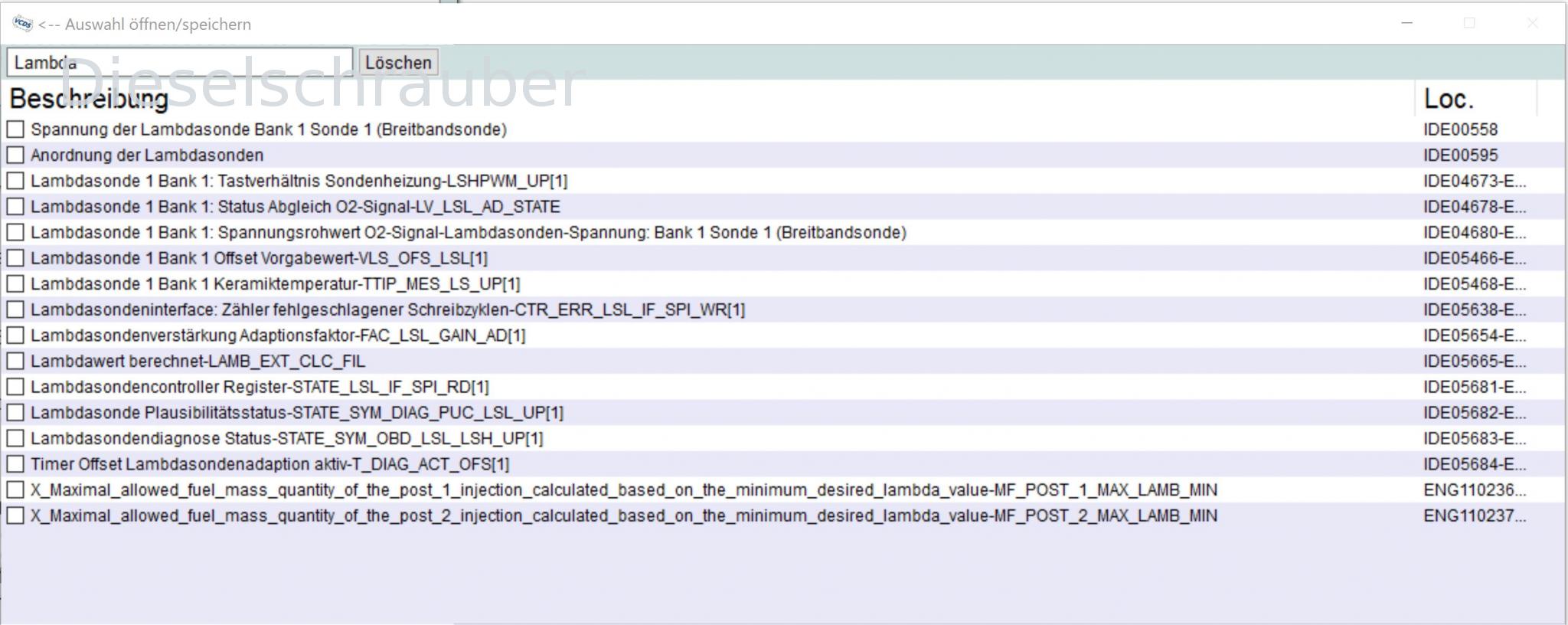
Thank you - Yes, I definitely want to avoid having any more parts break. What lambda values do you need?
These options are available to me in the VCDS system for this car.
| Description: |
|
| File size: |
319.81 KB |
| Viewed: |
189 times |
|
Translated on 05-07-2026, 8:08.
|
|
| Back to top |
Profile PM |
|
Herbert
Profi-Schrauber
Joined: 06/22/2005
Posts: 4627
Karma: +1342 / -0
Premium Support
|
| 31-10-2021, 11:05 Subject: |
Quote |
|
Hello Hauminix,
Calculate the lambda value. You've had that problem before, unfortunately, only when the engine was idling.
Do you have the possibility to introduce approximately 300 mbar into a small pressure accumulator, measure it, and connect a differential pressure sensor to it?
hg
Herbert.
Horch A4 8K CJCD
Golf 7 DDYA
(+ Audi 80 Avant B4 1Z 475Tkm - habe ich vom ersten bis zum letzten Tag gerne gefahren)
(+ Passat Variant 32B CY 400Tkm)
Translated on 05-07-2026, 8:09.
|
|
| Back to top |
Profile PM |
|
hauminix
Joined: 07/11/2016
Posts: 46
Karma: +7 / -0
Location: Austria
Premium Support
|
| 31-10-2021, 11:34 Subject: |
Quote |
|
No - unfortunately not. But the differential pressure sensor is new. Today I blew through the differential pressure lines (without the sensor) to check if there was any leakage. They are sealed and permeable. The smaller hose, after the DPF, seems to have slightly less permeability. However, the smaller diameter and longer pipe run are certainly factors.
Translated on 05-07-2026, 8:09.
|
|
| Back to top |
Profile PM |
|
hauminix
Joined: 07/11/2016
Posts: 46
Karma: +7 / -0
Location: Austria
Premium Support
|
| 31-10-2021, 12:56 Subject: |
Quote |
|
Hello Herbert.
Here are two log files.
First trip. From cold to warm. He started the regeneration process when the oil temperature reached approximately 60 degrees. I then drove to a parking lot and had it completely regenerated.
2nd gear. Engine was warm. Drove to the regeneration point and then continued at a steady speed. Finally, I stopped, let it finish generating, and then rode about 1 kilometer home.
Perhaps you can recognize something.
| Description: |
|
Download |
| File name: |
2-fahrt-LOG-01-IDE00021_&11.CSV |
| File size: |
168.34 KB |
| Downloaded: |
233 times |
| Description: |
|
Download |
| File name: |
1-fahrt-LOG-01-IDE00021_&11.CSV |
| File size: |
80.98 KB |
| Downloaded: |
255 times |
Translated on 05-07-2026, 8:10.
|
|
| Back to top |
Profile PM |
|
Herbert
Profi-Schrauber
Joined: 06/22/2005
Posts: 4627
Karma: +1342 / -0
Premium Support
|
| 01-11-2021, 10:20 Subject: |
Quote |
|
Hi Hauminix,
The data doesn't help me much, at least. The "lambda value" is likely not calculated from the sensor data itself, but rather determined based on the amount of air and fuel.
What is the vehicle's history? How many kilometers were on the car when it was purchased? Is the DPF still the original part, or has it been replaced with an aftermarket part? Is the replacement differential pressure filter an original VW part, or from another supplier?
The suspected solution, a faulty DPF, is unfortunately very expensive.
Are all the other sensors on the DPF functioning correctly?
hg
Herbert.
Horch A4 8K CJCD
Golf 7 DDYA
(+ Audi 80 Avant B4 1Z 475Tkm - habe ich vom ersten bis zum letzten Tag gerne gefahren)
(+ Passat Variant 32B CY 400Tkm)
Translated on 05-07-2026, 8:12.
|
|
| Back to top |
Profile PM |
|
hauminix
Joined: 07/11/2016
Posts: 46
Karma: +7 / -0
Location: Austria
Premium Support
|
| 01-11-2021, 10:53 Subject: |
Quote |
|
Hello Herbert. The car doesn't really have a remarkable history. It was purchased as a new car. About 30,000 km ago, the AGR valve was replaced by VW as a goodwill gesture due to the diesel scandal. About 10,000 km ago, an injector was replaced because it was defective. Oil changes, etc., everything was done according to plan. The fluids and wear parts were replaced according to schedule.
Approximately 4 months ago, the car's engine control unit (ECU) malfunctioned. There was a processor error, and the car wouldn't start. A used ECU (same model for CAYB) was obtained through a tuner, and it was programmed at a VW dealership (due to the immobilizer). The data and software version were adopted - Volkswagen did the same.
It's my wife's car, and she's mentioned several times in the past year that the engine feels a bit rough. But since she mostly drives my A6, I thought the difference in smoothness between the 4-cylinder and 6-cylinder engines might be the cause. And the Audi also runs incomparably better and smoother.
Just about a month ago, I took a closer look and, in addition to the problem with the injectors, I encountered this regeneration issue. You can only see it by reading the data. Also, the oil level was slightly above the maximum mark, which indicated oil dilution. Since then, I have carried out the activities described in this thread. Of course, I changed the oil immediately.
What surprises me about this regeneration process is that it seems impossible to complete it while driving. It only ever finishes when the car is stationary and idling. Even if I put the engine under a slight load while it's in regeneration mode, the soot level actually increases. Have you checked the differential pressure? Is this value plausible given the expected load conditions, or is it already too high?
Therefore, I suspect that the DPF is quite clogged due to the driving conditions over the past year, or that it is no longer able to burn off the accumulated soot. I've checked to see if there's any oil anywhere in the system. There's none in the coolant, nor on top of the air filter. The problem is that it's very difficult to access the DPF on this car. Otherwise, I could take a look inside with an endoscope camera. At least, I'll take a look at the oxygen sensor inlet in the next few days.
I also don't understand how the "soot value" is calculated within the system. Which values or sensors contribute to this value? However, I haven't found anything related to that.
The car has only 110,000 km. That's not really a lot, so you'd think the DPF (which has never been replaced) shouldn't be at the end of its life at this point. However, the values like ash content and soot levels are all calculated values and only partially reflect the truth. The differential pressure sensor and the lambda sensor have already been replaced with genuine VW parts. System tests that can be performed via VCDS are all OK. The temperature sensors also provide plausible values in normal operation and during regeneration. The mass airflow sensor (MAF) has never been replaced, but it also doesn't show any errors in the engine control unit (ECU). But could wear in the MAF sensor lead to this result? Wouldn't that manifest as issues like rough idling, difficulty starting, and a loss of power?
But thank you very much for your help. Perhaps someone will come up with a brilliant idea about how and where something could be tested.
Translated on 05-07-2026, 8:16.
|
|
| Back to top |
Profile PM |
|
guste100
Profi-Schrauber

Joined: 07/27/2004
Posts: 2403
Karma: +441 / -0
Location: Mitte Schleswig Holsteins
2007 Volkswagen Passat
Premium Support
|
| 01-11-2021, 12:35 Subject: |
Quote |
|
I'm not familiar with the calculation method used for "calculated soot" in the MSG. However, soot generally forms when there's too much diesel fuel compared to the amount of air. That's why I'm asking about the lambda value. It probably also makes sense to look at the LMM (mass airflow) values and the fuel injection volume values.
The calculated value doesn't relate to which wear parts might potentially cause increased soot. Rather, the question is based on which measurable values the MSG calculates an increased soot level.
Alternatively, the engine control unit (ECU) could calculate an increased soot level if it detects a significant increase in back pressure within the diesel particulate filter (DPF). I would, however, expect to see this more often when "soot levels" are being measured.
Could you please run a classic log with the traditional measurement blocks 3, 8, and 11 at full load and high gear?
Here's the translation:
"In this case, air mass, fuel injection quantity, boost pressure, and engine speed are relevant (if your device doesn't already have the older measurement capabilities). Focus on logging only full-throttle acceleration data within the range of ~1,500-4,000 rpm in a high gear, and avoid logging data from normal driving over long distances." Then, at the very least, we can see if the input parameters are within the normal range.
Since your DPF is full within 20km, the problem must be quite severe. Do I remember correctly that your differential pressure also increased significantly within the 20km range? (which would suggest a real, heavy soot load).
Regards,
Guste.
Translated on 05-07-2026, 8:22.
|
|
| Back to top |
Profile PM Garage |
|
Herbert
Profi-Schrauber
Joined: 06/22/2005
Posts: 4627
Karma: +1342 / -0
Premium Support
|
| 01-11-2021, 12:51 Subject: |
Quote |
|
Quote: | | About 4 months ago, the MSG (Motorelektroniksteuergerät) was defective. There was a processor error, and the car wouldn't start. I got a used one from a tuner (the same MSG for CAYB) and had it coded at VW (due to the immobilizer). The data and software version were adopted - VW also did this. |
At least, it's noteworthy.
hg
Herbert. Horch A4 8K CJCD
Golf 7 DDYA
(+ Audi 80 Avant B4 1Z 475Tkm - habe ich vom ersten bis zum letzten Tag gerne gefahren)
(+ Passat Variant 32B CY 400Tkm)
Translated on 05-07-2026, 8:24.
|
|
| Back to top |
Profile PM |
|
|


 Bookmarks
 Links
Links Garage
 FAQ, Legal Notice & Privacy
 RSS Feed
 Register
 Login
Login

