| Author |
Message |
F B
Guest
Free account, no CAN development support
|
 25-04-2007, 7:15 Subject: Brake Performance and Engine Power 25-04-2007, 7:15 Subject: Brake Performance and Engine Power |
Quote |
|
Hi.
I have a question regarding the above topic.
There are some really nice cars out there, like the Mercedes-Benz ML AMG with 500 horsepower, etc.
Are the brakes only designed to bring the vehicle to a safe stop?
Or is it absolutely necessary to be able to stop every car, even with its engine running at full power?
I'm now thinking that for some reason, the electronics might be malfunctioning, causing the motor to be driven at full throttle, and I'm wondering if the braking performance is, by law, sufficient to bring the car to a stop.
When I think of Mercedes AMG cars now, I'm talking about models with up to 500 horsepower on the rear axle, which only has 20 to 30% of the braking power compared to the front axle.
Yes, the ML has all-wheel drive, but what about the other models?
Best regards, Frank.
Translated on 07-09-2026, 7:16.
|
|
| Back to top |
|
 |
wutz
Blaumann

Joined: 08/13/2004
Posts: 247
Karma: +11 / -1 
Location: BRA
2006 Seat Leon
Free account, no CAN development support
|
| 25-04-2007, 15:56 Subject: Brake Performance and Engine Power |
Quote |
|
There's the clutch, and in automatic transmissions, the "N" (neutral) position. If the engine receives a full-load signal for any reason, the safest method is to decouple the power from the drivetrain.
VW Golf V, 1,9 TDI, 77KW, BLS, 2007;
Ford Fiesta MK7 (B299 MCA), TDCI, 1,5l 95PS, 2015
Kawasaki GPZ 500 S jetzt mit TÜV(Wiederbelebungsversuch erfolgreich)
Translated on 07-09-2026, 7:17.
|
|
| Back to top |
Profile PM Garage |
|
mahk
Blaumann
Joined: 08/12/2004
Posts: 121
Karma: +1 / -0
Location: München
Support
|
| 25-04-2007, 16:52 Subject: Brake Performance and Engine Power |
Quote |
|
if one is to believe: http://www.spiegel.de/auto/aktuell/0,1518,321452,00.html
It doesn't seem easy to brake while accelerating. The report doesn't explain why engaging the "N" (neutral) position didn't help. Typ89 SB: 05/2000 120.000km - 01/2005 295.000km (unfall)
B5 Avant AEB 07/2005 166.000km ( [email protected]) - 07/2007 195.000km (verkauft)
1K BMM: 03/2011 120.000 km - aktuell
Translated on 07-09-2026, 7:17.
|
|
| Back to top |
Profile PM |
|
Jochen_145
Guest
Free account, no CAN development support
|
| 25-04-2007, 17:10 Subject: Brake Performance and Engine Power |
Quote |
|
Hello,
If you calculate the braking power of a vehicle, considering that it comes to a complete stop from 100 km/h within 40 meters, and express that power in horsepower, you will see how significant the power of the brakes is.
This is significantly larger than the driving force.
For a 911 Turbo, I'm aiming for power outputs in the range of over 1000 horsepower (0-100 km/h in approximately 2.2 seconds).
Therefore, I should be able to, and can (it works perfectly fine with my diesel car), use the brake pedal to slow the car down even when accelerating fully, to the extent that, in extreme cases, I can stall the engine.
Left-side brakes operate according to the exact same principle and significantly reduce the vehicle's speed.
A disadvantage of this method is:
The brakes are subjected to very high thermal stress.
However, I once heard someone say, in a friendly way, that you can't press the brake and accelerate at the same time. I managed to convince them otherwise.
Best regards, Jochen.
Translated on 07-09-2026, 7:19.
|
|
| Back to top |
|
|
dieselmartin
Profi-Schrauber

Joined: 03/13/2003
Posts: 10121
Karma: +29 / -0
Location: in der Werkstatt
2007 Volkswagen Passat
Premium Support
|
| 25-04-2007, 17:15 Subject: Brake Performance and Engine Power |
Quote |
|
Well, personally, I don't believe much of it, except that the colleague from France was apparently very busy.
There are, even in a Renault, countless ways to manipulate the engine's power output. And the fact that *all* braking mechanisms failed, but *all* components responsible for acceleration worked perfectly... that's very strange.
The E63 AMG has an automatic transmission, which will automatically disengage once you've installed the brake pads onto the drilled brake rotors all around.
PS: My GRA will activate on its own when the ESP says "go" - done this  . Transparency, Teamwork
... there was another T.
I don't know what the f*ck it was.
Translated on 07-09-2026, 7:21.
|
|
| Back to top |
Profile PM Garage |
|
bloesch
Profi-Schrauber
Joined: 03/18/2005
Posts: 622
Karma: +16 / -0
Location: FL
Support
|
| 25-04-2007, 17:37 Subject: Brake Performance and Engine Power |
Quote |
|
So, my father's 1996(?) Lexus wouldn't "cooperate" when it came to stopping, after the accelerator pedal got stuck under the floor mat in the "kick-down" position.
The software probably interpreted this as an incline and simply downshifted, allowing it to continue smoothly.
My dad didn't turn on the TV;  instead, he was messing around in the footwell at a speed of 160.
Translated on 07-09-2026, 7:22.
|
|
| Back to top |
Profile PM |
|
Jan6K
Joined: 04/12/2002
Posts: 4741
Karma: +107 / -0
Location: Hagen
Premium Support
|
| 25-04-2007, 17:52 Subject: Brake Performance and Engine Power |
Quote |
|
Hi,
Quote: |
However, I once heard someone say, in a friendly way, that you can't press the accelerator pedal at the same time as you press the brake. I managed to convince them otherwise.
|
I think that's possible, but: The TDI might detect this through the brake switches... I'm not sure if it will actually provide full power when the pedal is pressed, or if it will only provide a little less.
Regarding the Frenchman: I think we've already discussed this. Either it was just a lame excuse, or he braked too gently, causing the brake pads to glaze over. With a brutal full stop, the car should have come to a complete stop.
Best regards,
Jan. 1Z5 CFHF  / AHB H4D 
Translated on 07-09-2026, 7:24.
|
|
| Back to top |
Profile PM |
|
leo_b
Blaumann
Joined: 02/03/2005
Posts: 145
Karma: +1 / -0
Location: Hamburg
Support
|
| 25-04-2007, 18:09 Subject: Brakes and Gas: How to Control Your Car |
Quote |
|
hi,
Two brake switches are installed in the T4 TDI models.
One is for the brake light, the other is for the message.
If you press the accelerator and brake pedal at the same time, the engine will only run at a higher idle speed (approximately 1200 RPM).
If you suddenly press the accelerator from zero to full, the engine will respond based on the accelerator pedal position.
Best regards, Leo.
edith: because of a typo. 
Mein Bussi: Trapo, 7/1999, Kombi L, 8 Sitze, Indianblau, 88PS (65kW) TDI, MKB: AJT, GKB: DUJ, mit kleinem LLK, 340000km
Translated on 07-09-2026, 7:25.
|
|
| Back to top |
Profile PM |
|
Jochen_145
Guest
Free account, no CAN development support
|
| 25-04-2007, 18:58 Subject: Brake Performance and Engine Power |
Quote |
|
I believe that's possible, but: The TDI might detect this through the brake switches... I don't know if it will actually give full power when the pedal is pressed down, or if it will only give a little less.
Hello Jan,
For the 'older' TDIs (AHU, ASV), it's full throttle.
'It always downshifts with intermediate gas. Depending on how much I press the accelerator, the RPMs increase. Going above 3500 RPM isn't a problem; I rarely rev higher when downshifting.'
The rental BKC (105 hp, Golf V) that I drove could also be downshifted with intermediate throttle.
I don't currently know about the other PDs.
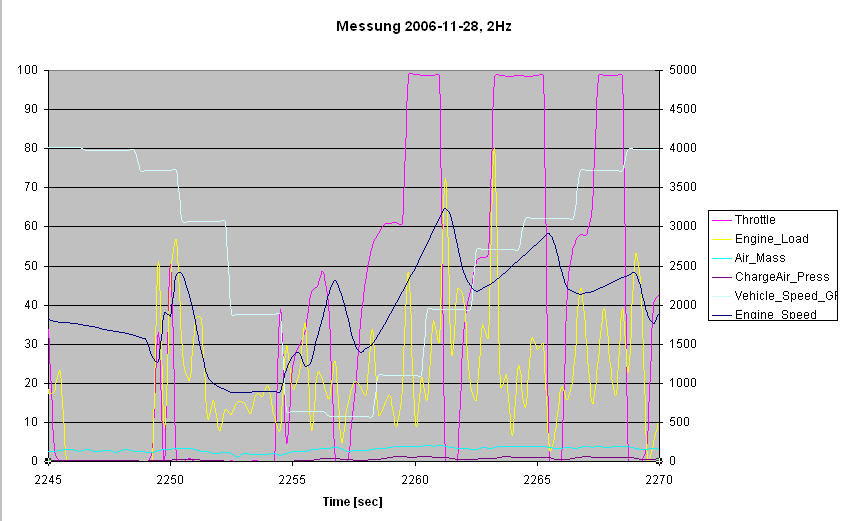
I've attached a quick-and-dirty intermediate gas pressure reading I found. (t = approximately 2255 seconds.)
The braking was not excessively hard.
Considering the level of Engine_Load (the PWM signal of the VP control), it is similar during a brief throttle lift-off as it is during subsequent acceleration.
It shows: after all, it's about 
Best regards, Jochen.
| Description: |
| Brake Performance and Engine Power |
|
| File size: |
81.94 KB |
| Viewed: |
3177 times |
|
Translated on 07-09-2026, 7:27.
|
|
| Back to top |
|
|
F B
Guest
Free account, no CAN development support
|
| 25-04-2007, 19:04 Subject: Brake Performance and Engine Power |
Quote |
|
There is the clutch, and in automatic transmissions, the 'N' position. If the engine receives a full load signal for any reason, the safest method is to decouple the power from the drivetrain.
Hey there!
Unfortunately, that wasn't the question.
Turning off the ignition might also help, but I didn't ask about that.
I can vividly imagine forcing a front-wheel-drive car to oversteer by applying the brakes while accelerating.
It seems a bit insufficient to have a Benz with 500 horsepower on the rear axle and a rear brake that only needs to provide 25% of the total braking force.
It might look funny if the front wheels are stationary, but then the rear wheels would first be the brakes, and then the rims could overheat.
I actually wanted to know if the braking power needs to be higher than the engine power, and whether the drive axle/brakes alone have to be able to handle it.
I would like to know which law, regulation, DIN standard, etc. governs such a matter.
Best regards, Frank.
Translated on 07-09-2026, 7:30.
|
|
| Back to top |
|
|
bloesch
Profi-Schrauber
Joined: 03/18/2005
Posts: 622
Karma: +16 / -0
Location: FL
Support
|
| 25-04-2007, 19:26 Subject: Brake Performance and Engine Power |
Quote |
|
I can't think of a specific legal basis for that off the top of my head.
But maybe you should take a look at the German Road Traffic Regulations (STVZO) sometime.
Sure, please provide the text you would like me to translate from German to English.
Quote: | Road Traffic Licensing Regulations (StVZO).
B. Vehicles.
III. Construction and operational regulations.
§41 Brakes and wheel chocks.
...(4) For motor vehicles - excluding motorcycles - a mean full deceleration of at least 5.0 m/s² must be achieved using the service brake; however, for motor vehicles with a maximum speed, as determined by their design, of no more than 25 km/h, a mean full deceleration of 3.5 m/s² is sufficient.
|
or
Quote: |
§65 Brakes
...
(2) Any device that is securely attached to the vehicle and is capable of reducing the vehicle's speed and bringing the vehicle to a stop shall be considered an adequate brake. |
"By the way, rear-wheel drive vehicles (at least as far as I know from all-wheel drive systems) likely have significantly more than 25% of the weight on the rear axle... probably closer to 40%."
Quote: | | It might look funny if the front wheels are stationary; then the rear wheels would first be the brakes, and then the rims would start to glow. |
which brings us back to the old Lexus.
- Black ice: Engage driving mode D and apply the brakes.
--> The front wheels lock up, while the rear wheels propel the car forward at approximately 3 km/h.
Translated on 07-09-2026, 7:33.
|
|
| Back to top |
Profile PM |
|
Jan6K
Joined: 04/12/2002
Posts: 4741
Karma: +107 / -0
Location: Hagen
Premium Support
|
| 25-04-2007, 23:10 Subject: Brake Performance and Engine Power |
Quote |
|
Hi,
Quote: |
"It always downshifts with intermediate gas. Depending on how much I press the accelerator, the RPMs increase. Going above 3500 RPM isn't a problem; I rarely rev higher when downshifting."
|
Okay... maybe we're not understanding each other... I definitely mean the scenario where the clutch is engaged, a gear is selected, the brake is applied, and the accelerator is fully pressed. You're not doing that when you're downshifting with throttle blipping – either you're pressing the clutch or you're not in a gear, meaning there's no power transfer between the engine and the wheels.
Or have I misunderstood something else that you meant?
Quote: |
It seems a bit insufficient to have a rear brake that only needs to provide 25% of the total braking force, especially considering a Mercedes with 500 horsepower at the rear axle.
|
Hmm... yes... that is quite interesting.
The 25% figure essentially results from the fact that the rear wheels, which are unloaded during braking, can only transmit 25% of the braking force before they lock up. This doesn't mean that the brakes aren't powerful; I'm not sure what size brake rotors are on the rear, but for 500 horsepower, they probably don't need to be excessively large.
Looking at my 280 (or were they 288?) 22mm internally ventilated front discs, which almost single-handedly provide the braking power for the Ibiza and can operate right at the limit of adhesion during a 100->0 km/h braking maneuver, that's probably roughly equivalent to what's needed for a 0->100 km/h acceleration in 4...5 seconds – which also translates to well over 300 horsepower of braking power. However, the rear discs on that Mercedes are probably more robust than mine... so I can definitely imagine that.
Best regards,
Jan. 1Z5 CFHF / AHB H4D
Translated on 07-09-2026, 7:37.
|
|
| Back to top |
Profile PM |
|
Jochen_145
Guest
Free account, no CAN development support
|
| 26-04-2007, 11:14 Subject: Brake Performance and Engine Power |
Quote |
|
Moment... maybe we're talking about different things... I definitely mean the scenario where the clutch is engaged, a gear is selected, the brake is applied, and the accelerator is fully pressed. You don't do that when downshifting with throttle blipping - either you've pressed the clutch or you're not in a gear, so there's no power transfer between the engine and the wheels.
Oh, yes, we will probably do that  .
When you apply the brakes while in gear and simultaneously give full throttle, the load request, and therefore the fuel injection amount, is initially limited by the driver's request and the engine speed. (Fuel quantity requested = function(driver request / engine speed)).
Depending on the speed and characteristic curve, I can already request the maximum amount here.
Since the speed is unlikely to change much (or at all, as the engaged brake prevents an increase in speed), you are correct that while you can request the maximum amount, it will not correspond to the maximum possible full load amount. It will be limited by the smoke curve and the torque limiter.
If you now apply stronger braking and reduce the engine speed, the amount of fuel delivered is increasingly reduced according to torque and smoke limits. Consequently, even with 100% pedal input, the engine does not release the maximum possible amount of fuel, and it can be braked all the way to stalling using only the brake.
Actually, I don't need a brake switch to limit the amount in this case. The limits on the injection amount are sufficient for this purpose.
'Well, it's a bit complicated to describe, but I hope it was somewhat understandable.'
Actually, in this case, you are operating within fixed load points that are controlled by the engine control unit (ECU) via the injection quantities.
I hope I now understand what you meant.
Best regards, Jochen.
Translated on 07-09-2026, 7:41.
|
|
| Back to top |
|
|
Jan6K
Joined: 04/12/2002
Posts: 4741
Karma: +107 / -0
Location: Hagen
Premium Support
|
| 26-04-2007, 15:25 Subject: Brake Performance and Engine Power |
Quote |
|
Hi,
Okay, so we're on the same page now.
Quote: |
Actually, I don't need a brake switch to limit the amount in this case. The limits on the injection amount are sufficient for this purpose.
|
"That's quite a bit of material wear and tear... I would have implemented it so that when the brake pedal is pressed and the engine speed is above idle, the fuel injection is completely shut off, regardless of what the driver does with the accelerator pedal. I haven't tested it... but if you say that the anti-stall valve actually still injects fuel in that case, then mine probably does too."
Best regards,
Jan. 1Z5 CFHF / AHB H4D
Translated on 07-09-2026, 7:44.
|
|
| Back to top |
Profile PM |
|
Jochen_145
Guest
Free account, no CAN development support
|
| 26-04-2007, 15:50 Subject: Brake Performance and Engine Power |
Quote |
|
I haven't tested it... but if you say that the ASV actually injects more in that case, then mine probably will too.
Hello Jan,
You can easily try this out:
Try to gently brake with your left foot while simultaneously accelerating (but be very careful, it's not a clutch ), I initially gripped the steering wheel quite tightly  ).
Then, brake with the same intensity without pressing the accelerator.
The difference is noticeable, even if you only give it a little bit of gas.
It's quite a material waste, though... I would have implemented it so that when the brake pedal is pressed and the engine speed is above idle, the fuel injection is completely shut off, regardless of what the driver does with the accelerator pedal.
You're right, in principle, it can be done that way.
Perhaps people thought that only crazy people would brake and accelerate at the same time.
An average rider would likely feel a jolt in their legs there, and if you brake with the right side, you're probably already in the traction control or wheelie limit mode.
You can do without that switch.
Best regards, Jochen.
Translated on 07-09-2026, 7:46.
|
|
| Back to top |
|
|
Jan6K
Joined: 04/12/2002
Posts: 4741
Karma: +107 / -0
Location: Hagen
Premium Support
|
| 26-04-2007, 22:01 Subject: Brake Performance and Engine Power |
Quote |
|
Hi,
Quote: |
You can do without that switch.
|
Basically, yes... but it's already there and being monitored, partly to disable the GRA (presumably a system or function). So, it would essentially be a software issue.
But you're probably right... It's probably due to developer laziness.
I'll take the test tomorrow.
By the way, I always do something similar when I'm starting the car on a hill or in a parking garage. I generally do it without using the handbrake, just the foot brake. Clutch and neutral. It works perfectly, especially with the strict LL (low-speed) regulations of the ASV (presumably a specific system or organization).
Best regards,
Jan. 1Z5 CFHF / AHB H4D
Translated on 07-09-2026, 7:49.
|
|
| Back to top |
Profile PM |
|
|


 Bookmarks
 Links
Links Garage
 FAQ, Legal Notice & Privacy
 RSS Feed
 Register
 Login
Login

