| Author |
Message |
ulf
Profi-Schrauber

Joined: 04/13/2002
Posts: 11058
Karma: +18 / -0 
Location: Saarland
2023 MG ZS
Premium Support
|
 21-07-2011, 7:47 Subject: LMM Temperature Compensation: Wrong or Just Physics? |
Quote |
|
Hello,
After collecting a large amount of log data from various vehicles equipped with the EDC15 system, I wanted to compare the efficiency of different series chargers by examining the ratio of air mass to boost pressure (actual value) at wide-open throttle (WOT).
Initially, the data showed a general correlation between engine speed and the LuMa/LD ratio: at 4500 rpm, the value decreased by approximately 15% compared to the initial value at around 2000 rpm, depending on the turbocharger.
In addition, it was also noticeable that this relationship generally becomes worse with increasing LLT (Lower Limb Torque).
To eliminate this source of error, I have normalized the LuMa values in all logs to a uniform temperature of 50°C (chosen arbitrarily), using the following formula:
LuMa(50) = LuMa-log value * (LLT + 273) / (50 + 273), where LLT is expressed in °C.
Using this standardized LuMa value, I recalculated the LuMa/LD relationship, assuming that the resulting value would no longer be influenced by the LLT (Low Light Threshold) for at least the same vehicle.
But that's incorrect: The higher the logged LLT values, the higher the normalized LuMa/LD ratio (normalized to 50°C)!
What could be the reason for that?
Do I have a thermodynamic error in the above calculation, such that it only applies at 1 bar absolute pressure and is therefore invalid at 2 bar or higher?
Or does the largely consistently tempered engine block, into which the intake air flows, play a role? Does this mean that the above calculation only applies if the temperature of the engine block changes in parallel with the intake air temperature?
However, that would require the coolant temperature to change significantly towards the engine block temperature in the very short moment when the intake valves are open, and I find that hard to imagine.
Or is the temperature compensation of the Bosch HFM simply not designed adequately?
Gruß Ulf
_________
MG4 Electric
Translated on 06-10-2026, 8:54.
|
|
| Back to top |
Profile PM Garage |
 |
Georg_G
Profi-Schrauber
Joined: 04/12/2002
Posts: 332
Karma: +6 / -0
Location: Freiburg im Breisgau
2012 Volkswagen Golf
Support
|
| 21-07-2011, 10:26 Subject: LMM Temperature Compensation: Wrong or Just Physics? |
Quote |
|
Hello Ulf,
While I can't provide you with an answer to your actual question, I can at least reassure you that your normalization formula is correct.
From the ideal gas equation, pV = nRT, it follows that n is inversely proportional to T (n ~ 1/T).
With a mass of approximately 'n', the following applies for two masses, M1 and M2, at temperatures T1 and T2:
(1) M1 ≈ 1/T1
(2) M2 ≈ 1/T2
If you divide one equation by the other, you get...
M2 = (M1 * T1) / T2
which exactly corresponds to your conversion formula.
Unfortunately, I don't know how the efficiency of the turbocharger depends on the temperature on the compressor side. However, I would like to point out that the compressibility of the gas is a function of temperature, and therefore, temperature-dependent effects will definitely occur.
Best regards,
Georg
Golf VI Variant (2012) 140 tkm, CFHC Schummeldiesel
Translated on 06-10-2026, 8:58.
|
|
| Back to top |
Profile PM Garage |
|
Herbert
Profi-Schrauber
Joined: 06/22/2005
Posts: 4632
Karma: +1346 / -0
Premium Support
|
| 26-07-2011, 8:20 Subject: LMM Temperature Compensation: Wrong or Just Physics? |
Quote |
|
Hello Ulf,
The fact that the amount of air drawn in (air mass) decreases with increasing charge air temperature (charge air temperature) while the boost pressure remains constant is simply a consequence of thermodynamics. Therefore, it is not a source of error.
Whether the relationship between air masses changes exactly inversely to the relationship between temperatures likely depends on several factors.
Are the measurement conditions truly identical, i.e., engine speed, load, and engine temperature? The blow-by gases that are vented through the crankcase ventilation system are not measured by the mass airflow sensor, but they do contribute to cylinder filling. The exhaust back pressure alters the cylinder filling level.
It may be necessary to consider the intake air not as an ideal gas, but as a real gas. This results in an approximate correction factor for the relationship between the air-mass ratio and the intake air temperature ratio, which causes the air-mass ratio to decrease slightly less than inversely proportional to the temperature ratio. An example: T1 = 323 K, T2 = 343 K, V = 0.5 l (i.e., a 2-liter 4-cylinder engine) - T1/T2 = 0.942; a correction of 0.0035 * M1 (g) should be subtracted.
You see, the actual change occurs in the percentage range, and the correction is an order of magnitude smaller. The underlying physics is that the molecules attract each other slightly more during compression. I've initially omitted the contribution from the intrinsic volume of the molecules, as it's even smaller.
That could explain your observation.
Since I don't know your specific numbers, I can't really assess this further. Also, the question is how accurate the LM and LLT measurements are.
hg
Herbert.
Horch A4 8K CJCD
Golf 7 DDYA
(+ Audi 80 Avant B4 1Z 475Tkm - habe ich vom ersten bis zum letzten Tag gerne gefahren)
(+ Passat Variant 32B CY 400Tkm)
Translated on 06-10-2026, 9:01.
|
|
| Back to top |
Profile PM |
|
ulf
Profi-Schrauber
Joined: 04/13/2002
Posts: 11058
Karma: +18 / -0
Location: Saarland
2023 MG ZS
Premium Support
|
| 26-07-2011, 9:05 Subject: LMM Temperature Compensation: Wrong or Just Physics? |
Quote |
|
Herbert wrote: |
Are the measurement conditions really the same, i.e., speed, load, engine temperature? | Hello Herbert,
Within a few weeks, I logged data using my BUK (boost gauge), each time with the engine warm, running at full throttle at 4000 rpm, and with the boost pressure set to 1.5 bar.
At LLT 12°C -> Luminous efficacy / luminous intensity = 0.461, normalized to 50°C = 0.407.
At LLT 45°C, the luminous efficacy (LuMa) / luminous intensity (LD) is 0.44, normalized to 50°C = 0.432.
Quote: | | The question is also how accurate the LM and LLT measurements are. | In my opinion, this doesn't play such a big role, since the same measurement hardware was used, and I primarily consider the relative data: The normalized LuMa / LD ratios differ by 6.1% with a 33K difference in the LLT. Gruß Ulf
_________
MG4 Electric
Translated on 06-10-2026, 9:05.
|
|
| Back to top |
Profile PM Garage |
|
Herbert
Profi-Schrauber
Joined: 06/22/2005
Posts: 4632
Karma: +1346 / -0
Premium Support
|
| 26-07-2011, 19:53 Subject: LMM Temperature Compensation: Wrong or Just Physics? |
Quote |
|
Hi Ulf,
Please provide me with the values for the air masses. I can't calculate anything with just the numerical ratios.
hg
Herbert.
Horch A4 8K CJCD
Golf 7 DDYA
(+ Audi 80 Avant B4 1Z 475Tkm - habe ich vom ersten bis zum letzten Tag gerne gefahren)
(+ Passat Variant 32B CY 400Tkm)
Translated on 06-10-2026, 9:06.
|
|
| Back to top |
Profile PM |
|
ulf
Profi-Schrauber
Joined: 04/13/2002
Posts: 11058
Karma: +18 / -0
Location: Saarland
2023 MG ZS
Premium Support
|
| 26-07-2011, 20:59 Subject: LMM Temperature Compensation: Wrong or Just Physics? |
Quote |
|
Herbert wrote: | Hi Ulf,
Please provide me with the values for the air masses. I can't calculate anything with just the numerical ratios.
hg
Herbert |
Sure, please provide the text you would like me to translate from German to English.
At LLT 12°C, the relative humidity is 1168 mg/m³ and the atmospheric pressure is 2532 mbar.
At LLT 45°C, the Lower Limit of Flammability (LLF) is 1071 mg/L, and the Lower Explosive Limit (LEL) is 2436 mbar. Gruß Ulf
_________
MG4 Electric
Translated on 06-10-2026, 9:07.
|
|
| Back to top |
Profile PM Garage |
|
Herbert
Profi-Schrauber
Joined: 06/22/2005
Posts: 4632
Karma: +1346 / -0
Premium Support
|
| 27-07-2011, 7:41 Subject: LMM Temperature Compensation: Wrong or Just Physics? |
Quote |
|
Hi Ulf,
Essentially, what you're doing with the "normalization" and comparison of your data is applying the ideal gas law (pV=nRT) to pairs of values (m, T) under the assumption that pV is constant, so that the relationship m1/m2 = T2/T1 holds.
The condition pV=constant does not apply to your measurements, as you yourself state: in measurement 1, LD=2532 mbar, and in measurement 2, LD=2436 mbar.
That makes the comparison irrelevant.
hg
Herbert.
Horch A4 8K CJCD
Golf 7 DDYA
(+ Audi 80 Avant B4 1Z 475Tkm - habe ich vom ersten bis zum letzten Tag gerne gefahren)
(+ Passat Variant 32B CY 400Tkm)
Translated on 06-10-2026, 9:09.
|
|
| Back to top |
Profile PM |
|
ulf
Profi-Schrauber
Joined: 04/13/2002
Posts: 11058
Karma: +18 / -0
Location: Saarland
2023 MG ZS
Premium Support
|
| 27-07-2011, 8:37 Subject: LMM Temperature Compensation: Wrong or Just Physics? |
Quote |
|
Herbert wrote: | The condition pV=constant does not apply to your measurements, as you yourself write: in measurement 1, LD=2532 mbar, and in measurement 2, LD=2436 mbar.
That makes the comparison irrelevant. | Hi Herbert,
Does pV = constant mean that the product of pressure (p) and volume (V) of a specific mass of gas is constant?
Shouldn't that be the case (at least approximately) in the charge air cooler system?
I'll create a graph that shows the trend of the LuMa/LD relationship during my logs (including the normalized trend at 50°C). This will make it clearer what I mean. Gruß Ulf
_________
MG4 Electric
Translated on 06-10-2026, 9:10.
|
|
| Back to top |
Profile PM Garage |
|
Herbert
Profi-Schrauber
Joined: 06/22/2005
Posts: 4632
Karma: +1346 / -0
Premium Support
|
| 27-07-2011, 17:31 Subject: LMM Temperature Compensation: Wrong or Just Physics? |
Quote |
|
Hello Ulf,
I'm quoting again: Quote: | Does pV=constant mean that the product of pressure (p) and volume (V) of a specific mass of gas is constant?
Shouldn't that be the case (at least approximately) in the charge air cooler?
|
The expression p*V = constant is used to compare two states.
Under the assumption of an ideal gas for the compressed air (which may not be true), the relationship p*V = m/M*R*T applies. Here, p represents the intake pressure, V is the cylinder volume per stroke, m is the air mass per stroke, M is the molar mass of air, R is the gas constant, and T is the temperature of the compressed air.
You are now comparing two states with p1, V1, m1, T1 and p2, V2, m2, T2 (you are doing nothing else, just with the intermediate step of "normalization"). If p1*V1 = p2*V2 (=constant) holds, you can apply the relationship m1/m2 = T2/T1, provided the condition of "ideal gas" is met. In principle, you are doing exactly that with your normalization, where you convert all the m values to T=50.
However, if p1 is not equal to p2, as in your example, the principle itself simply doesn't work.
What you want to do can only be achieved with values for M and T that were measured under truly identical conditions of boost pressure and engine state (engine temperature, ignition timing, load, and RPM). Assuming a constant V (voltage) would be a good starting point if the engine state is the same. This would also allow you to assess how well the assumption of an ideal gas holds, or whether a more realistic calculation for a real gas is necessary.
hg
Herbert. Horch A4 8K CJCD
Golf 7 DDYA
(+ Audi 80 Avant B4 1Z 475Tkm - habe ich vom ersten bis zum letzten Tag gerne gefahren)
(+ Passat Variant 32B CY 400Tkm)
Translated on 06-10-2026, 9:13.
|
|
| Back to top |
Profile PM |
|
ulf
Profi-Schrauber
Joined: 04/13/2002
Posts: 11058
Karma: +18 / -0
Location: Saarland
2023 MG ZS
Premium Support
|
| 27-07-2011, 19:49 Subject: LMM Temperature Compensation: Wrong or Just Physics? |
Quote |
|
Hmm, right now I'm having a hard time following your explanations...
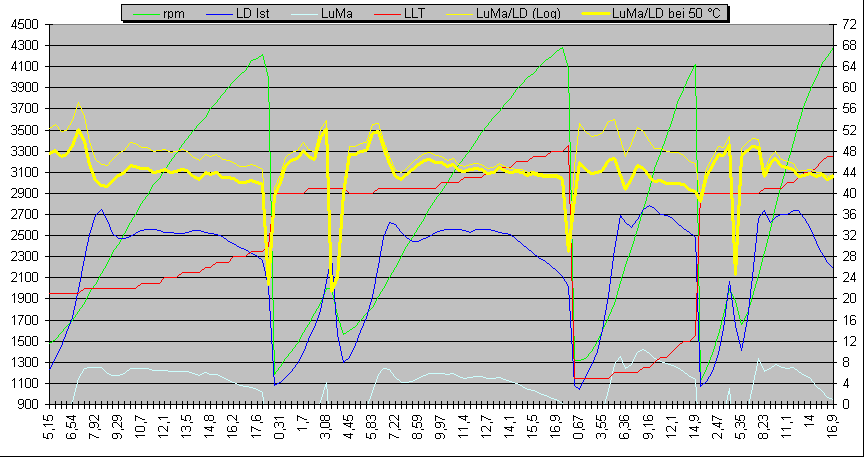
Here's the graph that's making me suspicious.
The 3rd and 4th logs appear shorter because I was running other background processes at the time, which are not relevant here.
Das Verhältnis LuMa/LD (gelb dünn, Faktor = 100) läßt sich vom obenraus deutlich sinkendem LD offenbar nicht beeindrucken. Selbst der LD-Unterschied zwischen Serie und Tuning ändert die Relation nicht merklich - solange die LLT gleich bleibt, siehe 2. und 4. Log.
The more I expected that the LuMa, normalized to 50°C, would show a LuMa/LD profile at the same level in all logs... the clearest example of my personal confusion can be seen when comparing the 3rd and 4th logs  .
| Description: |
| LMM Temperature Compensation: Wrong or Just Physics? |
|
| File size: |
18.95 KB |
| Viewed: |
2515 times |
|
Gruß Ulf
_________
MG4 Electric
Translated on 06-10-2026, 9:16.
|
|
| Back to top |
Profile PM Garage |
|
Herbert
Profi-Schrauber
Joined: 06/22/2005
Posts: 4632
Karma: +1346 / -0
Premium Support
|
| 27-07-2011, 20:07 Subject: LMM Temperature Compensation: Wrong or Just Physics? |
Quote |
|
Hi Ulf,
Quote: | | The more I expected that the LuMa, normalized to 50°C, would show a LuMa/LD profile at the same level in all logs | .
That's exactly where you're mistaken. You've gotten caught up in a context that doesn't align with the principles of thermodynamics.
hg
Herbert. Horch A4 8K CJCD
Golf 7 DDYA
(+ Audi 80 Avant B4 1Z 475Tkm - habe ich vom ersten bis zum letzten Tag gerne gefahren)
(+ Passat Variant 32B CY 400Tkm)
Translated on 06-10-2026, 9:17.
|
|
| Back to top |
Profile PM |
|
ulf
Profi-Schrauber
Joined: 04/13/2002
Posts: 11058
Karma: +18 / -0
Location: Saarland
2023 MG ZS
Premium Support
|
| 27-07-2011, 20:36 Subject: LMM Temperature Compensation: Wrong or Just Physics? |
Quote |
|
Herbert wrote: | | You seem to have gotten mixed up in a context that doesn't quite align with thermodynamics. | Okay, thank you anyway.
Maybe I'll understand it someday... Gruß Ulf
_________
MG4 Electric
Translated on 06-10-2026, 9:18.
|
|
| Back to top |
Profile PM Garage |
|
Herbert
Profi-Schrauber
Joined: 06/22/2005
Posts: 4632
Karma: +1346 / -0
Premium Support
|
| 27-07-2011, 21:12 Subject: LMM Temperature Compensation: Wrong or Just Physics? |
Quote |
|
Hi Ulf,
You shouldn't give up on this yet. You just need to make your measurements under the same conditions (boost pressure, engine load) and avoid introducing any assumptions too early. I'm also interested in this, and I'd be happy to discuss the results with you.
Sure, here's the translation:
"Best regards," or "Sincerely,".
Herbert.
Horch A4 8K CJCD
Golf 7 DDYA
(+ Audi 80 Avant B4 1Z 475Tkm - habe ich vom ersten bis zum letzten Tag gerne gefahren)
(+ Passat Variant 32B CY 400Tkm)
Translated on 06-10-2026, 9:19.
|
|
| Back to top |
Profile PM |
|
ulf
Profi-Schrauber
Joined: 04/13/2002
Posts: 11058
Karma: +18 / -0
Location: Saarland
2023 MG ZS
Premium Support
|
| 28-07-2011, 5:16 Subject: LMM Temperature Compensation: Wrong or Just Physics? |
Quote |
|
Herbert wrote: | | You only need to take your measurements under the same boundary conditions (boost pressure, engine load). | Well, it's actually impossible to be "more" identical than what the logs show. The engine was always at operating temperature, and the different boost pressure curves over the RPM range are due to normal control tolerances or a reduction in the target boost pressure at "high" engine loads.
I'm confused because the LuMa/LD (air mass/load pressure) relationship in each log seems to be independent of the load pressure curve. It's not affected by the downward inflection point of the load pressure starting around 3700 rpm. However, on the other hand, attempting to "calculate" the LLT (lambda - air-fuel ratio) by normalizing the air mass, for example, to 50°C, fails quite noticeably. Gruß Ulf
_________
MG4 Electric
Translated on 06-10-2026, 9:20.
|
|
| Back to top |
Profile PM Garage |
|
Herbert
Profi-Schrauber
Joined: 06/22/2005
Posts: 4632
Karma: +1346 / -0
Premium Support
|
| 28-07-2011, 7:37 Subject: LMM Temperature Compensation: Wrong or Just Physics? |
Quote |
|
Hi Ulf,
You can't simply ignore different pressures and say, "It doesn't matter, I'll just convert everything to 50°C," and expect it to work out.
Let's say you want to compare the specific gravity of water and oil. You have one liter of each, one in a heavy metal can, heated to 80°C, and the other in a light plastic container, heated to 10°C. Even if you correct the volume values for thermal expansion, you can't simply weigh them using the containers, and you can't ignore the different containers. You're doing something similar.
The ratio of the two specified pressure values is 2532/2436 = 1.04. The corresponding temperatures have a ratio of 318/285 = 1.09, which is in the same order of magnitude. Mass, temperature, pressure, and volume are directly related.
Therefore, your evaluation is fundamentally flawed from the methodological perspective.
hg
Herbert.
Horch A4 8K CJCD
Golf 7 DDYA
(+ Audi 80 Avant B4 1Z 475Tkm - habe ich vom ersten bis zum letzten Tag gerne gefahren)
(+ Passat Variant 32B CY 400Tkm)
Translated on 06-10-2026, 9:22.
|
|
| Back to top |
Profile PM |
|
ulf
Profi-Schrauber
Joined: 04/13/2002
Posts: 11058
Karma: +18 / -0
Location: Saarland
2023 MG ZS
Premium Support
|
| 26-03-2012, 15:31 Subject: LMM Temperature Compensation: Wrong or Just Physics? |
Quote |
|
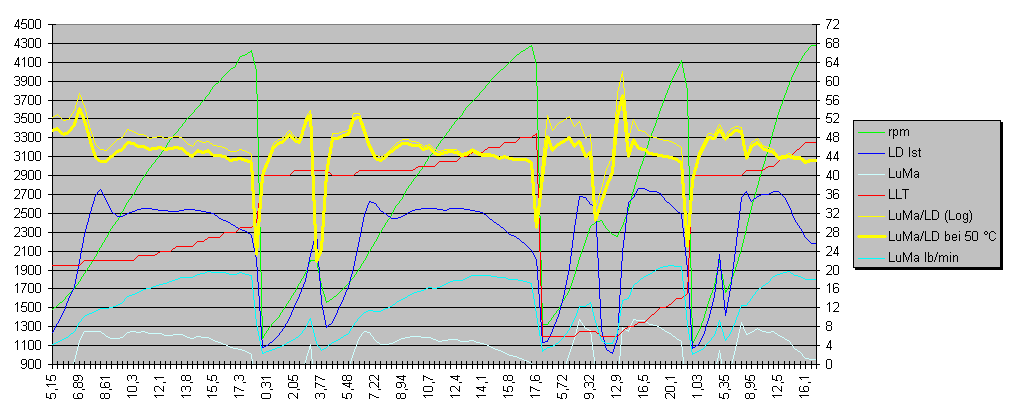
Okay, I've been experimenting a bit with exponents in the formula.
LuMa(50°C) = LuMa logarithm value * (LLT + 273) / (50 + 273)
tested, because the correction factor (LLT + 273) / (50 + 273) apparently overcompensates for the effect of the LLT on the volumetric flow rate.
If I were to, in a sense, reduce the correction factor by 40% by...
LuMa(50°C) = LuMa logarithm value * ((LLT + 273) / (50 + 273))^0.6
If you calculate it, the "normalized" LuMa/LD values in the LLT range between 14 and 48°C (for Pmax) will almost perfectly match for the same vehicle. Attached is the diagram from above with the newly calculated LuMa/LD profiles for an LLT of 50°C.
I don't know why this works the way it does, but the result allows me to make a more precise comparison of different turbocharger types for 1.9L TDIs in terms of their efficiency.
| Description: |
| LMM Temperature Compensation: Wrong or Just Physics? |
|
| File size: |
19.95 KB |
| Viewed: |
1460 times |
|
Gruß Ulf
_________
MG4 Electric
Translated on 06-10-2026, 9:24.
|
|
| Back to top |
Profile PM Garage |
|
|


 Bookmarks
 Links
 Garage
 FAQ, Legal Notice & Privacy
 RSS Feed
 Register
 Login

