| Author |
Message |
Bertil
Profi-Schrauber

Joined: 04/15/2002
Posts: 5628
Karma: +108 / -0 
Premium Support
Muenchhausen likes this. |
 13-01-2004, 13:35 Subject: The Story of the 827 Four-Cylinder Engine (extensive text) 13-01-2004, 13:35 Subject: The Story of the 827 Four-Cylinder Engine (extensive text) |
Quote |
|
Vor ewigen Zeiten mal hab ich das mal versprochen ..... 
If desired, we can also publish this as a technical article.
Please provide the German text you would like me to translate into English.
This article is (still) not complete and is intended to be expanded with the knowledge of forum participants.
The article should focus on the basic versions of the 827 engine and its key development stages, without covering each individual engine type in detail. Variants such as the five-cylinder, V8, W12, and even the V6 will not be discussed here. These engines were mostly developed by creatively utilizing existing 827 components.
The EA 827 engine (EA stands for "development order") was developed at Audi in Ingolstadt in the late 1960s under the direction of Franz Hauck, head of engine development at Audi.
The goal was a 1.2-liter four-cylinder engine with a five-bearing crankshaft (KW), an overhead camshaft (NW) with a quiet, maintenance-free timing chain drive, tappets, and parallel valves. An intermediate shaft drives the distributor. The engine was designed for longitudinal installation in an Audi 80. After some modifications, the displacement increased to 1.5 liters with 70 horsepower.
The Audi 80 saw the introduction of the 827 engine in 1972, initially offered as a 1.3-liter and a 1.5-liter unit. In 1973, the same engine was also introduced in the Passat. The bore of the original engine, at 76.5mm, was still significantly smaller than what would become possible later on.
VW CEO Leiding ordered that the engine be installed transversely and, as a trial run, it was incorporated into the then-under-development Golf/Scirocco. As a result, the 827 engine also found its way into the Golf, where it is now an indispensable part.
In 1975 wurde der Block schon das erste mal gravierend geändert. Eine Hubraumvergrößerung auf 1,6 Liter wurde durch einen Block mit 79,5mm Bohrung ermöglicht. Dazu mussten die Wasserkanäle, die der 827 ursprünglich noch zwischen den Zylindern hatte, weichen. Als in 1976/77 der Golf GTI mit dem 110PS starken Einspritzmotor erschien war schon wieder eine Neuheit am 827er zu beobachten. Der "Heron" Zylinderkopf des GTI Motors mit der mechanischen K-Jetronik Einspritzanlage. The Heron cylinder head is a completely flat cylinder head that relocates the combustion chambers into a piston recess.
In 1980, the 1.6-liter engine with 75 horsepower was replaced by a 1.5-liter short-stroke engine with 70 horsepower. This change was intended to improve smoothness.
With the introduction of the 1.8-liter GTI engine in 1982, the Heron cylinder head was discontinued, and the bore of the 827 was increased to 81 mm. The housing of the 827 had to be slightly widened to accommodate the crankshaft with a diameter of 86.4 mm in the 1.8-liter engine.
Later on, a 16-valve cylinder head was even fitted to this engine in the Golf 2, increasing the maximum power output to 139 hp.
Doch damit sollte der 827 noch nicht am Ende sein. Mit der Einführung der Passat Baureihe 35 erhielt der 827 erneut eine größere Bohrung von 83mm! Der Hubraum wuchs damit auf 2,0 Liter an. Dieser Motor stellte zunächst das maximal Machbare dar. Die Laufbuchsen der Zylinder hatten bei diesem Motor einen Abstand von gerade mal 3mm! Diese Konstruktion war nur durch neue Werkstoffe und Gussverfahren möglich. Experts doubted that the 2-liter engine would ever run reliably, as the cylinder wall thickness of 5 mm was significantly too thin according to the experience of the time.
In 1992, the 1.6-liter engine's bore was increased from 79.5mm to 81mm, which allowed for a shorter connecting rod. This modification was intended to improve the engine's smoothness while maintaining the same power output (we've seen something like this before).
--- Okay, so I have a problem: I currently don't have precise data on when, where, and which engines were equipped with turbos, 5V heads, etc.
I eventually switched to diesel  . .
Hier wird der Artikel bei Gelegenheit ergänzt.
Ach jetzt hätte ich doch glatt was vergessen ....
Of course, the 827 engine has also been available as a diesel engine since 1976.
How did this happen? This was a long and arduous process. For a long time, Volkswagen saw no need for a passenger car diesel engine (the first passenger car diesel came from Mercedes in 1936 – Volkswagen hadn't even considered it at that point).
It all started with the Beetle! In 1952, Porsche received the order to develop a diesel version of the Beetle. The result was likely not very convincing; some say it was even a disaster. Until the oil crisis of 1972, no one at VW wanted anything more to do with diesel passenger cars. It wasn't until then, under the leadership of Ernst Fiala, that they started considering a diesel passenger car again. At the end of 1973, the first VW diesel engine ran on a test bench and immediately produced 40 horsepower. It was a 1.5-liter 827 engine with a bore of 76.5mm, using a Peugeot cylinder head that had been hastily adapted to the 827, as VW did not yet have its own diesel cylinder head.
The shift in the diesel debate was triggered by the strict US emissions regulations of 1973, which diesel engines could easily meet. However, gasoline engines would only be able to achieve these limits in the future with a catalytic converter. This catalytic converter would likely eliminate the cost difference between diesel and gasoline engines. Furthermore, it was assumed that the catalytic converter would result in an additional fuel consumption of 10%.
It wasn't until the end of 1974 that the diesel experiment evolved into a real project. The goal was to develop a 1.5-liter engine with 45 horsepower, which was already more than what competitors could offer at the time. By the start of series production in 1976, the diesel engine was producing 50 horsepower. Initial experiments with turbochargers also resulted in engines producing approximately 70 horsepower.
The first diesel Volkswagen Golf had an engine of 1.5 liters and 50 horsepower, weighed only 805 kg, and could reach a top speed of 140 km/h. The acceleration from 0 to 100 km/h took approximately 20 seconds! Fuel consumption of around 5 liters was possible. With this, the Golf set a higher standard for its competitors in terms of specific power output.
The engine was already increased to 1.6 liters in 1979 and now produced 54 horsepower. This engine was installed in almost all vehicles of the group with virtually no changes until the early 1990s. In 1981, the turbocharged diesel version was introduced. The bore remained at 76.5mm for a long time.
In 1986, the 1.6-liter engine was increased to 1.7 liters by expanding the bore from 79.5 mm. The next step was the development of a 1.9-liter Wankel engine. However, to achieve a displacement of 1.9 liters, it wasn't enough to simply enlarge the bore; the engine block also had to be increased in size. Since the external dimensions of the 827 were not to be changed, the block had to grow taller by 15 mm, which allowed for a longer stroke.Here, the step towards direct injection was not far off.
However, this developmental step was expected to take a total of 14 years. Both Audi in Neckarsulm and Volkswagen in Wolfsburg were working on diesel direct injection technology. Without the active support of Bosch, it likely would have taken even longer. The required fuel injection pressure of 800 bar was by no means easy to integrate into a passenger car engine at that time (approximately 400 bar for naturally aspirated engines). Die Ehre des ersten TDI Motors gebührte allerdings dem von 827er entlehneten Fünfzylinder. Es handelte sich dabei um den 1T aus dem Jahre 1989 (2,5l mit 120PS -- damals schon 81mmm Bohrung!). Erst 1992 war es dann so weit, auch der 827 wurde zum DI Motor. Von Anfang an überzeugte der Motor mit einem Drehmoment und einer Fahrfreude die für einen Diesel bisher ungeahnt war. Wieder legte VW die Messlatte für die Mitbewerber etwas höher. EinThe model range was completed by a version with 110 horsepower.
A naturally aspirated SDI engine with 68 horsepower was introduced as the smallest engine option and replaced the good old 54 horsepower engine. However, various SDI variants with 1.9 liters and 1.7 liters play a rather minor role in the shadow of the more powerful TDIs.
Stricter emission regulations led Volkswagen to experiment with the well-known but complex common rail injection system. The goal was to achieve injection pressures of 2000 bar and further improve the performance of direct injection (DI) engines. As early as 1984, the company Elsbett had built a plant oil engine similar to a common rail design and had gained positive experience with it in long-term tests.
Der erste 115PS PD Motor war für VW jedoch ein Debakel. Der Zahnriemenantrieb war mit dem PD Prinzip und den damit verbundenen Belastungen an seine Grenzen geraten und sorgte für unschöne Schlagzeilen. Es wurde nachgebessert. Daher wurde der 110PS VP Motor der eigentlich vom 115PS PD Motor abgelöst werden sollte noch etwas länger gebaut. Mit Erscheinen des 115PS PD Motors verschwand die Zwischenwelle aus den 827 er Motorgehäusen. Die Vakuumpumpe für den Bremskraftverstärker wanderte an das Ende der Nockenwelle. {MA This change also affects the VP engines that are still in the program.
With more robust materials and modified turbochargers, the power output of the PD TDI engines increased to 130 and 150 horsepower. The 100-horsepower PD engine was intended to replace the 90-horsepower VP engine. At the end of 2001, this 100-horsepower PD engine was brought up to the D4 emission standard (equivalent to EU4 in terms of emissions) with minor modifications and further developed PD injectors.
In the spring of 2002, the last VP TDI engines disappeared from the product listings. Currently, only in America , at SEAT and Skoda, is the VP TDI still being sold.
The next revolution is the 2.0-liter 16V PD TDI engine. The increase in displacement was achieved by boring the cylinder block to 81mm (a practice common in gasoline engines since 1982).
Even the SDI has been updated with the new Golf. The engine displacement is now also 2.0 liters (81mm bore * 95.5mm stroke), and it has been converted to a PD engine. This means another VP diesel engine disappears from the VW engine lineup.
Curiosities of the year 827:
In the late 1970s, Volkswagen developed an 827 engine for the Chrysler Corporation, which was struggling financially at the time and could not afford its own development projects. This was a 1.7-liter engine. A larger crankshaft with a stroke of 84.5 mm, combined with a bore of 79.5 mm, resulted in the increased displacement.
The engine was used in the Chrysler/Talbot Horizon.
Angeblich sollen einige Motoren diesm Weg nach England gefunden haben und dort in diversen Konstruktionen sich wiederfinden.
... will be completed and expanded ...
Changes inserted are highlighted in green.
© 2004 Bertil Kraft
Translated on 16-07-2026, 0:27.
|
|
| Back to top |
Profile PM |
 |
dieselschrauber
Administrator

Joined: 04/12/2002
Posts: 18113
Karma: +800 / -0
Location: St.Gallen
2018 Volkswagen T6 
|
| 13-01-2004, 14:05 Subject: The Story of the 827 Four-Cylinder Engine (extensive text) |
Quote |
|
Quote: | | Wenn gewünscht können wir das auch als Fachartikel einstellen. |
Sure, great article! 
Translated on 16-07-2026, 0:39.
|
|
| Back to top |
Profile PM WWW Garage |
|
Jan6K
Joined: 04/12/2002
Posts: 4741
Karma: +107 / -0
Location: Hagen
Premium Support
|
| 13-01-2004, 14:15 Subject: The Story of the 827 Four-Cylinder Engine (extensive text) |
Quote |
|
Hi,
I agree with Rainer; great article!
Here are a couple of suggestions/requests, although unfortunately I can't contribute much beyond offering ideas.
In a discussion thread, someone mentioned that when comparing AFN and ASV engines, the latter (the last generation of VP engines, i.e., ALH/ASV) also has the vacuum pump located at the end of the camshaft. This is the same configuration that is also mentioned in the text regarding PD engines. Perhaps this "backport" should also be mentioned.
It would also be interesting to see the integration of the SDI. The VP seems to last longer in those engines than in the TDI engines, and that block is almost certainly an 827.
Best regards,
Jan.
1Z5 CFHF  / AHB H4D 
Translated on 16-07-2026, 0:40.
|
|
| Back to top |
Profile PM |
|
dieselmartin
Profi-Schrauber
Joined: 03/13/2003
Posts: 10121
Karma: +29 / -0
Location: in der Werkstatt
2007 Volkswagen Passat
Premium Support
|
| 13-01-2004, 14:36 Subject: The Story of the 827 Four-Cylinder Engine (extensive text) |
Quote |
|
If anyone is still interested, they can take a look at this BOOK. Okay, okay, the topic could have been presented better than in this book, but it's fine to borrow it and browse through it.

These also include photos showing how VW envisioned a FULL ENCLOSURE for a G1 diesel engine  .
The V10 shown in the picture is, incidentally, not mentioned anywhere  .
Translated on 16-07-2026, 0:42.
|
|
| Back to top |
Profile PM Garage |
|
Bertil
Profi-Schrauber
Joined: 04/15/2002
Posts: 5628
Karma: +108 / -0
Premium Support
|
| 13-01-2004, 14:54 Subject: The Story of the 827 Four-Cylinder Engine (extensive text) |
Quote |
|
Jan6K wrote: | ...In a certain thread, it was mentioned that when discussing the differences between AFN and ASV engines, the last generation of VP engines (i.e., ALH/ASV) also has the vacuum pump at the end of the camshaft. So, the same configuration as mentioned in the text for PD engines. Perhaps this "backport" should also be mentioned...
It would also be interesting to see the integration of the SDI. The VP seems to last longer in those engines than in the TDI engines, and that block is almost certainly an 827.
|
Thanks, Jan, I've added it.
Does anyone have more detailed information about the SDI (Strategic Defense Initiative)? It's not really my area of expertise, and it's quite difficult to find reliable information about it.
@ dieselmartin
I've glanced through this book before. It's not bad. The problem is, I don't want to infringe on any copyrights, so I wrote all of it myself. I might also add some pictures later if I can work out the copyright issues. So, ideally, they would be my own photos...
@everyone
Bei den Dieselmotoren bin ich mir über die Einführungsdaten nicht so ganz im klaren, daher fehlen sie oft. BPlease complete the sentence.
Thank you. Gruß Bertil
Skoda 5E5 CZDA + Mini R50 W10 + VW ID.3 + Fiat Ducato 250 + 161 DX
*** Technische Anfragen per PN werden von mir nicht beantwortet! ***
Translated on 16-07-2026, 0:44.
|
|
| Back to top |
Profile PM |
|
Jan6K
Joined: 04/12/2002
Posts: 4741
Karma: +107 / -0
Location: Hagen
Premium Support
|
| 13-01-2004, 16:13 Subject: The Story of the 827 Four-Cylinder Engine (extensive text) |
Quote |
|
Hi Bertil,
If you need help with photos, just let me know. I think we can get a lot done together by sharing information through the forum.
Best regards,
Jan.
1Z5 CFHF / AHB H4D
Translated on 16-07-2026, 0:46.
|
|
| Back to top |
Profile PM |
|
Jan6K
Joined: 04/12/2002
Posts: 4741
Karma: +107 / -0
Location: Hagen
Premium Support
|
| 13-01-2004, 16:19 Subject: The Story of the 827 Four-Cylinder Engine (extensive text) |
Quote |
|
Hi,
Regarding the Strategic Defense Initiative (SDI):
There's also the 1.7 version. According to my Polo manual, it has the same bore as the 1.9 engine, but with a correspondingly smaller displacement (the exact number is in the manual, which I'm at home, but I can provide it later). The cylinder head is likely identical as well (but that's just an assumption).
Otherwise, there's also:
1.7L, 57 hp (DIN)
1.7L, 60 hp (AKU)
1.9L, 64 hp (AEF, AGD engines)
1.9L, 68 hp (AQM)
Best regards,
Jan.
1Z5 CFHF / AHB H4D
Translated on 16-07-2026, 0:47.
|
|
| Back to top |
Profile PM |
|
Markus H.
Guest
Free account, no CAN development support
|
| 13-01-2004, 21:24 Subject: The Story of the 827 Four-Cylinder Engine (extensive text) |
Quote |
|
Hi,
First of all, 'hats off' for the work.
Regarding the Strategic Defense Initiative (SDI):
Indeed, it is somewhat more difficult to find data on that topic.
However, from an older AMS article, I learned that the new generation of SDI engines is also being switched to PD. (There was a discussion about this here before). It's supposed to be the 2.0-liter PD-SDI engine with 75 horsepower (Mercedes had already surpassed that power output for diesel engines almost 20 years ago, with the W124...).
Regarding the current 2.0 TDI engine:
Die nächste Revolution ist der 2,0 Liter 16V PD TDI. Die Hubraumerweiterung wurde durch aufbohren das Blockes auf 81mm (wie bei den Benzinern schon seit 1982 üblich) erreicht.
Sure, it would be excessive if you were to explain all the engines with more or fewer cylinders.
Der '1T' (nicht 1Z) darf aber nicht fehlen! Es war der 1. TDI!
It was the glorious year of 1989.
The 1T already had a bore of 81mm, the same as the current 2.0 TDI, and also featured the same stroke as the 2.0.
Translated on 16-07-2026, 0:49.
|
|
| Back to top |
|
|
Marco
Guest
Free account, no CAN development support
|
| 13-01-2004, 21:54 Subject: The Story of the 827 Four-Cylinder Engine (extensive text) |
Quote |
|
Hi Bertil,
Great article!!!
It would be interesting to further highlight the individual evolutionary stages of the 827, perhaps through photos or a chronological arrangement. For example, I need to find some information about the AQM somewhere.
To have photos.
Translated on 16-07-2026, 0:51.
|
|
| Back to top |
|
|
WarLord
Guest
Free account, no CAN development support
|
| 13-01-2004, 23:16 Subject: The Story of the 827 Four-Cylinder Engine (extensive text) |
Quote |
|
Der '1T' (nicht 1Z) darf aber nicht fehlen! Es war der 1. TDI!
It was the glorious year of 1989.
Der 1T hatte bereits eine Bohrung von 81mm, wie der aktuelle 2,0 TDI - dazu den selben Hub wie der 2,0.
The T-model is iconic. It has a fuel consumption of 1.9 liters and a range of 4800 kilometers on a single tank, all with an engine displacement of 2.5 liters (if I remember correctly).
Best regards, WarLord.
Translated on 16-07-2026, 0:52.
|
|
| Back to top |
|
|
m3_bremse
Guest
Free account, no CAN development support
|
| 13-01-2004, 23:29 Subject: The Story of the 827 Four-Cylinder Engine (extensive text) |
Quote |
|
@bertil
Excellent article! Congratulations and thank you very much.
Translated on 16-07-2026, 0:53.
|
|
| Back to top |
|
|
Gremlin
Guest
Free account, no CAN development support
|
| 14-01-2004, 10:26 Subject: The Story of the 827 Four-Cylinder Engine (extensive text) |
Quote |
|
The T-model is iconic. It has a fuel consumption of 1.9 liters and a range of 4800 kilometers on a single tank, all with an engine displacement of 2.5 liters (if I remember correctly).
Greetings, WarLord.
with aerodynamics 'optimized' using duct tape and tires that are almost balloon-like in their inflation.
CU Gremlin.
Translated on 16-07-2026, 0:53.
|
|
| Back to top |
|
|
Jens 16syncro
Joined: 09/16/2002
Posts: 469
Karma: +2 / -3
Premium Support
|
| 14-01-2004, 17:42 Subject: The Story of the 827 Four-Cylinder Engine (extensive text) |
Quote |
|
Hi,
Beautiful text about one of the most ingenious engine designs from Volkswagen  .
In another thread, I once speculated about the 1.7L diesel variant; here's the text from that time regarding it:
Please provide the German text you would like me to translate into English. I will then give you only the translation, without any explanations.
Hi there,
The 1.7 SDI is a very familiar engine.
The origins clearly trace back to the 1.7D engine in the T3 from 1986.
The 1.7D engine (engine code KY) is based on the old 827 engine block and is essentially a 1.6TD (not "D" because it uses the reinforced block/crankshaft of the 1.6TD and has piston bottom cooling oil lubrication) with the bore size of the later 1.9D engine (engine code 1Y). The valve size also corresponds to that of the 1.9D. Therefore, the 1.9D is essentially a 1.7D with an extended stroke.
The 1.9TDI engines (1Z, AHU, AFN) are known to be based on the engine block of the 1.9D or TD engines (1Y, AAZ).So, the 1.7L diesel engine is not a step backward from the 1.9L engine, but rather its origin!
The 1.7-liter engine was never offered with a turbocharger, neither as a swirl chamber diesel nor as a TDI. Therefore, the 1.7 TDI would have been a very late upgrade of an old naturally aspirated diesel engine.
Please provide the German text you would like me to translate into English. I will then give you only the translation, without any explanations.
I'm not very knowledgeable about car engines, especially gasoline engines. In the T3 and T4 models, there were the following variations of the 827 engine (only 4-cylinder versions):
T3:
1.6D engine with 37 kW power output, engine code "CS", manufactured from 1980 to 1986.
1.6TD engine with 51 kW power output, engine code JX, manufactured from 1984 to 1992.
1.7D with a 42 kW engine, engine code KY, manufactured from approximately 1986 to 1992.
The cylinder heads of all these engines, unlike the versions used in passenger cars, have conventional tappets between the camshaft and valves, and do not feature hydraulic valve clearance compensation!
The 1.6TD engine in the T3 is considered by engine experts to be the thermally most stressed engine ever installed in a mass-produced vehicle! Consequently, these engines often only lasted for 50,000 km in "DIY mechanic" vehicles, and even with careful driving, rarely exceeded 200,000 km! This is quite different from the nearly identical engine in the Golf2, which sometimes reached half a million kilometers.
Rumor has it that the 1.7D variant was created at the request of the then-German Federal Post Office to give the very weak 1.6D engine a bit more life. The 1.6TD was rarely found in government vehicles due to the aforementioned issues. Similarly, the first 1.6D engine in the T3 (which was the first water-cooled engine in a VW Transporter in 1980!) was also created at the request of the German Federal Post Office and appeared even before the Waterboxer models.
T4:
1.9D engine with 44 kW, engine code 1X, manufactured from 1990 until ????.
1.9 TD engine with 50 kW power output, engine code ABL, manufactured from 1992 (approximately) until [year].
2.0L B engine with 62 kW, but I don't know the engine code or the year of manufacture.
Regards,
Jens. Marcus "Ar Gwenn": Für uns sind Leute arm, weil sie mit einem Eselskarren unterwegs sind, für sie sind wir arm, weil wir ein Leben lang dafür arbeiten und Geld verdienen müssen, um uns im Alter von wildfremden Leuten pflegen zu lassen.
Translated on 16-07-2026, 0:59.
|
|
| Back to top |
Profile PM |
|
Bertil
Profi-Schrauber
Joined: 04/15/2002
Posts: 5628
Karma: +108 / -0
Premium Support
|
| 14-01-2004, 18:52 Subject: The Story of the 827 Four-Cylinder Engine (extensive text) |
Quote |
|
Hi Jens,
Jens 16syncro wrote: | ...a beautiful text about one of the most ingenious engine designs from Volkswagen.
|
Well, as much as it pains me to say as an 827 fan, but I consider the 827 to be the most ingenious design flaw of Volkswagen.
The reason is very simple:
The engine was originally designed as a 1300cc unit, but due to extensive modifications involving the crankshaft, it has now reached a displacement of 2000cc. In diesel engines, this isn't a major issue because of the slower combustion process; in fact, it can even be advantageous.
However, the gasoline engine is now quite problematic precisely because of its long stroke. One cannot expect properly balanced performance figures from this engine with a long stroke. High RPMs are detrimental to the engine, but a 16V engine needs high RPMs. Therefore, VW has taken a different approach and added a turbocharger. While this mitigates the power deficit of the long-stroke design, it also causes the engine to become a "fuel guzzler" under full load.The FSI engines, which were not particularly praised in the press, likely suffer from the same problem.
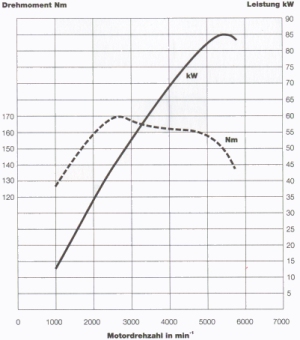
Opel made the better choice in the early 1980s by purchasing a Cosworth engine. This 2-liter engine with a square design (86x86 mm) is significantly more modern and versatile, but also 10 years younger and still relevant today.
Quote: |
In another thread, I once speculated about the 1.7L diesel variant; here's the text from that time regarding it:
.... |
... Will be inserted. I had forgotten about the bus with the 1.7-liter engine. Gruß Bertil
Skoda 5E5 CZDA + Mini R50 W10 + VW ID.3 + Fiat Ducato 250 + 161 DX
*** Technische Anfragen per PN werden von mir nicht beantwortet! ***
Translated on 16-07-2026, 1:05.
|
|
| Back to top |
Profile PM |
|
Gremlin
Guest
Free account, no CAN development support
|
| 14-01-2004, 19:15 Subject: The Story of the 827 Four-Cylinder Engine (extensive text) |
Quote |
|
Opel made the better choice at the beginning of the 80s by purchasing a Cosworth engine. This 2L engine with a square design (86*86) is far more modern and versatile, but also 10 years younger and still current.
'And for a naturally aspirated engine, it has an amazing torque curve, without any variable valve timing or other complex features like a switchable intake manifold.'
It went well in the 'old grandpa's box.'
CU Gremlin.
| Description: |
| The Story of the 827 Four-Cylinder Engine (extensive text) |
|
| File size: |
42.17 KB |
| Viewed: |
27697 times |
|
Translated on 16-07-2026, 1:08.
|
|
| Back to top |
|
|
Thomas K.
Guest
Free account, no CAN development support
|
| 14-01-2004, 22:00 Subject: The Story of the 827 Four-Cylinder Engine (extensive text) |
Quote |
|
Hello Bertil,
'Sorry to correct you, but the 1.8-liter engine had a stroke of 86.4mm, not 84.5mm. Also, the crankshaft used by Chrysler is not identical to the 1.8-liter crankshaft, except for the stroke. Furthermore, the same Chrysler crankshaft was also found in the Bundeswehr Iltis vehicle with a 1.7-liter engine.'
As a long-time driver of a Golf I GTI 1.8, I had to correct that (I still feel bad about selling it four years ago)  .
Translated on 16-07-2026, 1:09.
|
|
| Back to top |
|
|
|


 Bookmarks
 Links
Links Garage
 FAQ, Legal Notice & Privacy
 RSS Feed
 Register
 Login
Login

