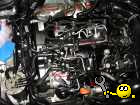
I was tempted to buy an old Caddy from 1990 that had been modified with a naturally aspirated diesel engine replaced by a 1.6 TD SB engine from a Golf 2 (1991). The car has been sitting for 10 years, and the modification is neither registered nor completed...
It's not running properly; I suspect the fuel injection pump.
Everything that had been done up to that point involved using an auxiliary tank located in the engine compartment, specifically to avoid having to deal with the main fuel tank and its lines.
The initial situation was that the car would only run if the diesel tank in the engine compartment was positioned higher than the fuel pump. However, when it did run, it always idled at 2000 RPM and wouldn't accelerate. Self-priming was only possible to a very limited extent.
For me, it was clear that the pump itself must have a problem.
That's why I ordered a gasket set and started taking it apart. So far, everything worked well. In the process, I also removed and adjusted the mixture screw at the back and the screws at the front (where the centrifugal governor is located), because the previous owner had apparently messed with them, and at least the mixture screw was completely screwed in.
During the initial disassembly, I only opened the top cover and made the regulator functional again. Unfortunately, the pump was stuck inside.
It ran well enough initially, and I gave it some gas, but only up to 3000 RPM, and it started very poorly. It was still producing that gray smoke. Then, as soon as I drove it, it stalled shortly after because the impeller housing pump at the bottom was also clogged.
That's why I took the pump apart again, completely disassembled it, cleaned it, and reassembled it.
Okay, that's enough about the background information.
Currently, I have the following values:
I have checked the valve timing multiple times now, and it seems to be correct.
For the initial start-up with the new old pump, the pressure gauge indicated a starting pressure of 91, because I accidentally positioned it exactly there during installation. The recommended setting is around 90, if I remember correctly.
The pump has good suction. When it's been idle for a longer period, no air bubbles form in the pipes.
When the motor is running, I have a continuous backflow.
It only starts when the choke is pulled out.
I always have to fiddle with it, and you can smell unburnt diesel even before it starts.
If I adjust the timing of fuel injection while the engine is running, it doesn't change the engine's performance much.
Currently, it's not accelerating properly and actually runs worse when you try to accelerate without revving the engine.
The idle speed is approximately 850 RPM. However, when the choke is engaged, there are fluctuations in the engine speed.
Although I trained as an automotive mechatronics technician, I have to admit that I only started working with common rail systems, and my experience with distributor injection pumps is limited to basic knowledge.
Thank you in advance to everyone who has read this far, and I hope you can help me.
For the initial start-up with the new old pump, the starting pressure, according to the measuring gauge, was set to 91 because I accidentally positioned it exactly there during installation. The target is around 90, if I remember correctly.
91 what, bananas?
What you call the "choke" is actually the cold start accelerator; it advances the fuel injection timing.
Quote:
It only starts with the choke pulled out.
Therefore, your perspective is incorrect.
First, I would make sure that the fuel supply is sufficient and that there is enough pressure inside the pump (check port?).
Sure, here is the translation of the text from German to English:
"LG" can be translated as "Best regards" or "Sincerely". It is a common abbreviation for "Liebe Grüße", which means "Warm greetings" in English.
With your 91 bananas, I mean a spark timing advance of 0.91 mm before Top Dead Center (TDC).
I understand that it's the cold start accelerator. I just always call it the "choke," whether it's a diesel or gasoline engine. That's how it became common practice back at the workshop.
Where can I measure the internal pressure? Right now, I only see a plug located relatively high up, about at the same level and opposite the return screw. It looks like an M10 thread.
You can clearly see how the pump from my auxiliary tank in the engine compartment is drawing fuel. Therefore, there should be enough diesel in it. Whether the pressure is correct, of course, is another question.
What pressure setting should I use? I'm currently estimating around 2-3 bar at idle and approximately 5-6 bar at higher RPMs.
Hi there,
You mean a stroke of 0.91 mm at top dead center (TDC). This was measured using a dial indicator at the TDC position. It's actually slightly early, but it should help with starting.
Probably, the valve inside the pump is faulty.
But first things first: are the injectors leaking, and what is the injection pressure on the test bench? What does the compression look like?
Specifically, the internal workings of the ESP and its repair are described elsewhere - in the T3/T4 wiki or in information provided in https://community.dieselschrauber.org/en/viewtopic.php?t=30721.
hg
Herbert.
Horch A4 8K CJCD
Golf 7 DDYA
(+ Audi 80 Avant B4 1Z 475Tkm - habe ich vom ersten bis zum letzten Tag gerne gefahren)
(+ Passat Variant 32B CY 400Tkm)
"...and is the injection nozzle common, and does it tend to droop or sag in any way? Unfortunately, you can only tell by looking at the disassembled pump."
That will be difficult now.
to complete a renovation project that has already been started.
Because you don't know what has already been done.
Yes, I still remember that thing about the 0.91 bananas.
Then, I believe the turbo engines had different fuel injectors.
and also oil spray nozzles for cooling the pistons.
And an oil-water heat exchanger.
Turbo engines typically have the membrane dome located on top of the ESP (Electrostatic Precipitator).
which increases the amount of fuel injected depending on the boost pressure.
I have to say, I'm familiar with the term "Motor SB," but I don't know all the details about it off the top of my head.
I once had a Golf with a JR engine producing 70 horsepower. And I think my T3 had a JX engine, which was also a 1.6 diesel.
You're asking that question about 25 years too late.
At that time, I probably could have helped you better with that.
At that time, I had been very involved with those types of engines.
Okay, I'll just read along.
Perhaps I can write something more meaningful about it sometime later.
In an emergency,
I still have the original microfilm and a reader for it.
Okay, I still have the book "Jetzt helfe ich mir selbst" (which translates to "Now I help myself") for the Volkswagen Golf diesel.
The book is so old that it's slowly falling apart.
So, the "SB" refers to a 1.6-liter diesel engine with a turbocharger, direct injection, and an intercooler.
I believe it has around 80 horsepower. It's an extremely rare engine; I've never seen one before.
I would start by checking which engine code letter is stamped on the engine block.
At that time, you could pretty much assemble the engines however you wanted.
It all worked out perfectly.
But if you have a 54 horsepower engine with a turbocharger and you've really put it through its paces,
It didn't last very long.
The original turbo engines also had reinforced crankshafts.
Yes, I have a complete turbocharger. It's installed in the block. Yes, it has a water-cooled compressor and an intercooler.
I've also looked at the "So wird's gemacht" guide. There's a lot of information in it. It's available for online reading.
"Last time, I completely disassembled and cleaned the pump while it was open. Everything is moving freely, and (hopefully, but I think so), it's assembled correctly."
The shaft where the centrifugal regulator is located (I believe this is the injection control valve) is in good condition and moves freely. However, I accidentally discovered that the shaft that guides it seems to need a specific clearance of 7.65 mm from the pump housing. (I hope this value is the same for everyone; I haven't found any further information about it.) I had it set at approximately 8.15 mm.
Then I reinstalled the pump and adjusted the timing and fuel injection start. This time, it's set to 0.90.
The engine doesn't start without jump-starting. As soon as I add a squirt of starting fluid, it starts right up and then runs pretty well. It still smokes, though.
He's now accepting fuel again and running without the cold start accelerator function. However, the throttle response is delayed. I have about a third of the pedal travel before anything happens.
Accordingly, the wave frequency that I set seems to have a significant impact on the pump.
Next, I removed the fuel injectors. For that, I had to make a custom 27mm socket. But thanks to a piece of exhaust pipe and my welding machine, it worked perfectly.
The gasket on the third cylinder was installed upside down. The injector is heavily carbonized.
I temporarily connected the injectors to the fuel lines and tested them. Three of them sprayed properly. One of them seemed to be dripping. The fourth one didn't produce any spray at all. I'll get the testing equipment on Monday, then I'll check the values and see if they are leaking or anything like that.
"As part of this process, it would be interesting to measure the compression. Unfortunately, I don't have a measuring device for that. However, based on sound alone, at least all the cylinders seem similar. So far, I haven't found any cylinder that sounds completely empty."
Theoretically, there should be a few photos here. Two of the seals, one where one was installed incorrectly, and one of the shaft I'm referring to, and one of the regulator.
Well, that certainly looks very positive at first glance.
The most important thing first is to make sure you have the correct engine block.
Wiping the nozzles is also correct and important.
The gaskets, or heat shields as they are sometimes called, should also be installed the correct way around.
You already realized that too.
Unfortunately, I can't help you with the fuel injection pump.
At the time when I was working in the workshop...
I've replaced seals before, but that's all.
That was around 1992/1993.
There were hardly any documents available, and the internet didn't exist yet.
If one of them ever stopped working properly, we took it to the Bosch service center, but even there, it wasn't always fixed completely.
I never really looked into it later either, because they were actually very reliable and rarely broke down.
Well, I'm really curious to see what happens next.
It's a nice project, though, this Caddy.
How will you ever let him in?
It's unlikely to get an H-registration if the inspector sees the turbocharger.
Perhaps as a truck?
Hi there,
I can't open the photos. You should upload them directly instead of from that strange source.
I wouldn't use a "Startpilot" type additive with diesel fuel because it ignites at the wrong time, not at top dead center (TDC), and that causes a shock to the piston, bearings, and crankshaft.
If one of the nozzles isn't spraying properly, try swapping it with another nozzle before disassembling and cleaning.
The engine is an EA086. Is the fuel injection pump made by Bosch? Please upload a photo of the type plate.
hg
Herbert.
Horch A4 8K CJCD
Golf 7 DDYA
(+ Audi 80 Avant B4 1Z 475Tkm - habe ich vom ersten bis zum letzten Tag gerne gefahren)
(+ Passat Variant 32B CY 400Tkm)
The images have been uploaded directly here. They should work. At least, they work for me.
It's a Bosch pump installed. I haven't found the type plate yet because the outer casing is quite corroded. However, I haven't looked too closely either.
"I know that using starting fluid isn't ideal. But he really only needs a small amount of it. So, just spray it briefly into the intake manifold and then start the engine. That's enough for him. I'll check the injectors on Monday. The one that wasn't spraying might not have been properly bled yet. Unfortunately, I didn't have time to look at it further. But he is running on all 4 cylinders. When I disconnect the fuel lines while the engine is running, the engine runs worse and diesel leaks out."
The glow plugs are working fine. The only problem is the relay, which is defective. Currently, I'm bypassing the relay and manually adjusting the preheating time.
Sure, here is the translation of the text from German to English:
Good evening everyone, I've been doing some more research.
I have now tested the injectors. They all open at approximately 155 bar, which I believe is within the standard specification. However, they all start to drip just before 155 bar, and some even spray jets.
As I gradually approach the opening pressure, only a very small amount of diesel starts to come out of the nozzle at around 150 bar, and a very fine spray appears at around 155 bar. However, the nozzle only atomizes properly when the pressure threshold is exceeded more quickly.
If I exceed the pressure point too quickly, it also becomes messy again.
I opened it up. It doesn't look too bad so far. It's a bit dirty. There's "Henzo DNS0D 297" written on the nozzles.
"However, since the spray pattern doesn't change after disassembling and reassembling, I think new injectors would be a good idea. If the injectors are slightly leaking, it could explain why he's having trouble starting because he only has the starter motor speed to work with. The starting fluid helps him overcome that and gives him enough RPM to run. He's smoking because he's not injecting fuel properly. That's my assessment."
Jetzt weiß ich aber nicht, was ich genau machen will. 4 neue komplette düsen kaufen(die gibts ja auf ebay für 230 bzw. 290€) oder nur die düsen selber für round about 50€ je nach Anbieter.(Preise auf 4stk. Bezogen)
However, you can also find the DNS0D 273 there.
What is the difference between 273 and 297?
I'm completely out of my depth when it comes to experience in this area. I haven't delved into the topic of fuel injection systems to that extent before.
Here's a video about it in the attachment. I think I'm leaning towards using all of them, for warranty purposes and other considerations.
Best regards,
Leo.
1.6 TDI Not Running? Adjust Fuel Injector Pump - 20250922_195330_1.mp4
Description:
Video, wenn der Druck mit dem prüfgerät langsam aufgebaut wird.


 Bookmarks
 Links
Links Garage
 FAQ, Legal Notice & Privacy
 RSS Feed
 Register
 Login
Login