My daughter's Polo went into emergency mode yesterday. Or it experienced a significant loss of power, I'm not entirely sure which.
It's a Polo with a 1.4 TDI engine, model year 2015, engine code CUSB.
Here is the error log. Could you please give me a brief tip on how to best proceed with troubleshooting?
I've cleared the error memory and will take it for a test drive. I'll let you know how it goes. Thank you very much!
Umgebungsdruck ist der normale Druck (knapp 1 bar absolut). So far, so good.
The target boost pressure is 2.24 bar absolute, which is approximately 1.3 bar above atmospheric pressure. This indicates a high load requirement and is within the acceptable range.
"I don't see the term 'actual boost pressure' in the error memory. However, I do see 'intake manifold pressure,' which is probably the same thing. This value is only 77 kPa, which is 770 mbar absolute. This means approximately 0.2 bar of vacuum compared to atmospheric pressure."
Not only is there insufficient boost pressure being generated, but no pressure is being generated at all, and the engine is actually experiencing a vacuum.
Check the boost pressure line. Something is either completely disconnected or completely blocked.
I went out again to look for leaks or bite marks.
Since I couldn't find anything with my naked eye, I took out my "baby oil leak detector" and blew fragrant vapor into the intake pipe.
Despite looking in the engine compartment, nothing was visible. However, there was a significant amount of smoke coming from the area around the exhaust manifold. Additionally, there was steam coming from the exhaust valve control unit.
But it's probably not the primary cause of the error messages, right?
I'll probably have to continue investigating the intercooler system...
Polo 1.4 TDI: Limp Mode - Turbocharger Issue - IMG_0001.MOV
If there's a vacuum in the intake system while driving, I would first disconnect the intake snorkel from the turbocharger, check if the turbine wheel is still there, inspect the turbine shaft for any breaks, and ensure there's no excessive play.
Thank you very much, Rainer!
Of course, I tried that. Unfortunately, with this design of the turbocharger, the turbine wheel is not visible after removing the air intake duct.
However, I've gained some new insights and would appreciate your feedback.
- I found a few nuts (literally, like the edible kind) on the intake side of the air filter housing (fun fact).
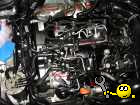
- I found a part inside the air filter housing, on the engine side, and I absolutely can't figure out where it came from. Here's a picture of it. Does anyone know what it is?
- As a test, I removed the turbocharger pressure sensor (G31) from the second, identical Polo belonging to my other daughter and installed it in this Polo. I was hoping that perhaps only this part was faulty. Unfortunately, this was not the case.
- Please find attached the report from the subsequent test drive. According to the report, the "calculated actual value" of the boost pressure remains relatively constant between 0.8 and 0.9 bar. The engine power is also significantly lower than expected.
I would now like to rule out a major leak in the charge air system. In this vehicle, besides the intercooler and fixed plastic pipes, there are only two short rubber hoses. I have not been able to detect any leaks in those.
I then also compared the engine noises at a higher idle speed for both Polos. I believe that I could hear the faint whistling of the turbocharger in the working Polo, but not in the defective one.
My suspicion is therefore:
The turbocharger has failed.
What do you think? That would be a really crappy job to do, replacing it. But I'm definitely confident that I can do it.
Do you think it might be worth having the intercooler checked again by the mechanic? Or do you have any other ideas about what the problem might be?
What is the image "Polo - 2.jpeg", is it the broken turbine shaft from the turbocharger?
Before you unscrew the charger, I would suggest looking into the charger's intake using a mirror, your phone camera, or a borescope.
If there are shavings everywhere, do not drive the vehicle. The oil cooler and intake manifolds must be thoroughly cleaned, and it's best to replace the oil cooler. Some shavings will always remain and eventually make their way through the engine.
My project "turbocharger replacement" is progressing slowly - because I only have time to work on it during the weekends, it's taking a bit longer.
But I have a question for you all.
The intercooler seems to have caught quite a bit of debris (fortunately).
Do you think it's enough to just rinse it thoroughly? Or do I need a new one?
And what are your thoughts about the intake manifold? Given the EGR system, it's likely to be quite dirty and might have also collected some debris. Should I also remove and clean it while I'm at it? I hope it's relatively straightforward to do on this model...
Furthermore, I wouldn't feel comfortable if all components of the air intake system couldn't be meticulously cleaned or definitively classified as uncontaminated.
Automobile Zeitzeugen: |SUZUKI Swift Sport (2008)| |Smart 450 (2002)| |Honda CB 125 F (2018)|
I'm still in the process of replacing the turbocharger. And I've decided to replace the intercooler as well.
According to VW, the entire cooling system needs to be flushed in this case. And that's a very complex procedure – it's about 20 pages long. I almost think that you wouldn't be able to do it yourself.
My question to you is: Is this really necessary? And if so, could I have it done by VW after I have the vehicle repaired and roadworthy again?
Hi,
The procedure reads as if you are afraid that coolants of today's and past specifications might not be compatible. However, this applies to every coolant change and every top-up with a newer specification.
Make sure to use coolant with the same specifications as the original. If you can't find that, don't just drain the old coolant; drain everything, including from the radiator. Then, first fill it with distilled water to flush the system (don't forget to bleed the air). I would recommend doing this flushing while the engine is running, as auxiliary pumps and valves can be controlled with VCDS. If the water becomes discolored, flush it again. Pure water has no corrosion protection, so only leave it in the engine for a short time.
hg
Herbert.
Horch A4 8K CJCD
Golf 7 DDYA
(+ Audi 80 Avant B4 1Z 475Tkm - habe ich vom ersten bis zum letzten Tag gerne gefahren)
(+ Passat Variant 32B CY 400Tkm)
When it comes to changing the coolant, you can also drive for a few days with "clear water" during the warm or frost-free season. For this application, demineralized water is sufficient. This ensures that no puddle of the "old" coolant remains in any component. What remains after draining is diluted so much by the "clear water" that it no longer matters.
Note on the side: I'm not sure if any special tricks are needed to bleed the affected vehicle. For example, one of my own vehicles (with a rear engine) needs to be positioned higher at the front for bleeding, and the radiator and heater need to be bled separately.
Automobile Zeitzeugen: |SUZUKI Swift Sport (2008)| |Smart 450 (2002)| |Honda CB 125 F (2018)|


 Bookmarks
 Links
Links Garage
 FAQ, Legal Notice & Privacy
 RSS Feed
 Register
 Login
Login





 Check the boost pressure line. Something is either completely disconnected or completely blocked.