Hello,
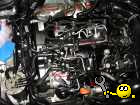
My oil cap is rattling.
Der Ventildeckel ist neu. Dabei fiel mir auf, dass bei dem alten Deckel, den ich wegen KGE-Verdachts getauscht habe, das interne Führungsplastikgehäuse (ein Plastikdeckel mit 3 oder 4 Öffnungen zu Schächten am Zylinderkopf, um diese Blow-by-Gase direkt zur KGE zu führen) nicht vorhanden war.
Hat es jemand entfernt oder war es nie da? No idea.
Yes, I already measured the compression about 2 years ago.
Cylinder 1: 25 bar; Cylinders 2, 3, and 4: 29 bar.
Therefore, dancing is most likely to happen as well.
(PS: I just replaced the timing belt, camshaft with hydraulic lifters, and the fuel injectors on all four pre-combustion chambers.)
I noticed that the nozzle of the first cylinder was extremely clogged with carbon deposits, unlike all the others.
Da waren, übertrieben gesagt, schon Schächte an der Einspritzdüse.
Well, and now the question: Where does this extreme, incomplete combustion come from?
Of course, pressure loss is also related to the diesel's willingness to ignite.
What I wanted to ask is: I read something about a cylinder cleaner.
You run the diesel engine hot, remove the glow plug from the cylinder (making sure the affected cylinder is at top dead center in the combustion stroke), and then fill the cylinder with the foam.
Allow it to soak; the foam will reappear at the glow plug bore. Repeat the process until the foam is white. Then, vacuum it up again, and afterwards, rinse and vacuum the combustion chamber once more with a neutralizer.
It is supposed to loosen stuck piston rings.
...and now, the really stupid question and the disastrous thought:
If a ring is fractured but fixed by carbon deposition...
Disaster: It then dissolves and completely breaks apart!
Has anyone had any experience with these types of cleaning services?
What would you do? As far as I recall, according to VW, the limit is actually 19 bar.
I'm looking forward to it, thank you, Anton.
Translated on 25-08-2026, 15:58.
|


 Bookmarks
 Links
Links Garage
 FAQ, Legal Notice & Privacy
 RSS Feed
 Register
 Login
Login