Hi everyone,
Based on the idea that the turbo isn't getting as much air as it should, I have now made some changes.
1. The engine ventilation system no longer works with the turbo, but with a plastic bottle filled with cotton. (Cotton for oil separation)
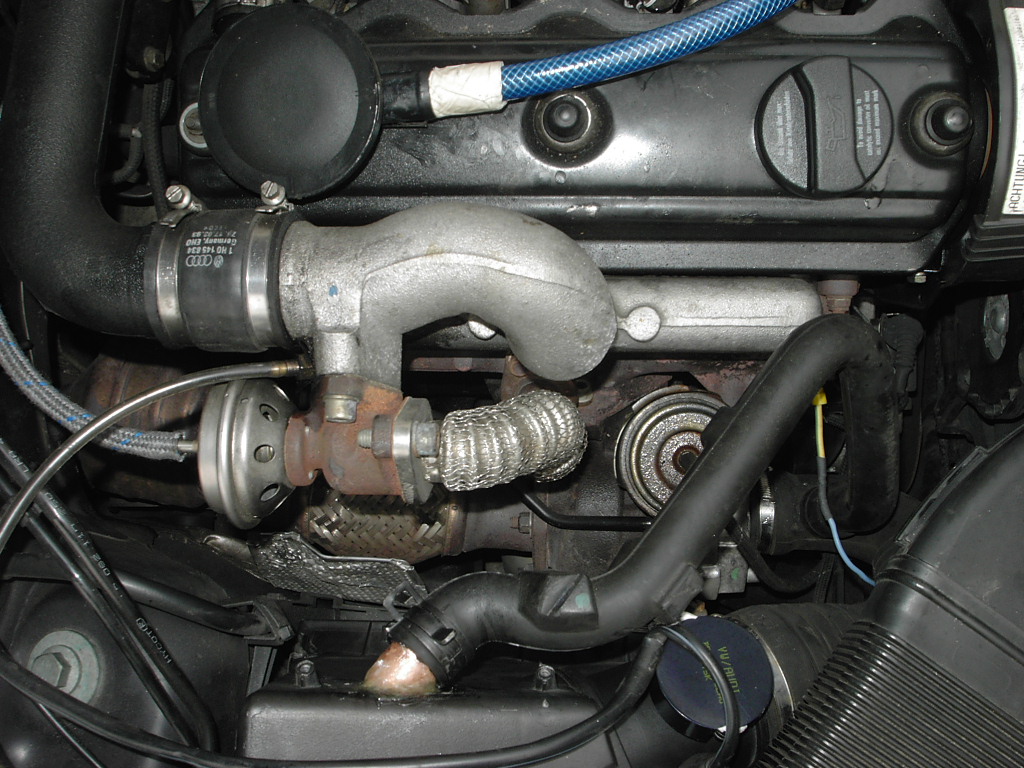
2. The vacuum hose from the turbo is routed to the air filter housing, as a bypass to the IAT sensor. This was also necessary because the IAT sensor, when exposed to a certain amount of airflow, starts to provide a decreasing output signal, because the excessive airflow essentially overloads it. This effect has been reduced. On Image 2, you can see this clearly.
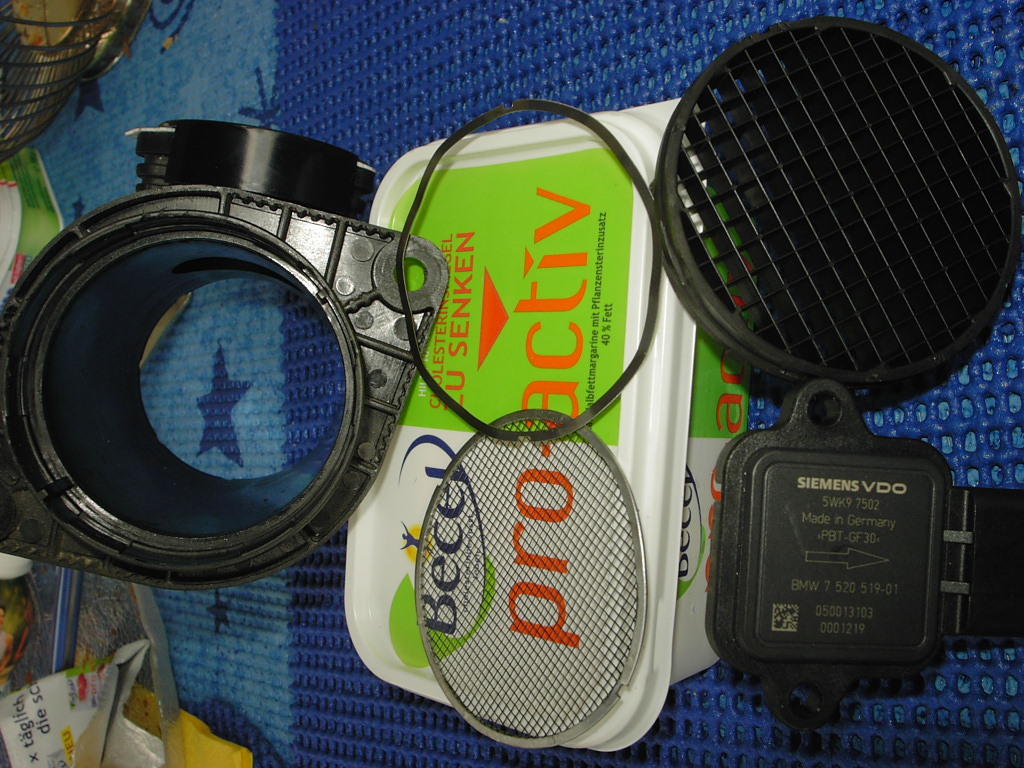
One of the main causes of the intake air pressure drop is the filters on the LMM. After some consideration, these, along with the LMM sensor, were completely removed, and the resulting hole was closed with a cover. The signal from the LMM is now obtained from the speed up to approximately 0.1 bar of intake pressure, and then only from the intake pressure. The circuit is set up so that there is always enough air mass reported from the moment the boost pressure is applied. Below the boost pressure, it should not result in noticeable smoking.
Which mass flow sensor was in use up to that point is shown in Figure 1.
A significant effect does not occur, (is it ?), but it is clear that it will reduce the speed of my worn-out VNT15.
I don't have a vacuum gauge, but using a hose filled with water, I was initially able to confirm a loading pressure of around 80-90 mb (1.3 bar/3800 units per minute). Now, it's around 40-50 mb.
(Furthermore, due to the lack of engine compartment exhaust, he now also gets more oxygen. Percentage unknown)
Regarding the circuit: I don't have a schematic I can post, and I don't want to. I have currently only 'thrown it together' and it is definitely not reproducible.
Function:
1. Acquire KW signal from OP, convert to analog signal via potentiometer. = Signal for LMM below boost pressure.
2. Obtain the load signal from the OP, adjustable amplification, and also send to the LMM input of the MSG.
Setting: First, adjust the circuit 1 so that it runs smoothly without noticeable backfiring, without using boost pressure.
Then adjust Offset Circuit 2 so that the value becomes higher than that of Circuit 1 starting from 0.1-0.2 bar. Then, adjust Circuit 2 so that the measured air mass is always greater than the target value.
Those who have some knowledge of electronics can design it themselves, while others prefer to avoid frustration and save themselves a lot of trouble and let others do it.
If someone wants to implement this in software, they can contact me.
Incidentally, one can also see the LDA inlet with a model-made nipple in the intake bridge.
| Description: |
| Changes for increased intake air without an oxygen sensor |
|
| File size: |
335.27 KB |
| Viewed: |
1600 times |
|
| Description: |
| Changes for increased intake air without an oxygen sensor |
|
| File size: |
300.79 KB |
| Viewed: |
1811 times |
|
Translated on 03-07-2026, 15:19.
|


 Bookmarks
 Links
Links Garage
 FAQ, Legal Notice & Privacy
 RSS Feed
 Register
 Login
Login


