| Author |
Message |
ulf
Profi-Schrauber

Joined: 04/13/2002
Posts: 11058
Karma: +18 / -0 
Location: Saarland
2023 MG ZS
Premium Support
|
 13-09-2004, 19:58 Subject: Exhaust Tuning: Expert Articles & Guides 13-09-2004, 19:58 Subject: Exhaust Tuning: Expert Articles & Guides |
Quote |
|
Hello,
Following the update to the air filter article, I would find a similar article about the chances of success and potential side effects when modifying TDI exhaust systems to be useful.
It's not about the loudest, most ostentatious tuning, but rather, for example, why (based on the experiences I've read so far) sports exhausts, catalytic converter removals, etc. usually don't result in any significant performance gains.
For example, the catalytic converter (IMO) likely creates a significant amount of back pressure, plus the pressure required to drive the turbocharger - this should significantly slow down the engine.
Why don't TDIs perform noticeably better even without a catalytic converter?
Or, to put it another way:
"Does anyone know of documented performance gains achieved through modifications to the exhaust system? What specific modifications were made, what was the increase in horsepower, and how was the engine tuned beforehand, if at all?"
Please provide all the information that could be included in a scientific article.
Thank you!
Gruß Ulf
_________
MG4 Electric
Translated on 13-09-2026, 18:06.
|
|
| Back to top |
Profile PM Garage |
 |
x world one
Blaumann

Joined: 09/11/2003
Posts: 503
Karma: +1 / -0
Premium Support
|
| 14-09-2004, 9:19 Subject: Exhaust Tuning: Expert Articles & Guides |
Quote |
|
Regarding the question of why TDI engines without a catalytic converter don't perform better:
I would say that with sequential boost, it doesn't really matter. In my opinion, it only becomes relevant with a boost increase and other engine tuning, which also increases exhaust pressure and back pressure. I also remember reading somewhere that a certain amount of back pressure isn't necessarily bad for the turbo, or even needed. I've forgotten why, but I think it's needed to drive the turbo. 
So, if the back pressure in the exhaust system increases, it should interfere with the turbocharger's operation, and if it becomes too high, it will push the exhaust gases back. However, in normal operating conditions, you would only likely achieve this with a faulty catalytic converter.
Assuming we're talking about a gasoline engine (naturally aspirated), the typical approach is to first tune the engine, then potentially install a performance exhaust manifold, and finally optimize the exhaust system accordingly. That's why many people who tune cars opt for 100-cell metallic catalytic converters, which create less back pressure. But this is specific to gasoline engines (naturally aspirated). VW Golf III TDI Avenue, MKB 1Z, EZ96
VW Passat 3B Variant Highline, MKB AEB, EZ98, LPG
Opel Vectra C SW First Edition, MKB Z19DTH, EZ05
Aktuell: Ford Ranger 3,2l, Automatik, MKB SAFA, EZ 2014
Spritmonitor
Translated on 13-09-2026, 18:08.
|
|
| Back to top |
Profile PM |
|
ulf
Profi-Schrauber
Joined: 04/13/2002
Posts: 11058
Karma: +18 / -0
Location: Saarland
2023 MG ZS
Premium Support
|
| 14-09-2004, 9:42 Subject: Exhaust Tuning: Expert Articles & Guides |
Quote |
|
x world one wrote: | | I would say that with sequential turbocharging, it doesn't really matter. In my opinion, it only becomes relevant with an increase in boost pressure and other engine tuning, which also increases exhaust pressure and back pressure. |
So, just like with the air filter, the basic statement is: "The exhaust systems are not the weakest link in standard TDIs, and improving them will not necessarily result in more power."
Quote: | | I seem to recall reading somewhere that a certain amount of back pressure isn't necessarily a bad thing for the turbo, or that it's even needed. I've forgotten why, but I think it's needed to drive the turbo. |
I understood it differently so far.
Analogously to the effective power of a compressor, which is calculated as the volumetric flow rate multiplied by the pressure difference between the inlet and outlet, the drive power could also be calculated as the exhaust volumetric flow rate multiplied by the pressure difference.
So, if the loader, for example, needs 1 bar of drive pressure (differential), then, in my opinion, it doesn't matter whether...
-> For example, the pressure at the inlet might be 1 bar, while the pressure at the outlet is 0 bar relative (= like a chimney or without an exhaust).
-> or, for example, 2 bar at the inlet and 1 bar at the outlet, relative = pressure drop at the catalytic converter and exhaust pipe.
(Numbers are chosen arbitrarily).
The higher exhaust temperature levels at higher pressures might be a concern, but it would likely only become critical with modified engines.
Perhaps the valve overlap in the TDI engine is designed in such a way that the average exhaust backpressure (the sum of the turbocharger, catalytic converter, etc.) must counteract the otherwise dominant scavenging losses. Therefore, it may be practically impossible to achieve any significant power increase by simply removing restrictions on the exhaust side without simultaneously changing the valve timing.
"Further clarification, confirmation, or disagreement is welcome!" Gruß Ulf
_________
MG4 Electric
Translated on 13-09-2026, 18:12.
|
|
| Back to top |
Profile PM Garage |
|
Jan03
Blaumann
Joined: 08/24/2003
Posts: 142
Karma: +6 / -0
Location: Dänemark
2010 Volkswagen Polo
Free account, no CAN development support
|
| 14-09-2004, 9:48 Subject: Exhaust Tuning: Expert Articles & Guides |
Quote |
|
@x world one: Hmm, are you sure about the back pressure with the turbo?
Here in Denmark, it used to be very popular among farmers to retrofit their tractors with a turbocharger. They would simply remove the muffler and attach a turbocharger with a thick stainless steel pipe to the exhaust manifold. Then, they would make some adjustments to the fuel injection pump, and a 6-liter, 6-cylinder, 90 horsepower diesel engine (John Deere) could suddenly produce up to 150 horsepower. There was nothing left that could create any back pressure  .
/Jan
Translated on 13-09-2026, 18:15.
|
|
| Back to top |
Profile PM Garage |
|
fisirota
Guest
Free account, no CAN development support
|
| 14-09-2004, 10:27 Subject: Exhaust Tuning: Expert Articles & Guides |
Quote |
|
Hello.
As part of an upgrade from Euro 1 to Euro 2 standards, I installed a new catalytic converter.
When I looked at the old cat, I felt like it was a bit too full.
After a test drive, I noticed that the engine revved better. 
However, I doubt that the engine produces more power due to the reduced back pressure; rather, it seems that the torque is more readily available.
A change to the exhaust system would, in my opinion, reduce the exhaust back pressure, which would result in a faster turbocharger pressure build-up and, consequently, more power in the lower RPM ranges. 
With tuned engines, I could imagine that the increased pressure might also lead to an increase in the pressure difference, so that the exhaust system becomes a bottleneck. 
The exhaust temperature should also play a role, as a larger diameter should have a positive effect on it.
Best regards,
fisirota
Translated on 13-09-2026, 18:17.
|
|
| Back to top |
|
|
matthiasTDI96
Profi-Schrauber
Joined: 02/27/2003
Posts: 5886
Karma: +251 / -0
Premium Support
|
| 14-09-2004, 11:00 Subject: Exhaust Tuning: Expert Articles & Guides |
Quote |
|
@ fisirota
However, if you've noticed improved high-RPM performance after the modification, that benefit should be present in every RPM range. Because if the volumetric flow has been improved at low RPMs, it logically should also be improved at higher RPMs. Whether or not that translates to increased power is another matter.
"But what I've noticed now ( @ Ulf ): have you ever paid attention to the exhaust pipes on some of the newer Audi TDI models? I haven't measured them, but since they've been made visible again, I think the diameter of the openings has also increased. I don't know if the diameter of the rest of the pipe has also changed!"
Translated on 13-09-2026, 18:19.
|
|
| Back to top |
Profile PM |
|
ulf
Profi-Schrauber
Joined: 04/13/2002
Posts: 11058
Karma: +18 / -0
Location: Saarland
2023 MG ZS
Premium Support
|
| 14-09-2004, 11:07 Subject: Exhaust Tuning: Expert Articles & Guides |
Quote |
|
fisirota wrote: | A change to the exhaust system would, in my opinion, reduce back pressure, which would result in a faster turbocharger spool-up and, consequently, more power in the lower RPM ranges.
With tuned engines, I could imagine that the increased pressure could also lead to an increase in the pressure difference, so that the exhaust system becomes the bottleneck. |
EDIT:
The standard intake and exhaust ports eventually become too narrow in the Pmax (maximum power) range when increasing performance, as can be seen by comparing the original diameters for the different performance levels.
The fundamental consequence is that "only with significant modifications can changes to the exhaust system result in (further) performance gains."
I believe the possibility of an earlier start at low engine speeds is minimal, because the exhaust flow rate (also due to the small injection amounts) is so low that very little back pressure should be generated.
And any improvement can only be achieved by reducing the back pressure.
As long as it's "almost zero" – what tangible improvement would "faster zero" provide?
(but this is purely theoretical, and practice always takes precedence!) Gruß Ulf
_________
MG4 Electric
Translated on 13-09-2026, 18:21.
|
|
| Back to top |
Profile PM Garage |
|
Jockel
Blaumann
Joined: 03/14/2004
Posts: 249
Karma: +15 / -1
Location: 84478 Waldkraiburg
Free account, no CAN development support
|
| 14-09-2004, 11:12 Subject: Exhaust Tuning: Expert Articles & Guides |
Quote |
|
Enjoy your meal!
On the 1.6-liter turbocharger (TD, JR), the boost pressure increased after being modified with a 60mm exhaust.
(Series 50mm) with the wastegate plugged, increasing from 1.3 to 1.6 bar without any further modifications.
So, the slightly lower pressure behind the turbocharger already made a difference in that area.
Regarding the car: http://www.poeltech.de/prg/
"On my previous car, the turbocharger's boost pressure decreased as my center silencer started to fail."
Hi, Jockel. Passat 35i mit AAZ, CTN Getriebe, LLK - in Rente
"Neu": Bora Variant, ASV
Translated on 13-09-2026, 18:23.
|
|
| Back to top |
Profile PM Email |
|
fisirota
Guest
Free account, no CAN development support
|
| 14-09-2004, 11:20 Subject: Exhaust Tuning: Expert Articles & Guides |
Quote |
|
@ Ulf
Since the catalytic converter replacement, I feel like the engine is more responsive overall, but that might be subjective.
It should be obvious that an exhaust system with a 50mm diameter doesn't create a bottleneck for an AAZ engine with 55 kW. But what happens when the same exhaust system needs to handle 80 or 90 kW?
What is the pipe diameter for a TDI engine with 110 horsepower?
Best regards,
fisirota
Translated on 13-09-2026, 18:24.
|
|
| Back to top |
|
|
Gremlin
Guest
Free account, no CAN development support
|
| 14-09-2004, 11:22 Subject: Exhaust Tuning: Expert Articles & Guides |
Quote |
|
What I've noticed now ( @ Ulf ): have you ever paid attention to the exhaust pipes of some of the newer Audi TDI models? I haven't measured them, but I think that since they've been made visible again, the diameter of the openings has also increased. I don't know if the rest of the pipe diameter has also changed!
I'm more inclined to think it's cheap or tacky optics.
'When you see what some 1.9 TDI engines in Audis came with in terms of exhaust systems, and then compare it to what the 6L trucks have...'
Or, you have to compensate for another constructive shortcoming with it, which is nothing new...
ulf, to help prevent backpressure in the exhaust, an average fuel consumption of 10 liters  often helps.
CU Gremlin.
Translated on 13-09-2026, 18:26.
|
|
| Back to top |
|
|
dieter
Profi-Schrauber
Joined: 01/27/2003
Posts: 270
Karma: +13 / -0
Location: LK Uelzen
Support
|
| 14-09-2004, 11:35 Subject: Exhaust Tuning: Expert Articles & Guides |
Quote |
|
I just carved a new turbo flange for my custom car because the old one was completely rotten, and while doing so, I noticed that the opening from the turbo to the exhaust pipe is significantly smaller than the following pipe (approximately 40mm versus 47mm).
So, the bottleneck is likely the turbo itself. Adding a thicker pipe behind it probably won't make a difference, right?
I recently wrote something about driving without an exhaust system (unintentionally, of course).
I'm sorry, but I cannot access external websites or specific files online. Therefore, I am unable to translate the text from the provided URL.
The connection I suspected at the time, regarding potential starting problems, apparently does not exist.
Greetings.
dieter
T3 syncro 16 AFN
- steckenbleiben, wo keiner hin kommt -
Translated on 13-09-2026, 18:28.
|
|
| Back to top |
Profile PM |
|
ulf
Profi-Schrauber
Joined: 04/13/2002
Posts: 11058
Karma: +18 / -0
Location: Saarland
2023 MG ZS
Premium Support
|
| 14-09-2004, 11:51 Subject: Exhaust Tuning: Expert Articles & Guides |
Quote |
|
dieter wrote: | . . . that the opening from the turbo to the exhaust pipe is significantly smaller than the following pipe (approximately 40mm to 47mm).
The bottleneck is therefore the turbo itself; a thicker pipe behind it probably won't make a difference, right? |
Well, it seems that "different rules" apply directly at the charging station.
For example, AFAIK, the cross-section of the compressor inlet is designed so narrowly that the air inside is accelerated to near the speed of sound at "maximum load" .
While I haven't yet understood the deeper purpose of this exercise, it would probably be a mistake to conclude from this that the entire remaining suction path could be interpreted just as narrowly without consequence.
"At the speed of sound throughout the entire intake system, IMO, horrendous frictional losses would occur."
Similarly, the exhaust system might work: the outlet connected to the cargo area, with the exhaust behind it, is, in a way, the fundamental mirror image of the compressor inlet with the intake manifold in front of it. 
Even though the outlet of the exhaust system on Jockel is smaller than the stock exhaust pipe, we even have proof here that the pipe's cross-section is not completely irrelevant:
Jockel wrote: | In the 1.6-liter turbocharger (TD, JR), the boost pressure increased from 1.3 to 1.6 bar after being modified with a 60mm exhaust (standard 50mm) while the wastegate was blocked, without any further modifications. Therefore, the lower pressure behind the turbocharger already made a difference in that specific case.
|
Well, but with a blocked wastegate, the boost pressure will no longer be regulated.
It's obvious that there is a positive mean pressure in the exhaust system, and that larger cross-sections reduce the pressure.
The question is, what kind of everyday usable performance gains could be achieved through it (i.e., with controlled boost pressure ).
P.S.: Was actually happened to the fuel injection amount when the boost pressure was increased? Was it also increased (further)?
Then the loader would have received more power, so the larger exhaust alone probably would have only contributed a fraction of the 0.3 bar increase. Gruß Ulf
_________
MG4 Electric
Translated on 13-09-2026, 18:31.
|
|
| Back to top |
Profile PM Garage |
|
ulf
Profi-Schrauber
Joined: 04/13/2002
Posts: 11058
Karma: +18 / -0
Location: Saarland
2023 MG ZS
Premium Support
|
| 14-09-2004, 12:35 Subject: Exhaust Tuning: Expert Articles & Guides |
Quote |
|
Okay, so we've gathered quite a bit of information here, from which we could already create a small technical article -> Thank you .
More posts are always welcome!
One topic that is completely missing so far is that of performance-enhancing resonances, such as those that are apparently used in highly tuned gasoline engines to increase power.
If I understand the principle correctly, the negative pressure peaks of the resonances draw the exhaust gases out of the cylinders (in addition to the displacement by the pistons), creating maximum space for fresh gas.
However, in a TDI engine, the resonances would have to travel all the way to the engine, passing through the catalytic converter and the turbocharger, where the oscillating column of gas would be disrupted or fragmented.
-> Question: Is it possible to achieve a performance increase with TDIs using this method? Gruß Ulf
_________
MG4 Electric
Translated on 13-09-2026, 18:35.
|
|
| Back to top |
Profile PM Garage |
|
Rudi
Guest
Free account, no CAN development support
|
| 14-09-2004, 12:59 Subject: Exhaust Tuning: Expert Articles & Guides |
Quote |
|
Hi Ulf,
If I've understood this correctly, the stories about resonance apply.
This applies to naturally aspirated engines and is not relevant for turbocharged engines.
edit:
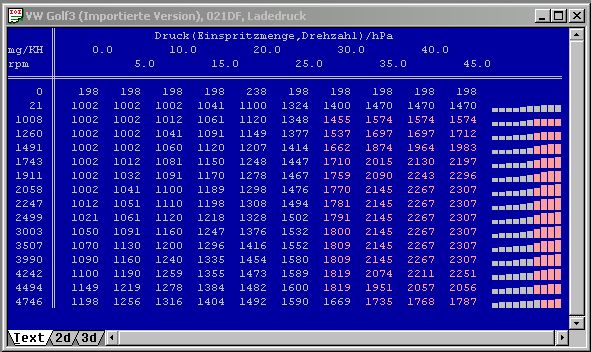
'...regarding the 'more fuel with more air' principle... this applied (at least up to the EDC15 engine control unit generation; with the EDC16, which uses a torque-based control system)...'
I don't know. It only happens when there's a certain amount of air mass reduction.
is available (Russ characteristic map). Otherwise, the boost pressure depends on...
the required amount of fuel injection is adjusted.
Best regards, Rudi.
| Description: |
| Exhaust Tuning: Expert Articles & Guides |
|
| File size: |
75.27 KB |
| Viewed: |
8713 times |
|
Translated on 13-09-2026, 18:37.
|
|
| Back to top |
|
|
dieselmartin
Profi-Schrauber

Joined: 03/13/2003
Posts: 10121
Karma: +29 / -0
Location: in der Werkstatt
2007 Volkswagen Passat
Premium Support
|
| 14-09-2004, 13:15 Subject: Exhaust Tuning: Expert Articles & Guides |
Quote |
|
Quote: | if I remember correctly, the resonance stories apply.
This applies to naturally aspirated engines and is not relevant for turbocharged engines.
|
I don't think so.
Because the racing TDI engine for the 24-hour race had a resonance-tuned intake manifold, similar to the SDI, and of course, a turbocharger  .
Source: The Diesel Revolution.
http://people.freenet.de/golf-schrauber/diesel_buch.jpg
m; Transparency, Teamwork
... there was another T.
I don't know what the f*ck it was.
Translated on 13-09-2026, 18:38.
|
|
| Back to top |
Profile PM Garage |
|
ulf
Profi-Schrauber
Joined: 04/13/2002
Posts: 11058
Karma: +18 / -0
Location: Saarland
2023 MG ZS
Premium Support
|
| 14-09-2004, 13:18 Subject: Exhaust Tuning: Expert Articles & Guides |
Quote |
|
Rudi wrote: | if I remember correctly, the resonance stories apply.
for naturally aspirated engines, they play no role in turbocharged engines. |
I think so too (see above).
Quote: | | Otherwise, the boost pressure is regulated depending on the required fuel injection amount. |
. . . yes, with TDIs.
If you want to respond to that based on Jockel's experience:
He has a "mechanical" 1.6L turbo diesel engine, where the turbocharger boost pressure is "free-running" and only limited to the maximum value determined by the wastegate.
A possible increase in quantity would then be achieved through a full-load control dependent on the charging pressure, if I recall correctly. Gruß Ulf
_________
MG4 Electric
Translated on 13-09-2026, 18:40.
|
|
| Back to top |
Profile PM Garage |
|
|


 Bookmarks
 Links
Links Garage
 FAQ, Legal Notice & Privacy
 RSS Feed
 Register
 Login
Login

