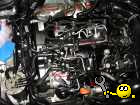
I have a Skoda Octavia 3, which is just under a year old, with an engine size of 1600ccm TDI and a power output of 85 kW.
Now, during this cold season (temperatures are around -5 to +2 degrees, I'd say), I've noticed the following:
When accelerating with a cold engine (but also rarely with a warm engine), I hear a "jerky" or "stuttering" sound from the engine in the range between 1500 and 2000 RPM.
The engine then sputters and makes louder noises at irregular intervals, as if it's choking. The tachometer doesn't increase smoothly; instead, it pulsates 3 or 4 times. The needle jumps up, then hesitates for a fraction of a second (or even drops slightly), then goes up again, hesitates again, and so on.
Around 2000 RPM, this issue either no longer occurs (or is no longer noticeable). Under load, especially when climbing uphill, the popping sound is still clearly audible and can even be felt.
However, I wouldn't call it a complete failure. There are no errors in that area stored in the error memory either.
The sound reminds me of my brother-in-law's old TDI. He had a power box installed before the fuel injection pump, I think it increased the fuel injection volume.
When I accelerated, the engine seemed to stall and made this strange rumbling/jerking noise.
In addition, I have what I believe is an unusually high fuel consumption, which I've experienced since the beginning. I know some people might say "be careful with your foot on the accelerator," but even my old Golf with a similar engine only needed 5.6 liters for the same distance.
Currently, I need between 6.3 and 7.1 liters. Or, on average, over the last 3 months, it's been 6.75 liters per 100km.
These values were calculated using data recorded for mileage and fuel consumption.
The onboard computer is already giving me readings of 5.3 to at most 5.7 liters (currently 5.7 liters over the long term), which is also strange...
In the fall, the AGR cooler was replaced because I was experiencing a slow coolant leak. Possibly, is there still a dependent issue?
Do you have any idea what the problem might be? According to the forums, I suspect there might be a problem with the LMM (likely referring to a mass airflow sensor) or with the temperature sensors.
What measurement values should I check in VCDS?
Thank you all for your help.
Greetings from the beautiful Waldviertel region!
Best regards, Löwi.
Hi.
Well, what you're describing is definitely not normal.
Similarly, the power consumption should be lower, and the "optimistic" estimates provided by the battery management system are usually no more than 10%, and often closer to 5%.
Regarding logging, there are specialized articles available. A good starting point is to perform an Autoscan, followed by accelerating from low RPMs (e.g., 1,500 RPM) to above 3,000 RPM in a single gear, while recording parameters such as fuel injection volume and various limits (e.g., soot, torque, driver preferences). See [reference/link]. Technical article.
I am unable to translate "haithamina" because it does not appear to be a word or phrase in the German language. It may be a misspelling, a proper noun, or a term from a specialized field. If you can provide more context or clarify the intended meaning, I would be happy to assist you with the translation.
Okay, I'm ready. Please provide the German text you want me to translate.
Sure, I'm ready. Please provide the text you would like me to translate from German to English.
- Speed/RPM (Revolutions Per Minute)
- Air mass, target value vs. actual value.
- Target vs. Actual Boost Pressure
Today, I made a recording. Unfortunately, it was probably already too warm (+4°C). The rattling sound was not audible today.
Attached you will find the Autoscan results, the log data, and a diagram that I have prepared.
As far as I can tell from reading this, the actual values are following the target values, which is how they should be. Jumps are also not available.
I had some difficulty because my STG (Steuergerät) doesn't have any MWBs (Mechatronic Workbenches). I couldn't find anything about "Ruß" or "Fahrerwunsch" at all.
Are the measurements okay, or should I use different ones? In the two screenshots, I have included the possible measurement values and filtered them by keywords.
Thank you very much for your help!
Best regards, Löwi.
moegliche Messwerte2.jpg
Description:
Mögliche Messwerte nach Stichworten 2
File size:
95.7 KB
Viewed:
767 times
moegliche Messwerte1.jpg
Description:
Mögliche Messwerte nach Stichworten 1
File size:
99.35 KB
Viewed:
716 times
LOG.xlsx
Description:
Aufbereitetes Diagramm
Drehzahl hab ich wegen dem Maßstab durch 10 dividiert und der Zeitbereich sollte auf 120-130 eingegrenzt werden dort habe ich den Beschleunigungstest gemacht.
In these situations, I don't have the adaptive cruise control (ACC) activated because it's during acceleration, and I don't use the cruise control function at those times.
The error occurred due to snow on the sensor, and I am receiving a message about it on the MFD (Multi-Function Display).
I'll still try to switch the system to speed limiting mode; that should completely deactivate the adaptive cruise control. Therefore, I can also rule out a faulty activation.
However, as described above, it's not really braking, but rather the engine "swallowing" the power, similar to "slipping" the clutch.
Sorry for my somewhat descriptive writing style, but I hope this is the best way to describe it.
When accelerating with a cold engine (but also rarely with a warm engine), I hear a "jerky" or "rough" sound from the engine in the range between 1500 and 2000 RPM.
Can the behavior be narrowed down to one or more gears (-> gear indicator in the MFA)?
Hello.
No, it's especially noticeable in the lower gears (2-4). And particularly when you're accelerating uphill, where you really need power, you'll feel it in every gear. But really, only up to about 2000 RPM; beyond that, you don't notice anything.
I can also rule out ACC. I also tested it.
With the warm temperatures, it's becoming increasingly difficult because the effect is only noticeable when the engine is cold, and that's really only at the beginning.
And the pulsing of the tachometer is also strange, as I said, it doesn't increase constantly and smoothly, but it increases, then pulses around 100 RPM, briefly drops, then increases again, etc. It does this 2-3 times before exceeding 2000 RPM.
Could it possibly have something to do with "regular" diesel fuel in newer engines? I'd like to try a premium diesel version at the next refueling to see if it makes a difference.
Today I noticed that he's now keeping the engine speed within the range of approximately 1200 to 2500 RPM for the first 1-2 kilometers, which results in a noticeable "clack clack clack" sound that increases with the engine speed.
Today I made a video where you can somewhat see the pulsating/jumping of the tachometer. Unfortunately, you can't hear the engine noise very clearly there.
The first jump is visible from 1600 to 1650, and then it's much more noticeable from 2050 to 2100 RPM.
As you can see, it's in 5th gear. However, when starting on an incline, it's best to be in 1st or 2nd gear. Same here.
Okay, and now, just as I'm nearing home, the dashboard indicates that I should check the oil level. I pulled over and waited a few minutes. The oil level is below the minimum mark; only the very tip of the dipstick is covered. When I received it, it was at its maximum mileage, and now I have approximately 26,000 kilometers on it.
Does anyone know what oil consumption that indicates, i.e., from maximum to minimum? Is that normal at 26,000 km? In the operating manual, I couldn't find any specific fill amounts, but it does state that up to 0.5 liters per 1000 km is normal, depending on driving style.
"Check the oil level... Normally, you should check this every 26,000 km. It's actually faster than making videos and the like." Theoretically, the clicking sound after a cold start could be coming from the hydraulic lifters.
I would first get your car into a reasonable state of maintenance and then continue the search.
The difference between Min and Max is about 0.5 liters. Since you are below the Min level, it might be closer to 0.7 liters. At 26,000 km, that translates to 0.0269 liters per 1000 km, which is considered "normal" by a wide margin.
Thank you for the sharp reply.
I forgot to mention: At approximately 5,000 km and 10,000 km, I checked the oil level, and it was slightly below the maximum mark.
At 20,000 km, the car was checked at the workshop because I had a coolant leak (the AGR cooler was replaced). According to the workshop, the oil level should have also been checked. It's possible that it was forgotten back then, and therefore, I personally haven't performed any checks here for the last 10,000 km.
As a support technician, I have a lot of experience with poorly written tickets or problem descriptions where crucial information about the issue is missing. I've applied this experience to writing a bug report in this forum. Therefore, I've written down as much information as possible about the problem, based on what I've observed, and I think a video is probably the best way to describe the behavior.
Would a forum post with the error description "My engine is making a buzzing noise and using too much fuel, HELP!" have been more appropriate?
Anyway, I'm going to check the oil level myself more often now, because an oil consumption of 0.7 liters over 6,000 km is a bit higher than it would be over 26,000 km. According to the owner's manual, 0.5 liters per 1000 km is acceptable, so I'm not too worried about it. However, it would be suspicious if the workshop hadn't detected any oil leaks at 20,000 km, but then detected them in the last 6,000 km.
By the way, I topped up the oil to bring the vehicle up to a reasonable maintenance level, but the problem with the engine misfire still persists.
I'm going to switch to premium diesel today and see if it improves the performance.
And is the clicking noise gone now? That would be good to know.
I don't understand what was supposed to be biting or sarcastic about the previous response. It was a clear indication. When driving for extended periods with insufficient oil, not only will the hydraulic lifters become empty.
hg
Herbert.
Horch A4 8K CJCD
Golf 7 DDYA
(+ Audi 80 Avant B4 1Z 475Tkm - habe ich vom ersten bis zum letzten Tag gerne gefahren)
(+ Passat Variant 32B CY 400Tkm)
The small, dry DSG transmission has caused problems before, and the speed fluctuations shown can, in my opinion, only be caused by a clutch that is slipping intermittently.
Could it possibly be limited to only the even or odd-numbered aisles?
Regarding the previous question: no, the problem cannot be attributed to even or odd rows.
Meanwhile, I had taken my Octavia to the workshop, and they determined that it was definitely a problem with the clutch. The workshop was even able to reproduce the behavior and record it on video.
The workshop was then commissioned by Skoda Austria to perform a basic DSG reset, which was done, but it did not result in any improvement.
The Skoda specialist from Austria is in Germany this week, visiting his colleagues, and the problem is being discussed there. They in Austria aren't entirely sure what the exact cause of the issue is. It could be the clutch or even the transmission... We should hopefully have more specific information next week about what exactly will be exchanged.
Thank you for your help. I will continue to report on what is being exchanged and whether that resolves the problem.
"The clutch" does not exist in the DSG (Dual Shift Gearbox). Instead, there is one clutch for the even gears and one for the odd gears. If both clutches are slipping, it's likely there's a problem with the hydraulics that aren't providing enough pressure to both clutches.
"Do some research on how a DSG (dual-clutch transmission) works, so the mechanics at the workshop don't try to pull the wool over your eyes."


 Bookmarks
 Links
Links Garage
 FAQ, Legal Notice & Privacy
 RSS Feed
 Register
 Login
Login