| Author |
Message |
Jochen_145
Guest
Free account, no CAN development support
|
 20-05-2007, 11:06 Subject: 20-05-2007, 11:06 Subject: |
Quote |
|
Hello Rainer,
If those 245,000 km were driven with your specific vehicle, that makes sense. You're more likely to see this effect in vehicles with PD (presumably referring to a particular type of engine or component).
Barfische has also written about this topic before.
My experience comes from the continuous tests we conduct on our test benches.
Please refer to the following:
Okay, I understand. Please provide the German text you want me to translate into English. I will only provide the translation.
I've already had new 140HP 2.0 TDI engines with DPF installed, and they definitely performed too well for 140HP plus tolerance.
This is one of those typical examples.
Best regards, Jochen.
Translated on 20-08-2026, 17:39.
|
|
| Back to top |
|
 |
ObenbeiMutti
Guest
Free account, no CAN development support
|
| 21-05-2007, 18:00 Subject: |
Quote |
|
Hello Jochen, Hello Ulf,
I was also aware of your objections beforehand.
Of course, all the factors that influence the maximum speed (Vmax) must be taken into account.
However, after several months, the results usually represent a good average.
You're not doing anything different with the DZR either.
Dem Einfluss der Bauform-> CW Wertes auf Vmax bin ich mir auch bewusst. I.
I was just very surprised that all of our company cars are definitely logged via GPS.
It should match the maximum speed (V-max) specified in the vehicle registration document very closely.
Even with the exponential/tangent-like behavior of wind resistance.
If the maximum speed (Vmax) measurement is affected by variations within a production series, it could introduce measurable errors.
It's that precise. I was able to achieve very good results with my AFN box by making adjustments in millimeter increments.
you can read the potentiometer's resistance very accurately at the maximum voltage.
Pmax changes, regardless of the fact that Pmax is usually equal to Vmax in the highest gear.
corresponds to.
The objection regarding whether K-power or the DZR accounts for these 'induced inertia resistances' on the motor side was related to torque, not something else.
'It depends on the performance. I am already aware that a flow calculator derives the Pmax+ value based on the acceleration that has occurred.'
It seems strange to me today that the series variation is at or above 5% in general.
should be successful in a highly competitive market where every small advantage is fiercely contested.
Otherwise, they would have marketed the ASZ with 140 horsepower. The old Passat did have...
it also had a 140 hp engine and a different top speed compared to the best-selling 130 hp version.
registered.
But I'm just speculating, and the very last thing I would do is attribute questionable expertise or a 'motortalk beautification factor' to this forum.
The realistic maximum speeds of the respective models don't align with the significant variations found in production units.
I also don't know how significant the difference is today between a bad and a good engine of the same type.
Ultimately, this might simply mean wanting to show the market how...
'Extremely high performance across all engines, measured relative to their rated power output. However, they typically add a standard 10 horsepower that is not declared. And because everyone does it, it's only noticeable to experts who know how to use a dynamometer.'
Interestingly, the results from independent automotive endurance tests conducted by organizations like AMS, ADAC, and Motorvision consistently align very closely with the manufacturers' stated power output figures when using their respective testing equipment.
Good evening.
Translated on 20-08-2026, 17:44.
|
|
| Back to top |
|
|
haithamina
Schrauber

Joined: 05/15/2006
Posts: 666
Karma: +27 / -3 
Location: 69221 Dossenheim
Premium Support
|
| 22-05-2007, 9:57 Subject: |
Quote |
|
@ObenbeiMutti
Recently, there was a long-term test of a Mitsubishi Grandis 2.0 Di-D on television, which had a VAG-TDI engine inside, supposedly with an output of 136 horsepower (??!!). The testers then measured significantly more power on the dynamometer, I believe it was around 157 horsepower. After 50,000 kilometers, the power output was still 149 horsepower. Unfortunately, I didn't remember much of the details, but what stuck with me is that it was about the VAG-TDI engine.
In this particular case, the measured power was about 15% higher than the rated power.
haithamina
P.S. Here is a link to episode 173 http://base.sport1.de/de/sport/artikel_1006433.html that I just found. 3G5, 110 kW, DFGA, TGV, Variant HL 2018-
ex 3G5, 110 kW, CRLB, QFZ, Variant HL, 2015-2018, 108 Tkm
ex 3BG, 74 kW, DPF, AVB, EEN, Variant HL, 2003-2015, 271 Tkm
Translated on 20-08-2026, 17:49.
|
|
| Back to top |
Profile PM |
|
ObenbeiMutti
Guest
Free account, no CAN development support
|
| 22-05-2007, 11:06 Subject: |
Quote |
|
Hello,
Thanks for this report; everything I've known so far has been the opposite.
Approximately 98% of the rated power at the beginning, and then a maximum of 5 horsepower more towards the end, regardless.
from the overall performance.
'That's definitely not legal if the measurement was accurate! If you factor out the power-reducing 'break-in' effect, then the car should...'
Approximately at 10,000 kilometers, it had even more power.
It would be a disgrace for VAG engines if they lost almost 10 horsepower after only 100,000 km. 
But maybe it's the DPF (diesel particulate filter), or the wheel bearings, or the MAF sensor (mass airflow sensor), or the oil level/condition, or something else entirely... the EGR valve has clogged the intake manifold.
It remains mysterious.
Translated on 20-08-2026, 17:51.
|
|
| Back to top |
|
|
haithamina
Schrauber
Joined: 05/15/2006
Posts: 666
Karma: +27 / -3
Location: 69221 Dossenheim
Premium Support
|
| 22-05-2007, 12:25 Subject: |
Quote |
|
Hi,
So far as I understand it, most measurements from automotive magazines regarding disassembled engines with over 100,000 km (approximately 62,000 miles) actually show little to no wear on the "critical" components such as pistons, connecting rod, crankshaft, etc.
Nozzles, ATL (presumably referring to a specific component), etc., are usually not measured, and therefore might already look different.
However, I also consider the issue of AGR (Abgasrückführung - Exhaust Gas Recirculation) to be very important when measuring performance after 100,000 km in a "normal" test environment. After all, the test vehicles are primarily used for long-distance driving, and this is the only way to complete the long-distance test within a reasonable timeframe. A decrease of 8 horsepower or 5% at 50,000 km is certainly an average value, isn't it? What do the professional engine testers in this forum (Bavarian, Jochen 145, etc.) think about this?
haithamina
3G5, 110 kW, DFGA, TGV, Variant HL 2018-
ex 3G5, 110 kW, CRLB, QFZ, Variant HL, 2015-2018, 108 Tkm
ex 3BG, 74 kW, DPF, AVB, EEN, Variant HL, 2003-2015, 271 Tkm
Translated on 20-08-2026, 17:54.
|
|
| Back to top |
Profile PM |
|
ulf
Profi-Schrauber

Joined: 04/13/2002
Posts: 11058
Karma: +18 / -0
Location: Saarland
2023 MG ZS
Premium Support
|
| 11-06-2007, 7:58 Subject: |
Quote |
|
Sure, here is the translation of the text from German to English:
"BTT:"
Here, there's another amazing measurement to admire, where a chipped AXR engine is "enhanced" from 134 to 158 horsepower.
Unfortunately, the data regarding power output and engine performance is somewhat unclear. Perhaps it's part of the testing facility operator's strategy to attract as many customers as possible with misleading information and marketing tactics... Gruß Ulf
_________
MG4 Electric
Translated on 20-08-2026, 17:55.
|
|
| Back to top |
Profile PM Garage |
|
Bertil
Profi-Schrauber
Joined: 04/15/2002
Posts: 5628
Karma: +108 / -0
Premium Support
|
| 11-06-2007, 22:57 Subject: |
Quote |
|
...
The measurement is excellent!
Die Luftdruckmessung hat der Prüfstandsbediener wohl absichtilich "disabled" ... oder warum wird dort der Wert (Man P) -0,1 angegeben ...  ... Prima, negativer Luftdruck ..... Great!
And somehow, Mitch is bothered by this black line in unit 25... It should be a reference offset! So, his readings would be 25 PS too high....
"However, you would need to check the WinDyn manual on Superflow.com for that... I'm not entirely sure because I'm not very familiar with Superflow systems."
But 133.1 hp at 369.9 Nm sounds much more believable for a tuned AXR engine.
His statements:
Quote: |
AXR is superior to ATD; here's why.
It features many of the internal components found in the 130 hp common-rail diesel engine, including the intake manifold, improved injectors, and other enhancements.
|
... are equally nonsense.
The AXR shares very few parts with the 96 model. In fact, there are absolutely no shared components that affect performance.
The intake system for the ATD and AXR engines is virtually identical (except for the electric throttle body).
They had already told him that the clutch was definitely not from a 1996 model.
HEROES! Gruß Bertil
Skoda 5E5 CZDA + Mini R50 W10 + VW ID.3 + Fiat Ducato 250 + 161 DX
*** Technische Anfragen per PN werden von mir nicht beantwortet! ***
Translated on 20-08-2026, 17:58.
|
|
| Back to top |
Profile PM |
|
ulf
Profi-Schrauber
Joined: 04/13/2002
Posts: 11058
Karma: +18 / -0
Location: Saarland
2023 MG ZS
Premium Support
|
| 12-06-2007, 9:50 Subject: |
Quote |
|
Bertil wrote: | | ...And somehow, this black line in unit 25 is bothering me... It's supposed to be a reference offset! So, its readings would be 25 horsepower too high ... |
You should check that out on the WinDyn manual at Superflow.com... 
Are there testing setups where you can essentially shift the zero point of the power measurement arbitrarily?
That just encourages people to fake it even more }. Gruß Ulf
_________
MG4 Electric
Translated on 20-08-2026, 18:00.
|
|
| Back to top |
Profile PM Garage |
|
Bertil
Profi-Schrauber
Joined: 04/15/2002
Posts: 5628
Karma: +108 / -0
Premium Support
|
| 12-06-2007, 22:20 Subject: |
Quote |
|
ulf wrote: |
Are there testing setups where you can essentially shift the zero point of the power measurement arbitrarily?
|
Correction: ... remove "test benches"; add "test bench software".
Sure, they exist...
Quote: |
That just encourages people to fake it even more. |
Exactly ... Gruß Bertil
Skoda 5E5 CZDA + Mini R50 W10 + VW ID.3 + Fiat Ducato 250 + 161 DX
*** Technische Anfragen per PN werden von mir nicht beantwortet! ***
Translated on 20-08-2026, 18:01.
|
|
| Back to top |
Profile PM |
|
ulf
Profi-Schrauber
Joined: 04/13/2002
Posts: 11058
Karma: +18 / -0
Location: Saarland
2023 MG ZS
Premium Support
|
| 01-10-2007, 22:21 Subject: |
Quote |
|
The next level:
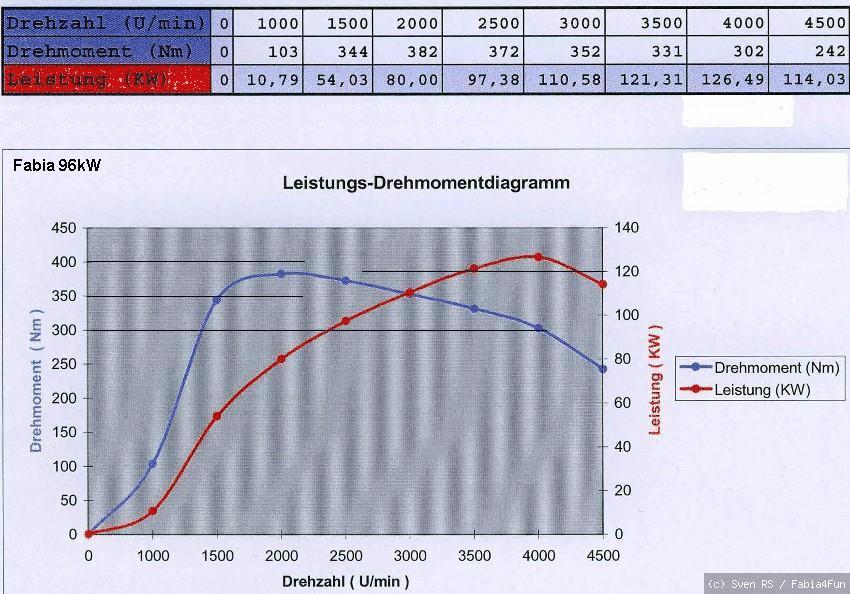
Here's an updated "performance" diagram of the same tuner as in the original post: No more slew rate limitations, no more environmental data from the measurement, and perfectly smooth curves like those shown in the datasheet.
(The black grid lines you see are mine; the white areas only contained tuner and customer data.)
Well done, because now it's impossible to tell whether or how much cheating occurred!
This perfectly fits my overall impression of the tuner: They boast about high performance figures at every opportunity, fudge the numbers to get the promised peak power (Pmax) on paper, and now they print "zero-value" charts where cheating is no longer detectable due to a lack of reference data, and they make it as difficult as possible to verify the actual performance increase.
Here's the translation:
"The customer explains with this diagram in the Fabia forum why no pre-performance measurements are taken: Quote: | | Unfortunately, an initial measurement is no longer performed because, according to the tuner, it is not necessary, as they have already conducted long-term tests on the engines. | "
Without a prior measurement, the customer doesn't know how much extra performance the tuner has unlocked. This means the tuner can subtly and elegantly exploit the typical variations in standard TDI engine output and attribute it as part of their own success.
| Description: |
|
| File size: |
100.03 KB |
| Viewed: |
1743 times |
|
Gruß Ulf
_________
MG4 Electric
Translated on 20-08-2026, 18:03.
|
|
| Back to top |
Profile PM Garage |
|
ulf
Profi-Schrauber
Joined: 04/13/2002
Posts: 11058
Karma: +18 / -0
Location: Saarland
2023 MG ZS
Premium Support
|
| 24-11-2012, 16:44 Subject: |
Quote |
|
*quickly dusts off*
...since the topic of performance test data is currently occupying my attention again:
Are operators of dynamometers legally obligated to provide their customers with the most accurate data possible?
For example, in the Metrology Act / the Calibration Ordinance.
http://www.gesetze-im-internet.de/bundesrecht/eichg/gesamt.pdf
http://www.gesetze-im-internet.de/bundesrecht/eo_1988/gesamt.pdf
It is stipulated that, for example, landlords who create consumption statements using data from water meters with expired calibration dates may have to pay fines of up to €10,000.
But I can't find anything about engine dynamometers anywhere.
So, who could seriously blame a test bench operator if they were simply acting as a seller of "grin numbers" to get good word-of-mouth from their customers and avoid any trouble?
For example, there might be frustration after measuring the performance of a modified car (a hypothetical example!), where the actual peak power is 10% lower than what the tuner promised.
A precise measurement result would certainly give the test bench operator one frustrated customer who wouldn't spread positive word-of-mouth and might even argue with their tuner. The tuner would most likely question the measurement, which would create additional work for the test bench operator to resolve the issue and counteract a negative image of their business.
However, if the test bench was initially configured with a 12% gain adjustment (assuming the operator is familiar with the tuner settings), then the "measured" maximum power would still be 2% higher than the tuner data, and everyone would be satisfied.
"In most cases, I believe a +5% margin increase would probably be sufficient to ensure that even the owners of vehicles with lower performance figures are satisfied and drive home happy, while also preventing the data for higher-performing models from appearing too unrealistic."
Question:
Could it be correct to assume that testing facility operators for whom revenue and profit are more important than truth can operate with impunity as suppliers of unreliable data, and stage the tests as mere performances?
And that they would only start to face problems if, for example, educated professionals repeatedly identify physically impossible combinations of motor hardware and claimed maximum power output, leading to the perception that the company is essentially a "fairy tale factory"? Gruß Ulf
_________
MG4 Electric
Translated on 20-08-2026, 18:07.
|
|
| Back to top |
Profile PM Garage |
|
RedR32
Schrauber
Joined: 12/21/2008
Posts: 1071
Karma: +11 / -0
Location: Bad Lobenstein
1998 Volkswagen Golf
Premium Support
|
| 24-11-2012, 22:10 Subject: |
Quote |
|
Audi is allowed to do this: An average of 385 horsepower instead of 420 horsepower!
http://vimeo.com/34019389#embed2010 Caddy kombi life 103 tdisg6 BMM KXW
reflexsilber met.
Translated on 20-08-2026, 18:10.
|
|
| Back to top |
Profile PM Garage |
|
goettmann
Guest
Free account, no CAN development support
|
| 27-11-2012, 16:48 Subject: |
Quote |
|
Hello Ulf,
Here are a few brief comments from me on that.
Are operators of dynamometers legally obligated to provide their customers with the most accurate data possible?
No, there's no need to.
If a dealer were to claim that 1 horsepower costs €100, they would be legally obligated to have their equipment calibrated. However, it is unlikely that anyone would actually do this.
Question:
Could it be correct to assume that testing facility operators for whom revenue and profit are more important than truth can operate with impunity as suppliers of unreliable data, and stage the tests as mere performances?
Welcome to reality!
Translated on 20-08-2026, 18:12.
|
|
| Back to top |
|
|
ulf
Profi-Schrauber
Joined: 04/13/2002
Posts: 11058
Karma: +18 / -0
Location: Saarland
2023 MG ZS
Premium Support
|
| 27-11-2012, 21:39 Subject: |
Quote |
|
goettmann wrote: | | Welcome to reality! | It took a while to get there, but your response (thank you!) confirms that my interpretations of the available information are correct. Gruß Ulf
_________
MG4 Electric
Translated on 20-08-2026, 18:13.
|
|
| Back to top |
Profile PM Garage |
|
ulf
Profi-Schrauber
Joined: 04/13/2002
Posts: 11058
Karma: +18 / -0
Location: Saarland
2023 MG ZS
Premium Support
|
| 21-12-2012, 16:59 Subject: |
Quote |
|
Follow-up question:
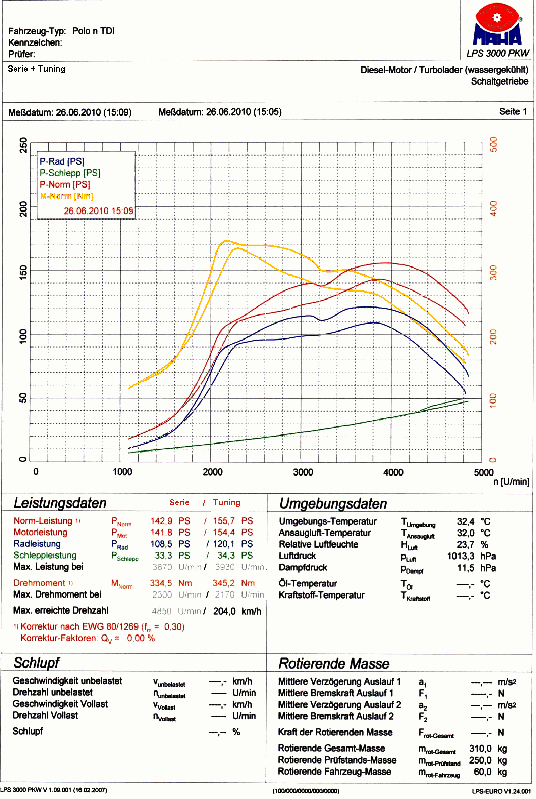
What is the approximate power output range when measuring traction force with a 1.9L TDI engine *without* disengaging the clutch?
Reason:
The attached document shows two superimposed measurements of the same car, using both stock and tuning software. The torque curves are virtually identical, except in the range above 4300 rpm: there, the stock torque reaches its peak at approximately 4800 rpm, which is about 3.4 horsepower higher than the tuned measurement.
Did the dynamometer operator disengage the clutch too late, and does the difference between the two curves indicate the engine's drag power?
My calculation attempt, independent of the diagram:
a) The displayed idle fuel consumption (engine warm, 900 rpm) is usually around 0.8 liters per hour.
b) Energy content per liter of diesel fuel = 10 kWh.
c) Assumed thermal-to-mechanical efficiency of the engine at low load conditions (rough estimate) = 0.15 or 15%.
Mechanical energy generated per hour = a * b * c = 1.2 kWh, which means the motor's load power at 900 rpm would be 1.2 kW or 1.63 horsepower.
At 4800 rpm, it would then be 1.63 hp / 900 * 4800 = 8.7 hp – assuming the same amount of mechanical energy loss per revolution. While this is more than double the difference in drawbar power shown in the diagram, anything below a factor of 10 deviation already indicates the same order of magnitude to me.
If the thermal to mechanical efficiency in the above calculation is changed to 6% = 0.06, then a motor parasitic power loss of 3.48 horsepower is calculated for 4800 rpm. This also seems plausible, and that would be exactly the difference between the two parasitic power curves.
Is this roughly correct, or am I completely off with my assumptions?
What is the actual horsepower output of a 1.9 TDI engine at approximately 4000 rpm?
| Description: |
|
| File size: |
80.27 KB |
| Viewed: |
890 times |
|
Gruß Ulf
_________
MG4 Electric
Translated on 20-08-2026, 18:16.
|
|
| Back to top |
Profile PM Garage |
|
|


 Bookmarks
 Links
Links Garage
 FAQ, Legal Notice & Privacy
 RSS Feed
 Register
 Login
Login

