| Author |
Message |
SeatArosa1.7SDI
Guest
Free account, no CAN development support
|
 31-05-2004, 16:21 Subject: |
Quote |
|
Hi Christian, I'm sorry that I'm putting your patience to the test and that I'm probably already pushing your nerves to the limit, but...
The mark refers to the marking on the flywheel.
Do you mean the flywheel, i.e., the part where the starter ring gear is located?
That's on the other side of the engine. To see it, I'll have to remove the starter motor, at the very least.
And one more thing about turning the crankshaft: It must be extremely difficult to turn against the compression. Do you have to remove the glow plugs to make the crankshaft easier to turn?
Regards,
Holger.
Translated on 11-09-2026, 0:20.
|
|
| Back to top |
|
 |
haehnlein
Schrauber

Joined: 08/22/2002
Posts: 877
Karma: +6 / -0 
Location: Griesheim
Support
|
| 31-05-2004, 16:26 Subject: |
Quote |
|
SeatArosa1.7SDI wrote: | | Are you referring to the flywheel, i.e., the part where the starter ring gear is located? |
Okay, there are inspection holes for these cases there (and they are different for each car).
-- That's on the other side of the engine. To see it, I'll have to remove the starter motor, at the very least.
No, you see it from above.
-- And one more thing about turning the crankshaft: It must be extremely difficult to turn against the compression. Do you have to remove the glow plugs to make the crankshaft easier to turn?
If you want to make a full rotation as quickly as possible, then the compression ratio naturally plays a role. If cylinder 1 is at top dead center (TDC) and the crankshaft rotates a few degrees, then there's no compression happening. In a real emergency, it can even be done with your bare hand. ____________
Für Antworten danke ich Euch im Voraus. Gruß Christian
Kein Auto mehr!
Translated on 11-09-2026, 0:21.
|
|
| Back to top |
Profile PM |
|
SeatArosa1.7SDI
Guest
Free account, no CAN development support
|
| 31-05-2004, 16:42 Subject: |
Quote |
|
Thank you for the tip, I'll go check out the 'Guggloch' right away. 
Regarding the rotation: In a 4-cylinder engine, when it comes to a stop, all the pistons are positioned at the middle of their strokes because the air columns in the cylinder, which are in the process of compression and expansion, act like two gas springs that reach their equilibrium point at 90 degrees before or after Top Dead Center (TDC).
Therefore, I have to rotate the engine 90 degrees towards the top dead center (TDC) from its natural resting position. Isn't that difficult due to the compression stroke?
Regards,
Holger.
Translated on 11-09-2026, 0:23.
|
|
| Back to top |
|
|
haehnlein
Schrauber
Joined: 08/22/2002
Posts: 877
Karma: +6 / -0
Location: Griesheim
Support
|
| 31-05-2004, 16:45 Subject: |
Quote |
|
SeatArosa1.7SDI wrote: | | Therefore, I have to rotate the engine out of its natural resting position by 90° towards the top dead center (TDC). Isn't that difficult due to the compression stroke? |
"If you turn it slowly with a ratchet (and a bit of force), it's not a problem at all. Even in new cars, there's always some air that escapes past the piston rings, etc." ____________
Für Antworten danke ich Euch im Voraus. Gruß Christian
Kein Auto mehr!
Translated on 11-09-2026, 0:24.
|
|
| Back to top |
Profile PM |
|
SeatArosa1.7SDI
Guest
Free account, no CAN development support
|
| 31-05-2004, 16:57 Subject: |
Quote |
|
If you turn it slowly with a ratchet (and some force), it's not a problem at all.
I still remember that Trabant engine. I used to turn it over by hand, using the pulley (which, by the way, had a timing mark). But it was quite difficult to turn.
Translated on 11-09-2026, 0:25.
|
|
| Back to top |
|
|
Gremlin
Guest
Free account, no CAN development support
|
| 31-05-2004, 19:27 Subject: |
Quote |
|
Okay, so, if you have experience and are skilled with your hands, you can change the ZR tire without having to remove any of the other tires.
You need to place the belt, along with the large pulley, and then fully tighten it by turning it. The smaller pulleys are still located below.
and of course, beforehand, marking everything with a marker pen (YES, IT'S ALLOWED)  .
For many 16-valve gasoline engines, there's no other way.
Advantage: No need to adjust the camshaft, and it's faster than using the locking and unlocking mechanisms.
'Disadvantage: Without a locking mechanism, the pump rotates back about 1-2 teeth, so be careful when installing. Experience is very helpful. But as I said, if you have two people, the changing process is so quick that everything around it almost seems like a joke.'
And YES, you have to adjust the injection start time. It deviates quite significantly from the state before the change. Although the grinder starts up and runs immediately, and the values are still within the tolerance range... but perfection is the goal.
'By the way, I have a 1F gasoline engine here that barely ran after the timing belt replacement. It seems the ignition timing was completely off (yay, intermediate shaft, grumble). Nothing works without addressing that...'
Sure, here is the translation of the text from German to English:
'Cu Gremlin'
Translated on 11-09-2026, 0:27.
|
|
| Back to top |
|
|
mcgregg
Blaumann

Joined: 01/17/2003
Posts: 142
Karma: +7 / -1
Premium Support
|
| 01-06-2004, 9:34 Subject: |
Quote |
|
Gremlin wrote: | So, if you have experience and are skilled with both hands, you can change the ZR without removing any of the ZR wheels...
You need to place the belt, along with the large pulley, and then fully tighten it by turning it. The smaller pulleys are still located below.
and of course, beforehand, marking everything with a marker pen (YES, IT'S ALLOWED) .
|
@ Gremlin :
You seem to be very knowledgeable about this. If the timing belt on my Octavia needs to be replaced, I might visit you. I'll bring two hands. 
@everyone:
I once heard about a rather unconventional method. The old timing belt is cut lengthwise with a carpet knife while still installed. The front part is then removed. The new timing belt is then slid over the partially exposed gears until it reaches the halfway point of the old timing belt. Once the old belt is cut, the new timing belt can be completely slid onto the gears.
That's the story so far. Unfortunately, I wasn't informed about how this all interacts with the tensioner pulley, over the edge of which it's difficult to get the timing belt even when the tensioner is relaxed.
I hope I don't get scolded here for getting into the world of Grimms' fairy tales about mechanics. 
Regards,
mcgregg Skoda Octavia II Combi TDI, 2012, 103kW/140PS MKB CFHC
Translated on 11-09-2026, 0:31.
|
|
| Back to top |
Profile PM |
|
Gremlin
Guest
Free account, no CAN development support
|
| 01-06-2004, 9:55 Subject: |
Quote |
|
@Gremlin:
You seem to be very knowledgeable about this. If the timing belt on my Octavia needs to be replaced, I might visit you. I'll bring two hands.
Sure, the workshop is open to everyone after all. Should I look up the hourly rates?
@everyone:
I once heard about a rather unconventional method. The old timing belt is cut lengthwise with a carpet knife while still installed. The front part is then removed. The new timing belt is then slid over the partially exposed gears until it reaches the halfway point of the old timing belt. Once the old belt is cut, the new timing belt can be completely slid onto the gears.
That's the story so far. Unfortunately, I wasn't informed about how all of this interacts with the tensioner pulley, over the edge of which it's difficult to get the timing belt even when the tensioner is relaxed.
There are many engines that have a small lip on the tensioner pulley (which is usually the water pump - like in Opel cars). Also, older engines often don't have any idler pulleys; there's only the crankshaft, water pump, and camshaft. It could work there... but I don't quite understand the purpose.
The only problem with the belts, besides the technical design flaws, is the biological entity known as 'human,' because they only have two hands  .
CU Gremlin.
Translated on 11-09-2026, 0:34.
|
|
| Back to top |
|
|
haehnlein
Schrauber
Joined: 08/22/2002
Posts: 877
Karma: +6 / -0
Location: Griesheim
Support
|
| 01-06-2004, 10:30 Subject: |
Quote |
|
mcgregg wrote: | | I once heard about a rather adventurous-sounding method. The old timing belt is cut lengthwise with a carpet knife while it is still mounted. The front part is then removed. The new timing belt is then pushed over the half-exposed gears until it reaches the middle of the old timing belt. Once it has been cut, the new timing belt can be completely pushed onto the gears. |
....then you saved yourself an hour of work, but you'll have to work a week later on the new motor, which failed because of a seized tension roller bearing  . ____________
Für Antworten danke ich Euch im Voraus. Gruß Christian
Kein Auto mehr!
Translated on 11-09-2026, 0:36.
|
|
| Back to top |
Profile PM |
|
SeatArosa1.7SDI
Guest
Free account, no CAN development support
|
| 06-06-2004, 10:55 Subject: |
Quote |
|
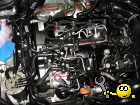
Hi! To get back to my question: Please take a look at my ESP bike: http://www.luxus-wg.de/~martin/auto_bilder/SeatArosa/Blick%20auf%20Triebwerk%20und%20Zahnriementrieb.jpg
As you can see, there are no adjustment holes for setting the static injection start.
Here you can see the ESP wheel of a 1.9 TDI: http://www.rasender-killer.de/usenet/zahnriemen_2/index.htm
There are elongated holes in the ESP wheel.
 How is the static injection start configured for me
Thank you in advance for any tips and ideas.
Regards,
Holger.
Translated on 11-09-2026, 0:37.
|
|
| Back to top |
|
|
wolfi_b
Profi-Schrauber

Joined: 02/17/2004
Posts: 860
Karma: +1 / -0
Support
|
| 06-06-2004, 11:55 Subject: |
Quote |
|
Hello!
Most likely, it's the same as with my 1Z.
The setting is done by twisting the ESP .
Simply loosen the screws through the holes in the ESP wheel, and one is located on the back of the ESP.
However, it is important to loosen and retighten the locking nuts on the fuel injection lines at the ESP unit afterward, so that they are not permanently under tension.
Translated on 11-09-2026, 0:39.
|
|
| Back to top |
Profile PM |
|
garth.brooks
Guest
Free account, no CAN development support
|
| 06-06-2004, 12:22 Subject: Crankshaft Rotation: Remove Glow Plugs. |
Quote |
|
Hi,
To rotate the crankshaft. I wouldn't have dared to adjust the compression at the crankshaft screw like that, but...
Removing the spark plugs is a job that takes about 5 minutes.
After that, there will be no more compression against which one would have to push.
Then, with reasonable effort, it can be easily accessed via the crankshaft bolt, or alternatively, via the water pump pulley using the belt.
Then you no longer need a locking ruler. Instead, if you think the belt is correctly positioned, adjust the NW (Non-Working) side so that the ruler would fit, and then check the OT (Output Timing) mark. If you're lucky, that's all you need to do, otherwise you'll have to adjust it.
I can only confirm that the injection timing must be checked in all cases.
Translated on 11-09-2026, 0:40.
|
|
| Back to top |
|
|
SeatArosa1.7SDI
Guest
Free account, no CAN development support
|
| 06-06-2004, 12:23 Subject: |
Quote |
|
The setting is adjusted by twisting the ESP .
Hmmm... that sounds pretty unbelievable. Are the ES lines doing this just like that? Or do the cone angles of the lines even allow for such an angular offset?
But it's still the only plausible explanation.
By how many degrees can the injection start be shifted in this way?
Regards,
Holger.
Translated on 11-09-2026, 0:42.
|
|
| Back to top |
|
|
SeatArosa1.7SDI
Guest
Free account, no CAN development support
|
| 06-06-2004, 12:33 Subject: |
Quote |
|
Removing the spark plugs is a job that takes about 5 minutes.
Okay, a really silly question: The glow plugs are basically attached in a similar way to spark plugs. Do you need a special socket for them? And do you have to replace the seals every time, or can there be sealing problems?
But I've also been thinking: I imagine it would be very reassuring to slowly turn the engine by hand, without compression, after replacing the timing belt. If there's a valve collision, you should definitely feel some resistance, or the engine should even lock up when turned by hand.
Do you do that too?
then position the NW so that the ruler would fit inside
Is there a photo of this famous ruler? I can't quite picture it, and I'm imagining something like the rulers we used in math class. What does an embedded Northwest ruler look like?
Regards,
Holger.
Translated on 11-09-2026, 0:44.
|
|
| Back to top |
|
|
dieselschrauber
Administrator

Joined: 04/12/2002
Posts: 18119
Karma: +801 / -0
Location: St.Gallen
2018 Volkswagen T6 
|
| 06-06-2004, 12:57 Subject: |
Quote |
|
SeatArosa1.7SDI wrote: | Quote: | | The adjustment is made by twisting the ESP | .
Hmmm... that sounds pretty unbelievable. Are the ES lines doing this just like that? Or do the cone angles of the lines even allow for such an angular offset?
But it's still the only plausible explanation.
By how many degrees can the injection start be shifted in this way?
Regards,
Holger |
 Well, it might be a good idea to loosen the fuel injection lines if you're turning the ESP...
Translated on 11-09-2026, 0:46.
|
|
| Back to top |
Profile PM WWW Garage |
|
SeatArosa1.7SDI
Guest
Free account, no CAN development support
|
| 06-06-2004, 13:55 Subject: |
Quote |
|
Well, it might be quite useful to loosen the fuel injection lines if you're turning the ESP...
I think you misunderstood me. When twisting, an angular offset inevitably occurs between the ES line and the high-pressure connection. This means that the end of the ES line no longer meets the high-pressure connection at a 100% perpendicular angle. My thought was to determine within what limits the seal can still be guaranteed, or whether the sealing surface is not damaged when tightening at an angle.
Second point: When the ESP is rotated, the geometric distance between the high-pressure connection of the ESP and the high-pressure connection of the nozzle holder inevitably changes. (This is because the high-pressure connections are located outside the swivel axis of the ESP.) Since the lines are rigid and do not have a ball joint in the middle, it is definitely impossible to guarantee absolute stress-free conditions at all times. The bends in the lines must inevitably 'flex' to some extent.
From this, we can conclude that different ESP settings result in varying levels of risk for cable breakage.
Regards,
Holger.
Translated on 11-09-2026, 0:47.
|
|
| Back to top |
|
|
|


 Bookmarks
 Links
 Garage
 FAQ, Legal Notice & Privacy
 RSS Feed
 Register
 Login

