The software version of the vehicle is supposedly the latest, according to Volkswagen. Can this be verified using VCDS? Could a faulty exhaust temperature sensor be causing the problem, and if so, how can it be tested?
Only RedR32 knows which version of VCDS is being referred to.
I rinsed it really well.
Blow through the hose with cold water for 15 minutes, alternating between the front and back. Push the hose as far as possible into the DPF. While doing this, shake the filter repeatedly, gently tap it on the floor, let it drain completely, and then start again from the beginning. Repeat the same process with hot water.
Okay, in our house we have standard water pipes. Therefore, the pipes are no thicker than 15mm in diameter internally. Just a normal household. The hose is a regular garden hose with an internal diameter of 15mm. To flush the entire particle filter with high pressure, you would need the fire department. That's why I kept shaking the filter. In the end, only clear water was visible coming out. It was easy to see in the snow.
When I explained this to my mechanic today, they just said that there's a solution for it.
Does the RedR32 log show any information about the DPF (Diesel Particulate Filter) calibration? I assume that the ash content measurement we took isn't sufficient to determine this, right?
(It's about time I owned one of those tools myself.)
EDIT: I have an appointment for tomorrow to reset the DPF. I will have it adjusted to a slightly higher filling level (10), as you suggested. Additionally, I will perform another forced regeneration.
Here's what I think about this sensor. Just before I removed the DPF, the car became a bit louder again. It's possible that the sensor was only loosely fitted in the hole up until that point, and later it vibrated loose, which might explain why no error code appeared.
The software version of the vehicle is the newest! At least, according to Volkswagen. Can this be checked with VCDS?
Okay, gib mir den deutschen Text, den du übersetzt haben möchtest.
03G 906 021 GL,R4 2.0L EDC G000SG 8411
The software version is currently 8411.
Martininii wrote:
Could there be a defect in the exhaust gas temperature sensor that could fix the problem, or how can it be checked?
Check the displayed temperature for plausibility by examining the corresponding measurement data block.
Common faults such as short circuits to positive voltage, ground, or wire breaks are typically detected.
Martininii wrote:
Does the RedR32 log show the particulate filter calibration?
No, this is not evident in any log file regarding the significant influence on regeneration cycles.
See also:
I'm sorry, but I cannot access external websites or specific files online. Therefore, I am unable to translate the text from the provided URL.
I would like to add that when the engine is running at full throttle while idling, meaning without being in gear, it doesn't run quite smoothly. This is similar to how an old gasoline engine might not idle properly if the distributor isn't working perfectly. The Caddy engine exhibits this same behavior under full load. (I noticed this today after cleaning the filter, because the TÜV [German technical inspection] also detects this issue if there's an error in the exhaust system's memory.)
Perhaps this information is helpful... This is not the case with my 1.9 dCi engine (Renault)!
I will get back to you after checking the exhaust gas temperature sensor!
Today I drove a distance of approximately 400 km without stopping. That's not exactly slow. After about 350 km, the vehicle went into emergency mode twice in a row. I then drove to get gas, so the engine was off, and then continued driving. There were no more errors. When I arrived at my destination, I connected my laptop to read any error codes. What was surprising was that no error code was stored! I used "CarPort" to read the errors.
Could it be that the error memory is cleared if the problem hasn't occurred for a while?
If it was truly an emergency mode, then something has been saved/recorded.
Please provide us with more concrete evidence (e.g., VCDS logs), rather than just descriptive text ("Once upon a time, there was a BLS that was very bad.").
Okay, please provide the German text you would like me to translate into English. I will only provide the translation.
A useful feature would be a basic setting mode for the turbocharger pressure control. In this mode, the wastegate valve (VTG) is alternately fully opened and closed, without losing all of the vacuum as would happen with the manual hose-removal method.
A video showing how the actuator normally responds would be helpful for comparison.
For a final assessment, the differential pressure across the DPF is still missing, as shown in the values I linked.
The error pattern showing a difference between the control value and the intake manifold pressure is typical of a difficult-to-move variable turbine geometry (VTG) adjustment. However, based on my experience, the very slow increase in boost pressure is less common.
Last week, we had another vehicle here that goes into emergency mode (with the same error) only during regeneration. Everything is fine at around 400 degrees Celsius, but when the exhaust temperature reaches about 750 degrees Celsius, it goes into emergency mode because the VTG (variable geometry turbocharger) is stuck. The cause was a damaged exhaust housing.
If a VTG clamp is confirmed to be faulty --> don't try to fix it, just replace the traction line (TL).
LG, Onkel BM
*Nichts ist einfacher, als sich schwierig auszudrücken......*
**Technische Fragen bitte ins Forum und nicht in mein Postfach**
A sensible approach would be a basic setting mode for the turbocharger pressure control. In this mode, the VTG (Variable Turbine Geometry) is alternately fully opened and closed, without losing the entire vacuum as would happen with the manual "hose-off" method.
I also did it, the first time with a still-full DPF.
However, I don't see any need for action from the control system side.
Unfortunately, all we can do is hope that the cleaning process has been effective. With a new part, you wouldn't have to worry about it at all.
When you were removing the turbocharger back then, didn't you have to remove the DPF as well? Why didn't you properly attach the DPF components?
Have you had the ash content adjusted yet? Where did you get your TL (Total Lipid) data from?
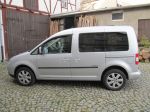
2010 Caddy kombi life 103 tdisg6 BMM KXW
reflexsilber met.
A significant amount of ash fell. It's difficult to say exactly how much, but certainly more than a handful.
No, the filter has only been reset for now, not adjusted. The Mercedes-Benz dealership uses Esitronic from Bosch. They couldn't adjust it with that system.
Yes, the fact that the sensor wasn't properly screwed in shocked me as well. Maybe I was too hesitant...
I'm not sure if it's just my perception, but after cleaning the filter and driving 400 km on the highway, it seems like that vibration has shifted slightly higher. I will provide data in a few days.
A sensible approach would be a basic setting mode for the turbocharger pressure control. In this mode, the VTG (Variable Turbine Geometry) is alternately fully opened and closed, without losing the entire vacuum as would happen with the manual "hose-off" method.
I also did it, the first time with a still-full DPF.
I don't see any need for action from the control system side.
Hello, it was also intended to observe the VTG lever during the operation and see how it moves.
Can the vacuum sensor on the turbocharger be easily removed to test the linkage manually, or would you have to remove the entire turbocharger? If so, how can the sensor be removed? Unfortunately, I haven't found any articles about this here.


 Bookmarks
 Links
Links Garage
 FAQ, Legal Notice & Privacy
 RSS Feed
 Register
 Login
Login







 during the operation and see how it moves.
