| Author |
Message |
donalexo
Profi-Schrauber

Joined: 01/09/2003
Posts: 695
Karma: +0 / -0 
Location: Würzburg
Support
|
 08-09-2005, 12:32 Subject: ALH Load Disconnect Control System 08-09-2005, 12:32 Subject: ALH Load Disconnect Control System |
Quote |
|
Hello everyone!
The turbocharger pressure control system in our ALH engine is acting up. Externally, this isn't very noticeable because there's no significant loss of power, nor any error messages or limp-home mode. However, you can only see what's going on by logging data with a diagnostic tool like MWB11.
The build-up of boost pressure in the low RPM range (below 2000 RPM) is clearly too slow, followed by a massive, prolonged overshooting (2100-2600 RPM) that reaches 2350-2400 mbar (absolute). Only above approximately 2600 RPM does the pressure begin to decrease again, but it then settles just below the target value of 1950 mbar.
Sure, I've already looked at the VTG (so far, only with the loader installed) and haven't been able to detect any leaks, either when it's cold or warm.
Therefore, I suspect that the turbocharger is already quite worn (currently, at approximately 180,000 km), which is likely being accelerated by the high pressures.
Who knows what criteria lead to an entry in the error memory due to a deviation from the LD (Load Dump) regulation, since there is a deviation of 350-450 mbar for several seconds  ?
Who knows more details?
Regards,
Alex. AUDI A3 1.9 TDI, EZ 12/96, ursprüglich MKB AGR, umgebaut zum AHF mit GT1749V-Lader, verkauft mit 250tkm
Golf 4 1.9 TDI, EZ 1/98, MKB ALH, jetzt auch mit GT1749V-Lader, verkauft mit 300tkm
Touran 1.9 TDI, EZ 09/2004
Audi A4 Avant 2.0 TDI, EZ 03/2010
Translated on 04-09-2026, 18:42.
|
|
| Back to top |
Profile PM |
 |
dieselschrauber
Administrator

Joined: 04/12/2002
Posts: 18097
Karma: +799 / -0
Location: St.Gallen
2018 Volkswagen T6 
|
| 08-09-2005, 12:52 Subject: ALH Load Disconnect Control System |
Quote |
|
Hi Alex,
Have you ever looked at the vacuum diaphragm to see if it's stuck inside? I saw that happen with someone recently.
I've never tried putting anything like talcum powder (baby powder) in after rinsing, so I have no idea what kind of mess that would create.
Best regards, Rainer.
Translated on 04-09-2026, 18:45.
|
|
| Back to top |
Profile PM WWW Garage |
|
wutz
Blaumann

Joined: 08/13/2004
Posts: 247
Karma: +11 / -1
Location: BRA
2006 Seat Leon
Free account, no CAN development support
|
| 08-09-2005, 14:22 Subject: ALH Load Disconnect Control System |
Quote |
|
I would also be very interested in a solution, as my car exhibits very similar symptoms, but I haven't been able to find a reason for it yet. However, mine only has 100,000 km on the odometer.
According to a post by Bertil, the emergency mode is only triggered after approximately 6 seconds of exceeding the limit.
(You can find the post under the search term "Concrete".)
Best regards,
VW Golf V, 1,9 TDI, 77KW, BLS, 2007;
Ford Fiesta MK7 (B299 MCA), TDCI, 1,5l 95PS, 2015
Kawasaki GPZ 500 S jetzt mit TÜV(Wiederbelebungsversuch erfolgreich)
Translated on 04-09-2026, 18:45.
|
|
| Back to top |
Profile PM Garage |
|
bafische
Profi-Schrauber
Joined: 01/13/2005
Posts: 196
Karma: +22 / -0
Support
|
| 08-09-2005, 14:23 Subject: ALH Load Disconnect Control System |
Quote |
|
@Donalexo,
Okay, then we can go bowling together.
"My ALH engine in my Golf IV, with 160,000 km, is showing similar symptoms. There are no noticeable driving or performance issues, but there are overboosts up to 500 mbar absolute for times less than 2 seconds, and corresponding underboosts down to 300 mbar for times less than 4 seconds, both occurring at engine speeds above 2500 RPM."
I can't do anything about it; I've already tried everything.
- Intake manifold cleaned.
- Air intake checked/cleaned.
- KAT inspected (visual inspection + blown clean with compressed air).
- Adjustment mechanism checked/cleaned.
- Can (large size), cleaned.
- EPW checked and cross-referenced.
- Vacuum supply/hosing checked.
- Entire charge air intake system pressure tested and cleaned.
- Twisted the rod in all directions until the doctor arrived (although I should know better than to mess around with it - but trial and error is the best way to learn).
I've reached the point where I'm only considering normal wear and tear, but a new ATL (presumably a component or part) will only be issued when there are noticeable defects.
Unfortunately, I can't check the RPM range below 2500 RPM in this vehicle because it has an automatic transmission.
"The overshoots at engine speeds below 3250 RPM are not critical for the ATL because the volumetric flow rate is relatively low. Overshoots only become critical at engine speeds above 3500 RPM, so you should definitely check the following:"
Keep the engine in 3rd, 4th, or ideally 5th gear up to approximately 4250 RPM, then release the accelerator (0% throttle) – let the engine coast down to 4000 RPM, then apply full throttle (100% throttle) until the load decreases again, then release the accelerator (0% throttle) and let the engine coast down to 3750 RPM, then apply full throttle (100% throttle) until the load decreases again, then release the accelerator (0% throttle) and let the engine coast down to 3500 RPM, then apply full throttle (100% throttle) until the load decreases again. If you experience these extreme overshoots in this RPM range, the ATL (presumably a sensor or system) will be heavily stressed (over-revving). Only log one MWB (presumably a data log) to ensure you have the highest sampling rate, and repeat the measurement a few times, otherwise you may lose the maximum/minimum values.
You do this automatically when driving near the maximum speed on the highway and occasionally lifting off the gas pedal until the car in front of you has merged back into your lane.
At all engine speeds, the peak pressure increases significantly with LD (Low-Drag) turbochargers, which is not ideal for the cylinder head gasket or bearings. However, the ALH engine, with its original 66 kW output, has plenty of headroom in this regard, so I don't see it as a major issue.
The time threshold is approximately 6 seconds for positive and negative RA (Relative Altitude). The height is 300 millibars negative and 400 millibars positive (which may vary slightly depending on the software).
I would like to post my logs here as well, but I can't get the data off my laptop. It still has Windows 95 without USB, and while it has a floppy disk drive, my home PC doesn't. So, I need to figure out some way to connect them before I can post any measurements.
"Luft und Menge müssen stimmen - der Rest ist Physik."
unumstössliches Gesetz in der Dieselmotorenentwicklung
Translated on 04-09-2026, 18:50.
|
|
| Back to top |
Profile PM |
|
ulf
Profi-Schrauber
Joined: 04/13/2002
Posts: 11058
Karma: +18 / -0
Location: Saarland
2023 MG ZS
Premium Support
|
| 08-09-2005, 15:07 Subject: ALH Load Disconnect Control System |
Quote |
|
bafische wrote: | Can (large size), cleaned.
. . . Twisted the rod in all directions until the doctor arrives | .
Hi Bavarian,
What do you think about the theory that the "charging coil spring (or membrane, depending on the design) becomes weak"?
If the spring constant is incorrect (a small change in force results in too large an adjustment), the sensor becomes overly sensitive to changes in the duty cycle, and this cannot be compensated for by twisting the VTG rod.
A possible solution might be "repair chip tuning," which would involve compressing the TV-KF (throttle valve control) on the Z-axis, bringing the TV (throttle valve) values closer together between the maximum and minimum settings.
Otherwise, this could explain the large overshoots, but can feathers really change their stiffness due to aging?
BTW - How is the spring constant actually defined: as "compliance" (m/N) or "stiffness" (N/m)?
My penne has been too long ago... 
Quote: | | I have now reached the point where only natural wear and tear is considered a possibility, |
How should the wear manifest itself? Increased play in the connecting rod? As far as I know, these are oil pressure compensated, so the actual play shouldn't change...
Or are you suggesting that the valve timing gear (VTG) is causing a delay, so that the impeller blades only respond to the pressure from the can after a certain amount of travel? This, too, could increase the over-travel - unless some gas forces are constantly pushing the impellers in a specific rotational direction during operation, thereby reducing the actual interaction between the blades and the can membrane to zero...?
Perhaps someone could disassemble their aging VTG loader and post the maximum play allowed on the control lever before the buckets start moving. Gruß Ulf
_________
MG4 Electric
Translated on 04-09-2026, 18:56.
|
|
| Back to top |
Profile PM Garage |
|
wutz
Blaumann
Joined: 08/13/2004
Posts: 247
Karma: +11 / -1
Location: BRA
2006 Seat Leon
Free account, no CAN development support
|
| 08-09-2005, 16:50 Subject: ALH Load Disconnect Control System |
Quote |
|
Quote: | Keep the engine in 3rd, 4th, or preferably 5th gear up to ~4250 RPM, then 0% throttle (lift your foot off the gas) - let it coast down to 4000 RPM, then 100% throttle (put your foot back on the gas) until the load is regulated again, then 0% throttle, let it coast down to 3750 RPM, then 100% throttle until the load is regulated again, then throttle to a certain percentage, let it coast down to 3500 RPM, then 100% throttle until the load is regulated again. If you experience these extreme overshoots in this RPM range, the ATL (Air Throttle Lever) will be heavily stressed (over-rev). Only log one MWB (Mass Air Flow) reading to get the highest resolution, and repeat the measurement a few times, otherwise you might lose the maximum/minimum values.
|
Okay, if I do it the way you describe, I get very strong pressure spikes up to 1.5 bar (measured with VAG-Com). However, according to Bertil, these are induced pressure spikes and would be perfectly normal.
Now I'm starting to feel uncertain about what to believe.
Well, maybe Donalexo will figure something out. VW Golf V, 1,9 TDI, 77KW, BLS, 2007;
Ford Fiesta MK7 (B299 MCA), TDCI, 1,5l 95PS, 2015
Kawasaki GPZ 500 S jetzt mit TÜV(Wiederbelebungsversuch erfolgreich)
Translated on 04-09-2026, 19:00.
|
|
| Back to top |
Profile PM Garage |
|
bafische
Profi-Schrauber
Joined: 01/13/2005
Posts: 196
Karma: +22 / -0
Support
|
| 08-09-2005, 18:50 Subject: ALH Load Disconnect Control System |
Quote |
|
ulf wrote: |
What do you think about the theory that the "charging coil spring (or membrane, depending on the design) becomes weak"?
If the spring constant is no longer correct (a small change in force leads to too large a deflection), the sensor becomes overly sensitive to changes in the duty cycle, and this cannot be compensated for, even by twisting the VTG rod. |
Hi Ulf,
"Yes, I've considered that before, but I dismissed it because my system tends to be more sluggish than erratic. After an undershoot, the setpoint is held rigidly – which contradicts this theory. Otherwise, the LDR (Light Dependent Resistor) would have difficulty stabilizing during the initial regulation phase. Also, the LDR can't generate any output from a standstill, even at partial load."
Quote: | Or do you mean that the VTG (Variable Turbine Geometry) is acting in such a way that the blades only follow the command of the control system after a certain amount of travel? This, in my opinion, could also increase the overshooting - unless some gas forces are constantly pushing them in a specific rotational direction during operation, thereby reducing the actual play between the blades and the can membrane to zero...?
|
Yes, that's more what I'm envisioning, and that would likely lead to excessive hysteresis in the adjustment mechanism.
Another characteristic also makes me a bit suspicious. Up to about 75% load, the TV is always below the setpoint (regulated state). On the VL (presumably a different system), it's the opposite; the TV is significantly above the setpoint (regulated state). This is also why changing the rod length couldn't have a positive effect. To counteract the overshoot, I would need to shorten the rod, but since the TV would then be even further from the setpoint in the regulated state, the undershoot would become proportionally larger – which is also problematic.
Perhaps this is a sign of slowly increasing back pressure in the exhaust system, possibly due to a clogged catalytic converter, or decreasing turbine efficiency due to excessive blade clearance.
I highly doubt that the guys at VW would release something like that into mass production.
@Wutz,
An LDR (Low-Pressure Drop) devices function well with over/undershoots of a maximum of 150 mbar, regardless of who or how they are triggered. 300 mbar is acceptable for series applications. At the inlet, operating at the nominal power point, it's actually no longer possible to exceed 150 mbar. As in our case, 500 mbar at the nominal power point is unacceptable, especially when considering the compressor characteristic curves and the resulting impeller speeds.
How does your ALH Ulf behave in terms of over/underswing at the vertical landing (VL) point at its rated power output, or how do other ALH pilots behave when performing this maneuver as described above? "Luft und Menge müssen stimmen - der Rest ist Physik."
unumstössliches Gesetz in der Dieselmotorenentwicklung
Translated on 04-09-2026, 19:04.
|
|
| Back to top |
Profile PM |
|
ulf
Profi-Schrauber
Joined: 04/13/2002
Posts: 11058
Karma: +18 / -0
Location: Saarland
2023 MG ZS
Premium Support
|
| 09-09-2005, 8:02 Subject: ALH Load Disconnect Control System |
Quote |
|
bafische wrote: | | because my regulation is more likely to be described as sluggish rather than nervous. After an undershoot, the setpoint is held rigidly - this contradicts this theory - otherwise, the LDR would have difficulty during the initial regulation phase. |
Yes, that may be the case - unless [Speculation]the Electronic Data Capture system is clever enough to switch to a different, more "robust" control strategy based on general pattern fluctuations... ?[/Speculation]
Quote: | | Up to approximately 75% load, the TV is always below the control value (regulated state). In the case of the VL, it is the opposite; the TV is significantly above the control value (regulated state). |
Do you mean by "tax value" the value from the key ratio characteristic curve (which is generally not visible in logs, but only if you look directly into the MSG data set)?
It could also be a result of the vehicle's improper adaptation to real-world conditions, or perhaps from a power box or other tuning modifications.
Quote: | | How does your ALH Ulf behave in terms of over/underswing at the vertical line (VL) at the nominal power point, or do other ALH drivers experience this when performing the flying exercise as described above? |
I rarely drive the Ibi, but I once tried to induce oversteer. So far (~45,000 km), this has only been possible in the mid-RPM range, and in exceptional cases, up to a maximum of 0.2 bar according to the LDA (Lean Definition Angle).
Starting around 3000 (presumably RPM), the load pressure increases relatively slowly (like yours), but precisely to approximately 1 bar. The maximum overshoot (occasionally) is around 50 mbar, if I recall correctly. Gruß Ulf
_________
MG4 Electric
Translated on 04-09-2026, 19:09.
|
|
| Back to top |
Profile PM Garage |
|
donalexo
Profi-Schrauber
Joined: 01/09/2003
Posts: 695
Karma: +0 / -0
Location: Würzburg
Support
|
| 09-09-2005, 12:32 Subject: ALH Load Disconnect Control System |
Quote |
|
Hello everyone!
IMO, the EDC definitely performs a "mode switching," specifically by being speed-dependent (as seen in the AHF dataset at 2016 rpm) and also through a "pressure window monitoring with hysteresis." This means that within the dataset, you can find pressure thresholds (regulation deviation/pressure difference from the setpoint) that actually activate and deactivate the controller.
The two characteristic curves indicate the control threshold as a function of the speed.
Above 1200 RPM, the threshold is gradually reduced, and as the speed increases, the range becomes increasingly narrow (I believe it's around 40-60 mbar above 300 RPM).
This also explains why large overshoots are common in the lower speed range, while small deviations from the setpoint are quickly corrected at higher speeds.
The EDC only pre-activates the turbocharger (based on the TV characteristic curve) in the low-speed range, while the controller only engages either with a significant overshoot or from a medium speed onwards.
I'm still not entirely clear on what the speed-dependent operating mode switch does at exactly 2016 RPM. My opinion is that it adjusts the loop gain.
If anyone knows more details, feel free to share.
Sure, I'd be happy to help. Please provide the text you would like me to translate from German to English.
Regards,
Alex.
AUDI A3 1.9 TDI, EZ 12/96, ursprüglich MKB AGR, umgebaut zum AHF mit GT1749V-Lader, verkauft mit 250tkm
Golf 4 1.9 TDI, EZ 1/98, MKB ALH, jetzt auch mit GT1749V-Lader, verkauft mit 300tkm
Touran 1.9 TDI, EZ 09/2004
Audi A4 Avant 2.0 TDI, EZ 03/2010
Translated on 04-09-2026, 19:13.
|
|
| Back to top |
Profile PM |
|
wutz
Blaumann
Joined: 08/13/2004
Posts: 247
Karma: +11 / -1
Location: BRA
2006 Seat Leon
Free account, no CAN development support
|
| 13-09-2005, 19:28 Subject: ALH Load Disconnect Control System |
Quote |
|
@Donalexo
Have you figured anything out regarding your problem yet?
Since I've already partially disassembled my car to fix a screw in the headlight and removed the intercooler (for cleaning), I'm considering removing the turbo as well. However, I only want to do that if it makes sense. The variable turbine geometry (VTG) seems to be very loose.
Therefore, a suggestion would be helpful.
VW Golf V, 1,9 TDI, 77KW, BLS, 2007;
Ford Fiesta MK7 (B299 MCA), TDCI, 1,5l 95PS, 2015
Kawasaki GPZ 500 S jetzt mit TÜV(Wiederbelebungsversuch erfolgreich)
Translated on 04-09-2026, 19:15.
|
|
| Back to top |
Profile PM Garage |
|
ulf
Profi-Schrauber
Joined: 04/13/2002
Posts: 11058
Karma: +18 / -0
Location: Saarland
2023 MG ZS
Premium Support
|
| 13-09-2005, 21:08 Subject: ALH Load Disconnect Control System |
Quote |
|
wutz wrote: | | I'm thinking about whether to also upgrade the turbo. However, I only want to do that if it makes sense. | The VTG is very easy to adjust.
Hmm, in my opinion, you could potentially do some pioneering work by disassembling the modified loader to determine the overall interaction between the outer lever and the buckets.
If the external lever can move a few millimeters while the paddles are held in place, this would confirm that the VTG (Variable Transmission Gear) wears out over time, making precise control increasingly "impossible."
Then, VTG loaders would be nothing more than wear parts, just like, for example, the fuel injectors  .
Would this test not be useful (for you and the rest of us in this forum)? Gruß Ulf
_________
MG4 Electric
Translated on 04-09-2026, 19:17.
|
|
| Back to top |
Profile PM Garage |
|
wutz
Blaumann
Joined: 08/13/2004
Posts: 247
Karma: +11 / -1
Location: BRA
2006 Seat Leon
Free account, no CAN development support
|
| 14-09-2005, 8:48 Subject: ALH Load Disconnect Control System |
Quote |
|
Quote: | By the way - How is the spring constant actually defined: as "compliance" (m/N) or "stiffness" (N/m)?
My last exam was a long time ago...
|
Spring constant is N/m. VW Golf V, 1,9 TDI, 77KW, BLS, 2007;
Ford Fiesta MK7 (B299 MCA), TDCI, 1,5l 95PS, 2015
Kawasaki GPZ 500 S jetzt mit TÜV(Wiederbelebungsversuch erfolgreich)
Translated on 04-09-2026, 19:18.
|
|
| Back to top |
Profile PM Garage |
|
ulf
Profi-Schrauber
Joined: 04/13/2002
Posts: 11058
Karma: +18 / -0
Location: Saarland
2023 MG ZS
Premium Support
|
| 14-09-2005, 21:33 Subject: ALH Load Disconnect Control System |
Quote |
|
wutz wrote: | | The spring constant is N/m | . Thank you  . Gruß Ulf
_________
MG4 Electric
Translated on 04-09-2026, 19:18.
|
|
| Back to top |
Profile PM Garage |
|
ulf
Profi-Schrauber
Joined: 04/13/2002
Posts: 11058
Karma: +18 / -0
Location: Saarland
2023 MG ZS
Premium Support
|
| 25-11-2007, 13:14 Subject: ALH Load Disconnect Control System |
Quote |
|
Hello again,
Since my partner's ALH Ibiza, despite having a very smooth-operating variable turbo geometry (VTG) system (as confirmed by a nozzle test), sometimes delivers excessive boost (up to >0.3 bar according to the logs), I decided to try addressing the issue from a software perspective.
I compared the specifications of the pre-tax KF (presumably a component or system) with the logged TV data across the entire operating speed range, as shown in the attached document.
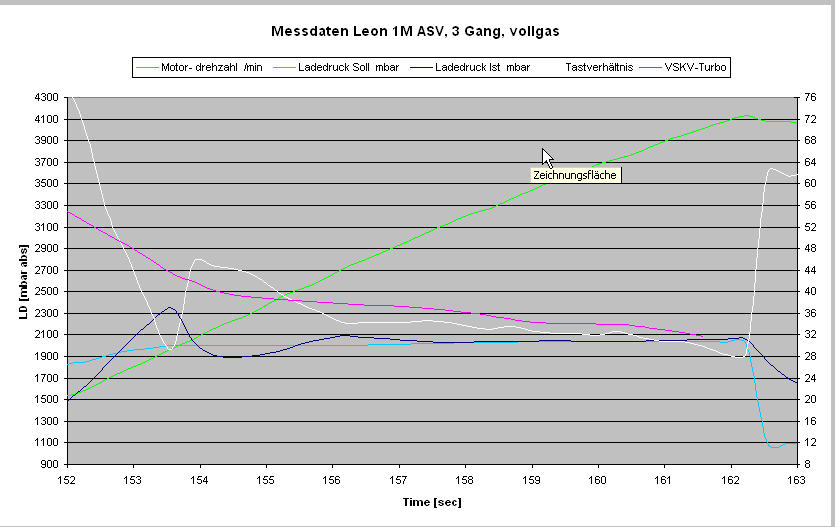
When the systematic error is acceptably small or zero, the white line of the logged TV signal can be considered an approximate representation of the actual TV power requirement when LD is equal to the setpoint.
And lo, the pre-tax KF (purple line) aims everywhere at an LD above the setpoint, thereby intentionally causing overshoots at first, which are then brought down towards the setpoint during the course of a control intervention.
Jochen's posts, with their deliberately exaggerated settings for a lively engine character, have at least been confirmed on our Ibiza - however, I can't accurately estimate to what extent the log data is already skewed due to the mileage (currently ~82,000 km) compared to a new car.
When the weather and my time allow, I will gradually increase the length of the VTG rod. This will shift the TV requirement for LD (Ist = Soll) upwards in the diagram (towards the purple line), and the overshoots should decrease (and the response behavior will become more sluggish, I know  ).
To be continued... Gruß Ulf
_________
MG4 Electric
Translated on 04-09-2026, 19:20.
|
|
| Back to top |
Profile PM Garage |
|
donalexo
Profi-Schrauber
Joined: 01/09/2003
Posts: 695
Karma: +0 / -0
Location: Würzburg
Support
|
| 25-11-2007, 15:23 Subject: ALH Load Disconnect Control System |
Quote |
|
Hello Ulf!
Your results are by no means surprising, quite the opposite. You need to imagine that the pre-tax calculation parameters of the software must be configured in such a way that they are robust (in the sense of a minimally required boost pressure build-up dynamics) so that, even when combining several unfavorable conditions (low air pressure, high temperature, etc.), a certain step response can always be achieved when there is a sudden demand for power.
If you look at the issue from a "control engineering" perspective, you will never achieve the best dynamic response with a damping factor of 1 (which means no overshoot), but rather with a damping factor of 0.7.
The pre-setting is designed for the "worst-case" scenario, and the controller only needs to compensate for the difference. The system seems to be designed in such a way that the correction always occurs in only one direction, namely, a reduction.
Regards,
Alex.
AUDI A3 1.9 TDI, EZ 12/96, ursprüglich MKB AGR, umgebaut zum AHF mit GT1749V-Lader, verkauft mit 250tkm
Golf 4 1.9 TDI, EZ 1/98, MKB ALH, jetzt auch mit GT1749V-Lader, verkauft mit 300tkm
Touran 1.9 TDI, EZ 09/2004
Audi A4 Avant 2.0 TDI, EZ 03/2010
Translated on 04-09-2026, 19:23.
|
|
| Back to top |
Profile PM |
|
Jochen_145
Guest
Free account, no CAN development support
|
| 25-11-2007, 17:28 Subject: ALH Load Disconnect Control System |
Quote |
|
Hello Ulf,
I once created a comparable MBW11 log in the middle of last year, similar to the one you created.
The behavior is fundamentally the same. However, due to the larger amount of ASV (standard software), the duty cycle in the VSKF is significantly lower than in the AHL.
Basically, based on your log, I wouldn't see any signs of aging.
I know directly from application specialists that the 'overshoot' is a 'stem element.' That's why I've always passed that information on.
I find what the person from Bavaria said above to be interesting:
The overshoots at engine speeds below 3250 RPM are not critical for the ATL, as the volumetric flow rate is relatively low. Overshoots only become critical at engine speeds above 3500 RPM, therefore, you should definitely check the following:
This also confirms my assertion that the load on the charger is dependent on the current flow and, therefore, overshoots in the low RPM range are perfectly acceptable.
Unfortunately, this also means that you and Rainer have invested a lot of work, which is partially useless.
But, well, the timing of the VSKF at high speeds remains an important point that must not be forgotten. Therefore, your work is not entirely in vain.
You need to imagine that the pre-tax settings in the software must be calibrated to be so robust (in the sense of a minimally required boost pressure build-up dynamics) that even when combining several unfavorable conditions (low air pressure, high temperature, etc.), a certain step response must always be achievable when there is a sudden demand for power.
(..)
The pre-control is therefore designed for the 'worst case' scenario, and the controller only needs to compensate for the difference.
Hmm, I see things a bit differently:
ULF has entered the values for the property tax identification field in the VS system.
All correction factors have not yet been taken into account. Therefore, a 'worst-case' calibration of the property tax characteristic curve is not necessary. These correction factors will handle it.
The VS (Valve Setting) is only active when the actual value (Ist_Wert) deviates sufficiently (in my case, at least 70 hPa) from the setpoint value (Soll_Wert). Therefore, there should be no combination of feedforward control and feedback control.
At least, that's how I've always understood it so far.
Best regards, Jochen.
| Description: |
| ALH Load Disconnect Control System |
|
| File size: |
75.42 KB |
| Viewed: |
3479 times |
|
Translated on 04-09-2026, 19:27.
|
|
| Back to top |
|
|
|


 Bookmarks
 Links
Links Garage
 FAQ, Legal Notice & Privacy
 RSS Feed
 Register
 Login
Login

