| Author |
Message |
B.C.
Blaumann

Joined: 11/28/2004
Posts: 54
Karma: +1 / -0 
Support
|
 03-06-2013, 21:28 Subject: Synchronization angle 16V PD Germany (SOLVED) 03-06-2013, 21:28 Subject: Synchronization angle 16V PD Germany (SOLVED) |
Quote |
|
Hello everyone,
ich habe heute den Zahnriemen (Wapu, Spannrolle, Rolle groß + klein) beim BRD (A4) gewechselt. Die Absteckwerkzeuge (beide Nockenwellen) und der Kurbelwellenstop passten auch nach mehrmaligen Durchdrehen des Motors nach der Montage des neuen Zahnriemens. So far, so good.
Result: The synchronization angle (MWB4) at a warm engine is (+) 0.74 degrees.
You really can't complain about that, right?
I've already read that the intake manifold and crankshaft components have tolerances on the mounting side, which means the MWB4 value doesn't necessarily have to be 100% accurate.
What surprises me and where I need your advice is that above 2500 RPM, I have a value of (  .09°); and around 4000 RPM, a value of ( .89°)!!??
(measured at idle and with the engine running).
Okay, everything is within the tolerance of +/- 3°. BUT: how does this deviation of a maximum of 1.15° occur across the speed range? This is a mechanical belt drive... Are these measurement tolerances at high speeds? Does the timing belt expand? Should I be concerned or is this normal?
I can't explain it and I need your help.
"Thank you!"
Björn.
Translated on 13-07-2026, 13:04.
|
|
| Back to top |
Profile PM |
 |
dieselschrauber
Administrator

Joined: 04/12/2002
Posts: 18095
Karma: +799 / -0
Location: St.Gallen
2018 Volkswagen T6 
|
| 03-06-2013, 21:42 Subject: Synchronization angle 16V PD Germany (SOLVED) |
Quote |
|
Hello,
Quote: | | Okay, everything is within the tolerance of +/- 3°. BUT: how does the deviation of a maximum of 1.15° occur across the speed range? |
I haven't been able to observe that in my own experience, but it's also not a Siemens PPD unit. The only thing that comes to mind is the timing belt tension. Is the tensioner pulley mounted correctly?
Best regards, Rainer.
Translated on 13-07-2026, 13:06.
|
|
| Back to top |
Profile PM WWW Garage |
|
Autoservice
Profi-Schrauber

Joined: 04/14/2012
Posts: 2130
Karma: +99 / -0
Location: Nähe Düsseldorf
Support
|
| 03-06-2013, 21:51 Subject: Synchronization angle 16V PD Germany (SOLVED) |
Quote |
|
I just installed a ZR (presumably referring to a specific product or component) on a Skoda Octavia RS. Seems like it's a fairly common thing to do.
Idle: 0.0 - Increases to 0.8-0.9 with acceleration.
Could it be due to the oval-shaped wheel?
I think it's related to the natural elasticity of the belt.
If that weren't the case, one could install a "rigid" chain. However, during tests, these chains repeatedly broke and flew off, causing problems for the Volkswagen engineers.
It might decrease once the belt has stretched out a bit. But a difference of 1° kW is practically nothing. Ideally, you want a deviation of 0.0°. You can only achieve that if the belt is tensioned in the direction of pull when it's being installed.
LG, Onkel BM
*Nichts ist einfacher, als sich schwierig auszudrücken......*
**Technische Fragen bitte ins Forum und nicht in mein Postfach**
Translated on 13-07-2026, 13:08.
|
|
| Back to top |
Profile PM |
|
B.C.
Blaumann
Joined: 11/28/2004
Posts: 54
Karma: +1 / -0
Support
|
| 04-06-2013, 20:19 Subject: Synchronization angle 16V PD Germany (SOLVED) |
Quote |
|
Hello Rainer, hello Uncle BM,
Thank you for your feedback!
Rainer, what mistakes can be made when assembling the tensioner?
I made sure that the nose of the tensioner pulley was seated in the opening of the timing belt cover (at the rear) and, after placing the timing belt, I tightened it with the T 10020 nut spinner in the direction of engine rotation/clockwise until the indicator was centered in the gap on the tensioner pulley. After tightening the tensioner pulley, the indicator was approximately 5mm further to the left, which should be normal.
I used the T10115 tensioner during the timing belt installation. Is this correct, or have I made a mistake somewhere?
"@Uncle BM: I took another measurement today: 0.74 degrees up to approximately 2500 RPM, 1.09 degrees up to approximately 3500 RPM, then 1.84 degrees - this time ridden in 4th gear. The 1.89 degrees were not reached again. This could be a measurement error, or, following your theory, the belt might still be breaking in?"
Sehr interessant ist Dein Hinweis, dass der Riemen beim Abstecken im Zugturm gestrafft sein soll: ich hatte den Zahnriemen (wie oben beschrieben gespannt), abgesteckt war alles, nur hatte ich den Gegenhalter T10172 nicht zur Verfügung. Ich hatte trotzdem versucht, mittels einer Stange (gegen den Uhrzeigersinn) Spannung/Zug am Nockenwellenrad der Auslasswelle (beide Nockenwellenräder waren gelöst)aufzubauen und dann Beide festzuziehen. Da passierte aber nicht wirklich etwas. Z"On the right side of the engine, the timing belt was already quite tight (on the intake camshaft, tensioner pulley, water pump, and crankshaft)."
Maybe it's not enough? Do you mean that? Is that why I didn't reach 0 degrees?
And I ended up with a reading of (+0.74° at idle). Is that possible? Does this indicate a positive angle? Do I need to adjust it again and set the proper tension? While I can live with the angular deviation, I'm wondering if the tension on the right side is sufficient.
Thank you!
VG Björn.
Translated on 13-07-2026, 13:11.
|
|
| Back to top |
Profile PM |
|
Autoservice
Profi-Schrauber
Joined: 04/14/2012
Posts: 2130
Karma: +99 / -0
Location: Nähe Düsseldorf
Support
|
| 04-06-2013, 21:52 Subject: Synchronization angle 16V PD Germany (SOLVED) |
Quote |
|
Quote: | | Nach festziehen der Spannrolle war der Zeiger ca. 5mm weiter links, was normal sein sollte. |
You need to think about that again.
The belt is adjusted too loosely! The tension indicates that the belt needs to be replaced. If the rear bracket of the tensioner hits its limit, it will fly off and hit you in the ear.
The same applies to the end stop!
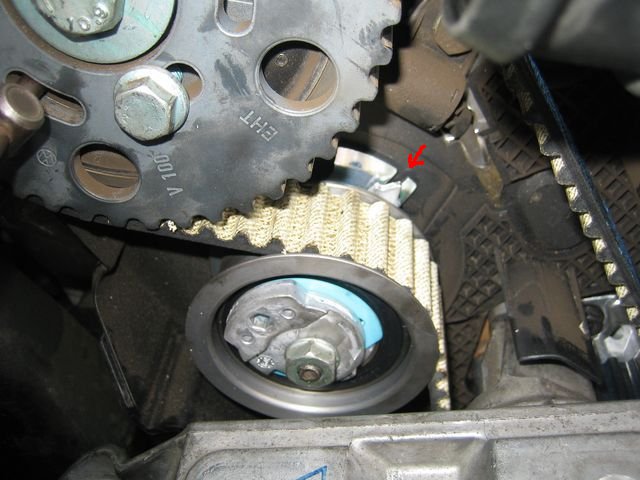
And – importantly -> the roller must only be turned to the right (clockwise) for tension adjustment. If the belt is too tight, completely release the tension and then re-tension it by turning it to the right again.
The correct tension is achieved when the markings (photo) on the tension roller are aligned.
Here's how to proceed:
- Manually rotate the motor clockwise to the designated position (do not engage the locking mechanism!).
- ZR - Check the tension as described and adjust if necessary. Tighten the tensioner roller with a torque of 20 Nm.
- Rotate the motor two more revolutions - check the voltage. If the voltage is okay, pull the tensioner 45 degrees - move to the next point.
- Rotate the engine approximately two more revolutions until the crankshaft stopper can be engaged with the crankshaft.
- Continue rotating the motor slowly until the crankshaft stopper can be inserted straight into the fixing hole. Now, secure the flywheel and make any necessary adjustments.
Also, erst die Spannung, dann die Steuerzeiten. Viel Spaß dabei. 
And one more thing, what did you use to check the synchronization angle?
Please enter your VCDS serial number under "Settings".
| Description: |
| Spannrolle AXR, richtige Einstellung der Zahnriemenspannung. |
|
| File size: |
66.77 KB |
| Viewed: |
10541 times |
|
LG, Onkel BM
*Nichts ist einfacher, als sich schwierig auszudrücken......*
**Technische Fragen bitte ins Forum und nicht in mein Postfach**
Translated on 13-07-2026, 13:15.
|
|
| Back to top |
Profile PM |
|
Herbert
Profi-Schrauber
Joined: 06/22/2005
Posts: 4619
Karma: +1337 / -0
Premium Support
dieselschrauber likes this. |
| 05-06-2013, 8:57 Subject: Synchronization angle 16V PD Germany (SOLVED) |
Quote |
|
Hi there,
Quote: | | ich hatte den Zahnriemen (wie oben beschrieben gespannt), abgesteckt war alles, nur hatte ich den Gegenhalter T10172 nicht zur Verfügung. |
You must tension the belt without using any shims, so that the tension is evenly distributed across the entire belt path. Otherwise, you will only be applying tension on one side between the two shim points.
hg
Herbert. Horch A4 8K CJCD
Golf 7 DDYA
(+ Audi 80 Avant B4 1Z 475Tkm - habe ich vom ersten bis zum letzten Tag gerne gefahren)
(+ Passat Variant 32B CY 400Tkm)
Translated on 13-07-2026, 13:18.
|
|
| Back to top |
Profile PM |
|
B.C.
Blaumann
Joined: 11/28/2004
Posts: 54
Karma: +1 / -0
Support
|
| 05-06-2013, 20:18 Subject: Synchronization angle 16V PD Germany (SOLVED) |
Quote |
|
Thank you both for the information.
@ Herbert: da habe ich mich nicht genau ausgedrückt, sorry. Lt. meiner Unterlagen sollen die Nockenwellenzahnräder vor dem Auflegen des Zahnriemens gelöst und auf Rechtsanschlag gedreht werden. Die Nockenwellen selbst bleiben abgesteckt. Durch das Spannen drehen sich die Nockenwellenzahnräder nach links, so daß auch auf der Zugseite gespannt wird und auch die Spannung zwischen den Zahnrädern stimmt. ZAdditionally, after tensioning, the left camshaft sprocket should be held in place by pulling it counterclockwise (using the holding tool T10172) while tightening the camshaft sprockets.
The purpose of this procedure is likely also to ensure that the valve timing is correct after the tensioning process.
Is there sufficient tension between the camshaft gears?
@Onkel BM: auch an Dich erstmal eine Entschuldigung - ich habe rechts/links verwechselt.... 
Ich hatte den Zahnriemen entspr. Deines Fotos eingestellt. Then 20 Nm plus 45 degrees.
Nicht erst 2 Umdrehungen und dann 45°. Stand in meinen Unterlagen (VAG) nicht so. Abgesteckt waren die Nockenwellen, die Nockenwellenzahnräder waren aber gelöst (s.o.). Nach dem Anziehen von den 45° ist der Zeiger nach rechts (ca. 3mm gewandert). Danach habe ich den Motor mindestens 4 Umdrehungen durch gedreht, dabei immer wieder abgesteckt und die Riemenspannung kontrolliert. Alles okay. Dann wieder 4 Umdrehungen durchgedreht. Danach war der Zeiger nach links gewandert. Ca. 2mm links von der Markierung. Ah, I thought, the timing belt must have stretched a bit.
The tensioner's locking mechanism has been released, and it was tightened by turning it to the right (clockwise) until the marking was reached. Then, it was tightened again by 20 Nm + 45 degrees without over-tightening (see above). The indicator needle has moved approximately 3 mm to the right.
Okay, I thought, because there is a note in the documentation: When tightening the mounting nut, the pointer moves a maximum of 5mm to the right out of the slot on the base plate. This position must not be adjusted, as the timing belt will settle after a certain period of use.
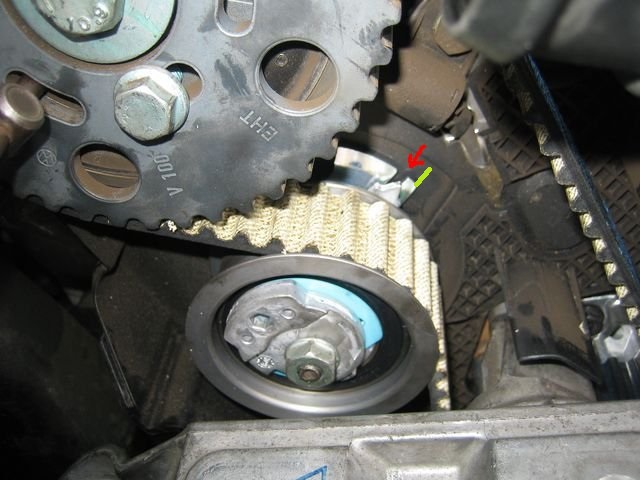
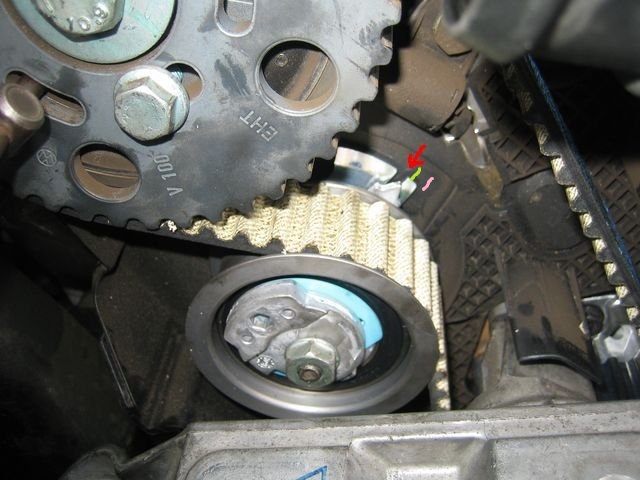
Today, I removed the upper timing belt cover as you suggested, and I can see that the indicator is even further to the right after driving 40 kilometers (see photo, green marking). I just measured it on the old tensioner pulley. It's about 6mm, not 5!
Is the belt too tight now? Do I need to disassemble everything again (including putting the lock carrier back into service mode, etc.) and readjust it?
Or is this still acceptable right now?
I haven't been able to afford VCDS yet. I'm using a VAGCom version that I bought from RossTech some time ago.
VG
Björn.
| Description: |
| Synchronization angle 16V PD Germany (SOLVED) |
|
| File size: |
93.08 KB |
| Viewed: |
4858 times |
|
Translated on 13-07-2026, 13:20.
|
|
| Back to top |
Profile PM |
|
Autoservice
Profi-Schrauber
Joined: 04/14/2012
Posts: 2130
Karma: +99 / -0
Location: Nähe Düsseldorf
Support
|
| 05-06-2013, 23:12 Subject: Synchronization angle 16V PD Germany (SOLVED) |
Quote |
|
You need to adjust it --> it's far too tight. You're only 4-5mm away from the limit (see post). When the motor reaches operating temperature, there might already be contact. There is significantly more room in the "loose" direction. If you leave it like this, you're leaving the rest of the engine's life to chance...
Quote: | | It's not just 2 rotations and then 45°. The information in my documentation (VAG) wasn't stated that way. |
There are also people working there who can do this perfectly right away and understand what they're doing. Also, the film doesn't jam when threading because it hasn't been pulled too tightly beforehand; instead, the tension remains exactly the same after it's engaged.
The studs are delicate and essentially undersized, not suitable for repeated adjustments of the angle. I replace them every time I change the timing belt. Who knows who might have tightened them before, possibly overtightening them.
Therefore, adjust the timing for non-experts only when the engine is running correctly, or after the motor has reached its maximum speed and is still running smoothly.
You've probably messed with it too much; you can just throw away the stud bolt.
The instructions were already specifically for "you." Inserting and tensioning can only be done with the NW wheels loosened - that's a given. But why loosen them again now? You only do that "in this case" if the valve timing will no longer be correct afterward. Therefore, DO NOT insert it, but check the tension in this position! LG, Onkel BM
*Nichts ist einfacher, als sich schwierig auszudrücken......*
**Technische Fragen bitte ins Forum und nicht in mein Postfach**
Translated on 13-07-2026, 13:25.
|
|
| Back to top |
Profile PM |
|
B.C.
Blaumann
Joined: 11/28/2004
Posts: 54
Karma: +1 / -0
Support
|
| 06-06-2013, 1:10 Subject: Synchronization angle 16V PD Germany (SOLVED) |
Quote |
|
Thank you very much for your reply!
Okay, I'll correct that. You're right; I just checked it using the old tensioner pulley – in that position, it's about 6 mm.
Okay, I understand the connection with the angle adjustment now.
After my previous post, I had already considered that I wouldn't loosen the camshaft pulleys again to re-tension the timing belt.
Only if the valve timing is incorrect - I completely agree with you!
"Furthermore, I've been thinking about this to avoid having to remove the bumper again: put the locking mechanism in the service position, and lower the vibration dampener (would I need new screws for that too?)."
I remove the upper timing belt cover, bring the engine to Top Dead Center (TDC) by aligning the camshafts - there's also a TDC mark/notch on the vibration damper and the lower timing belt cover. I lock the crankshaft by engaging first gear and pulling the handbrake. Then, I re-tension the timing belt and tighten the tensioner pulley to 20 Nm.
Rotate the engine two revolutions by pushing it in third gear (since I can't access the crankshaft bolt without further disassembly), then adjust the timing. After that, re-install the camshafts and check the marking on the vibration damper/pulley. If everything is correct, start the engine and check the synchronization angle.
As far as my idea goes. Does this make sense from your perspective, or should I, just to be on the safe side, disconnect at the crankshaft to check the timing beforehand? - Then everything would have to be taken apart again  .
Here's the translation:
"One more question: Does a positive synchronization angle mean that the intake camshaft is positioned too early/to the right? That's how I interpreted it!"
Thank you very much for your help!
Translated on 13-07-2026, 13:29.
|
|
| Back to top |
Profile PM |
|
B.C.
Blaumann
Joined: 11/28/2004
Posts: 54
Karma: +1 / -0
Support
mae1988 likes this. |
| 06-06-2013, 13:50 Subject: Synchronization angle 16V PD Germany (SOLVED) |
Quote |
|
I don't understand... Today I brought the engine with the second gear engaged to Top Dead Center (TDC), and to check the TDC position, I marked both camshafts and paid attention to the marking on the lower pulley. And what do you know, the indicator on the tensioner was exactly in the middle of the recess!
Okay, perfect. The motor spun three more times and then stopped; everything is fine now.
Engine started and ignition timing measured: 1.49 degrees (engine cold, idle).
Engine warmed up and measurements taken. 1.09 degrees at idle.
It was about 0.74 degrees shortly after assembly.
Has the belt settled in now?
The tension seems to be just right now, doesn't it?
Can I leave it like this now?
VG
Translated on 13-07-2026, 13:32.
|
|
| Back to top |
Profile PM |
|
Autoservice
Profi-Schrauber
Joined: 04/14/2012
Posts: 2130
Karma: +99 / -0
Location: Nähe Düsseldorf
Support
|
| 06-06-2013, 14:56 Subject: Synchronization angle 16V PD Germany (SOLVED) |
Quote |
|
Quote: | Has the belt settled in now?
The tension seems to be just right now, doesn't it?
Kann ich das jetzt so lassen? |
Wenn es denn alles den Tatsachen entspricht - ja.
I would personally adjust the valve timing – it's just a slight adjustment. You don't need to loosen the tensioner for this. A setting between 0 and -1 degrees would be ideal.
Quote: | | VCDS habe ich mir noch nicht leisten können. Benutze eine VAGCom-Version, die ich mal bei RossTech gekauft hatte. |
For a modern vehicle, you also need modern equipment. Take a look around this shop and see what's available. LG, Onkel BM
*Nichts ist einfacher, als sich schwierig auszudrücken......*
**Technische Fragen bitte ins Forum und nicht in mein Postfach**
Translated on 13-07-2026, 13:34.
|
|
| Back to top |
Profile PM |
|
B.C.
Blaumann
Joined: 11/28/2004
Posts: 54
Karma: +1 / -0
Support
|
| 06-06-2013, 15:34 Subject: Synchronization angle 16V PD Germany (SOLVED) |
Quote |
|
Thank you for your help!
I'm a bit unsure now...
Okay, I just checked the voltage with the engine warm – just to be on the safe side, because I was a bit unsure. Then the needle is pointing slightly further to the right, as you can see in the photo, marked in green. That should be okay, due to the expansion of the block and head, right?
After that, I observed how the voltage changes when the motor is run further (motor warm). At approximately 180° (crankshaft gear rotating clockwise), the pointer indicates the pink marking (photo). This is obviously due to the oval-shaped gear.
This position is very close to its maximum adjustment, as I could determine from the old roller. Why are they using an oval gear here, and how is the tensioner supposed to compensate for that?
Okay, in which direction do the camshaft gears need to be rotated to move from .09° towards 0°? Or, what's the best way to do this now?
Regarding VCDS, I had already been in contact and was planning to order it, but then I unexpectedly lost my job. If I'm lucky, that might change tomorrow, but I need the Audi to get there.
Thank you!
| Description: |
| Synchronization angle 16V PD Germany (SOLVED) |
|
| File size: |
92.89 KB |
| Viewed: |
3994 times |
|
Translated on 13-07-2026, 13:36.
|
|
| Back to top |
Profile PM |
|
Herbert
Profi-Schrauber
Joined: 06/22/2005
Posts: 4619
Karma: +1337 / -0
Premium Support
|
| 07-06-2013, 6:20 Subject: Synchronization angle 16V PD Germany (SOLVED) |
Quote |
|
Actually, the drive pinion is not oval; instead, it has two areas offset by 180 degrees with larger spaces between the teeth. This tooth design with larger gaps allows the timing chain to be accommodated in the top dead center (TDC) area. The timing chain becomes slightly longer around TDC due to the acceleration of the crankshaft and the opposing resistance of the power delivery drive. The timing chain teeth engage with these larger spaces, which protects them (according to the manufacturer).Torsion angles refer to the crankshaft (KW) position, starting at 0° in Top Dead Center (OT). A positive angle means the crankshaft has rotated further, while a negative angle indicates that the crankshaft is still moving towards OT (or, if you will, it has already been rotated quite far; 359° corresponds to -1°).
I'm not entirely clear from your description, but it seems like you might be confusing the tensioning and the locking mechanisms used to check the timing.
Questions: What is the manufacturer of the ZR (device)? Where was it purchased? Which guidelines are you following? Is there a specific kW setting specified for checking the voltage of the ZR?
hg
Herbert. Horch A4 8K CJCD
Golf 7 DDYA
(+ Audi 80 Avant B4 1Z 475Tkm - habe ich vom ersten bis zum letzten Tag gerne gefahren)
(+ Passat Variant 32B CY 400Tkm)
Translated on 13-07-2026, 13:39.
|
|
| Back to top |
Profile PM |
|
B.C.
Blaumann
Joined: 11/28/2004
Posts: 54
Karma: +1 / -0
Support
|
| 07-06-2013, 13:33 Subject: Synchronization angle 16V PD Germany (SOLVED) |
Quote |
|
Hello Herbert,
The timing belt kit is from ContiTech (CT1051WP1) and includes the water pump (Ruville), both idler pulleys, and the tensioner pulley. The description is provided by VAG.
The timing belt is tensioned in the disengaged/OT (Out-of-Time) position.
Here is the "context" regarding using shims to control valve timing.
And the tensioning. So yes, even the inspection of the timing belt tension is performed in the "KW" (eccentric shaft) position: Top Dead Center (TDC).
If you continue to turn it, the tension changes, as described yesterday. In some KW positions, it becomes tighter until it reaches the maximum value (photo, pink marking). As I said, I attributed this behavior to the "oval" crankshaft gear.
VG
Björn.
Translated on 13-07-2026, 13:41.
|
|
| Back to top |
Profile PM |
|
Autoservice
Profi-Schrauber
Joined: 04/14/2012
Posts: 2130
Karma: +99 / -0
Location: Nähe Düsseldorf
Support
|
| 07-06-2013, 15:17 Subject: Synchronization angle 16V PD Germany (SOLVED) |
Quote |
|
Quote: | | Actually, the timing gear is not oval, but has two areas offset by 180 degrees with larger tooth gaps. | With this toothing with larger gaps, the ZRP (Zero-Point Regulator) is engaged in the TDC (Top Dead Center) area.http://www.litens.com/belttension2.cfm
That was already the case with the round wheels.
The oval wheel originally came from Litens (developed in 2004).
Und ich dachte, die Entwicklung wäre von Schäffler. Also ist das Rad doch oval. Dort steht: a>b. Die Aufnahme schein mittig zu sein. Somit könnte auch der Zeigerausschlag bis zu der rosa Markierung hinkommen?
Don't act like that now... } The ZR voltage is set in the designated position, not at any random point. And it must be correct at precisely that position - period. Everything else will follow from there. It doesn't matter whether the wheel is round, oval, or triangular.
The rest is already described. Why make simple things so complicated?
Of course, one would not want to remove the timing chain tensioner at tax time.
You only need to offset the camshafts by a small amount (approximately 0.5 degrees of crankshaft rotation) relative to the cam gears in the direction of rotation, or offset the cam gears accordingly against the direction of rotation.
What's the problem here? Just think logically for a moment. LG, Onkel BM
*Nichts ist einfacher, als sich schwierig auszudrücken......*
**Technische Fragen bitte ins Forum und nicht in mein Postfach**
Translated on 13-07-2026, 13:44.
|
|
| Back to top |
Profile PM |
|
B.C.
Blaumann
Joined: 11/28/2004
Posts: 54
Karma: +1 / -0
Support
|
| 07-06-2013, 15:42 Subject: Synchronization angle 16V PD Germany (SOLVED) |
Quote |
|
So, the dial seems to be oval. It says "a > b" there. The indicator appears to be centered. Therefore, could the needle swing all the way up to the pink marking?
Regarding the valve timing correction: if I understand correctly, I only need to loosen the camshaft sprockets (after disconnecting them) and then tighten the tensioner tower? That is, in a counter-clockwise direction. If that's the case, is it absolutely necessary to use a crankshaft locking tool? Or, if the camshafts are disconnected, can I block the crankshaft by engaging first gear and using the handbrake? This would save a lot of work, and I would only need to obtain a holding tool (T10172) or improvise something.
VG
Björn.
Translated on 13-07-2026, 13:46.
|
|
| Back to top |
Profile PM |
|
|


 Bookmarks
 Links
Links Garage
 FAQ, Legal Notice & Privacy
 RSS Feed
 Register
 Login
Login

