I'm experiencing the following problem, which I've only noticed for the past two weeks.
The only thing I had worked on before on the vehicle was a xenon bulb replacement, which probably wouldn't have much of an impact.
When I use cruise control in relatively flat areas, for example at 140 km/h, and encounter hills where very little fuel injection would be needed on the downhill side, the cruise control starts to malfunction. He presses the accelerator, then releases it, and then presses it again.
It's so strong that I have to turn it off.
You can even see the knocking on the tachometer.
The current fuel consumption is then around 1.6 liters per 100 kilometers.
Unfortunately, I don't have any specific data on the engine control (e.g., mg/stroke), as I noticed it while out on the water at night with my family on board.
My only idea is that the ZMS (zero-maneuver speed) has too large a free angle, or the ZMS springs are worn out... nothing that can be easily fixed.
My only idea is that the ZMS has too large a free play, or the ZMS springs are worn out... nothing that can be easily fixed.
You're not alone; I experience similar issues, which seem to depend on driving speed, gear, and road conditions.
While it's not ideal for me, I can live with it in the rare cases when it occurs. As an attentive driver, one might be surprised, but it's relatively weakly pronounced, and as long as the heads of the occupants don't nod, I don't see a need for action.
The cause in my case is too much play in the drivetrain, specifically in the motor mount, which causes the system to oscillate under unfavorable conditions.
I suspect you might be experiencing something similar, although it's less likely to be the ZMS (usually, if that's the issue, you'd have other problems as well). Of course, it could still be the cause.
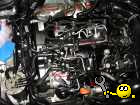
-> Go inside the engine compartment, push the car forward/backward in the garage, and observe the engine mounts, drive shafts, wheel suspension, etc. Stop anything that could lead to more playtime.
-> Go inside the engine compartment, push the car forward/backward in the garage, and observe the engine mounts, drive shafts, wheel suspension, etc. Stop anything that could lead to more playtime.
Which brings us to the next question.
In this test, the Golf's engine "pops."
I expect: Some play, then all "sides" and freedoms are under tension, and then the motor moves linearly relative to the body's movement.
The golf engine initially doesn't move, then it sputters to life, and then it stops moving again.
"I also lack experience with the Golf and Passat regarding how "soft" the engine mounts can be."
For example, the left club of the golf set comes pre-slotted from the factory, which is presumably intended to make it relatively flexible.
Is this okay if I pull on the valve cover by hand?
Is this okay when pulling with your hand on the valve cover?
I don't have any personal experience with the Golf 5, but I would say probably not.
"It seems like the valve block almost stays in place in its extreme positions. And if you can achieve that just by manually turning the valve cover (without using the vehicle's momentum and pushing it), it's far too easy."
Are there any learning values (for the GRA) that could be deleted?
I have this feeling that it's become more temperamental with the new nozzles.
Sure, because now 4 mg still means 4 mg, and not 3 mg, which is what was getting through before due to those clogged things .
Yes, that should work; it worked that way on my Fabia, at least.
I also once experienced a similar issue with the cruise control. Afterward, the error log indicated that a signal from the lever was implausible. I then turned the cruise control on and off, and it started working again.
But all compliance in the powertrain is poison to controllers.
I noticed this when I converted to a ZMS, as the idle speed control system no longer seemed to have any effect. But that's where Ulf could help .


 Bookmarks
 Links
Links Garage
 FAQ, Legal Notice & Privacy
 RSS Feed
 Register
 Login
Login