I previously thought that the soot load of the diesel particulate filter (DPF) was determined by measuring the pressure difference across the DPF. However, it seems that this can also be achieved by measuring the pressure difference against the outside air pressure.
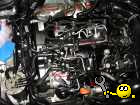
In my specific CJCD system, the "differential pressure sensor" is only connected to the engine side of the DPF; the other connection on the sensor is just a short, open hose. The RLF (presumably a diagnostic tool) shows something different.
hg
Herbert.
Horch A4 8K CJCD
Golf 7 DDYA
(+ Audi 80 Avant B4 1Z 475Tkm - habe ich vom ersten bis zum letzten Tag gerne gefahren)
(+ Passat Variant 32B CY 400Tkm)
Correct, in a properly sized exhaust system, there isn't much pressure change after the DPF – and that small amount can be modeled using a calculation model.
Incidentally, a "calculation model" is a) cheaper than connecting to the DPF and b) more reliable because nothing can mechanically break.
"In principle, it is possible if you know the resistance of the rest of the exhaust system, the exhaust flow (based on exhaust temperature, air mass, and injection quantity), and the external pressure. The air pressure sensor is probably located in the engine control unit (ECU). There is no air pressure sensor shown in the wiring diagram."
hg
Herbert.
Horch A4 8K CJCD
Golf 7 DDYA
(+ Audi 80 Avant B4 1Z 475Tkm - habe ich vom ersten bis zum letzten Tag gerne gefahren)
(+ Passat Variant 32B CY 400Tkm)