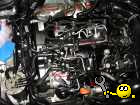
It's about a VW Caddy manufactured in 2012 with a 2.0 TDI engine, 140 horsepower, and engine code CHFC.
The engine has approximately 180,000 kilometers (about 112,000 miles). The injectors were recently replaced (by someone else). The engine runs well overall, and there are no noticeable issues while driving. However, it sometimes starts poorly, it might jerk briefly, but then it runs normally after a few seconds.
There's quite a bit of oil around the cylinder head cover, especially near the injectors. In addition, diesel fuel leaked from the pressure lines leading to the injectors.
So far, so good. This means removing the injectors, replacing the cover or seals. Then, reseal the injectors (with a copper ring and O-ring) and reinstall them. Correct?
What I'm having trouble understanding is the phenomenon shown in the two videos.
The oil cap wobbles quite a bit when you unscrew it with the engine running, and there's a noticeable amount of smoke coming out of the oil filler neck. This smoke also escapes through the hood, even when the lid is closed.
Is this still normal? Should I suspect a more serious defect? Could it be a KGE (Kernel Generic Error)? Can it still be driven, or should the vehicle be left where it is until the problem is fixed?
I would greatly appreciate a professional assessment.
Smoke and gases in 2.0 TDI EA189 engines, oil on injectors - Zu-viel-Blowby-2.0.-TDI.mp4
Description:
Smoke and gases in 2.0 TDI EA189 engines, oil on injectors
File size:
10.99 MB
Viewed:
2748 times
Smoke and gases in 2.0 TDI EA189 engines, oil on injectors - Zylinderkopfhaube-undicht-2.0-TDI.mp4
Description:
Smoke and gases in 2.0 TDI EA189 engines, oil on injectors
Unfortunately, it doesn't look good. Why were the injectors replaced in the first place?
"You can see for yourself that the cylinder head cover is leaking where it meets the oil filler neck."
I think the blow-by (smoke from the oil filler neck) is too high. Is the crankcase ventilation system (PCV) working? Even if it's clogged, I find the blow-by to be too large when idling. I'd rather not imagine what it would be like if it were going full throttle.
Spontaneously, I would suspect a crack in one of the pistons, which would likely indicate a total loss.
I would invest in a maximum pressure loss test to find out what's going on.


 Bookmarks
 Links
Links Garage
 FAQ, Legal Notice & Privacy
 RSS Feed
 Register
 Login
Login