I know I'm in the DIESEL repair forum, but it seems like there are a lot of knowledgeable people here.
Perhaps someone here has an idea, or can confirm or refute my "final suspicion."
It's about my Skoda Superb 3T5 (estate/wagon) with a CFFB engine and a DQ250 DSG gearbox.
I've now owned the vehicle for almost 5 years. I bought it with just over 100,000 km on the odometer, and it currently has about 215,000 km.
What I've experienced since the beginning is a noticeable oscillation (I would deliberately NOT describe it as a vibration) in the steering wheel, but only starting at speeds around 140 km/h. More noticeable in:
1. Low load or in gliding mode.
2. Steering wheel in neutral position or with minimal steering input.
You can also hear a certain "rumbling" inside the car when you find the right driving conditions, which is also when the swaying is most pronounced.
Now, here comes the big BUT:
Over the past 5 years, everything that could be replaced has been replaced, the wheels have been balanced countless times, and they've been checked for damage.
Initially, the suspension was replaced with a KW Streetcomfort system, but that didn't improve things either.
As a last resort, I completely replaced the entire front axle in the winter of 2023.
The Superb is delivered from the factory with what is known as the "low-cost" steel sheet metal front axle.
This unit has been completely converted to the aluminum version, including aluminum crossmembers and aluminum wheel carriers, sourced from other platform models. Of course, all the bearings were replaced, including the engine mounts and torque strut. A new stabilizer bar was installed with new bushings, along with new tie rods, brakes, brake caliper carriers, drive shafts, etc.
In short, I can't imagine any part here that should be old or used.
However, even this significant overhaul did NOT resolve the issue, which, in retrospect, was a rather frustrating outcome and experience. It wasn't exactly cheap.
The problem occurs with both summer and winter tires.
Various suspension settings were tested, including different amounts of camber (positive and negative), toe-in and toe-out, and various combinations thereof, as well as different tire pressures. Without achieving a clear improvement.
The experiments, in total, only resulted in damaged tires on the front axle.
My last idea would therefore be the following:
Do you think it's possible, or even have experience with, vibrations coming from the powertrain?
I'm thinking about a wear-and-tear ZMS (dual-mass flywheel) that might be resonating with the rest of the chassis, particularly in the low-load range.
Or is that more likely to be relegated to the realm of fantasy?
Maybe someone else has another idea; I'm out of ideas .
Happy Sunday, and see you soon.
Alex.
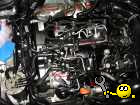
20231118_135502.jpg
Description:
Vibrations in the steering wheel at approximately 140 km/h
I've already had two sets of tires that showed uneven wear in certain areas, or weren't perfectly round. The shock absorbers are fine. The effect has so far only been observed in one tire manufacturer (very cheap ).
Constant rumbling, and during the disassembly and rotation of the wheels, it was possible to see with the naked eye that the wheel was oval-shaped.
The tire still held up okay, but the vibrations were annoying.
Since there were new sets of tires for both summer and winter conditions due to the track and alignment adjustments, I can also rule out the tires as the cause.
The summer tires are Michelin Pilot Sport 4 in size 225/35/19, and the winter tires are Dunlop Winter Sport 5 in size 225/40/18.
Let's think outside the box: Could it be possible that the vibrations have aerodynamic causes? For example, body panels (such as those on the undercarriage) that have become loose?
Automobile Zeitzeugen: |SUZUKI Swift Sport (2008)| |Smart 450 (2002)| |Honda CB 125 F (2018)|
Let's think outside the box: Could it be possible that the vibrations have aerodynamic causes? For example, body panels (such as those on the undercarriage) that have come loose?
Good point! I once had a car in front of me where parts of the underbody panel were flapping in the wind. If it's mostly upright when standing, it probably won't be that noticeable.
Does the problem also occur when the front axle is raised using a jack, within the specified speed range?
Good observation! If there was a car in front of me, parts of the underbody paneling would have been exposed to the wind. If it's mostly upright, it probably won't be that easy to notice. [...]
The first vehicles where this issue was frequently observed, and where the lower engine bay cover didn't immediately break apart, were the fourth generation Golf and related models. In some cases, this cover would bend downwards like a shovel and remain stuck in that position. Some people managed to make that not-so-small part vibrate quite a bit, which is probably what Rainer meant.
Automobile Zeitzeugen: |SUZUKI Swift Sport (2008)| |Smart 450 (2002)| |Honda CB 125 F (2018)|
For a more subtle vibration, I think the transmission to the steering wheel is too direct.
What I noticed from the parts catalog during the axle rebuild while I was studying:
For some reason, when vehicles leave the factory, there are two different types of drive shafts for the driver's side: one for vehicles with steel rims and one for vehicles with aluminum rims.
According to the catalog, the axles intended for delivery with steel rims have a balancing weight attached, while the axles intended for aluminum rims do not.
However, there is only one part number available as a replacement part, and even in the aftermarket, there is no differentiation.
Certainly, there was no weight balancing system on my vehicle, but perhaps that could be a possible solution for the vehicle with the modified wheel and tire combination?
LG
Alex.
Edit:
Even with a Google image search, I can't find a picture of a driveshaft showing a balancing weight with the corresponding part number... so, can you really believe that?
Okay, to summarize for myself: Everything that directly relates to suspension components and can contribute to noticeable vibrations has, in my experience with my vehicles, either been related to the tires (height variations, side impacts, saw-tooth patterns, or erosion in the tread) or to body panels or aerodynamic components.
Over more than 30 years of driving experience, I've also learned that there are certain tires, or specific tread patterns, that simply "don't work" on some vehicles, meaning they are "unpleasant and problematic" in terms of driving dynamics, and can even be "dangerous."
Unpleasant and annoying rolling noises can be a problem – and I've encountered some very peculiar examples. I remember retreaded summer tires that, upon mounting, appeared free of sidewall bulges and flat spots, but whose tread pattern produced a rolling noise very similar to that of Russian truck tires. One set of winter tires was characterized by a "slurping" rolling noise at speeds up to urban driving levels, but the noise disappeared as the speed increased. I never figured out where this tire model got that noise from. However, the Nokian tires were characterized by good grip on wet surfaces and excellent traction on snowy roads.
Here's another quirky detail: Many vehicles have shielding plates on the inside of the front disc brakes. I've often owned older cars, and in those, these plates would sometimes crack around the screw holes and start to rattle. Interestingly, this would transmit through the then-hydraulically assisted steering and could be felt on the steering wheel. Being pragmatic, or perhaps cheap, as I was back then, I simply removed the shielding plates on both sides. A friend actually offered to weld them back on, but he rightfully refused, considering the remaining metal thickness was already thin, bordering on "parchment." The cost-cutting business administrators in the development departments of the corporations would have rejoiced – it continued to operate for years without protective plates, never failed any technical inspections, and was therefore soon forgotten.
Anything beyond the suspension components that could cause vibrations and transmit them to the steering system is likely to rattle, clunk, or creak, which can help in troubleshooting.
I don't know the Superb well enough, even though I once drove one (in the winter, with steel rims and noisy winter tires). Does it have an electrically assisted power steering system? If so, could the level of assistance be reduced or turned off experimentally? Why am I even asking?
My Suzuki Swift (due to the model series with the M13A, M15A, and M16A engines) shares its front axle and steering system with numerous other models. The electrically assisted, speed-sensitive steering is the same across all models, and therefore, so are the potential faults. Aside from rare failures of the steering control unit, two components within the system are prone to wear-related noise over time, depending on mileage and the types of roads typically driven. One is a universal joint, which can start making rattling noises even before any noticeable play in the steering becomes apparent. The other component is a telescopic element that is roughly meshed and is designed to compensate for length differences depending on the steering wheel position selected by the driver. It also serves as a crash element, intended to give way if the driver impacts the steering wheel with force in the event of an accident. It tends to produce creaking noises, even when the steering wheel is not adjusted, during normal operation. This can be temporarily suppressed with a somewhat adhesive lubricant, but the manufacturer's specification was that it should remain dry. Workshops were instructed not to lubricate this component, even in response to customer complaints. The Suzuki workshop then added: "We can't prevent the customer from doing that themselves," which, for me, was the recommended course of action. While penetrating oil helps quickly, the effect doesn't last long. Over time, allowing a lubricating grease to seep in has proven more effective, and it now typically lasts for about a year.
And another thing: I've been experimenting with the power steering assist and have been using a different setting than the factory default for years. Below a speed of 100 km/h, I use 100% assist (compared to the factory setting of 70%), which, however, causes a jolt in the steering wheel when starting the engine with the steering wheel turned. I reduce the assist to 50% up to about 50-55 km/h, and completely disable it above 70-75 km/h (the factory setting was 30%). This results in a slight jolt in the steering when the assist is turned off due to exceeding the speed threshold while cornering. This slight compromise in comfort, however, gives me straight-line stability like a much heavier and longer car, as well as a "reduced sensitivity to crosswinds." The nervous tracking of tire marks has also improved, but many other cars can already achieve this with the factory settings. However, disabling the steering assist above a certain speed also introduced vibrations into the steering, which I can already feel with even slightly uneven road surfaces or the porous "whisper asphalt." Note: Summer tires, size 195/45 R17 - these no longer have any inherent suspension or damping.
Automobile Zeitzeugen: |SUZUKI Swift Sport (2008)| |Smart 450 (2002)| |Honda CB 125 F (2018)|
I had already experienced this described behavior in 2 Passat C6 vehicles with the following configuration: Diesel engine (CFFB & CBBB) + DSG transmission + sport suspension 8-inch wheels.
It's identifiable because it initially vibrates and makes a rumbling noise only during very slight acceleration. The more weight in the car, the worse it is.
The factory-fitted R-Line CBBB model even required a new driveshaft every 60,000 to 70,000 km.
Regards,
Bo.
2012 Nissan Pathfinder R51 2.5 dci (Tun. 225 PS)
2019 Skoda Superb iV 1.4 TSI Hybrid
2020 VW Tiguan eHybrid 1.4 TSI
Yes, the FZG has an electric servo, but I don't know if the assistance can be adjusted using VCDS; I'll have to take a look at that.
@Ste.Bo:
That's an interesting observation, indeed.
The brake discs and related components (or rather, "were" - it's been a while) are all new parts, assembled without any grease.
The driveshaft issues are also swirling around in my head, but if I replace all 4 joints and focus on quality, I could just get 2 new driveshafts for around €1100 from the Skoda dealer, which I'm currently hesitant to do.
Generally:
I have since abandoned my idea of using the ZMS as a trigger, after conducting a brief experiment.
At the speed I was traveling (140+ km/h), I simply downshifted to the 5th gear; the engine RPM wasn't an issue. BUT, if the dual-mass flywheel were somehow creating resonances in the powertrain, then the significant change in engine speed would have had to at least somewhat alter the vibration problem.
That was not the case.
In addition, on Thursday I had the wheels checked for imbalance and runout at another workshop. The master mechanic there was 100% convinced that the problem was related to that, and he even bet on it, covering the costs of the workshop if he was wrong. And lost.
If the steering mechanism is mounted on the power unit (?), it is conceivable that vibrations from the drive could be transmitted to the steering. However, this is contradicted by the fact that the effect depends on speed rather than rotational speed. A faulty ZMS (centrifugal mass flywheel) would have likely disintegrated by now.
Another possible cause could be an unsuitable driveshaft (e.g., a hollow shaft instead of a solid one, or vice versa, or missing balancing weights).
A static imbalance, which means... The wheel bounces, and this becomes noticeable within the resonance range, specifically at speeds of 80-100 km/h.
Dynamic imbalance, where the wheel wobbles or sways, becomes noticeable at higher speeds. Depending on the load, the wheel is pulled outwards or inwards, relative to the drive.
Possible causes include not only the actual imbalance of the wheel, but also imbalances in the brake disc, hub, or even lateral runout of related components. Therefore, it is crucial to pay close attention to ensuring perfectly flat mounting surfaces. I, however, have always found that applying some grease for corrosion protection is helpful, contrary to the opinion expressed above.
Wheel bearings can also cause problems. I once had hubcaps on my Audi 80, like a little gnome.
hg
Herbert.
Horch A4 8K CJCD
Golf 7 DDYA
(+ Audi 80 Avant B4 1Z 475Tkm - habe ich vom ersten bis zum letzten Tag gerne gefahren)
(+ Passat Variant 32B CY 400Tkm)
The drive shafts are also swirling around in my head, but if I replace all 4 joints and pay attention to quality, then I might as well just get 2 new shafts for €1100 from the Skoda dealer, and that currently feels too expensive to me.
So, in my experience, with both cars, it was always the inner constant velocity joint (CV joint) on the right side.
Once, it even happened immediately after installing a new part from SKF. Then the automatic transmission was rotated by one hole on the transmission flange and re-tightened, after which it remained quiet for 60,000 kilometers.
I now believe that lowered versions may be manufactured on Mondays and have a geometry that permanently exceeds the stress limits on this joint.
It doesn't necessarily have to be your area of expertise; I just wanted to share my experiences.
2012 Nissan Pathfinder R51 2.5 dci (Tun. 225 PS)
2019 Skoda Superb iV 1.4 TSI Hybrid
2020 VW Tiguan eHybrid 1.4 TSI
Actually, I also suspected that the 18" wheel covers were the problem, but I've been driving without them since then, and there's been no improvement.
The suggestion from @Ste.Bo doesn't seem entirely wrong, because, indeed, I've noticed a slight noise under certain driving conditions.
Specifically, when taking right-hand turns and the load shifts to the outer left wheel, a slight grinding noise can be heard, similar to the sound of a failing wheel bearing.
I think I'll risk the €120 for a new inner joint, and I'll get back to you .
But then I got too engrossed in the work, and dealing with the old and new grease on the AW joints on my hands became too tedious for me.
Anyway:
To my surprise, when the drive shafts were replaced on the driver's side at that time, a non-original (aftermarket) shaft was installed, but the bill showed that an original equipment (OE) shaft had been used... someone was definitely trying to pull a fast one.
The problem: I ended up buying both joints at the same time. When the shaft is already removed, replacing them is practically just a formality, BUT:
On the replica Spidan shaft, the seat for the seal is located on the inside, meaning the smaller diameter, and is approximately 4mm smaller than on an original shaft. Therefore, the cuffs didn't fit properly on the inside because they were simply too large.
So, I went back to the parts dealer, explained the problem, and got an original shaft.
Then everything seemed to be working correctly, the slight grinding noises when turning right are gone, but the vibrations/oscillations are still present.
Well, it's actually happening now – there's going to be a resolution!
It was because of the winter tires. Not specifically the exact tires that were mounted on my car, but rather apparently based on the TYPE/brand/tread pattern.
Since the problem persisted even after installing new tires, I had ruled out the tires themselves as the cause, because new tires should always be in good condition.
For some reason, the profile or the blend (or both) is generating these vibrations.
Now that the 19-inch summer wheels have been reinstalled, the steering is finally stable again.
There are still some faint "grinding" noises, and I hope they're not coming from the transmission. (But after 120,000 km with tuning on the DQ250, that's certainly a possibility.)
Now that the car has already exceeded 220,000 km, I'm going to replace the engine mounts and hope for an improvement, as everything else on the front axle is already new.
I did the same complete overhaul on the rear axle last week, and now it will probably take a few more years for the investment to pay off.
Best regards,
Alex.
Vibrations in the steering wheel at approximately 140 km/h - 20250419_180844_720320879980353.mp4
Description:
Vibrations in the steering wheel at approximately 140 km/h
File size:
22.39 MB
Viewed:
183 times
20250416_163912.jpg
Description:
Vibrations in the steering wheel at approximately 140 km/h
File size:
2.2 MB
Viewed:
149 times
20250416_154651.jpg
Description:
Vibrations in the steering wheel at approximately 140 km/h
File size:
1.95 MB
Viewed:
152 times
20250416_154636.jpg
Description:
Vibrations in the steering wheel at approximately 140 km/h
File size:
1.93 MB
Viewed:
156 times
20250415_160404.jpg
Description:
Vibrations in the steering wheel at approximately 140 km/h


 Bookmarks
 Links
Links Garage
 FAQ, Legal Notice & Privacy
 RSS Feed
 Register
 Login
Login



 .
.



 ).
).




 8-inch wheels.

