| Author |
Message |
Avenga
Guest
Free account, no CAN development support
|
 20-11-2004, 19:11 Subject: Gas Price Panic: Desperate Measures? 20-11-2004, 19:11 Subject: Gas Price Panic: Desperate Measures? |
Quote |
|
Hi, I've been troubleshooting issues with my Corsa B for almost a year now, and of course, I've also been communicating with online forums.
This forum is probably the most knowledgeable one with the smartest people that I know, but unfortunately, it's only for TDI  Nevertheless, I'm going to ask a question here.
My 1.4 60hp Corsa (engine X14SZ) jerks after shifting, so it stutters a few times when you give it gas. It's probably running too rich, because my oil smells like gasoline, and it also consumes a significant amount of oil once it's properly hot.
The most extreme situation occurs when I turn it off while it's still warm, then wait until it's almost cold, say around 30-40°C water temperature. Then, as I ride down the mountain, after about 1 kilometer, I shift back into second gear in a turn and try to accelerate at 1500-2000 RPM, and it experiences extremely jerky behavior.
Then it (the engine) sometimes jolts slightly, for example in 4th gear when I'm coasting and slowly dropping below the 2000 RPM mark, around 1900 RPM, but not below that.
'When I'm in first gear and revving up to around 2000 RPM, and then quickly shift into second gear and give it gas, the engine jerks quite violently.'
What I did:
Coolant temperature sensor, replaced a few times.
Oxygen sensor replacement.
Cat Rohr through.
Intake manifold pressure sensor replaced.
AGR 'sealed' with sheet metal.
Crankshaft sensor tested.
Common items such as spark plugs, air filters, intake manifold, and fuel filters.
Throttle potentiometer measured.
Fuel tank vent valve checked.
Fuel injector 'visual inspection'.
(LMM, camshaft sensor not present)
Okay, I disconnected the knock sensor once, and nothing happened, no error message.
Opel: Compression test: OK, idling. All data checked: excellent.
I suspect it's a control unit  .
I'm completely at a loss, maybe someone has a crucial tip or has experienced something similar before.
Best regards,
<bitte>
Translated on 17-09-2026, 18:00.
|
|
| Back to top |
|
 |
Julian
Guest
Free account, no CAN development support
|
| 21-11-2004, 10:22 Subject: Gas Price Panic: Desperate Measures? |
Quote |
|
Have you tried looking on www.motortechworld.com? It seems to be a gasoline engine, although the EGR system is surprising. What emissions standard does this engine meet?
Is this a vehicle for short distances?
I'd like to learn more about cleaning the throttle body and the ignition system.
Translated on 17-09-2026, 18:04.
|
|
| Back to top |
|
|
Forenheini
Guest
Free account, no CAN development support
|
| 21-11-2004, 11:35 Subject: Gas Price Panic: Desperate Measures? |
Quote |
|
'AGR valves can also be found in gasoline engines... However, I would strongly advise getting it 'repaired' as quickly as possible, because gasoline engines sometimes don't react well to a 'faulty' AGR valve. It's even possible that the problem is actually caused by a defective AGR valve.'
Translated on 17-09-2026, 18:04.
|
|
| Back to top |
|
|
Bertil
Profi-Schrauber

Joined: 04/15/2002
Posts: 5628
Karma: +108 / -0 
Premium Support
|
| 21-11-2004, 12:53 Subject: Gas Price Panic: Desperate Measures? |
Quote |
|
Hi,
As far as I can tell, the Corsa has either a Mono Jetronic or a Mono Motronic fuel injection system.
"My father had a similar problem with his Golf 3 (1.8L, 90HP, Mono Motronic). The (rubber) foot (damper) of the intake manifold had torn off. As a result, the engine was drawing in unmetered air after the turbo phase, causing it to misfire. There were no error codes in the engine control unit (ECU). Several workshops were unable to find the problem. However, it's very easy to find: simply shake the intake manifold while the engine is running. If the engine speed changes, the damper is torn."
Due to the vacuum, the oscillating element is normally firmly held in place, and the fault cannot be localized.
When I picked up the spare part (from one of the workshops that had been unsuccessfully searching for it), the warehouse worker told me, "It often breaks."
My old Golf 2 with the 90 horsepower Mono Jetronic engine had the same problem.
Gruß Bertil
Skoda 5E5 CZDA + Mini R50 W10 + VW ID.3 + Fiat Ducato 250 + 161 DX
*** Technische Anfragen per PN werden von mir nicht beantwortet! ***
Translated on 17-09-2026, 18:06.
|
|
| Back to top |
Profile PM |
|
donalexo
Profi-Schrauber
Joined: 01/09/2003
Posts: 695
Karma: +0 / -0
Location: Würzburg
Support
|
| 21-11-2004, 13:32 Subject: Gas Price Panic: Desperate Measures? |
Quote |
|
@Avenga:
I agree with Bertil.
If a gasoline engine is misfiring, it's often because it's drawing in unmetered air somewhere in the intake system.
It's best to check all the connections.
Regards,
Alex.
AUDI A3 1.9 TDI, EZ 12/96, ursprüglich MKB AGR, umgebaut zum AHF mit GT1749V-Lader, verkauft mit 250tkm
Golf 4 1.9 TDI, EZ 1/98, MKB ALH, jetzt auch mit GT1749V-Lader, verkauft mit 300tkm
Touran 1.9 TDI, EZ 09/2004
Audi A4 Avant 2.0 TDI, EZ 03/2010
Translated on 17-09-2026, 18:07.
|
|
| Back to top |
Profile PM |
|
Avenga
Guest
Free account, no CAN development support
|
| 21-11-2004, 13:56 Subject: Gas Price Panic: Desperate Measures? |
Quote |
|
sorry
Sure, gasoline!
logically
The engine meets Euro2/D3 standards.
I reinstalled the AGR (exhaust gas recirculation system) by removing the metal plate, but it seems to be running even more roughly now.
It has a Multec central injection system with distributorless ignition and a knock sensor.
@Bertil, can you explain that to me in more detail?
Okay, so on the central injection system, there's an intake manifold, and after that comes the air filter. You can do anything you want with it (drill holes, for example) or even remove it completely; it won't make a difference.
From the central fuel injection system (single injector), the fuel passes through the throttle valve and then splits into four intake manifolds, one for each cylinder. The exhaust gas recirculation (EGR) 'air' is also introduced there, in the middle.
And what exactly am I supposed to change about that?
The intake manifolds are securely attached to the cylinder head, and I also sprayed brake cleaner around them while the engine was running... and of course, I checked all the hoses connected to the fuel injectors.
What looks strange to me: I once fully opened the throttle body and shone a flashlight inside: down there, it looks really weird, like some kind of rubber. Do you think that's what it is?
Translated on 17-09-2026, 18:09.
|
|
| Back to top |
|
|
Bertil
Profi-Schrauber
Joined: 04/15/2002
Posts: 5628
Karma: +108 / -0
Premium Support
|
| 21-11-2004, 19:12 Subject: Gas Price Panic: Desperate Measures? |
Quote |
|
Avenga wrote: | sorry
It has a Multec central injection system with distributorless ignition and a knock sensor.
|
"So, it's similar to the Mono Jet or Mono Motronic system from Bosch."
Quote: |
@Bertil , can you explain that to me in more detail? , can you explain that to me in more detail?
|
Sure, I will.
Quote: |
What looks strange to me: I once fully opened the throttle and shone a flashlight inside: it looks really weird down there, like some kind of rubber, do you think that's what it is??????????????? |
Yes, I think that's the part.
But let's start from the beginning.
The Mono Jet essentially looks like a carburetor. It consists of a "downpipe" with a throttle valve, and below that, an intake manifold that leads into the cylinder head. The transition from the "downpipe" to the intake manifold is achieved using a rubber foot (flexible element).
It is therefore quite possible to see the rubber through the open throttle valve.
"This rubber" is exposed to extreme temperature differences and is very prone to tearing. Additionally, the intake manifold often contains a preheating element that is intended to prevent the intake passages from freezing. The rubber becomes brittle due to the heat (from the engine and the preheating system), and over time it either becomes leaky or tears completely. This is simply a known weak point.
If you wiggle the "downspout," the motor should not exhibit any differences in its running behavior.
"On my father's car, that part was torn off almost completely... it's amazing that the engine was still running." Gruß Bertil
Skoda 5E5 CZDA + Mini R50 W10 + VW ID.3 + Fiat Ducato 250 + 161 DX
*** Technische Anfragen per PN werden von mir nicht beantwortet! ***
Translated on 17-09-2026, 18:13.
|
|
| Back to top |
Profile PM |
|
Avenga
Guest
Free account, no CAN development support
|
| 21-11-2004, 21:02 Subject: Gas Price Panic: Desperate Measures? |
Quote |
|
I don't understand the function!
and I once pressed on it from below with a screwdriver, and it's firm.
Someone in the Corsa forum says I don't have that.
And how is one supposed to obtain that?
Currently, I'm helping myself by reading a book, but there's nothing about that in the text.
Translated on 17-09-2026, 18:15.
|
|
| Back to top |
|
|
Bertil
Profi-Schrauber
Joined: 04/15/2002
Posts: 5628
Karma: +108 / -0
Premium Support
|
| 21-11-2004, 22:50 Subject: Gas Price Panic: Desperate Measures? |
Quote |
|
Avenga wrote: | | I don't understand the function! |
What is there to understand about that?
The part only needs to seal the intake manifold from outside air.
In carburetor engines, the oscillating element serves to decouple the fuel-air mixture preparation from the intake manifold. This allows for a (desired) oscillation of the air column.
Since monoblock injection systems function similarly to carburetors, they often also incorporate a similar oscillating element.
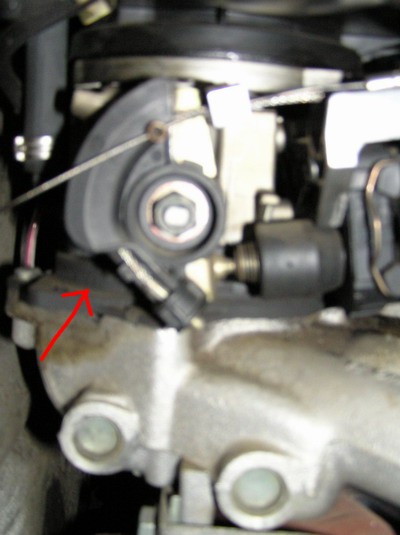
Attached is a blurry picture of the fuel injection system in a Golf 3.
At the very bottom, you can see the intake manifold, above which is the vibrating element (red arrow), followed by the mixing chamber with the throttle valve. On top of that (in black) is the snorkel that leads to the air filter.
On the Golf 3, the swirl flap is a single component and can be replaced separately with a total of 4 screws. On my Golf 2, the entire intake manifold with the throttle body had to be replaced.
| Description: |
| Gas Price Panic: Desperate Measures? |
|
| File size: |
42.26 KB |
| Viewed: |
7576 times |
|
Gruß Bertil
Skoda 5E5 CZDA + Mini R50 W10 + VW ID.3 + Fiat Ducato 250 + 161 DX
*** Technische Anfragen per PN werden von mir nicht beantwortet! ***
Translated on 17-09-2026, 18:17.
|
|
| Back to top |
Profile PM |
|
Avenga
Guest
Free account, no CAN development support
|
| 21-11-2004, 23:20 Subject: Gas Price Panic: Desperate Measures? |
Quote |
|
Sure.
I just checked the book again, and unfortunately, I can't find anything like that anywhere. 
I'm afraid I don't have that after all.

Translated on 17-09-2026, 18:18.
|
|
| Back to top |
|
|
christians
Profi-Schrauber
Joined: 09/05/2002
Posts: 2105
Karma: +17 / -0
Location: Sauerland
Premium Support
|
| 22-11-2004, 0:58 Subject: Gas Price Panic: Desperate Measures? |
Quote |
|
Hi,
A thankless topic.
I experienced something similar about a year ago with a Kadett 1.3i. The usual suspects seemed to be in good condition.
It eventually became clear that the engine misfire was worse when the radio was on. The lights were almost always on, regardless of the season. I then replaced the alternator's voltage regulator, which stopped the problem. Presumably, the engine control unit couldn't handle the unstable power supply.
Gruß Christian
A6 BPP, Ex-A6 AKN (Gurke), Ex-Audi100 92 AAT (5Zyl.)
Translated on 17-09-2026, 18:19.
|
|
| Back to top |
Profile PM |
|
meyert
Guest
Free account, no CAN development support
|
| 22-11-2004, 9:38 Subject: Skinny Fat? Causes, Solutions & Diet. |
Quote |
|
Hello,
I can add some more information about lean misfires and porous rubber parts. Even if the Corsa doesn't have a rubber flange under the fuel injection unit, there is definitely a rubber hose from the exhaust manifold towards the brake booster. These hoses also become porous and can cause lean misfires. I've experienced this before on a 35i with a Monojetronic system and also on an Audi 100 with a 4-cylinder Monojet. On the exhaust manifold-side connection for the vacuum, there's a rubber stopper because the Audi 100 doesn't have a vacuum-powered brake booster. The rubber stopper looked perfectly intact. However, with the engine running, the vacuum in the exhaust manifold caused the stopper to bulge inwards, and a crack appeared, through which it drew vacuum. I spent a lot of time troubleshooting it. By the way, in both cases, the VAG diagnosis was: throttle position sensor defective. The lower part of the fuel injection system needs to be replaced. The cost was 700 DM plus labor  .
Regards,
Thomas.
Translated on 17-09-2026, 18:21.
|
|
| Back to top |
|
|
Gremlin
Guest
Free account, no CAN development support
|
| 22-11-2004, 10:07 Subject: Gas Price Panic: Desperate Measures? |
Quote |
|
I'm almost certain that the Corsa also has the usual rubber buffer. It tends to tear quite easily. A colleague of mine used to experience jolting, especially in left turns... and then the fuel injection system would tilt out... that was quite extreme.
Another common issue with older Multecs used to be the control units. No one knows exactly why, but they would occasionally fail. This would then cause the vehicle to jerk or behave erratically, etc.
We've also had cases where swapping control units between two vehicles fixed the errors in both(!) of them. I really don't understand that at all.
Okay, so you can either just let it run idle and try to move everything around, or you can spray the flange with brake cleaner and wiggle it while you do.
Make sure to check ALL the hoses, absolutely ALL of them. If possible, verify the plausibility of the intake manifold pressure sensor.
CU Gremlin.
Translated on 17-09-2026, 18:23.
|
|
| Back to top |
|
|
meyert
Guest
Free account, no CAN development support
|
| 22-11-2004, 13:59 Subject: Slim Rolls: Easy & Delicious Recipe |
Quote |
|
Here's something else on the topic of 'unexplained spontaneous healing':
I had several problems with a Golf 2 that had an electronic carburetor (I think it's the 2EE model), such as misfires, high idle speed, and even the engine not starting (no fuel injection). The solution was a kind of 'actuator analysis' similar to what VAGCom does. You had to briefly connect a cable to ground in the engine compartment. Then, all the actuators, valves, etc., were 'shaken' for a few minutes. After that, the problem always disappeared.
Regards,
Thomas.
Translated on 17-09-2026, 18:25.
|
|
| Back to top |
|
|
Avenga
Guest
Free account, no CAN development support
|
| 22-11-2004, 18:14 Subject: Gas Price Panic: Desperate Measures? |
Quote |
|
Thank you very much for the great tips; it looks like I have a lot to do.
'It eventually became clear that the engine misfire was worse when the radio was on. The lights were almost always on anyway, due to the season. I then replaced the voltage regulator on the alternator, which stopped the problem. Presumably, the engine control unit couldn't handle the unstable power supply.'
I'll check that tomorrow! I'll turn on all the devices and then turn them all off and see if it reduces the stuttering.
'There's a rubber stopper on the vacuum connection on the manifold side, because the Audi 100 doesn't have a vacuum-assisted brake booster. The rubber stopper looked perfectly intact. However, with the engine running, the vacuum in the manifold caused the stopper to bulge inwards, and a crack appeared, through which the vacuum was being drawn. I almost drove myself crazy trying to figure it out.'
I have a universal joint (U-joint), and it looks tight, but I'm going to spray it with brake cleaner again just to be sure.
'I'm almost certain that the Corsa also has the usual rubber buffer. It really tends to tear easily. A colleague of mine used to experience jolting while turning left... and then the fuel injection system would tilt... that's quite extreme...'
Another common issue with older Multecs used to be the control units. No one knows exactly why, but they would occasionally fail. This would then cause the vehicle to jerk, etc.
We've even had cases where swapping control units between two vehicles fixed the errors in both(!) of them. I really don't understand that at all.
Okay, so you could just try moving everything around while it's idling, or spray the flange with brake cleaner and wiggle it while you do.
'Make sure to check ALL the hoses, really ALL of them. If possible, verify the plausibility of the intake manifold pressure sensor.'
Which rubber buffer should I use now? For braking force?
Yes, please the control unit! If that's the problem,  just replace it and it should be fine.
What does 'plausibility check' mean  ? I had someone else install it from another Corsa -> 0 change.
Bitte gib mir den deutschen Text, den du übersetzt haben möchtest.
I just spoke with a master mechanic from the dealership where the Corsa was sold.
He was also quite at a loss and suggested replacing the mainboard (StG), but reusing the EPROM from the old one.
Then, it's the voltage regulator of the alternator, or the entire alternator itself, that needs to be addressed.
Doesn't the voltage indicator also have to fluctuate or malfunction somehow?
Translated on 02-10-2026, 14:12.
|
|
| Back to top |
|
|
roli752001
Guest
Free account, no CAN development support
|
| 22-11-2004, 19:13 Subject: Gas Price Panic: Desperate Measures? |
Quote |
|
As an experienced Opel mechanic, I suspect the pressure membrane is located near the fuel injector. It's a small cover with four screws; underneath, there's a rubber membrane. Opel dealerships often don't know about this part, but replacing it usually fixes the problem, which I've seen happen many times before.
Translated on 02-10-2026, 14:16.
|
|
| Back to top |
|
|
|


 Bookmarks
 Links
Links Garage
 FAQ, Legal Notice & Privacy
 RSS Feed
 Register
 Login
Login
