Hey everyone.
Small problem with my VW Polo. It has a 1.9 diesel PD engine (engine code BLT).
The well-known "Pumpe Düse" engine with 130 horsepower.
Longer background:
I bought the vehicle privately with approximately 250,000 kilometers on the odometer, which seemed "low" to me at the time.
The vehicle was handed over to me with a "chip" installed. According to the chip tuner, it should have had approximately 170 horsepower at that time. The turbocharger didn't seem to be in the best condition, as it was already starting to whistle back then. After a brief moment of hesitation in front of this seemingly indestructible engine, I drove the vehicle for about 2500 kilometers.
After a short, enjoyable drive in the Polo (returning home with a salesperson in a representative car on the open highway) ... a sudden impact, followed by a loud clattering noise.
At that time, I suspected a connecting rod bearing failure, as the vehicle was making a knocking sound synchronized with the engine's firing order, and I had unfortunately experienced that issue before.
So, we got it out of the ditch and recovered the vehicle immediately.
Back home, under the carport, the truth finally came to light. The compressor impeller had made its way into the combustion chambers...
It had destroyed the pistons, cylinder head, and some other components.
Okay, so everything has been reworked from scratch:
- New piston series and accessories.
- Head, valve seats, and guides inspected.
- New intake and exhaust valves, etc., from the accessory parts.
- Head meticulously cleaned.
- New, larger GT1752 turbocharger, upgrade turbocharger.
- Connecting rod bearing shells (after inspection, even if they were not worn).
- New camshaft with hydraulic lifters and rocker arms, installed after determining "wear." The old camshaft had 1.3mm less lift on two of the lobes. (Purchased as a set from the accessories section.)
Arp head bolts for cylinder head. (No reason, I just wanted them.)
- New oil pump.
- Charge air cooling system (new, larger, and front-mounted).
- New timing belt with water pump, new thermostat, head gasket (brand name), etc.
The ARP head bolts came with washers that were much smaller than the original washers included with the bolts. We decided to use the original washers with the ARP bolts to reduce the clamping force on the head. The nuts for the ARP bolts didn't fit under the original holes in the bearing caps. Since ARP probably had a reason for using the thinner washers, we had to chamfer the bottom of the camshaft bearing caps on the milling machine so that we could use the original U-washers.
Next homemade item...
The camshaft supplied as an accessory could not be turned even with new bearings. Therefore, it was disassembled again. Compared to the original, well-worn camshaft, the new one was a hundredth of a millimeter too large. We ground down the new camshaft so that its dimensions matched the original.
We measured it again with plastic gauges for good measure. The clearance in the bearing was between 0.025mm and 0.038mm. In relation to the diameter of the pin and, for example, the connecting rod or main bearings (roughly speaking... let's say... about 0.080mm), this seemed appropriate to us.
Now, without the hydraulic lifters, the engine could be rotated as expected with the old screws pre-installed. So, everything is assembled. We used a 0.02mm feeler gauge to check if the bearing supports were making proper contact with the cylinder head. Unfortunately, we could only achieve this on the side facing the front of the vehicle, but it fit perfectly; nothing was obstructing it.
Well, I thought, I should probably drive it for at least 1000 km to break it in.
But then things turned out differently.
After 450 km:
Looking through a small opening in the oil filler cap, I saw signs of wear on the camshaft, evidence of initial running-in on the PD camshafts, and some lifters that were partially exposed. The pattern of damage is not consistent across all camshafts and lifters. The wear marks are mainly located on the base circle or at the points where the camshaft has minimal lift.
Of course, I checked the oil level first, and it was okay.
The rocker arm shaft plugs are in place.
Oil pan removed, checked the connecting rod bearings, all OK.

Therefore, the oil pressure must be present there.
Everything is put back together, and it runs without the cylinder head cover and glow plugs
. Oil is reaching the head. I thought I saw a leak of diesel coming from the element of the first cylinder.
Camshaft bearing shells, all with a copper-colored finish. Sometimes more, sometimes less.
Following the extensive repairs, a suspicion arose:
The oil level remains constant due to oil dilution, but it is also being burned at the same time.
Okay, so I'm putting in a new camshaft again, re-checking the valve seats, installing a new rocker arm shaft again, replacing the hydraulic lifters again, and now assembling everything together with the PD element holders.
600 km later:
I'm just checking to be sure, and I see that it's the same. The camshaft has signs of wear.
I measured the oil pressure with a cold engine because I didn't have a way to warm it up. The oil pressure was approximately 1.8 bar at starting engine speed and approximately 4 bar at idle.
Engine oil 5W-30, VW504/507 specification.
Oil is coming into my head. In my opinion, it's definitely a case of insufficient lubrication.
Okay, here are my questions:
What are the specified values for the camshaft bearing clearance?
Where can I measure the oil pressure in the head? And will that measurement be meaningful?
Where is the oil pressure control valve located?
Wrong oil?
Could there be problems with the studs or the washers?
Will the oil pressure in the cylinder head also decrease if oil leaks out through the head bolts?
Are you familiar with occasional issues related to oil production?
There's a lot to read, but I'm grateful for any help.
Best regards,


 Bookmarks
 Links
Links Garage
 FAQ, Legal Notice & Privacy
 RSS Feed
 Register
 Login
Login



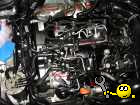



 before the repair...

