| Author |
Message |
Hutfahrer
Schrauber


Joined: 10/22/2005
Posts: 7817
Karma: +1092 / -0 
Location: BAR
Premium Support
|
 14-07-2012, 18:40 Subject: 14-07-2012, 18:40 Subject: |
Quote |
|
Let's put aside the specifics of a particular device: When does a cooling system need to be pressureless? Does every one? In my 1.4 HDI car, when I park it overnight, there is definitely still some pressure in the system the next morning. It's not necessarily a lot, but you can certainly hear a distinct "hiss!" sound.
Automobile Zeitzeugen: |SUZUKI Swift Sport (2008)| |Smart 450 (2002)| |Honda CB 125 F (2018)|
Translated on 04-08-2026, 16:06.
|
|
| Back to top |
Profile PM |
 |
Autoservice
Profi-Schrauber

Joined: 04/14/2012
Posts: 2130
Karma: +99 / -0
Location: Nähe Düsseldorf
Support
|
| 14-07-2012, 19:23 Subject: |
Quote |
|
Quote: | | It might not be a lot, but there's definitely a satisfying "hiss!". |
Let's say that the engines I know and which are still 100% leak-proof have cooled down and show 0 bar of overpressure. LG, Onkel BM
*Nichts ist einfacher, als sich schwierig auszudrücken......*
**Technische Fragen bitte ins Forum und nicht in mein Postfach**
Translated on 04-08-2026, 16:07.
|
|
| Back to top |
Profile PM |
|
RedR32
Schrauber

Joined: 12/21/2008
Posts: 1071
Karma: +11 / -0
Location: Bad Lobenstein
1998 Volkswagen Golf
Premium Support
|
| 14-07-2012, 22:08 Subject: |
Quote |
|
Who says it's overpressure?
2010 Caddy kombi life 103 tdisg6 BMM KXW
reflexsilber met.
Translated on 04-08-2026, 16:07.
|
|
| Back to top |
Profile PM Garage |
|
ulf
Profi-Schrauber
Joined: 04/13/2002
Posts: 11058
Karma: +18 / -0
Location: Saarland
2023 MG ZS
Premium Support
|
| 21-07-2012, 17:12 Subject: |
Quote |
|
I replaced the water globe lids two days ago, and I noticed that they have different part numbers.
Polo = 1J0 121 321 B
Ibiza = 3B0 121 321
After the initial inspection, none of our engines with the swapped caps have lost any coolant, and so far, we haven't seen any more condensation droplets on any of the caps.
Unfortunately, the documents do not provide any information about technical differences between the two lids. 
Does anyone happen to know any more details? Gruß Ulf
_________
MG4 Electric
Translated on 04-08-2026, 16:08.
|
|
| Back to top |
Profile PM Garage |
|
ulf
Profi-Schrauber
Joined: 04/13/2002
Posts: 11058
Karma: +18 / -0
Location: Saarland
2023 MG ZS
Premium Support
|
| 03-08-2012, 18:57 Subject: |
Quote |
|
Update:
Today, the coolant level is again at its minimum when the engine is almost cold, and the water reservoir cap from the Ibiza, which was initially thought to be leak-proof, is now also wet on the bottom. This means that the air conditioning compressor (ASZ) is apparently pushing water or steam through the pressure relief valve, even during normal highway driving.
I'm not going to add anything else for now and will continue to monitor the situation.
If he continues to consume water, I will remove the heat exchanger from the circuit, meaning I will bypass the motor-side pipes by connecting one of the hoses directly to the water tank.
Regarding the coolant smell coming from the ventilation: Strangely, it only smells like coolant when the heating is set to cold at the beginning of a journey. When you turn it to warm, the smell disappears, and it returns when you switch back to cold. However, in any case, the smell goes away after about 2 minutes.
How and where, for goodness sake, can coolant possibly accumulate in the ventilation stream and remain "cold"?
Gruß Ulf
_________
MG4 Electric
Translated on 04-08-2026, 16:10.
|
|
| Back to top |
Profile PM Garage |
|
Herbert
Profi-Schrauber
Joined: 06/22/2005
Posts: 4618
Karma: +1336 / -0
Premium Support
|
| 03-08-2012, 20:44 Subject: |
Quote |
|
Hi Ulf,
Is it definitely the smell of coolant? How does the dust and pollen filter look, and are the air ducts verschandeln and dry?
Coolant leaks can also be caused by a burr on the threaded neck of the expansion tank. Do you see the typical crystallized deposits on the threaded neck or on the heat exchanger?
Sure, here's the translation:
"Best regards," or "Sincerely," (depending on the context).
Herbert.
Horch A4 8K CJCD
Golf 7 DDYA
(+ Audi 80 Avant B4 1Z 475Tkm - habe ich vom ersten bis zum letzten Tag gerne gefahren)
(+ Passat Variant 32B CY 400Tkm)
Translated on 04-08-2026, 16:12.
|
|
| Back to top |
Profile PM |
|
ulf
Profi-Schrauber
Joined: 04/13/2002
Posts: 11058
Karma: +18 / -0
Location: Saarland
2023 MG ZS
Premium Support
|
| 04-08-2012, 17:42 Subject: |
Quote |
|
Herbert wrote: | Hi Ulf,
Is it definitely the smell of antifreeze? | 99% yes. It's certainly not windshield washer fluid; my nose can clearly distinguish it from antifreeze.
Quote: | | What does the dust and pollen filter look like, and are the air passages verschandeln and dry? | I could change the pollen filter sometime; that's true. Otherwise, everything is dry there.
Quote: | | Coolant losses can also be caused by a burr on the threaded stud of the expansion tank. Do you see the typical crystallized residue on the threaded stud or on the heat exchanger? | Neither. Although, the threaded stud doesn't seem to get dry enough for the white crust to become visible. 
BUT could a leak there potentially mimic the function of a pressure relief valve?
The container can practically remain closed and cool for an indefinite amount of time. However, even when you open the lid, you sometimes still hear a hissing sound, especially if the air pressure (weather) has changed significantly since the last time it was opened. This means that there are apparently no seals to prevent pressure differences, and pressure is only lost with larger temperature changes?
If this were a problem with the pressure equalization system: Would you be able to feel the pressure difference, or would you have to replace the expansion tank based on suspicion alone?
Right now, I'm thinking about replacing a section of the thin return hose leading to the expansion tank with a transparent piece (hoping it won't burst under the usual temperatures and pressures of the cooling system) and seeing if/when bubbles appear there. If I see bubbles even after the engine has been running for a while, then in my opinion, the case is clear -> blown head gasket or a crack between the combustion chamber and the water circulation system  . Gruß Ulf
_________
MG4 Electric
Translated on 04-08-2026, 16:15.
|
|
| Back to top |
Profile PM Garage |
|
Autoservice
Profi-Schrauber
Joined: 04/14/2012
Posts: 2130
Karma: +99 / -0
Location: Nähe Düsseldorf
Support
|
| 04-08-2012, 20:12 Subject: |
Quote |
|
Quote: | | I'm now thinking about replacing a section of the thin return hose leading to the expansion tank with a transparent piece (hoping that it won't burst under the usual temperatures and pressures of the cooling system) and observing whether/when bubbles appear there. |
Could you please compare the performance of both vehicles?
Warm it up, then drive a short distance (about 5 km) at full throttle, release the pressure, and repeat the full-throttle run. If you find that the hoses are bulging afterwards, or if it takes several seconds for the radiator cap to come off when opened carefully, ...
The sealing of the heat exchangers would then be under extreme stress... LG, Onkel BM
*Nichts ist einfacher, als sich schwierig auszudrücken......*
**Technische Fragen bitte ins Forum und nicht in mein Postfach**
Translated on 04-08-2026, 16:18.
|
|
| Back to top |
Profile PM |
|
Herbert
Profi-Schrauber
Joined: 06/22/2005
Posts: 4618
Karma: +1336 / -0
Premium Support
|
| 04-08-2012, 21:53 Subject: |
Quote |
|
Hi Ulf,
The screw cap on the expansion tank in our Polo (year 2011) is also wet inside, which I consider to be normal.
How much coolant are you losing?
A small ridge on a sealing surface can often be removed with careful planning using a pocket knife. In my Audi, there was a leak between the connector and the overflow hose from the radiator. Removing the excess material with the blade solved the problem.
In all cases of leaks I have observed so far, I have seen the typical white deposits.
hg
Herbert.
Horch A4 8K CJCD
Golf 7 DDYA
(+ Audi 80 Avant B4 1Z 475Tkm - habe ich vom ersten bis zum letzten Tag gerne gefahren)
(+ Passat Variant 32B CY 400Tkm)
Translated on 04-08-2026, 16:20.
|
|
| Back to top |
Profile PM |
|
ulf
Profi-Schrauber
Joined: 04/13/2002
Posts: 11058
Karma: +18 / -0
Location: Saarland
2023 MG ZS
Premium Support
|
| 05-08-2012, 15:20 Subject: |
Quote |
|
Herbert wrote: | | How much coolant are you losing? | Approximately ¼ liter in the last 2 weeks, or about 400 km, under mostly light driving conditions on country roads (woman's car, average fuel consumption display shows just under 5 l/100 km).
Autoservice wrote: | Could you please do a performance comparison of the two vehicles?
Warm it up, then drive a short distance (about 5 km) at full throttle, release the pressure, and repeat the full-throttle run. If you then find that the hoses are bulging or if it takes several seconds for the radiator cap to come off when opened carefully, ...
The sealing of the heat exchangers would then be extremely stressed... |
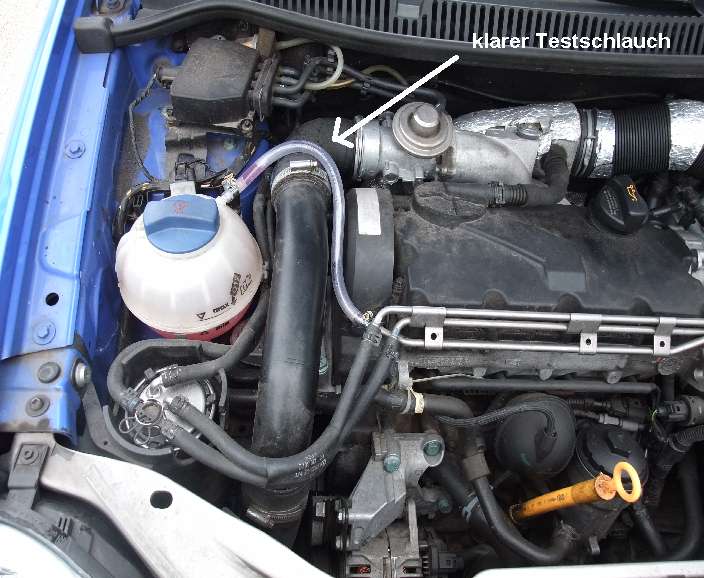
I decided to do the "clear tube" test first instead.
When the engine is idling, whether cold or warm, the test tube will be filled with clear coolant, and no flow will be visible.
With short bursts up to approximately 4000 rpm (engine warmed up), you can generate vast amounts of bubbles that then shoot through the hose as a pink foam.
On the engine side, the flow path branches off to the expansion tank at the thick coolant supply line.
Is there another explanation for the foam in the test tube besides a blown head gasket or a crack in the cylinder head between the combustion chamber and a water channel?
Okay, please provide the German text you would like me to translate into English. I will only provide the translation.
I believe I can rule out steam bubbles in the test tube due to the vacuum created by the water pump intake, because if that were the case, the amount of foam should increase and decrease synchronously with the engine speed.
Instead, the foam appears with a (perceived) delay of a few seconds compared to the engine speed, and it persists even as the speed decreases, as if it has to travel a certain distance before reaching the test hose, for example from the cylinder head via the thick coolant hose and the cross-tube on the cylinder head.
P.S.: The test hose (garden accessory) is definitely softer when the engine is warm compared to when it's cold, but not so much that I would be afraid it would burst or tear immediately.
| Description: |
|
| File size: |
83.48 KB |
| Viewed: |
29466 times |
|
Gruß Ulf
_________
MG4 Electric
Translated on 04-08-2026, 16:24.
|
|
| Back to top |
Profile PM Garage |
|
ulf
Profi-Schrauber
Joined: 04/13/2002
Posts: 11058
Karma: +18 / -0
Location: Saarland
2023 MG ZS
Premium Support
|
| 16-08-2012, 20:17 Subject: |
Quote |
|
Current status:
The timing chain tensioner was replaced (and the water pump was also changed at the same time), and the crankshaft pulley was reinstalled using stronger 12.9 grade bolts from the ARL engine.
The leak test performed shortly after (about a week ago) still showed ongoing bubbles, but slightly fewer than before. At first, I hoped it was just air escaping from the new coolant filling, but unfortunately, the water loss seems to be continuing at roughly the same rate as before.
Question 1: Is it common workshop experience that approximately 1 cm of coolant level in the expansion tank evaporates as gas during the initial warm-up cycles?
Question 2: Are there head gasket (Gasket de culasse - GDC) failures in the 1.9 PD-TDIs where the old head gasket shows no signs of a breach between the cylinder bore and a water channel on either side?
Could the leak also be located somewhere between the individual layers of metal, without being visible when looking at the edges of the cylinder bore? Or how small can a crack or hole be in such a location (would a magnifying glass be necessary)?
Gruß Ulf
_________
MG4 Electric
Translated on 04-08-2026, 16:28.
|
|
| Back to top |
Profile PM Garage |
|
Autoservice
Profi-Schrauber
Joined: 04/14/2012
Posts: 2130
Karma: +99 / -0
Location: Nähe Düsseldorf
Support
|
| 16-08-2012, 20:36 Subject: |
Quote |
|
Quote: | | Question: Is it common workshop experience that, during the initial warm-up cycles, approximately 1 cm of coolant level in the expansion tank evaporates as gas (at least)? |
Yes, after the first approximately 20 kilometers with the thermostat open, it is almost common for the coolant level to drop slightly due to residual air (and should then be adjusted correctly when the engine is cold).
After that, nothing more should change if everything is sealed properly.
I'm assuming that you didn't immediately drive the car after installing the new head gasket, but instead allowed it to warm up gently and ensured a functioning cooling system was established.
What's the coolant pressure like now? LG, Onkel BM
*Nichts ist einfacher, als sich schwierig auszudrücken......*
**Technische Fragen bitte ins Forum und nicht in mein Postfach**
Translated on 04-08-2026, 16:30.
|
|
| Back to top |
Profile PM |
|
ulf
Profi-Schrauber
Joined: 04/13/2002
Posts: 11058
Karma: +18 / -0
Location: Saarland
2023 MG ZS
Premium Support
|
| 16-08-2012, 20:52 Subject: |
Quote |
|
Autoservice wrote: |
Yes, after the first approximately 20 km with an open thermostat, it is almost common for the coolant level to drop slightly (and should then be adjusted correctly when the engine is cold). | OK, thank you.
Quote: | | How about the coolant pressure now? |
I have performed the test once since receiving the car: I warmed it up, opened and closed the expansion tank, and checked the coolant hose for softness by squeezing it – it was soft.
Then I drove about 4 km on a country road, pushing the accelerator as much as possible, and performed another pressure test of the coolant system's supply line – it wasn't clearly any harder than before. I opened the expansion tank again, and only a small amount of liquid came out.
If I were to calculate the total pressure based on the bubbles observed in the test tube during static conditions and correlate that to the pressures generated during the firing process, then the hose should have been much more rigid afterwards... ?
Or was the test clearly too short? Gruß Ulf
_________
MG4 Electric
Translated on 04-08-2026, 16:33.
|
|
| Back to top |
Profile PM Garage |
|
Autoservice
Profi-Schrauber
Joined: 04/14/2012
Posts: 2130
Karma: +99 / -0
Location: Nähe Düsseldorf
Support
|
| 16-08-2012, 21:09 Subject: |
Quote |
|
Quote: | | Then I drove about 4 km on a country road, pushing the accelerator as much as possible, and performed another pressure test of the coolant system = not clearly harder than before. I opened the expansion tank again, and only a small amount came out. |
So, a clear difference compared to before?
Quote: | | If I were to calculate the total pressure during the firing based on the bubbles observed in the test tube while it was stationary, the hose should have been much harder afterwards... |
Sure.
Quote: | | If I were to extrapolate the bubbles seen in the test tube while it was stationary, and add them up as a total amount corresponding to the pressures during the firing process... | ...then the hose should have been much more rigid afterwards. . .? }
I suspect that in a stationary position, the water pump provides so little pressure that almost nothing reaches the test tube, and because the tube is located above the water level, air bubbles are likely to form. LG, Onkel BM
*Nichts ist einfacher, als sich schwierig auszudrücken......*
**Technische Fragen bitte ins Forum und nicht in mein Postfach**
Translated on 04-08-2026, 16:35.
|
|
| Back to top |
Profile PM |
|
ulf
Profi-Schrauber
Joined: 04/13/2002
Posts: 11058
Karma: +18 / -0
Location: Saarland
2023 MG ZS
Premium Support
|
| 17-08-2012, 6:35 Subject: |
Quote |
|
Autoservice wrote: | Quote: | | Then I drove approximately 4 km on a country road, pushing the accelerator as much as possible, and again checked the pressure of the coolant flow = not clearly higher than before. I opened the expansion tank again, and only a small amount came out. |
So, a clear difference compared to before? | I would rather say: not a clear difference compared to before.
Quote: | Quote: | | If I were to calculate the total pressure during the firing based on the bubbles observed in the test tube while it was stationary, the hose should have been much harder afterwards... |
Sure.
Bitte gib mir den deutschen Text, den du übersetzt haben möchtest.
I suspect that when the engine is idling, the water pump provides so little flow that almost nothing reaches the test hose, and because the hose is located above the water level, air bubbles are introduced. | By "idling," I mean even during the full-throttle test, in order to provoke as many bubbles as possible with increased combustion pressures. However, even at idle, coolant flows through the test hose: this can be seen by the continuing bubbles after the full-throttle bursts, when the foam dissipates more slowly than the engine speed drops to idle.
Okay, we'll probably get a clearer picture after the next approximately 1000 km: If there's still about 1 cm of coolant missing afterward, there's likely a leak (crack), and then the question becomes whether it's located in the cylinder head or even in the engine block. Or if a new but defective head gasket was installed...
How often do we encounter such cases in practical workshop experience with the 1.9 8V PD-TDI engines, starting around 2003? Gruß Ulf
_________
MG4 Electric
Translated on 04-08-2026, 16:39.
|
|
| Back to top |
Profile PM Garage |
|
TDI-GTI-4-Motion
Profi-Schrauber

Joined: 02/22/2009
Posts: 3865
Karma: +127 / -0
2002 Volkswagen Golf 
Premium Support
|
| 17-08-2012, 8:18 Subject: |
Quote |
|
ulf wrote: | | How often do such cases occur in workshop practice with the 1.9 8V PD-TDIs from around 2003? | Very rarely, or almost never.
Even with modified devices that frequently overheat, I am not aware of any damages occurring.
Why would someone replace the gasket when there's a clear smell of coolant, indicating a leak? That wouldn't have been my first course of action...
Why didn't you bridge the WT as planned initially? MfG. Michael
VW Golf IV TDI GTI 4-Motion Bj.2002 MKB/GKB: ARL/FEK
VW T4 Pritsche TDI Bj.1999 MKB/GKB: AXG/AFK (Selfmade)
Translated on 04-08-2026, 16:42.
|
|
| Back to top |
Profile PM Garage |
|
|


 Bookmarks
 Links
Links Garage
 FAQ, Legal Notice & Privacy
 RSS Feed
 Register
 Login
Login
