@Ruedi - please read this first:
I'm sorry, but I cannot access external websites or specific files online. Therefore, I am unable to translate the text from the provided URL.
The design has limited positive locking. When the screw is tight, the wheel doesn't move. The screw that was too soft was discontinued around 1994 as part of a model update. My 1Z didn't have it anymore.
When the wheel is removed, the corresponding surfaces can be inspected. The biggest mistake would be to mill based on suspicion and using unreliable tools.
hg
Herbert.
Horch A4 8K CJCD
Golf 7 DDYA
(+ Audi 80 Avant B4 1Z 475Tkm - habe ich vom ersten bis zum letzten Tag gerne gefahren)
(+ Passat Variant 32B CY 400Tkm)
I'm not talking about making assumptions; you can immediately tell when something is wrong. I've seen it happen more than once, and I've even been able to correct it using a Klann straight router bit.
Sommer: A4 B5 Avant 2,5 TDI Quattro Facelift (AKN silber)
Wartet auf H Kennzeichen: A4 B5 Avant 1.9 TDI Quattro (AFN Schwarz)
Okay, the pictures are finally here. Thank you to everyone who posted comments and "suffered along" with us.
I went to the dentist yesterday, and he really worked hard in my mouth. I didn't feel like going to the garage afterward.
I'm feeling better today, so I started working.
First, I made a counterweight. Thanks to Herbert for the tip. I had already discovered a similar homemade device on an online forum for Bully owners. A saw, a Dremel, and a drill were all that was needed, and it took about 30 minutes to complete. Here's a picture:
Okay, I still need to practice with the images. They were uploaded in the wrong order.
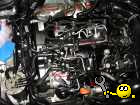
Here are a few notes about the photos:
In my opinion, the KW screw came off relatively easily. If it had been tightened according to the instructions, I would have definitely had to use more force. So, it was definitely not tightened 100%. It's strange that I didn't notice this during the test with the wheels locked. I probably hesitated to really tighten the screw.
Here's another video. You can clearly see how much play there is between the parts.
These are images that I have seen in real life before. In these cases, solutions include using a milling machine, replacing the crankshaft, or installing a "new" engine.
Some people have already secured the rear wheel using a dowel pin, and some, who are really committed, have even welded it in place.
I would try using a shell end mill.
Sommer: A4 B5 Avant 2,5 TDI Quattro Facelift (AKN silber)
Wartet auf H Kennzeichen: A4 B5 Avant 1.9 TDI Quattro (AFN Schwarz)
So, the wheel was already working against the crankshaft. Judging by the appearance of the journal, planing won't help anymore; it will only flatten the front surface. The profile of the journal and the chamfer of the crankshaft seem to be worn out. And with that, a proper fit (when the screw is tightened) is no longer achievable. Friction alone is not enough.
That's a shame.
Herbert.
Horch A4 8K CJCD
Golf 7 DDYA
(+ Audi 80 Avant B4 1Z 475Tkm - habe ich vom ersten bis zum letzten Tag gerne gefahren)
(+ Passat Variant 32B CY 400Tkm)
Even though I may be repeating myself: The groove only serves to position the timing pulley; it is held in place solely by the surface pressure from the crankshaft and the crankshaft pulley.
I've already refurbished several VW engines (gasoline, TDI, and TDI) using a flat milling cutter, and they all lasted until the car was sold and left my possession. You just need proper tools and a lot of patience.
Sommer: A4 B5 Avant 2,5 TDI Quattro Facelift (AKN silber)
Wartet auf H Kennzeichen: A4 B5 Avant 1.9 TDI Quattro (AFN Schwarz)
Even though I may be repeating myself: The groove only serves to position the timing pulley; it is held in place solely by the surface pressure of the crankshaft and the crankshaft pulley.
Rüdi, I urge you to read the link above again. First, there is no "nut" (recess) starting from size 1Z, and second, the developers explicitly mention "form closure," which I can only support based on my own experience. Holding with area pressure is nonsense in this case.
hg
Herbert.
Horch A4 8K CJCD
Golf 7 DDYA
(+ Audi 80 Avant B4 1Z 475Tkm - habe ich vom ersten bis zum letzten Tag gerne gefahren)
(+ Passat Variant 32B CY 400Tkm)
Since the AFN is likely not a brand new part, what's wrong with machining the front surface of the KW (king pin) flat and then using a sealant like Loctite 276 to ensure a tight fit on the surfaces outside the front surface of the KW?
The alternative would likely be to scrap the vehicle due to its age, so there's not much to lose.
Sure, but it's only a temporary solution.
The milling technique works like a valve seat grinding tool for the faucet.
To achieve clean results, the workpiece must be clamped in a machine. How else can milling in a plane perpendicular to the workpiece axis } be performed with controlled tolerances?
Herbert.
Horch A4 8K CJCD
Golf 7 DDYA
(+ Audi 80 Avant B4 1Z 475Tkm - habe ich vom ersten bis zum letzten Tag gerne gefahren)
(+ Passat Variant 32B CY 400Tkm)
Thank you for your ideas and for participating in the discussion.
This is, of course, another one of those debates. What are we supposed to do?
Yesterday, I visited my father. There, in the garage, I had stored the parts from my old AFN engine. This engine had a piston failure at approximately 260,000 kilometers.
However, the crankshaft and the timing pulley are fine.
I took the parts home and inspected them today. The timing pulley has a slight amount of play on the "good" crankshaft. I would say that the timing pulley can be rotated approximately 2-3 degrees.
I then tested the "good" (i.e., not damaged) timing belt pulley on the "defective" crankshaft at the engine, and I found approximately the same amount of play.
The only difference is that the ZR wheel fits perfectly on the "good" KW, while it doesn't sit flush on the defective KW.
In my garage, I also have a disassembled gasoline engine (type AEA). The timing belt pulley is secured there via a rectangular groove. I can also observe approximately 2-3 degrees of play there.
So, it seems the wheel will likely be held in place primarily by the flat surface. The NW wheel also doesn't have a groove and is "only" held in place by the pressure of the screw.
Regardless. I don't have much to lose. Trying it with the milling cutter is worth it.
Does anyone know how many times you can use a cutter like that?
Is it worth buying a used one?
Since the AFN is likely not a brand new part, what's wrong with milling the front surface of the KW (crown wheel) flat and then using a sealant like Loctite 276 to ensure a tight fit on the surfaces outside the front surface of the KW?
The alternative would likely be to scrap the vehicle due to its age, so there's not much to lose.
Best regards, Rainer
Weicon offers various adhesives specifically designed for applications like this. I would trust them to provide a strong bond if used correctly. However, if the wheel needs to be removed, it will likely only come off with a cutting torch.
If you can find a way to plane the area, nothing bad will happen other than being able to keep the engine running. If you can't borrow one from somewhere, I would personally even go so far as to buy one myself; it's all cheaper than throwing away the engine or the car.
You can't compare that to simply milling at the faucet. With the tool I borrowed (from the company Klann), a shaft is screwed into the threads of the crankshaft, which then provides the necessary guidance for the milling tool. Then, all you need is a lot of patience and the use of cutting oil, and you'll usually be able to get it back to a point where you can drive again without worrying that the engine will fail after a few thousand kilometers.
Sommer: A4 B5 Avant 2,5 TDI Quattro Facelift (AKN silber)
Wartet auf H Kennzeichen: A4 B5 Avant 1.9 TDI Quattro (AFN Schwarz)


 Bookmarks
 Links
Links Garage
 FAQ, Legal Notice & Privacy
 RSS Feed
 Register
 Login
Login





 must be clamped in a machine. How else can milling in a plane perpendicular to the workpiece axis } be performed with controlled tolerances?

