The camshaft supplied as an accessory could not be turned even with new bearing shells, so it was disassembled again. Compared to the original, well-worn camshaft, the new one was a hundredth of a millimeter too large. We ground down the new camshaft so that its dimensions matched the original.
"Is it possible that the diameter is incorrect here? Is the measurement method sufficient?"
A camshaft that first needs to be ground would be too unreliable for me. What about surface hardening?
Excessive northwest wind -> perhaps less oil in the bearing, and also less oil coming out of the bearing to lubricate the rest.
Perhaps other diameters are also incorrect?
Best regards and good luck!
pretzel man
Audi A3 Sportback [8PA], 2.0 TDI CR [CFGB], STH mit FB
[VERKAUFT] Polo 6NF 1.4TDI (AMF) mit nachgerüstetem DPF, STH+FFB, Bj. 2000, 222tkm
Hi,
Can the old camshaft and its bearing shells be installed for testing purposes? If the bearings don't seize, you don't need to investigate the oil pressure problem further. You definitely need to replace the hydraulic lifters.
hg
Herbert.
Horch A4 8K CJCD
Golf 7 DDYA
(+ Audi 80 Avant B4 1Z 475Tkm - habe ich vom ersten bis zum letzten Tag gerne gefahren)
(+ Passat Variant 32B CY 400Tkm)
Hello everyone.
Yes, it would generally be possible to try that, but since the original camshaft has a slightly shorter stroke (about 1.2mm), I'm hesitant to attempt it. I also no longer remember exactly which bearing shells and which lifters were installed where. That's where things get tricky. In all cases where aftermarket bearing shells were used, only the lower shells were discolored, appearing copper-colored.
The question is whether it will be meaningful if I replace parts with cross-referenced parts instead of using original, used parts.
I measured the hydrants yesterday. They have a diameter of:
34.97mm, the new ones from the accessories.
34.97mm original, with 250,000 km.
That should fit perfectly.
I've attached a video showing the starter motor speed without the glow plugs.
Is that enough oil?
Neue Nockenwelle nach 450km Fressspuren | Posts 16+ - 20250823_114931.mp4
I would say the oil situation looks good. I think the mistake was not replacing the old hydraulic lifters when the camshaft lobes had already become deeply etched. The old camshaft lobes then had a rounded shape, and the hydraulic lifters had a corresponding indentation.
If the new camshaft lobes are now straight, it's clear that they will only make contact in certain areas, and this makes wear damage at least more likely. This is because not the entire surface of the lobe is making contact, but only a (too) small portion.
Why not just drive a few thousand kilometers?
The cylinder head cover comes off quickly, and the camshaft can't really wear out any more than it already has.
Okay, I'm ready. Please provide the German text you want me to translate.
Why not just drive a few thousand kilometers?
The cylinder head cover comes off quickly, and the camshaft can't really wear out any more than it already has.
Best regards, Rainer
But please only with flawless valve stem seals and needle bearings, without any signs of wear. To avoid risking the entire engine.
The cup plungers shown in the photo will soon break through, and the NW (presumably referring to a specific material or process) may become lodged.
hg
Herbert.
Horch A4 8K CJCD
Golf 7 DDYA
(+ Audi 80 Avant B4 1Z 475Tkm - habe ich vom ersten bis zum letzten Tag gerne gefahren)
(+ Passat Variant 32B CY 400Tkm)
Gentlemen.
That might not have been entirely clear.
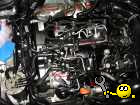
The photograph clearly shows the damage, including the eaten-away tip and the affected areas. This is the first image of the damage. After that, we replaced everything again.
The current damage pattern looks similar on the camshaft.
I didn't disassemble it any further. You can see the signs of wear on the camshaft again, and the worn-out hydraulic lifters.
I certainly don't want to proceed like this. So, are there any more well-founded statements regarding the assessment of the circumstances, or does anyone else want me to just replace parts?
Be patient with the young horses - the parts exchange didn't originate here on this forum.
Anything that was replaced beyond the slaughtered TL was your company's doing. We don't even know where you bought the parts, only that the replacement NW (presumably a component) was firmly seated, re-ground, and that we're repeatedly seeing signs of wear on new parts, which weren't present before.
Perhaps (?) none of this would have happened if original parts had been used.
The oil pressure seems to be fine, and the lifters probably aren't noisy (which indicates sufficient oil pressure in the cylinder head).
Es war ein Vorschlag da, einen Probelauf mit ursprünglich funktionierenden Teilen (NW und Lager) zu machen. What is this about?
hg
Herbert.
Horch A4 8K CJCD
Golf 7 DDYA
(+ Audi 80 Avant B4 1Z 475Tkm - habe ich vom ersten bis zum letzten Tag gerne gefahren)
(+ Passat Variant 32B CY 400Tkm)
Dir ist schon klar, dass das Einzige was die Nockenwelle nach unten drückt der Zahnriemen ist?
Hmm. Is that really the case? If it were the (too) tight timing belt, wouldn't that affect all the bearing housings, rather than just some of them?
The lifter rods also exert pressure from above. And if the cam profile isn't quite right, it might even be more than intended.
I've already fallen flat on my face several times with imitations...
Audi A3 Sportback [8PA], 2.0 TDI CR [CFGB], STH mit FB
[VERKAUFT] Polo 6NF 1.4TDI (AMF) mit nachgerüstetem DPF, STH+FFB, Bj. 2000, 222tkm
@ Brezelmann - My initial thought was similar. However, what the post probably intended to convey is that the contribution to a "downward" load is very small. The loads on the crankshaft bearings are caused by the periodic actuation of the tappets and rocker arms, and the vibrations of the crankshaft are caused by the changing load positions.
In my opinion, there is no explanation for the NW bearings that are worn down only on one side.
Given all of this, it seems likely that substandard or scrap materials were used.
I would either install a complete, functional camshaft or install a camshaft with bearings and tappets sourced from a VW parts supplier.
Check the camshaft bore beforehand.
hg
Herbert.
Horch A4 8K CJCD
Golf 7 DDYA
(+ Audi 80 Avant B4 1Z 475Tkm - habe ich vom ersten bis zum letzten Tag gerne gefahren)
(+ Passat Variant 32B CY 400Tkm)
Dir ist schon klar, dass das Einzige was die Nockenwelle nach unten drückt der Zahnriemen ist?
Hmm. Is that really the case? If it were the (too) tight timing belt, wouldn't that affect all the bearing housings, rather than just some of them?
The lifter rods also exert pressure from above. And if the cam profile isn't quite right, it might even be more than intended.
Ich bin jetzt mehrfach schon mit Nachbauten auf die Nase gefallen...
Good point! I was thinking about the VE37 when considering the 8V.
Sure, on the side with the timing belt pulley, the belt pulls downwards, but obviously not on the opposite side.
Is it really true that the lower bearing shells wear out? Then, besides the timing belt side, all that's left is the issue with the rocker arms, for example, due to incorrectly adjusted valve clearance adjustment elements. Hopefully, those were adjusted correctly. Otherwise, everything is probably broken anyway...
Sure, here's the translation:
"LG" translates to "Best regards" or "Sincerely" in English.
Okay, on the side with the timing belt pulley, the belt pulls downwards, but obviously not on the opposite side.
Ist das wirklich so, dass die unteren Lagerschalen verschleißen? ...
Der ZR "zieht" (mit Drehmoment) wechselnd leer und gegen den Widerstand der Nocken. Was belastet die NW Lager stärker?
hg
Herbert.
Horch A4 8K CJCD
Golf 7 DDYA
(+ Audi 80 Avant B4 1Z 475Tkm - habe ich vom ersten bis zum letzten Tag gerne gefahren)
(+ Passat Variant 32B CY 400Tkm)
The camshaft set was from Engineteam. The hydraulic lifters in this set were from Kolbenschmidt.
The timing belt kit is from Gates. (One of these tensioners has a gauge that needs to be visible in the middle of a window).
In principle, there isn't much that can go wrong with the voltage.
I adjusted the setting screw on the rocker arm shaft to the PD elements using a dial indicator. At the point of maximum deflection (where the PD element is actuated by the cam), I turned the setting screw in until it touched the stop with slight resistance, then turned it back 180-225 degrees and secured it.
The vehicle is actually running, so I don't think I made a complete mistake with the settings. If I had, the components would probably be damaged.
@brezelmann
What material-related issues or damages have you experienced with aftermarket camshafts?
Let's go back to the oil pressure. The cylinder head was removed to replace the pistons. A head gasket from Elring, with the correct thickness, was installed.
Are there oil return valves or check valves, similar to those found in other engines, located in the main channel leading to the cylinder head?
I can't find anything about this in the parts catalog. However, I've noticed that the oil pressure takes quite a while to build up after the engine starts.
Today, I'm going to remove the oil filter housing again and check the oil pressure control valve. If I can't figure it out after that, I'll probably have to take it to another mechanic who uses genuine parts.


 Bookmarks
 Links
Links Garage
 FAQ, Legal Notice & Privacy
 RSS Feed
 Register
 Login
Login





 when considering the 8V.


