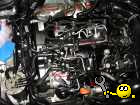
...while slowly inching along in traffic with my A6 4F, the air conditioning shut off (the outside temperature was approximately 28°C). After driving for 8 kilometers, it started working again. https://community.dieselschrauber.org/en/viewtopic.php?t=3475
The water level and the compressor can therefore be ruled out as potential sources of error. Does anyone have any spontaneous ideas?
I will connect VCDS this afternoon; perhaps it will reveal the cause of the shutdown or show an error code ( } ).
When stuck in traffic, the temperature of the condenser becomes a concern. A plausible scenario would be non-functioning radiator fans or a dirty radiator core.
But of course, there are also many other possible causes, such as faulty temperature sensors or defective high-pressure sensors.
Regarding the fill level: If there is too little refrigerant in the system, the evaporator would be less filled. This would result in a significantly higher temperature difference across the evaporator (with a higher average temperature), but also a lower evaporation temperature at the inlet (due to less mass flow, less pressure, and less temperature). If the evaporation temperature sensor is located there, it could also shut off due to localized freezing of the evaporator. Therefore, I would not completely rule out a refrigerant shortage as the cause of this problem. However, I don't understand how this relates to the fact that the issue doesn't occur when the vehicle is moving (a higher speed does not necessarily mean a higher mass flow in controlled swashplate compressors).
Let's participate in the cause.
Greetings.
Sure.
Here is the translation of the text from German to English:
"Guste" means "gust" in English. It can also be used as a verb, meaning "to gust."
100% sure that the air conditioning was turned off? Or could it also have been warm air from the heating system? The latter happens quite often with the 4F, due to faulty heating valves.
"I've already experienced defective electric fans in both the Passat 3B and the A2 models within my own fleet – so it could be a potential issue. With the A2, I managed to get it working again by disassembling it and cleaning the carbon brushes."
It's also a good idea to check if all the cooling fins on the condenser are still present. They sometimes detach. I saw this recently on a vehicle where about 40% of the fins had crumbled off, even though the condenser appeared relatively intact.
LG, Onkel BM
*Nichts ist einfacher, als sich schwierig auszudrücken......*
**Technische Fragen bitte ins Forum und nicht in mein Postfach**
Is the electric fan on the right side still working? Often, the control unit for the fan is faulty. The viscous fan on the left side often isn't powerful enough to cool the condenser. Usually, the error code is only stored in the main system timer (MST).
NA,Gehörlose wie ich können auch Schrauben! Ihr HÖRT ich FÜHLE! T3 TD EX-JX Jetzt 1Z mit 122PS und Renaultgetriebe Golf II TD Bj 84 512Tkm Passi 35I 1Z 468Tkm--> Seat Toledo AHF-- Toledo ARL 477Tkm mit Spritspartuning 99er T4 Syncro-Cross 100800km grad eingefahren
There is no viscous fan present, but both electric fans are running.
I've now had the various actuators of the air conditioning system working for a while and am waiting to see if the error reappears. If necessary, the cost of a new V197 should be reasonable, but the question is how much effort it will take to remove it.
Best regards, Rainer.
AC Not Cooling? Troubleshooting & Repair Tips. - Kuehlerluefter-A6-4F.mp4
If necessary, the cost of a new V197 should be manageable; the only question is the effort required for its installation.
That's how it is.
Therefore, my plan for the WRC Polo is: As soon as, for the first time (after the warranty expires), a valve motor fails, I will convert the entire air conditioning system to a manual version .
While this will be somewhat more expensive than simply replacing the flapper motor, looking back, converting to a manual system at the first failure would have been cheaper by the time you need to replace the flapper motor for the third time (which is bound to happen eventually).
Even when using the "manual" setting, it doesn't work any better than the "automatic" setting does when it's broken...
"With the old pickle machines from my youth, everything was manual, yet problems still arose with the heating control system, levers would break off, etc. What is the benefit/point of converting to a manual system in that case?"
Whether I'm driving around with the heater on in my car at an outside temperature of 30°C because the adjustment lever is broken or a stepper motor is defective, it doesn't make any difference.
Whether I'm driving around with the heater on in my car at an outside temperature of 30°C because the adjustment lever is broken or a servo motor is defective,
it doesn't make a difference. :wink:The result is the same.}
"But I've already read hundreds or even thousands of frustrated posts online about spinning servo motors (or their encoders), while you are the first writer I've encountered who deals with manual AC systems."
Since I don't believe that manual air conditioners account for only a 1% or less share compared to Climatronics, my assumption of the higher reliability of manual air conditioners remains }.
I've now had the various actuators of the air conditioning system working for a while and I'm waiting to see if the error reappears.
"So far, this method – along with a little WD40 sprayed into the potentiometer – has worked great on my Polo. Interestingly, during actuator diagnostics while driving, the engines quickly threw errors. What really helped was the learning function. I ran it sequentially about twenty times (as it goes through its full range of motion), and after that, everything was fine. Using VCDS, you could clearly see how the values at the limits became more stable with each run."
Quote:
If necessary, the cost of a new V197 should be manageable; the only question is the effort required to install it.
Here's where creativity comes in... For example, for the 9N, there are guides available on relevant forums that require significantly less work than the official ones.
Overall: Before I would completely convert the entire system to manual operation, I would simply design and install more robust position sensors. There is enough space around the motors and flaps in both the 9N and the 1Z to accommodate an external construction there. Ultimately, it only needs to convert a rotation or a distance into a voltage – there are plenty of solutions that are more durable than such a cheap potentiometer on the rotating axis. It probably wouldn't even matter much if the relationship between rotation and voltage isn't 100% linear (which would happen with a position sensor instead of a rotary encoder). If done cleverly, this can be achieved without completely disassembling anything, because it is easier to access the moving parts than to remove the motors.
Yes: These actuator motors occasionally fail. Yes, Volkswagen produces hundreds of thousands of cars, and it's not surprising that you can find many online posts about failed actuator motors.
Here are the VAG vehicles with Climatronic that I have observed in my immediate surroundings:
My Passat, manufactured in 2008, now has approximately 230,000 km on the odometer. You can occasionally hear the engines when the car is stationary, but everything is still running smoothly. No actuator motors have been replaced yet.
Our Galaxy MJ 2005 (which is the same as a Sharan) still has its original stepper motors at approximately 190,000 km.
My father's Audi A8 MJ2000 with Climatronic and approximately 340,000 km still has the original engines.
My brother's Passat 3C from MJ2007 (likely with around 100,000 to 150,000 km on it) still has one of the early engine versions.
My sister-in-law's Golf Plus is now reaching the end of its lifespan and experiencing engine problems.
I don't have any more VAG vehicles within my immediate surroundings.
Either the problem isn't as extreme as it seems, or you should marry into my family to be protected .
Perhaps the actuators have improved over the years .
On my Audi A6 C4 from 1996, I had to "reactivate" those things a total of 3 times. In a way, even when I sold it with 190,000 kilometers, it still had the original ones...
Actuator diagnosis or adaptation would not have helped in this case; instead, wear debris from the motor brushes had accumulated in the collector and created a "bypass" for the current. This caused the brushes to become slightly warm, but they no longer moved.
I would certainly be happy if, despite all the "optimizations," these things lasted longer than 10 years.
Regards,
olli
A6 CANA/JME /
'95 Cinquecento als Stadtgurke ~~ 124CS0 für den Sommer...
Ex-A6 AEL


 Bookmarks
 Links
Links Garage
 FAQ, Legal Notice & Privacy
 RSS Feed
 Register
 Login
Login



 After driving for 8 kilometers, it started working again.


 99er T4 Syncro-Cross 100800km grad eingefahren
 .
.