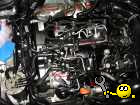
P0171 is one of the most common error codes in gasoline engines worldwide, and it's also extremely frequent in VW/Audi/Seat/Skoda vehicles. It indicates that the fuel-air mixture is too lean (too much air or not enough fuel). The oxygen sensor detects an excess of oxygen in the exhaust gases, which the engine control unit can no longer compensate for, even with maximum fuel enrichment.
What does P0171 mean?
The engine control unit aims for an optimal air-fuel ratio of 14.7:1 (Lambda = 1). The
lambda control has a specific operating range (usually +/- 25%). If this range is permanently exceeded in the direction of "enriching" (because there is too much air in the system), code P0171 is set. The cause is almost always secondary air (vacuum leak) - air that enters the engine bypassing the mass airflow sensor.
Typical symptoms:
- Engine check light is on.
- Erratic idle speed (engine RPM fluctuates).
- Jerky acceleration.
- Power loss
- Increased fuel consumption (ECU programmed for more power).
- Engine stalling at idle.
- Misfires under extreme conditions.
Most common causes:
- Vacuum leaks (secondary air), intake manifold leaks, cracks in hoses (approximately 70% of cases).
- Faulty positive crankcase ventilation (PCV) system, valve stuck open.
- Mass airflow sensor (MAF) is dirty or defective.
- Oxygen sensor before the catalytic converter is defective or measuring incorrectly (too lean).
- Fuel filter clogged.
- Fuel pump too weak / fuel pressure too low.
- Injector nozzles are clogged or defective.
- Vacuum hoses are leaking/porous.
Diagnosis with VCDS:
-
Autoscan: P0171 code detected in the engine control unit (01 - Engine).
- Measurement block 032 (gasoline engine): Long-term adaptation (additive/multiplicative).
- Additive adaptation: Values above

0% indicate a lean mixture.
- Multiplicative adaptation: Values above
0% indicate the influence of external air.
- Check lambda sensor readings (voltage and control behavior).
- Brake cleaner spray test: Spray onto the intake manifold; a change in engine speed indicates a vacuum leak.
For better understanding, see also:
https://community.dieselschrauber.org/en/viewtopic.php?t=21836


 Bookmarks
 Links
Links Garage
 FAQ, Legal Notice & Privacy
 RSS Feed
 Register
 Login
Login