| Author |
Message |
SeatArosa1.7SDI
Guest
Free account, no CAN development support
|
 08-05-2006, 21:34 Subject: |
Quote |
|
Hi!
Just like Tagessuppe, I see it that way. For vehicle operation, a VTG (Variable Geometry Turbine) compressor should have a better efficiency on average across all load and operating conditions, because, due to the adjustable vanes and the 'intelligent' control, it can simply maintain an acceptable efficiency over a much wider load range.
It's possible that the wastegate, operating at its optimal point, might outperform the variable geometry turbocharger (VTG) in terms of efficiency, but 'automobiles' are probably the last application where vehicles are consistently driven under a specific load and operating condition.
At the very least, if the wastegate has to vent frequently, the turbocharger's efficiency should drastically decrease. Venting is a complete waste of energy.
Regards,
Holger.
Translated on 30-10-2026, 18:37.
|
|
| Back to top |
|
 |
Nebelwerfer_TDI
Guest
Free account, no CAN development support
|
| 09-05-2006, 11:31 Subject: |
Quote |
|
On the other hand, a high back pressure is generated upstream of the compressor wheel in the wastegate, which then needs to be released through the wastegate valve.
not in front of the compressor wheel, but in front of the turbine wheel - although only for this reason, so that the boost pressure does not increase further, otherwise the turbocharger and head gasket would suffer.
It may be that the wastegate, when operating at its optimal point, exceeds the VTG in terms of efficiency.
Okay, according to Bertil's explanations, I now understand this: In a diagram, you plot the engine speed on the x-axis and the turbocharger efficiency on the y-axis, assuming full load. If you now calculate the integral with respect to engine speed in both cases, the VTG turbocharger results in a larger area, even though the wastegate turbocharger is significantly superior to the VTG turbocharger in a certain engine speed range. In return, the VTG turbocharger has a reasonably good efficiency over a wider engine speed range.[/b]
Translated on 30-10-2026, 18:39.
|
|
| Back to top |
|
|
Tagessuppe
Profi-Schrauber

Joined: 11/13/2002
Posts: 1142
Karma: +38 / -0 
Location: Wien
2001 Audi A2 
Premium Support
|
| 09-05-2006, 12:47 Subject: |
Quote |
|
Nebelwerfer_TDI wrote: |
not in front of the compressor wheel, but in front of the turbine wheel - although only for this reason, so that the boost pressure does not increase further, otherwise the turbocharger and head gasket would suffer.
|
Sorry, you're right. I got it mixed up.
Translated on 30-10-2026, 18:40.
|
|
| Back to top |
Profile PM Garage |
|
Bertil
Profi-Schrauber
Joined: 04/15/2002
Posts: 5628
Karma: +108 / -0
Premium Support
|
| 09-05-2006, 16:14 Subject: |
Quote |
|
SeatArosa1.7SDI wrote: | ....
It's possible that, at its optimal operating point, the wastegate could outperform the variable turbine geometry (VTG) in terms of efficiency.
|
Ahhh, now I get it. Now you understand.
Quote: |
"... but "Kfz" (motor vehicles) is probably the last application where vehicles are almost always operated under a specific load and operating condition."
|
Nevertheless, the efficiency of a wastegate turbocharger is better than that of a VTG turbocharger.
Just to be clear, I'm not talking about the engine's efficiency. That is naturally better in a VTG (Variable Turbine Geometry) system due to its significantly better controllability through electronics. With a VTG, the turbocharger can be largely tuned to the engine primarily through control adjustments to the VTG. This is not possible with a wastegate. Therefore, there are significant limitations in terms of engine performance.
Quote: | | At the very least, if the wastegate has to vent frequently, the turbocharger's efficiency should drastically decrease. Venting is pure energy waste. |
VTG does the same thing. In both systems, the energy must be "eliminated" to limit the charging pressure. Unfortunately, in this case, the energy is not eliminated, but rather not used because it is not needed.
Und "abgeblasen" wird beim TDI Wastegate schon gar nichts, sondern einfach an der Turbine vorbeigeleitet. Beim VTG muss der Abgasstrom weiterhin durch die Turbine. Nur mit einem größeren Querschnitt und somit einer langsameren Strömungsgeschwindigkeit. Ist das keine Energievernichtung? IcI already have one.
Nebelwerfer_TDI wrote: | | So, according to Bertil's explanations, I now understand this: In a diagram, you plot the engine speed on the x-axis and the turbocharger efficiency on the y-axis, assuming full load. If you now calculate the integral with respect to engine speed in both cases, the variable geometry turbocharger (VTG) charger results in a larger area, even though the wastegate turbocharger is significantly superior to the VTG charger in a certain engine speed range. In return, the VTG charger has a reasonably good efficiency over a wider engine speed range. |
That's exactly right. Gruß Bertil
Skoda 5E5 CZDA + Mini R50 W10 + VW ID.3 + Fiat Ducato 250 + 161 DX
*** Technische Anfragen per PN werden von mir nicht beantwortet! ***
Translated on 30-10-2026, 18:42.
|
|
| Back to top |
Profile PM |
|
bafische
Profi-Schrauber
Joined: 01/13/2005
Posts: 196
Karma: +22 / -0
Support
|
| 09-05-2006, 20:57 Subject: |
Quote |
|
Hi Bertil,
I don't want to join in the chorus of negativity, but I can't follow your arguments anymore.
Bertil wrote: |
Nevertheless, the efficiency of a wastegate turbocharger is better than a VTG turbocharger. |
"Gray is all theory." I can only think of one context where this phrasing makes sense, but I'll explain it later.
First, it's important to define what the efficiency of a turbine/compressor actually is. There isn't a single efficiency value. The efficiency of a turbine/compressor is described by a characteristic curve that relates it to the normalized volumetric flow rate and the pressure ratio P2/P1 or P4/P3, with a direct dependence on the rotor speed. The geometry/mass/hub ratio of the turbine blades and the geometry of the inlet flow have the greatest influence on the turbine efficiency (which is the focus here). In turbine housings without inlet guide vanes, as is common in cars, the influence of the inlet flow geometry is even smaller, given a specific inlet flow geometry.
How is a charging system designed?
Let's take a load point, for example, the maximum torque, for simplification. Based on the desired combustion, we determine the air-fuel ratio. Since everything else remains constant, we only have the boost pressure as a variable. For the chosen boost pressure, i.e., the pressure ratio, we select a compressor that has the best efficiency at that pressure ratio/flow rate. This also determines the impeller speed. Then, we go to the catalog and select a fixed turbine that delivers the best efficiency at the given impeller speed/flow rate. This way, we also find the appropriate pressure ratio and can iteratively adjust the pressure ratio and impeller speed a bit.
Voilà – the stationary engine is ready.
If you were to simply replace this fixed turbine casing with a variable geometry (VTG) casing while leaving everything else unchanged, then I agree with Bertil – in this scenario, the VTG would always have a lower efficiency.
However, other comparisons are misleading because that's not how things work in practice.
It is clear that a charging system for a modern passenger car, in addition to large areas of high static efficiency, must also provide good responsiveness at low flow rates (starting) and acceptable efficiencies in all load and speed ranges for emission and consumption reasons. Therefore, the turbine manufacturer can design a VTG turbine as a whole more efficiently (turbine wheel geometry/mass/hub ratio) than a fixed turbine, which can only make compromises for a large operating range and therefore, in practice, does not achieve a better static efficiency at any load point compared to a VTG turbine for the same application.
I was able to witness this practically when a sister company switched from a steam turbine generator (STG) to a gas turbine generator (VTG), and I could see it reflected in the turbine performance curves.
Damit es noch mal klar wird ich rede heir nicht Bertil wrote: | vom Motorwirkungsgrad. He is at the...
VTG is naturally better due to its significantly improved controllability through electronics.
Typically, the overall motor efficiency is determined under steady-state conditions, i.e., without any control processes. The variable geometry turbocharger (VTG) control has no influence on the measurement of the overall motor efficiency. In fact, the overall efficiency is better at every operating point with a VTG turbocharger, as confirmed by Tagessuppe. The fuel consumption advantage was, on average, around 5% with a 10% higher power output.
It is also a fact that the VTG (Variable Transmission Gearbox) is much, much more difficult to master from an engineering perspective than an STG (Sequential Transmission Gearbox).
...and in the future, we might also be able to look forward to variable compressor geometries...
VTG does the same thing. In both systems, the energy must be "eliminated" to regulate the charging pressure. Unfortunately, this energy is not eliminated here, but rather not used because it is not needed.
And with the TDI wastegate, nothing is "blown off"; it's simply bypassed around the turbine. With the VTG, the exhaust gas must still flow through the turbine, but with a larger cross-section and therefore a slower flow rate. Isn't that a destruction of energy? I think so. |
The airflow entering the turbine affects the turbine's efficiency, that's clear. Now, imagine what's happening aerodynamically before the turbine inlet when the bypass opens in a fixed geometry compressor. It's a chaotic situation. Of course, we don't have laminar flow in either type of turbine, but a bypass system is always aerodynamically less efficient.
By the way, the exhaust back pressure before the turbine in an 81kW TDI engine is approximately 2.5 bar relative at maximum power. The exhaust pressure after the turbine, with a reasonable exhaust system including an oxygen catalytic converter, a central silencer, and a rear silencer, is also approximately 0.4 bar at maximum power. If an oxygen catalytic converter upstream of the turbo produces more than 0.15 bar, that's already quite a lot. So much for the considerations regarding the impact of a missing oxygen catalytic converter.
Greetings. "Luft und Menge müssen stimmen - der Rest ist Physik."
unumstössliches Gesetz in der Dieselmotorenentwicklung
Translated on 30-10-2026, 18:50.
|
|
| Back to top |
Profile PM |
|
ulf
Profi-Schrauber
Joined: 04/13/2002
Posts: 11058
Karma: +18 / -0
Location: Saarland
2023 MG ZS
Premium Support
|
| 10-05-2006, 6:27 Subject: |
Quote |
|
bafische wrote: | | . . . By the way, the exhaust back pressure before the turbine in an 81kW TDI engine is approximately 2.5 bar relative at maximum power (Pmax). The exhaust pressure after the turbine, in a well-designed exhaust system with an oxygen catalytic converter (main cat), a central silencer, and a rear silencer, is also approximately 0.4 bar at Pmax. If an oxygen catalytic converter upstream of the turbo produces more than 0.15 bar, that is already quite a lot. So much for the considerations regarding the influence of a missing oxygen catalytic converter. |
Hello Bavarian.
Thank you for your detailed descriptions  .
"The following text is likely interesting, especially the last paragraph."
Do you happen to know what the back pressure is for the more powerful engine options, and how the turbine-related back pressure increases with LD (lambda) increases as part of a tuning process?
With today's (performance-oriented) small TDI turbochargers , I suspect that any increase in boost pressure will cause the back pressure before the turbine to rise too steeply at the maximum pressure (Pmax) level. Gruß Ulf
_________
MG4 Electric
Translated on 30-10-2026, 18:57.
|
|
| Back to top |
Profile PM Garage |
|
Henrik
Guest
Free account, no CAN development support
|
| 10-05-2006, 14:50 Subject: |
Quote |
|
What does that mean in German now?
Translated on 30-10-2026, 18:58.
|
|
| Back to top |
|
|
Nebelwerfer_TDI
Guest
Free account, no CAN development support
|
| 10-05-2006, 15:23 Subject: |
Quote |
|
@Henrik: What didn't you understand?
Translated on 30-10-2026, 18:59.
|
|
| Back to top |
|
|
Henrik
Guest
Free account, no CAN development support
|
| 10-05-2006, 15:36 Subject: |
Quote |
|
Okay, let's say I now remove the catalytic converter, or replace it with a large, high-performance (metal) cat, and the rest of the exhaust system is Group A, and I remove the flexible pipe. What benefit would I get from the reduced back pressure?
more top speed?
More acceleration?
Higher possible boost pressure?
Translated on 30-10-2026, 18:59.
|
|
| Back to top |
|
|
Nebelwerfer_TDI
Guest
Free account, no CAN development support
|
| 10-05-2006, 15:43 Subject: |
Quote |
|
more vmax?
More acceleration?
In your case, where the exhaust system of a moped likely matches the specifications of a standard TDI engine...
higher possible boost pressure?
From a purely physical perspective, that's true, but the boost pressure control system complicates things. If we had a turbocharger without a wastegate or variable geometry turbine (VTG) or variable stator turbine (VST), meaning a completely unregulated turbocharger, then the absence of the 0.4 bar back pressure would actually result in a higher boost pressure.
Translated on 30-10-2026, 19:00.
|
|
| Back to top |
|
|
Henrik
Guest
Free account, no CAN development support
|
| 10-05-2006, 15:46 Subject: |
Quote |
|
Well, when I said 'adaptation of the software,' I obviously meant  .
Well, I'll start by installing the Festo pressure gauge  .
Translated on 30-10-2026, 19:01.
|
|
| Back to top |
|
|
bafische
Profi-Schrauber
Joined: 01/13/2005
Posts: 196
Karma: +22 / -0
Support
|
| 10-05-2006, 20:11 Subject: |
Quote |
|
Hi Ulf,
ulf wrote: |
Do you happen to know what the back pressure is for the more powerful engine options, and how the turbine-related back pressure increases with LD (lambda) increases as part of a tuning process?
Regarding today's (performance-oriented) small TDI turbochargers , I suspect that any increase in boost pressure will cause the back pressure upstream of the turbine to rise too steeply at the maximum pressure (Pmax) level. |
Unfortunately, I can't provide exact figures. When I last looked into this, the turbines were undergoing the aforementioned conversion, which was about 7 years ago. At that time, the most powerful engine option was 81 kW. However, I believe that no standard production model uses a pneumatic EGR valve with a pressure greater than approximately 3 bar relative to the turbine, because otherwise the EGR valve could be forced open.
It's impossible to accurately determine the increase in P3 (boost pressure) during tuning without measurements or knowledge of the turbine's performance characteristics. It always depends on the specific hardware being used. In most tuning scenarios for the VL (likely a specific vehicle or engine), the engine's operating line is shifted into less efficient areas of the turbine/compressor map. However, this can look very different under partial load conditions.
Greetings. "Luft und Menge müssen stimmen - der Rest ist Physik."
unumstössliches Gesetz in der Dieselmotorenentwicklung
Translated on 30-10-2026, 19:03.
|
|
| Back to top |
Profile PM |
|
Bertil
Profi-Schrauber
Joined: 04/15/2002
Posts: 5628
Karma: +108 / -0
Premium Support
|
| 10-05-2006, 20:54 Subject: |
Quote |
|
bafische wrote: | ... but I can no longer follow your explanations.
|
You don't just follow them, but you explain them in a much simpler way, just like I did...
Okay, ich bin bereit. Bitte gib mir den deutschen Text, den du übersetzt haben möchtest.
Quote: |
If you were to simply replace this fixed turbine casing with a variable geometry (VTG) casing while leaving everything else unchanged, then I agree with Bertil – in this scenario, the VTG would always have a lower efficiency.
|
That's exactly what I assumed, because...
Quote: |
Further comparisons are lacking...
|
I completely agree with your further explanations. That's what I meant.
I'm not entirely sure about one of the statements.
Quote: |
The overall engine efficiency is typically determined under steady-state conditions, i.e., without any control processes.
|
During the tests I was able to observe, the efficiency was calculated over a complete load cycle with control.
I'm not sure what the manufacturer ultimately states.
Quote: |
By the way, the exhaust back pressure before the turbine in an 81kW TDI engine is approximately 2.5 bar relative at maximum power. The exhaust pressure after the turbine, with a reasonable exhaust system including an oxygen catalytic converter, a central silencer, and a rear silencer, is also approximately 0.4 bar at maximum power. If an oxygen catalytic converter upstream of the turbo produces more than 0.15 bar, that's already quite a lot. So much for the considerations regarding the impact of a missing oxygen catalytic converter.
|
We were looking for that exact sentence. Unfortunately, I can't find the data anymore.
Which TDI engine actually has two silencers (plus a catalytic converter)? My AXR only has one, and I'm not entirely sure about my 1Z, but I believe it also only has one. Gruß Bertil
Skoda 5E5 CZDA + Mini R50 W10 + VW ID.3 + Fiat Ducato 250 + 161 DX
*** Technische Anfragen per PN werden von mir nicht beantwortet! ***
Translated on 30-10-2026, 19:06.
|
|
| Back to top |
Profile PM |
|
Henrik
Guest
Free account, no CAN development support
|
| 10-05-2006, 21:34 Subject: |
Quote |
|
I believe the 2.5-liter 5-cylinder engine with 140 hp in an A6, for example, has a two-pipe exhaust system all the way to the muffler, and I think it also has two catalytic converters.
The synchronization system in the G3 model should also have that feature.
Translated on 30-10-2026, 19:08.
|
|
| Back to top |
|
|
ulf
Profi-Schrauber
Joined: 04/13/2002
Posts: 11058
Karma: +18 / -0
Location: Saarland
2023 MG ZS
Premium Support
|
| 11-05-2006, 7:23 Subject: |
Quote |
|
Bertil wrote: | | Which TDI actually has 2 silencers (+catalytic converter)? My AXR only has one, and with my 1Z, I'm not entirely sure anymore... But I think it only had one. |
My previous G3 AFN had a midpipe and rear silencer (including the catalytic converter) - I always thought having three silencers was excessive.
The first ASZ-Ibiza models definitely had two mufflers, as shown above.
There are likely to be others, possibly older G4 models. Gruß Ulf
_________
MG4 Electric
Translated on 30-10-2026, 19:09.
|
|
| Back to top |
Profile PM Garage |
|
dieselmartin
Profi-Schrauber

Joined: 03/13/2003
Posts: 10121
Karma: +29 / -0
Location: in der Werkstatt
2007 Volkswagen Passat
Premium Support
|
| 11-05-2006, 7:41 Subject: |
Quote |
|
Hi.
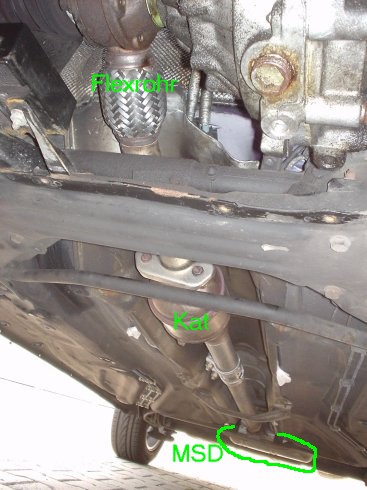
My understanding is that all Golf 3 TDI models have a catalytic converter, a pre-catalytic converter (located under the engine), and a rear silencer.
| Description: |
|
| File size: |
51.02 KB |
| Viewed: |
3169 times |
|
Transparency, Teamwork
... there was another T.
I don't know what the f*ck it was.
Translated on 30-10-2026, 19:10.
|
|
| Back to top |
Profile PM Garage |
|
|


 Bookmarks
 Links
 Garage
 FAQ, Legal Notice & Privacy
 RSS Feed
 Register
 Login

